
Yes, there are sharks off Israel, 21 species with solid Mediterranean records, and the two you can actually see are the dusky shark and the sandbar shark. They gather at the Hadera power-station outflow from November to May. Beyond them the coast holds common smooth-hounds, small-spotted catsharks, tope and spinner sharks inshore, and blue sharks, shortfin makos and threshers on the deep water beyond the shelf.
The risk is small but no longer zero. SharkSider's database lists ten records for Israel from 1933 to 2025 and no confirmed fatal shark attack; eight are on the Mediterranean coast and two are Red Sea cases from Eilat and Sinai. The most serious entry is from April 2025, when a diver filming the sharks at the Hadera outflow disappeared and his remains were recovered days later. Before that, the Mediterranean list amounts to a bitten swim fin, a bitten hand, and a handful of pre-1963 cases involving fishermen.
- Shark species recorded21 with solid records (Mediterranean coast)
- ProtectionAll sharks and rays are protected natural values; Hadera outflow closed to swimmers since 2025
- Most seen from the beachDusky and sandbar sharks at Hadera, November–May
- Signature encounterThe Orot Rabin power-station aggregation, the only one of its kind in the Mediterranean
- Incidents in the database10 (1933–2025), no confirmed fatal attack
- Water temperature16–17 °C in February, 29–31 °C in August; outflow up to 10 °C warmer

On this page
- Where sharks live off Israel
- List of the different types of sharks in Israel
- Where to see sharks in Israel
- Best time of year to see sharks in Israel
- Shark attacks in Israel: what the record actually shows
- Is it safe to swim in Israel?
- Shark conservation in Israel
- Sharks in neighbouring waters
- Frequently asked questions
- References
Where sharks live off Israel
Israel's Mediterranean shore runs about 190 km from Rosh HaNikra on the Lebanese border to the Gaza boundary south of Ashkelon, and almost all of it is sand. The continental shelf is narrow, 10 to 20 km wide, before it falls away into the Levantine Basin, and the seabed is a mix of sand, Nile-derived mud and the kurkar sandstone ridges that surface as reefs off Dor, Caesarea and Ashkelon. This is the hottest and saltiest water in the Mediterranean; the surface reaches 30 °C and more in August, which suits warm-water requiem sharks and is one reason so many Red Sea fish have settled here since the Suez Canal opened. The inshore sharks are those of the eastern basin as a whole: smooth-hounds and tope over sand, small-spotted catsharks and nursehounds on the rocky ridges, sandbar and spinner sharks in the surf zone in summer, and the deep-water lanternsharks, gulper sharks and sixgills on the slope, where trawlers from Haifa and Ashdod occasionally bring them up.
The thing that makes Israel worth a page of its own is Hadera. The Orot Rabin power station, the country's largest, draws seawater to cool its turbines and returns it through a channel beside the mouth of the Hadera Stream, several degrees warmer than the sea around it. In winter, when the Mediterranean drops to 16 or 17 °C, that plume is a warm bath, and dusky sharks (Carcharhinus obscurus) and sandbar sharks (C. plumbeus) come to it in numbers, mostly large pregnant female duskies and mostly male sandbars, from November to about May. Researchers from the Morris Kahn Marine Research Station at the University of Haifa have been tagging them since 2015; individual sharks return year after year, the count on a good day passes fifty, and the site became a winter attraction for kayakers, paddleboarders and snorkellers until the death of a diver there in April 2025 led the Nature and Parks Authority to close the water to the public. The Rutenberg power station at Ashkelon has a smaller version of the same gathering. Nobody yet knows why the sharks come: warmth, the fish drawn to the outflow, or the fresh water and nutrients of the stream have all been proposed.
Every shark and ray in Israeli waters is a protected natural value under the regulations of the Nature and Parks Authority, so catching, harming or selling one is an offence, and the marine reserves at Rosh HaNikra and Achziv, Dor HaBonim and the offshore Palmachim disturbance add habitat protection along the coast. Israel also has 11 km of Red Sea shore at Eilat, with an entirely different reef fauna; that coast belongs with the Gulf of Aqaba and is outside the scope of this page, apart from the two Red Sea entries that sit in the country's incident record.
List of the different types of sharks in Israel
The table lists every shark with a reliable record on Israel's Mediterranean coast, based on the University of Haifa tagging work, the fisheries landings at Jaffa, Haifa and Ashdod, research trawls on the slope, and verified sightings. Lengths are typical adults. The risk column concerns a swimmer at a Mediterranean beach, which for the smooth-hounds, catsharks and deep-water species is nil; only the dusky shark, because of the 2025 case at Hadera, and the makos and spinner sharks offshore rate above low. Hebrew uses karish for every shark; the smooth-hounds sold at the port markets go as kalbit.
| Species | Adult size | Risk to swimmers | Where in Israel & notes |
|---|---|---|---|
Dusky SharkCarcharhinus obscurus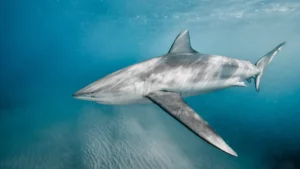 | 2.5–3.5 m (8–11.5 ft) | Moderate | Hadera outflow November–May; the shelf in summerThe big shark of the aggregation, mostly mature females. Named in the 2025 Hadera case. Endangered. |
Sandbar SharkCarcharhinus plumbeus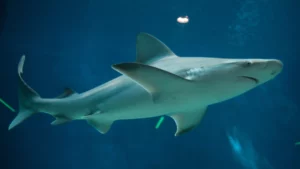 | 1.5–2.3 m (5–7.5 ft) | Low | Hadera and Ashkelon outflows in winter; sandy shelfTall-finned and placid; the smaller, more numerous member of the gathering, mostly males. |
Blue SharkPrionace glauca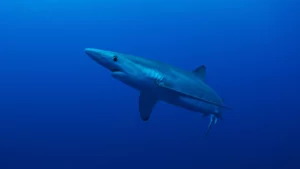 | 2–3 m (7–10 ft) | Low | Deep water beyond the shelf; longline bycatchThe commonest oceanic shark off Israel and never a beach animal. |
Shortfin Mako SharkIsurus oxyrinchus | 2–3 m (7–10 ft) | Moderate | Offshore, summer; the species in the 1974 Eilat caseFast pelagic hunter, endangered in the Mediterranean. No Mediterranean-coast incident in Israel. |
Common Thresher SharkAlopias vulpinus | 3–5 m (10–16 ft) incl. tail | Low | Shelf edge; landed by trawlers at Haifa and AshdodUses the long tail to stun sardines. Harmless; endangered. |
Bigeye Thresher SharkAlopias superciliosus | 3–4 m (10–13 ft) incl. tail | Low | Deep water offshore; occasional longline catchHuge eyes for hunting at depth. Rarely seen alive. |
Spinner SharkCarcharhinus brevipinna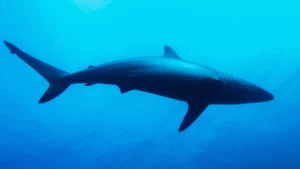 | 2–2.5 m (7–8 ft) | Moderate | Surf zone and bay mouths in summer, chasing sardinesSpins out of the water in pursuit of sardines. Excitable but with no bite on record here. |
Blacktip SharkCarcharhinus limbatus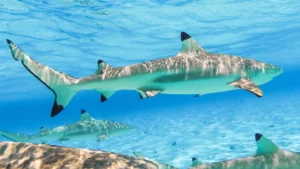 | 1.5–2.5 m (5–8 ft) | Moderate | Rare; warm summer shallowsA few Levantine records, easily confused with the spinner shark. |
Common Smooth-houndMustelus mustelus | 1–1.5 m (3–5 ft) | Low | Sandy shelf everywhere; the main shark at the port marketsCrab-crushing bottom shark, timid and harmless. Sold as kalbit despite protection. |
| Blackspotted Smooth-houndMustelus punctulatus | 1–1.2 m (3–4 ft) | Low | Shelf sand and mud, with the common smooth-houndTold apart by the dark flecks on the back. Harmless. |
Tope SharkGaleorhinus galeus | 1.5–1.8 m (5–6 ft) | Low | Outer shelf, 50–200 mSlim, fast schooling shark. Critically endangered; on the Barcelona Convention no-take list. |
Small-spotted CatsharkScyliorhinus canicula | 0.6–0.8 m (2–2.5 ft) | Low | Kurkar ridges and reserves; Rosh HaNikra, Dor HaBonimThe shark a diver on the reserves is most likely to meet. Lies still under ledges. |
| NursehoundScyliorhinus stellaris | 1–1.5 m (3–5 ft) | Low | Rocky reefs and grottoes in the northThe larger, bolder-spotted catshark. Near threatened; harmless. |
Blackmouth CatsharkGaleus melastomus | 0.6–0.9 m (2–3 ft) | Low | Slope mud, 200–800 m; trawl bycatchSlope catshark named for the black lining of its mouth. Never seen by swimmers. |
Bluntnose Sixgill SharkHexanchus griseus | 3–4.5 m (10–15 ft) | Low | Deep slope of the Levantine BasinA primitive giant of the deep, occasionally hooked on deep longlines off Haifa. |
Gulper SharkCentrophorus granulosus | 0.9–1.2 m (3–4 ft) | Low | Slope, 300–1,000 mSlow-growing deep shark, endangered from bottom trawling. |
Velvet Belly LanternsharkEtmopterus spinax | 0.35–0.45 m (14–18 in) | Low | Deep slope mudTiny, glowing deep-sea shark taken in research trawls off the coast. |
Kitefin SharkDalatias licha | 1–1.4 m (3–4.5 ft) | Low | Slope, 300–1,000 mA deep-water bite-taker of larger fish. Rare bycatch. |
Sand Tiger SharkCarcharias taurus | 2.2–3 m (7–10 ft) | Low | Rare; rocky reefs and shelf edgeFearsome teeth, docile nature. Critically endangered in the Mediterranean; a few Levantine records. |
Smooth Hammerhead SharkSphyrna zygaena | 2.5–4 m (8–13 ft) | Low | Rare; offshoreOnce regular in the eastern Mediterranean, now critically endangered and seldom recorded. |
Milk SharkRhizoprionodon acutus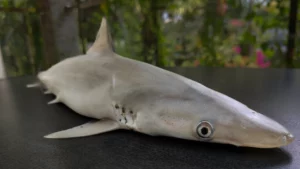 | 0.8–1.1 m (2.5–3.5 ft) | Low | Shallow sandy coast; a Red Sea species arrived via the Suez CanalOne of the Lessepsian migrants now breeding off the Levant. Harmless. |
Great White SharkCarcharodon carcharias | 4–6 m (13–20 ft) | n/a | No verified modern record off IsraelPresent in the Mediterranean far to the west; historical Levantine records exist, none recent. |
The earlier version of this page listed five sharks and one of them, the whale shark, does not belong: it is a Red Sea animal seen occasionally at Eilat and has no solid record on the Mediterranean coast. The old page also said the sea around Israel was “too warm for sharks” and that the power stations had created a shark habitat where there was none. Neither is right. The Levantine coast has always had sharks; what the outflow does is concentrate two species that would otherwise be scattered across the shelf in winter. On the great white, the honest position is that the Mediterranean has a small, critically endangered population centred far to the west, and that occasional white sharks have been recorded in the Levant over the past century, but there is no verified modern record from Israeli waters, and the old claim that the water is “too warm” is not the reason: white sharks hunt happily in 25 °C off Sicily. The bull shark, the tiger shark and the oceanic whitetip do not occur in the Mediterranean at all.
Where to see sharks in Israel
There is no shark diving industry in Israel and no baiting. The one reliable place is Hadera, and since 2025 that means watching from the shore. The rest of the list is for the patient diver and the fish-market visitor.
- Orot Rabin outflow and Hadera Stream mouthThe aggregation site, between Olga Beach and the power station's coal pier. From November to May dusky and sandbar sharks cruise the warm channel and the surf beside it, visible from the breakwater and the beach promenade. Entering the water is prohibited since April 2025; rangers patrol in season.
- Rutenberg power station, AshkelonThe southern power station's outflow draws a smaller winter group, mostly sandbar sharks, watched from the adjoining beach and the harbour wall. Less crowded and less studied than Hadera.
- Rosh HaNikra and Achziv marine reserveIsrael's northernmost coast, with sea grottoes, rocky ridges and the country's oldest marine reserve. Small-spotted catsharks and nursehounds shelter in the crevices at 10–25 m; a good shore dive from Achziv in calm weather.
- Dor HaBonim reserveA stretch of kurkar ridges, islets and coves south of Haifa where catsharks rest under ledges and smooth-hounds cross the sand at dusk. Snorkelling and easy diving inside the reserve.
- Caesarea and Sdot YamThe ancient harbour of Caesarea is a marked underwater archaeology trail, and the Morris Kahn station at Sdot Yam next door is the base for the Hadera research. Occasional sandbar sharks pass the harbour moles in winter, a few kilometres from the outflow.
- Ashdod south breakwaterDeep water against the port's outer wall attracts jacks, groupers and, in winter, sandbar and dusky sharks; the 2013 hand-bite in the record happened to a diver here.
- Haifa BayA wide, shallow bay with the Kishon estuary at its southern end. Sharks are seen by fishermen and, as the 2019 record shows, occasionally by snorkellers; a place for sightings rather than a dive destination.
- Jaffa and Acre fishing portsThe surest sighting in the country is on the quayside: smooth-hounds, tope and the occasional blue shark or thresher landed by the trawl and longline fleets. Note that sharks are protected and their sale is illegal, which does not always stop it.
If you are in Israel between December and March and want to see sharks, drive to Hadera on a calm morning, walk the breakwater at the stream mouth, and look for the dark shapes in the brown-green plume; polarised sunglasses help. Boat and kayak operators offer trips along the outflow's edge in season, but check the current rules with the Nature and Parks Authority, which has tightened them every year since 2023.
Best time of year to see sharks in Israel
Israel is the rare country where the best shark season is winter.
- November to May: the Hadera and Ashkelon gatherings. Duskies arrive first, usually in late November as the sea falls below 22 °C, sandbars follow, and numbers peak from December to February when the contrast between the 16–17 °C sea and the outflow is greatest. By May the plume has lost its advantage and the sharks disperse offshore.
- June to October: the sea warms to 29–31 °C, the warmest in the Mediterranean, and the aggregation is empty. Spinner sharks and the occasional blacktip feed on sardine and mullet schools along the beaches, blue sharks and makos are on the deep water beyond the shelf, and the trawlers land threshers. This is also jellyfish season, the real reason many Israelis stay out of the sea in July.
- Storm season, December to March: winter westerlies raise big surf on this exposed coast and close the Hadera breakwater for days; the sharks are still there, but you will not see them through the swell. Pick a calm spell of easterly wind.
Visibility on the sandy coast is modest all year, 5–15 m on the ridges and reserves, and worst after a storm or a heavy rain in the Hadera Stream.
Shark attacks in Israel: what the record actually shows
Israel's incident record is short and, until 2025, mild. SharkSider's database holds ten entries for the country, all dated between 1933 and 2025, and keeps them on the shark attacks in Israel page. None is flagged as a confirmed fatal attack. Eight are on the Mediterranean coast; two are Red Sea cases, a swimmer badly bitten by a shortfin mako at Eilat's North Beach in 1974 and a free diver bitten while swimming with dolphins off Marsa Bereika in Egyptian Sinai in 1996, which the database files under both countries. The six latest are rendered below from the database; the attacks page carries all ten:
- 2025 · Olga Beach near Hadera Stream, HaderaDiving — Remains recovered several days after the attcksSpecies: Dusky sharks · not fatal
- 2019 · HaifaSnorkeling — No injury, swim fin bittenSpecies not identified · not fatal
- 2013 · Ashdod, Southern DistrictDiving — Hand bitten Species not identified · not fatal
- 1996 · 1 km off the mouth of Marsa Bereika, north of Ras Mohammed, South Sinai, Gulf of AqabaFree diving with a pod of dolphins — Bitten on back, shoulder & chestSpecies: said to involve an oceanic whitetip shark · not fatal
- 1974 · North Beach, Eilat, Red SeaSwimming — Bitten 12 times: multiple lacerations on hands, arms, shoulder breast thigh, both legs, left forearm surgically amputated Species: Shortfin mako shark, 2.3 m [7.5'] · not fatal
- 1962 · 2 km north of Apollonia, SharonFishing — Details unknown, possibly a provoked incidentSpecies: 2.5 m [8.25'] shark · not fatal
The Mediterranean record splits into two eras. The old cases are mostly fishermen: two men bitten on the thigh and arm by three sharks at Nabi Rubin in 1933, human remains washed ashore at Sidna Ali near Herzliya in 1935 with shark involvement never confirmed, a swimmer off Tel Aviv in 1945 saved when an RAF pilot dived his aircraft at the shark, a fisherman lacerated at Jura village near Gaza in 1946, and a possibly provoked incident with a 2.5-metre shark north of Apollonia in 1962. Then nothing for half a century. The modern cases begin with a diver's hand bitten at Ashdod in September 2013 and a snorkeller at Haifa in November 2019 whose only loss was a swim fin; both are the kind of curious, exploratory bite a large requiem shark gives to something unfamiliar.
The 2025 entry is different. On 21 April 2025 a man diving with a camera among the sharks at Olga Beach, beside the Hadera outflow, was attacked and disappeared; the database records that his remains were recovered several days later and names dusky sharks as the species. Because the record documents recovered remains rather than a medically confirmed cause of death, the summary count on this page does not flag it as a fatal attack, but it is, by any practical reading, the first death involving sharks on Israel's Mediterranean coast, and it was the reason the Nature and Parks Authority closed the site. The lesson is specific rather than general: a large aggregation of two- to three-metre sharks, people entering the water among them in murky, warm, fish-rich water day after day, and the occasional swimmer carrying a camera or bait to get closer. Away from the outflow, nothing in the record suggests a Mediterranean beach in Israel is any more dangerous than one in Cyprus or Greece. The standard precautions cover the rest: no swimming at the stream mouths or near fishing activity, none at dawn or dusk in winter along the Hadera coast, and no approaching, touching or feeding a shark anywhere.
Is it safe to swim in Israel?
Yes. The hazards that actually fill the lifeguard logs on Israeli beaches are rip currents, which kill swimmers every summer on the sandy coast, the summer jellyfish blooms of Rhopilema nomadica, sea urchins and the venomous lionfish on the rocky reserves, and the surf that winter storms throw at the breakwaters. Sharks, outside Hadera, are not on the list, and even at Hadera the sensible response is now simple, because the water there is closed.
The sharks a swimmer might meet elsewhere on the coast behave as they do across the Mediterranean. Smooth-hounds and tope are timid bottom feeders that vanish at the sight of a person. Catsharks and nursehounds lie under ledges and will not move unless prodded. Sandbar sharks in the surf in winter are placid; the University of Haifa divers who tag them at Hadera describe an animal that tolerates a boat and a camera for hours. Spinner sharks chasing sardines in summer are fast and excitable but have no Israeli bite on record. Dusky sharks are the ones to give real space to: they are big, they are the species named in the 2025 case, and a large female in the murk of the outflow is not something to swim towards.
Divers on the deep water beyond the shelf who meet a blue shark or a mako should keep still, keep the shark in sight and let it lose interest, which usually takes under a minute. Spearfishers, who account for a share of the shark injuries around the Mediterranean, should not keep a bleeding catch on their belt and should surface promptly if a shark shows interest in it.
Shark conservation in Israel
Israel protects its sharks better on paper than most Mediterranean states. Every shark and ray species is a protected natural value under the regulations of the Nature and Parks Authority, which means no fishing, no possession and no sale; the eastern Mediterranean's regional fisheries body, the GFCM, adds the Barcelona Convention list of two dozen threatened sharks and rays that cannot be retained, among them the smooth hammerhead, the sand tiger, the tope and the angelsharks. In 2025 the authority moved to close the water at the Hadera outflow permanently and to declare the site a reserve for the sharks, with observation from shore only, ending a decade in which winter crowds paddled and swam among the animals.
The gaps are real. Sharks still turn up on the quayside at Jaffa and Acre, caught on longlines and in trawls that are aimed at other species, and enforcement of the protection rules at the ports is uneven. The trawl fleet works the same sandy shelf where smooth-hound and sandbar pups grow up. The wider eastern Mediterranean is the most depleted corner of the sea for sharks, with more than half the basin's species classed as threatened by the IUCN, and Israel's coast is at the receiving end of everything the Suez Canal delivers: warm-water competitors, changed food webs and a sea that has warmed faster than almost any other. What the country has that its neighbours lack is a dedicated research programme. The University of Haifa's tagging at Hadera has shown that the same dusky and sandbar sharks return each winter, that the duskies are mostly mature females and the sandbars mostly males, and that both range across the Levant in summer, data that did not exist for either species in the Mediterranean before. Our page on why sharks are endangered gives the global background.
Sharks in neighbouring waters
Israel's Mediterranean sharks are the sharks of the whole Levantine basin. Egypt, to the south-west, shares the sandbar sharks and smooth-hounds of the delta coast and, on its Red Sea side, the reef and oceanic sharks that Eilat's visitors see. Cyprus, 350 km across the water, has the same species on a rockier shelf and a single incident from 1901. Turkey, to the north, has the eastern Mediterranean's best-known sandbar shark nursery at Boncuk Cove, and Greece the richest species list in the basin. Further west, Tunisia is the heart of the Mediterranean great white's range. On the Red Sea side, Saudi Arabia owns the opposite shore of the Gulf of Aqaba from Eilat. Every country we cover is listed on sharks around the world.
Frequently asked questions
Are there sharks in Israel?
Yes. Twenty-one species have solid records on the Mediterranean coast, most of them small bottom sharks and deep-water species. The two that people actually see are the dusky shark and the sandbar shark, which gather each winter in the warm outflow of the Orot Rabin power station at Hadera. Eilat, on the Red Sea, has a separate reef fauna.
Why are there sharks at Hadera?
The Orot Rabin power station returns its cooling water to the sea beside the Hadera Stream several degrees warmer than the winter Mediterranean. From November to May dusky and sandbar sharks gather in the plume, probably for the warmth and the fish it attracts. University of Haifa researchers have tagged them since 2015 and the same individuals return each year.
Have there been shark attacks in Israel?
SharkSider's database lists ten records from 1933 to 2025 and no confirmed fatal attack. Eight are Mediterranean cases, mostly old fishermen's injuries plus a bitten hand at Ashdod in 2013 and a bitten swim fin at Haifa in 2019. The most serious is from April 2025, when a diver among the sharks at the Hadera outflow disappeared and his remains were found days later.
Is it safe to swim with the sharks at Hadera?
No, and it is no longer allowed. After the April 2025 death the Nature and Parks Authority closed the water at the outflow to swimmers, kayaks and divers, and rangers patrol the site in season. The sharks can be watched from the breakwater and the beach promenade between November and May.
Do great white sharks live in the waters around Israel?
There is no verified modern record from Israeli waters. The Mediterranean has a small, critically endangered white shark population centred on Sicily and Tunisia, and historical records exist from the Levant, but nothing recent off Israel. The old idea that the water is too warm is wrong; white sharks hunt in similar temperatures elsewhere in the Mediterranean.
What kind of sharks are in Israel?
Dusky and sandbar sharks at the power-station outflows in winter; common and blackspotted smooth-hounds, tope, small-spotted catsharks and nursehounds on the shelf and reefs; spinner and occasional blacktip sharks in the summer surf; blue sharks, makos and threshers offshore; and sixgills, gulper sharks, lanternsharks and blackmouth catsharks on the deep slope.
When is the best time to see sharks in Israel?
December to February, on a calm morning at the Hadera Stream mouth, when the contrast between the 16–17 °C sea and the warm outflow is greatest and the dusky and sandbar sharks are at peak numbers. The gathering runs from November to May; in summer the sharks disperse and the coast is given over to jellyfish and spinner sharks chasing sardines.
Are sharks protected in Israel?
Yes. All sharks and rays are protected natural values under the Nature and Parks Authority's regulations, so catching, keeping or selling them is illegal, and the regional GFCM rules add a no-take list of threatened Mediterranean species. Enforcement at the fishing ports is imperfect and smooth-hounds still appear on the quayside.
Are there sharks in Eilat?
Yes, but they are Red Sea species, whitetip reef sharks, blacktip reef sharks and occasional pelagic visitors on the Gulf of Aqaba reefs, and they are not covered on this Mediterranean page. The 1974 case at Eilat's North Beach, a swimmer badly bitten by a shortfin mako, is the only Red Sea incident in Israel's own record.
Are there bull sharks or tiger sharks in Israel?
No. Neither the bull shark nor the tiger shark occurs in the Mediterranean, and neither has been recorded off Israel's coast. The large sharks seen at Hadera and Ashkelon are dusky sharks and sandbar sharks, both requiem sharks that are often mistaken for bull sharks by beachgoers.
References

A small team focused on researching sharks and making marine biology easy to understand. Every page is reviewed against current species records and the SharkSider attack database, and updated when new incidents or research appear.
Published January 4, 2023 · Last updated September 21, 2026 · Incident data from the SharkSider attack database (10 records for Israel, 0 fatal).


