
Yes, Ireland has sharks, 29 species with reliable records, and the common ones are either tiny or gentle. The small-spotted catshark (the dogfish of every Irish angler) lives on almost every sandy bay; the basking shark, the second-largest fish in the world, feeds off the west coast from April to July; blue sharks and porbeagles arrive offshore in summer; and tope and smooth-hounds hunt crabs in the estuaries. Below 500 m, the slope holds sixgills, gulper sharks, lanternsharks and the occasional Greenland shark.
The safety picture is as clear as anywhere in Europe. The SharkSider database holds just two records for Ireland, one from 1917 and one from 2018, with a single death. The death was a wartime shipwreck 82 miles off the Fastnet Rock; the 2018 case was an angler in County Cork bitten on the forearm by a 47 kg blue shark he had just hooked. No swimmer, surfer or snorkeller has ever been recorded as bitten by a shark in Irish waters.
- Shark species recorded29 with solid records
- ProtectionBasking shark protected under the Wildlife Act since 2022; angelshark, porbeagle and spurdog protected under EU rules
- Most seen from the shoreSmall-spotted catshark; basking sharks from western headlands in early summer
- Signature encounterBasking sharks off Achill, Malin Head and the Blaskets, April–July
- Incidents in the database2 (1917–2018), 1 fatal (a 1917 shipwreck)
- Water temperature8–10 °C in March, 15–17 °C in August

On this page
- Where sharks live in Irish waters
- List of the different types of sharks in Ireland
- Where to see sharks in Ireland
- Best time of year to see sharks in Ireland
- Shark attacks in Ireland: what the record actually shows
- Is it safe to swim and snorkel in Ireland?
- Shark conservation in Ireland
- Sharks in neighbouring waters
- Frequently asked questions
- References
Where sharks live in Irish waters
Think of Ireland's seabed as three steps. The first is the shelf itself, a broad platform of sand, gravel and rock that rarely exceeds 150 m and extends far beyond the island in every direction, out to the Porcupine Bank in the west and across the Celtic Sea in the south. This is catshark and smooth-hound country: the small-spotted catshark lays its egg cases (the mermaid's purses that wash up on every strand) on kelp and hydroids in a few metres of water, nursehounds live in the rocky gullies of the south and west, tope and starry smooth-hounds push into the estuaries of Wexford, Cork and Clew Bay in summer to feed on crabs, and the spurdog forms huge, slow-moving packs over the muddy grounds of the Irish Sea and the Celtic Sea.
The second step is the shelf edge, 200 to 300 km west of Galway and Kerry, where the Atlantic arrives. The North Atlantic Current slides warm, salty water along this edge, and in spring the mixing of that water with the cold shelf water triggers the plankton bloom that basking sharks follow north. Satellite tags fitted to basking sharks off Donegal and Kerry show animals commuting between the Irish coast, the Hebrides, the Bay of Biscay and, in winter, the deep water of the mid-Atlantic. The same warm edge draws blue sharks, porbeagles and the occasional shortfin mako in from the open ocean once the surface passes about 15 °C, which is why Irish charter boats find them from July onward and lose them by October.
The third step is the slope. Beyond the shelf edge the seabed falls into the Porcupine Seabight and the Rockall Trough, reaching 3,000 m within sight of the Irish exclusive economic zone. Marine Institute trawl surveys on this slope have catalogued a deep-water shark fauna that few countries in Europe can match: the leafscale gulper shark and Portuguese dogfish that were once the target of an Irish and French longline fishery, the kitefin, black dogfish, birdbeak dogfish, velvet belly and great lanternsharks, the frilled shark and bluntnose sixgill, and the small, soft-bodied catsharks of the genus Apristurus and Galeus. Greenland sharks, animals that can live for centuries, are recorded on the cold northern slope off Donegal. None of these species ever comes near a beach, but they account for more than half the shark list.
List of the different types of sharks in Ireland
The table covers every shark with a solid Irish record, drawn from Marine Institute surveys, Inland Fisheries Ireland's angler tagging programme (which has tagged sharks since 1970), commercial landings and verified sightings. Lengths are those of an ordinary adult, not the Irish rod-caught record. The risk column concerns swimmers and snorkellers at an Irish beach, and for almost every species it is close to zero: they are either too small, too deep, too far offshore, or simply not interested. Irish anglers use dogfish for the small-spotted catshark, bull huss for the nursehound and spurdog for the spiny dogfish; the basking shark's old Irish name is liabhán chor gréine, the great fish of the sun.
| Species | Adult size | Risk to swimmers | Where in Ireland & notes |
|---|---|---|---|
Basking SharkCetorhinus maximus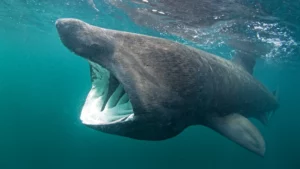 | 6–9 m (20–30 ft) | Low | West and north coasts, April–July: Achill, Malin Head, BlasketsThe second-largest fish in the world and Ireland's signature shark. A plankton feeder with no functional teeth; protected under the Wildlife Act since 2022. |
Small-spotted Catshark (Dogfish)Scyliorhinus canicula | 60–80 cm (2–2.6 ft) | Low | Sand and gravel from the shoreline to 100 m, every coastBy far the most abundant Irish shark and the one shore anglers catch nightly. Its egg cases are the mermaid's purses on the strand. |
| Nursehound (Bull Huss)Scyliorhinus stellaris | 1.2–1.5 m (4–5 ft) | Low | Rocky, weedy ground on the south and west coastsThe catshark's larger, blotchy cousin. Rests in gullies by day; harmless unless picked up. |
| Spiny Dogfish (Spurdog)Squalus acanthias | 0.8–1.2 m (2.6–4 ft) | Low | Irish Sea and Celtic Sea, in large packs over mud and sandOverfished for decades, now recovering under a strict quota. The venomous dorsal spines are a hazard to anglers, not swimmers. |
Tope (School Shark)Galeorhinus galeus | 1.3–1.8 m (4–6 ft) | Low | Estuaries and shallow bays in summer: Wexford, Cork Harbour, Clew BayA strong, fast houndshark tagged by Irish anglers since 1970. Catch-and-release only; timid around people. |
Starry Smooth-houndMustelus asterias | 1–1.3 m (3–4 ft) | Low | Sandy bays of the east and south coasts, May–SeptemberA crab-eating shark with flat crushing teeth. Increasingly common in the Irish Sea; completely harmless. |
| AngelsharkSquatina squatina | 1.2–1.8 m (4–6 ft) | Low | Tralee Bay and Clew Bay, a few individuals each summerCritically endangered; once so common that Tralee Bay held angling competitions for it. Lies buried in sand and must be released if caught. |
Blue SharkPrionace glauca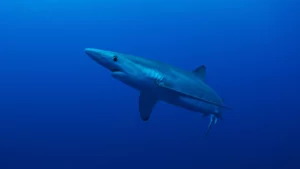 | 2–3 m (7–10 ft) | Low | Offshore south and west coasts, July–OctoberThe shark of Irish charter fishing and the only one in the incident record (a 2018 bite to an angler). Curious but not aggressive to snorkellers. |
Porbeagle SharkLamna nasus | 2–2.5 m (7–8 ft) | Low | All coasts in summer; Lough Swilly, Donegal and the Tuskar groundsA warm-bodied relative of the great white that often gets mistaken for one. Prohibited species in EU waters; must be released alive. |
Shortfin Mako SharkIsurus oxyrinchus | 2–3 m (7–10 ft) | Moderate | Rare summer visitor to the shelf edge off Cork and KerryThe fastest shark, recorded only occasionally on Irish charter lines. Dangerous mainly to the angler unhooking it. |
Common Thresher SharkAlopias vulpinus | 3–4.5 m (10–15 ft) incl. tail | Low | Shelf waters off the south coast in late summerUncommon but regular; stuns mackerel with its whip-like tail. Occasional landings still cause controversy. |
Bluntnose Sixgill SharkHexanchus griseus | 3.5–4.8 m (11–16 ft) | Low | Continental slope 300–1,500 m; occasionally shallower off the westA huge, sluggish deep-water shark with a single dorsal fin and a fossil lineage. Never meets swimmers. |
Sharpnose Sevengill SharkHeptranchias perlo | 1–1.4 m (3–4.5 ft) | Low | Deep water on the southern and western slope, rarely caughtA small, slender seven-gilled shark with enormous green eyes. Harmless and rarely seen alive. |
Greenland SharkSomniosus microcephalus | 3–5 m (10–16 ft) | Low | Cold, deep water off the north and north-west coastsThe longest-lived vertebrate known, possibly 400 years. Sleepy, slow and confined to depths far below any Irish beach. |
Frilled SharkChlamydoselachus anguineus | 1.2–1.8 m (4–6 ft) | Low | Porcupine Seabight and Rockall Trough, 500–1,500 mAn eel-shaped living fossil taken occasionally in deep-water surveys. Harmless. |
Blackmouth CatsharkGaleus melastomus | 50–70 cm (1.6–2.3 ft) | Low | Outer shelf and upper slope, 200–1,000 m, all round the westThe commonest deep-water shark in Irish trawl surveys, with a marbled back and black mouth lining. |
Mouse CatsharkGaleus murinus | 50–65 cm (1.6–2.1 ft) | Low | Slope off the west and north-west, 400–1,200 mA plain grey-brown deep-water catshark known mainly from survey hauls. |
Iceland CatsharkApristurus laurussonii | 55–70 cm (1.8–2.3 ft) | Low | Deep slope of the Rockall Trough and Porcupine SeabightSoft-bodied and dark, one of several Apristurus catsharks on the Irish slope. |
False CatsharkPseudotriakis microdon | 2.5–3 m (8–10 ft) | Low | Rare on the deep slope west of IrelandA big, flabby deep-sea shark with a very long dorsal fin. Only a handful of Irish records. |
Bramble SharkEchinorhinus brucus | 2–2.8 m (7–9 ft) | Low | Rare; outer shelf and slope of the south and westCovered in thorn-like denticles. Once caught by Irish trawlers more often; now a rarity everywhere in the north-east Atlantic. |
Kitefin SharkDalatias licha | 1–1.5 m (3–5 ft) | Low | Upper slope, 300–1,000 mA chocolate-brown deep-water shark that bites chunks from larger fish. Zero quota in EU waters. |
Leafscale Gulper SharkCentrophorus squamosus | 1.2–1.5 m (4–5 ft) | Low | Rockall Trough and Porcupine slope, 500–1,500 mA former target of the Irish deep-water longline fishery; endangered, and the reason that fishery was closed. |
Portuguese DogfishCentroscymnus coelolepis | 0.9–1.2 m (3–4 ft) | Low | Deep slope, 700–2,000 mOne of the deepest-living sharks on Earth and a survey regular off Ireland. |
Black DogfishCentroscyllium fabricii | 60–85 cm (2–2.8 ft) | Low | Cold deep water of the northern slope and Rockall TroughA luminous, jet-black dogfish that forms dense schools at depth. |
Birdbeak DogfishDeania calcea | 0.9–1.1 m (3–3.6 ft) | Low | Slope off the west coast, 400–1,000 mThe long, flattened snout gives it its name. A regular in deep survey hauls. |
Longnose Velvet DogfishCentroselachus crepidater | 70–100 cm (2.3–3.3 ft) | Low | Deep slope of the Porcupine SeabightA velvet-skinned, deep-living dogfish taken as bycatch in the old longline fishery. |
Knifetooth DogfishScymnodon ringens | 0.9–1.1 m (3–3.6 ft) | Low | Slope west of Ireland, 500–1,000 mBlade-like lower teeth for slicing squid and fish; recorded in Irish deep-water surveys. |
Velvet Belly LanternsharkEtmopterus spinax | 35–45 cm (1.1–1.5 ft) | Low | Outer shelf and slope, 200–800 m, abundantA glow-in-the-dark dwarf shark and the most numerous small shark on the Irish slope. |
Great LanternsharkEtmopterus princeps | 60–75 cm (2–2.5 ft) | Low | Deep slope of the Rockall Trough, 800–2,000 mThe larger, colder-water lanternshark of the north-west Irish deep. |
Great White SharkCarcharodon carcharias | 4–6 m (13–20 ft) | n/a | No confirmed Irish recordHere for the searchers who ask: every reported Irish sighting has turned out to be a porbeagle, a basking shark or a sunfish. |
Two sharks that people search for are missing on purpose. The great white shark has no confirmed Irish record. Irish summer temperatures of 15–17 °C are inside its range, and the species is recorded from the Bay of Biscay, so a visit is biologically possible, but the many reports over the years have all turned out to be porbeagles, basking sharks or, in one memorable case off Wexford, a sunfish. The bull shark, the tiger shark and the hammerheads are warm-water animals with no place in Irish seas. Smooth hammerheads and oceanic whitetips have been reported from the far south-west of the Irish zone on a handful of occasions, but not often enough to earn a row in the table.
Where to see sharks in Ireland
Ireland has no shark-diving industry in the tropical sense, but it has something rarer: reliable, free sightings of the second-largest fish in the world from a cliff path, and a growing number of licensed boat trips that put snorkellers in the water with blue sharks. These are the places with the strongest records.
- Achill Island and Keem Bay, County MayoThe most famous basking shark site in Ireland. Keem Bay was the centre of a commercial basking shark fishery from 1947 to 1975 that took more than 12,000 animals; today the same cliffs above the bay are where visitors watch surviving sharks feed in May and June, often within a stone's throw of the beach.
- Malin Head and Inishowen, County DonegalIreland's northern tip is one of the best land-based basking shark viewpoints in Europe. Aggregations of 50 or more sharks, and the first Irish observations of basking shark courtship behaviour, have been recorded here in spring and early summer.
- The Blasket Islands and Slea Head, County KerryBoat trips from Dingle and Ventry regularly meet basking sharks feeding along the tide lines off the Blaskets in May and June, alongside dolphins and minke whales. Blue sharks are found further out in late summer.
- West Cork: Baltimore, Courtmacsherry and KinsaleThe heart of Irish shark angling. Charter boats run 15–30 km offshore from July to October for blue sharks, with porbeagles on the deeper marks; several operators now offer snorkelling with blue sharks under a catch-free, cage-free protocol.
- Tralee Bay and Clew BayThe last strongholds of the critically endangered angelshark in Irish waters. Tralee Bay was a world-famous angelshark angling ground in the 1970s and 1980s; Inland Fisheries Ireland's tagging data show a handful of animals still using the bay each summer, and Clew Bay produces the occasional record too.
- Kilmore Quay and the Wexford coastTope, starry smooth-hounds and spurdog in the shallow, sandy Irish Sea and Celtic Sea, all catch-and-release. The Tuskar Rock grounds also produce porbeagles for boat anglers in late summer.
- Lough Swilly and the Donegal north coastPorbeagles come close inshore here in summer and autumn to follow mackerel; the lough has produced some of the largest rod-caught porbeagles in Europe. Greenland sharks are known from the deep, cold water beyond the headlands.
- Any sandy bay, especially at nightSmall-spotted catsharks come into a few metres of water after dark to hunt crabs and worms. Shore anglers catch them on every coast, snorkellers find them resting on sand in daylight, and their egg cases litter the strandline after a storm.
For a first Irish shark, walk the cliff path above Keem Bay or stand on Malin Head on a calm, sunny day in late May and look for a dark triangular fin moving slowly along the tide line. For an in-water encounter, book a blue shark snorkel out of West Cork in August or September with an operator that follows the Irish Basking Shark Group and Irish Whale and Dolphin Group codes of conduct.
Best time of year to see sharks in Ireland
Irish sharks run on temperature and plankton, and both swing a lot through the year.
- April to July, the basking shark season: the spring bloom starts in the south-west in April and works north up the coast, and the sharks follow it. Kerry and Cork see the first fins in April, Clare and Mayo in May, Donegal in June. Calm, sunny, windless days are best, because feeding sharks surface when plankton concentrates in the top metre.
- July to October, the pelagic season: once the surface warms past 15 °C, blue sharks move onto the shelf edge and inshore, porbeagles follow the mackerel, and the rare shortfin mako or thresher turns up on a charter line. September is usually the peak month for blues.
- May to September, the estuaries: tope, starry smooth-hounds and spurdog enter the bays to feed and, in the case of tope, to pup. Small-spotted catsharks are present all year but are most active inshore in summer.
- November to March: water temperatures fall to 8–10 °C, the basking sharks are in deep water far offshore, the blues have gone south, and only the catsharks, spurdog and the deep-water species remain. Winter storms wash egg cases ashore, which is the best time to go beachcombing for them.
Sea surface temperatures range from about 8 °C off the north coast in March to 15–17 °C in August, with sheltered bays occasionally touching 18–19 °C in a warm summer. Those summer highs are what allow the blue sharks in, and the winter lows are why tropical species never appear.
Shark attacks in Ireland: what the record actually shows
Ireland's incident list fits on a postcard. SharkSider tracks every reported case on the shark attacks in Ireland page, and the database holds only two records, both of which are shown below (the list is updated weekly on the attacks page):
- 2018 · County CorkFishing — Forearm bitten by hooked shark provoked incidentSpecies: Blue shark, 47kg · not fatal
- 1917 · 82 miles from Fastnet, Off IrelandShip Mariston torpedoed & sunk — Fatal, only 1 survivorSpecies not identified · fatal
Read them carefully and neither says much about the danger of an Irish beach. The 1917 entry is a wartime disaster: the steamship Mariston was torpedoed and sunk 82 miles from the Fastnet Rock in July 1917, and only one man survived. It is recorded as fatal because sharks were reported among the survivors in the water, in the same way that dozens of Second World War sinkings are recorded in shark databases worldwide. It happened in the open Atlantic, not at a beach, and the sharks involved would have been blue sharks or porbeagles drawn to the wreck. The 2018 entry is a classic provoked incident: an angler in County Cork was bitten on the forearm by a 47 kg blue shark he had just brought alongside the boat. Blue sharks have a mouth full of serrated teeth and thrash when handled, and an unhooking that goes wrong is the most common way an Irish person meets one at close quarters.
What is missing from the record is the important part. In more than a century of documented cases, no swimmer, surfer, snorkeller, kayaker or diver has ever been recorded as bitten by a shark in Ireland. Basking sharks, the only large sharks routinely within reach of a beach, have no teeth worth the name and feed on plankton. The advice on our shark attack survival page applies more to Irish anglers than to Irish bathers: keep your hands clear of a hooked shark's head, use a long-handled disgorger, and cut the trace rather than wrestle a large fish over the gunwale.
Is it safe to swim and snorkel in Ireland?
Yes, and sharks are not what will get you. Cold water is the real Irish hazard: even in August the sea is 15–17 °C, and cold-water shock, rip currents on the Atlantic surf beaches, and the speed with which weather changes on the west coast account for the lifeboat call-outs every summer. Lion's mane jellyfish, which arrive in late summer, are a far more likely source of a sting than any fish. Irish lifeguards have never had to close a beach for a shark.
If you meet a basking shark while snorkelling or kayaking, you are lucky, not in danger. The animal will be moving slowly with its mouth open, and the only real risk is being clipped by its tail if you get too close. The Irish Basking Shark Group asks people to stay at least 4 m from the body, well clear of the tail, never to touch the shark, and to avoid getting between two sharks or in front of a feeding line. Boats should keep 100 m away and drop to idle. Basking sharks are now protected by law, and harassing one is an offence.
Blue sharks are the one species an Irish snorkeller might meet with teeth, and the licensed West Cork trips manage that well: chum draws the sharks, the snorkellers stay together on a line beside the boat, and a guide watches the sharks' behaviour. Blue sharks are inquisitive and will bump a camera, but they are not aggressive toward people in the water, and there is no record of one injuring a swimmer anywhere in Ireland. On the bottom, the catsharks and nursehounds a diver might find under a ledge will simply swim off; a nursehound can bite if grabbed, which is the only reason Irish divers ever get a mark from one.
Shark conservation in Ireland
Ireland's shark story is one of heavy loss followed by slow, real recovery. The Achill fishery alone killed more than 12,000 basking sharks between 1947 and 1975, mostly for liver oil, and the population off the west coast collapsed so completely that the fishery closed for lack of sharks. The angelshark, once so common that Tralee Bay hosted international angling competitions for it, was caught to the edge of extinction by trawlers and is now critically endangered across its whole range. Spurdog, tope and porbeagle were all fished hard through the twentieth century, and an Irish deep-water longline fishery in the 1990s and 2000s removed large numbers of leafscale gulper sharks and Portuguese dogfish from the slope before it was closed.
The legal picture is now far better. Ireland is bound by EU fisheries rules that prohibit the retention of angelsharks, porbeagles and basking sharks, that banned shark finning in 2003 and required fins to stay naturally attached from 2013, and that set a zero quota for spurdog from 2011 until a small, controlled fishery reopened in 2023 on the strength of a recovering stock. Deep-water sharks have had a zero quota in EU waters since 2010. In October 2022 the Irish government went further and made the basking shark a protected wild animal under the Wildlife Act, the first fish to be listed, making it illegal to hunt, injure or wilfully disturb one in Irish waters. Inland Fisheries Ireland runs one of the longest-running shark tagging programmes in the world, with anglers releasing tagged blue sharks, tope, porbeagles and smooth-hounds since 1970; the returns from that programme are why we know that Irish blue sharks cross to the Azores, the Canaries and the Caribbean.
The gaps are real. Angelsharks still have no dedicated recovery plan, bycatch of porbeagles and blues in the tuna and swordfish longline fleets working the Irish zone is poorly monitored, and the basking shark's Irish population is still a fraction of what it was in the 1940s. Sightings reported to the Irish Basking Shark Group and the Irish Whale and Dolphin Group feed directly into research, so if you see a fin, photograph it and send it in. For the wider picture, read our guide on why sharks are endangered.
Sharks in neighbouring waters
Ireland's sharks are the sharks of the whole north-east Atlantic shelf. France, across the Celtic Sea, shares the same blue shark and porbeagle grounds in Biscay and has confirmed great white records on its Atlantic coast, something Ireland does not. Portugal and Spain lie at the warm end of the same current and add hammerheads and makos to the list. To the north, Iceland and Norway carry the cold-water end of Ireland's fauna: Greenland sharks, spurdog and basking sharks in summer. The Netherlands shows what the shallow North Sea holds, mostly catsharks, smooth-hounds and tope. Every coast we cover is listed on our sharks around the world page.
Frequently asked questions
Are there sharks in Ireland?
Yes. Twenty-nine species have reliable records in Irish waters. The most common is the small-spotted catshark, found on every sandy coast, followed by tope, smooth-hounds and spurdog in the bays. Basking sharks feed off the west and north coasts from April to July, and blue sharks and porbeagles arrive offshore in summer.
Have there been shark attacks in Ireland?
Only two records exist, and neither involves a swimmer. In 1917 the steamship Mariston was torpedoed 82 miles off the Fastnet Rock with a single survivor, and sharks were reported among the men in the water. In 2018 an angler in County Cork was bitten on the forearm by a 47 kg blue shark he had hooked. No bather, surfer or snorkeller has ever been bitten in Ireland.
Are there great white sharks in Ireland?
No confirmed sighting has ever been made. Irish summer water of 15–17 °C is within the great white's tolerance and the species reaches the Bay of Biscay, so a visitor is not impossible, but every Irish report to date has proved to be a porbeagle, a basking shark or a sunfish. The porbeagle, a close relative, is the usual culprit.
Can you swim with sharks in Ireland?
Yes. Licensed boats out of West Cork run snorkelling trips with blue sharks from July to October, using chum to draw the sharks alongside and keeping swimmers on a line by the boat. Basking sharks can be seen from kayaks and on boat trips off Kerry, Mayo and Donegal in early summer, with a 4 m no-approach rule and no touching.
Where can you see basking sharks in Ireland?
The classic sites are Keem Bay on Achill Island in County Mayo, Malin Head at the top of Donegal, and the Blasket Islands and Slea Head in County Kerry. Sightings run from April in the south-west to June and July in the north, on calm, bright days when plankton gathers at the surface. Boat trips leave from Dingle, Ventry and Achill.
Where are porbeagle sharks found in Ireland?
Porbeagles occur off every Irish coast in summer and autumn, following mackerel and herring. Lough Swilly and the north Donegal coast have produced some of Europe's largest rod-caught porbeagles, and the deeper marks off Cork, Clare, Galway and the Tuskar grounds of Wexford are regular. They are a prohibited species and must be released.
Are there thresher sharks in Ireland?
Yes, but they are uncommon. Common threshers visit the shelf waters off the south and south-west coasts in late summer, hunting mackerel with their long tails, and a few are caught on charter lines each year. The occasional landing of a thresher by a commercial boat draws criticism, because the species is vulnerable and slow to reproduce.
Do Greenland sharks live near Ireland?
Yes, in small numbers. Greenland sharks are recorded from the cold, deep water off the north and north-west coasts of Ireland, at the southern edge of their range. They live hundreds of metres down, move slowly and never approach beaches, so a sighting is almost always from a deep-water fishing boat or a research survey.
Are the sharks in Ireland endangered?
Several are. The angelshark is critically endangered and survives mainly in Tralee Bay; the basking shark, porbeagle and spurdog were all fished to low levels and are now protected or under strict quota; and deep-water species such as the leafscale gulper shark and Portuguese dogfish were hit by longlining before it was closed. Catsharks and smooth-hounds remain abundant.
When is the best time to see sharks in Ireland?
Late May and June for basking sharks, when the plankton bloom peaks along the west coast and the sharks feed at the surface on calm days. August and September for blue sharks and porbeagles offshore, once the sea passes 15 °C. Catsharks are present all year, and tope and smooth-hounds fill the estuaries from May to September.
References

A small team focused on researching sharks and making marine biology easy to understand. Every page is reviewed against current species records and the SharkSider attack database, and updated when new incidents or research appear.
Published December 13, 2022 · Last updated September 21, 2026 · Incident data from the SharkSider attack database (2 records for Ireland, 1 fatal).


