
Yes, Iran has sharks, and a lot of them. Around 20 species have solid records from Iranian waters. In the shallow, warm Persian Gulf the most common are the blacktip shark, the spot-tail shark, the milk shark, the whitecheek shark and the Arabian carpetshark; the deeper Gulf of Oman coast around Chabahar adds whale sharks, hammerheads, makos and oceanic whitetips. Bull sharks live in both and are the species that once travelled up the rivers of Khuzestan.
The incident record is large but old and geographically strange. SharkSider's database lists 30 incidents for Iran, 13 of them fatal, nearly all between 1941 and 1985 and almost all in fresh water on the Karun River and the Shatt al-Arab, not on the coast. The last dated case was a fisherman killed near Ahvaz in 1985. There is no recorded bite on a swimmer at any Iranian beach or island in the modern era.
- Shark species recorded20 with solid records
- ProtectionWhale shark protected; other species landed in Hormozgan and Sistan-Baluchestan fisheries
- Most seen from the beachBlacktip and spot-tail sharks at fish landings
- Signature encounterWhale sharks off Chabahar and the Strait of Hormuz
- Incidents in the database30 (1941–1987), 13 fatal; all but one in rivers
- Water temperature18–20 °C in winter, 32–35 °C in summer (Persian Gulf)

On this page
- Where sharks live in Iranian waters
- List of the different types of sharks in Iran
- Where to see sharks in Iran
- Best time of year to see sharks in Iran
- Shark attacks in Iran: what the record actually shows
- Is it safe to swim and snorkel in Iran?
- Shark conservation in Iran
- Sharks in neighbouring waters
- Frequently asked questions
- References
Where sharks live in Iranian waters
Iran's southern coast runs for roughly 2,000 kilometres and is really two seas joined at the Strait of Hormuz. The Persian Gulf side, from the Iraqi border at the Shatt al-Arab (the Arvand Rud to Iranians) down through Khuzestan, Bushehr and Hormozgan provinces, is one of the shallowest and saltiest seas on the planet. It averages only about 35 metres deep, its surface bakes to 32–35 °C in August and cools to 18–20 °C in January, and evaporation makes it saltier than the open ocean. Those are hard conditions, and the sharks that thrive here are hardy coastal species: blacktips, spot-tails, milk sharks, whitecheek sharks, the little Arabian carpetshark that lives among the coral and rubble, and bull sharks in the muddy north where the great rivers of Mesopotamia flow in.
East of Hormuz the picture changes completely. The Gulf of Oman coast of Hormozgan and Sistan-Baluchestan faces the Arabian Sea. The water is deeper within a few kilometres of shore, the seasonal monsoon drives cold, nutrient-rich upwelling, and the fauna becomes that of the open Indian Ocean: whale sharks, scalloped and smooth hammerheads, shortfin makos, blue sharks, oceanic whitetips and silky sharks. Chabahar, Iran's only port on the open ocean, sits at the centre of this coast and is where the country's biggest sharks are landed.
The third habitat is the one that made Iran's reputation. The Karun, the country's only navigable river, joins the Shatt al-Arab and reaches the Gulf near Abadan. Bull sharks, which can tolerate fresh water for months, historically followed it upstream past Ahvaz and as far as Shushtar, 420 kilometres from the sea. Dams, water abstraction and pollution have since made that journey much harder, and no river incident has been recorded for four decades, but the older records are the reason Iran appears so prominently in global shark attack statistics.
List of the different types of sharks in Iran
The table brings together the species with confirmed records from Iranian fish landings, fisheries surveys and diver reports on both coasts. Sizes are realistic adults, and the risk column judges the danger to a swimmer, not to a diver or a fisherman handling the animal on deck. A few identifications deserve a note: the nurse shark of the Persian Gulf is the tawny nurse shark, the lemon shark is the sicklefin lemon shark, and the small striped shark sold in Bandar Abbas market is the Arabian carpetshark (Chiloscyllium arabicum), a species found nowhere outside this region. The smoothtooth blacktip shark, thought extinct until it was rediscovered in a Kuwaiti fish market in 2008, has since been confirmed from the Gulf of Oman as well.
| Species | Adult size | Risk to swimmers | Where in Iran & notes |
|---|---|---|---|
Blacktip SharkCarcharhinus limbatus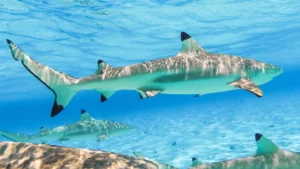 | 1.5–2.2 m (5–7 ft) | Moderate | Coastal Persian Gulf and Gulf of Oman; the commonest large shark landedFast, nervous, seen on Kish reefs and in every fish market. Rarely troubles swimmers. |
| Spot-tail SharkCarcharhinus sorrah | 1.2–1.6 m (4–5 ft) | Low | Shallow Gulf waters over sand and rubbleA mainstay of the Hormozgan fishery, recognised by the black tip on the lower tail lobe. Harmless. |
Whitecheek SharkCarcharhinus dussumieri | 0.8–1 m (2.5–3.3 ft) | Low | Inshore Persian Gulf, muddy and sandy bottomsSmall, abundant, and one of the most frequently landed sharks in the Gulf. No danger to people. |
Milk SharkRhizoprionodon acutus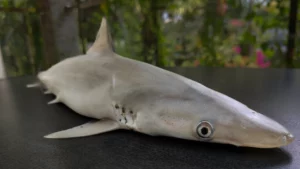 | 0.9–1.1 m (3–3.5 ft) | Low | Shallow coasts and mangrove creeks on both seasSlender, big-eyed and completely harmless; juveniles crowd the Qeshm mangroves. |
Grey Sharpnose SharkRhizoprionodon oligolinx | 0.6–0.8 m (2–2.6 ft) | Low | Inshore Persian GulfTiny and common; easily confused with the milk shark at landing sites. |
| Sliteye SharkLoxodon macrorhinus | 0.7–0.9 m (2.3–3 ft) | Low | Clear coastal water of the Gulf of Oman and eastern GulfNamed for the notch at the rear of its eye. Harmless; a regular in trawl catches. |
| Arabian CarpetsharkChiloscyllium arabicum | 0.6–0.8 m (2–2.6 ft) | Low | Coral heads, rubble and mangrove roots throughout the Persian GulfFound only in the Gulf region. A bottom-dweller that rests under ledges by day; divers on Kish see it often. |
Grey Bamboo SharkChiloscyllium griseum | 0.6–0.8 m (2–2.6 ft) | Low | Gulf of Oman coast and eastern Persian GulfThe carpetshark's plainer cousin. Placid, nocturnal, harmless. |
Bull SharkCarcharhinus leucas | 2.2–3.2 m (7–10 ft) | High | Northern Gulf river mouths; historically the Karun and Shatt al-ArabThe species behind every identified Iranian attack. Ranged 420 km up the Karun in the 1950s; not confirmed in the river for decades. |
Tiger SharkGaleocerdo cuvier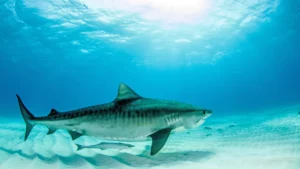 | 3–4.5 m (10–15 ft) | High | Deeper Gulf waters and the Gulf of OmanRecorded in fishery landings on both coasts. Never implicated in an Iranian incident. |
Pigeye SharkCarcharhinus amboinensis | 2–2.5 m (7–8 ft) | Moderate | Turbid coastal water of the northern GulfLooks almost identical to the bull shark but stays in salt water. Occasionally landed. |
Sandbar SharkCarcharhinus plumbeus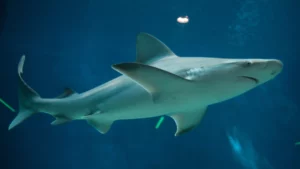 | 1.8–2.4 m (6–8 ft) | Low | Persian Gulf and Gulf of Oman over sandy bottomsTall-finned and slow to mature; a common fishery species. Very few bites on record worldwide. |
Spinner SharkCarcharhinus brevipinna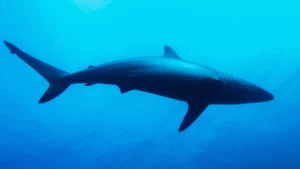 | 2–2.5 m (7–8 ft) | Moderate | Coastal waters on both seas, chasing sardine schoolsLeaps and spins when feeding. Minor bites elsewhere; none in Iran. |
Smoothtooth Blacktip SharkCarcharhinus leiodon | 1–1.3 m (3.3–4.3 ft) | Low | Northern Gulf and Gulf of Oman, rareLost to science for 100 years until it reappeared in a Kuwait fish market in 2008. Endangered. |
Sicklefin Lemon SharkNegaprion acutidens | 2.5–3 m (8–10 ft) | Low | Reefs and sand flats around Kish and QeshmThe Indo-Pacific lemon shark. Slow and easily approached by divers. |
Tawny Nurse SharkNebrius ferrugineus | 2.5–3.2 m (8–10 ft) | Low | Rocky reefs of the eastern Gulf and Gulf of OmanIran's nurse shark. Rests in caves by day; docile unless food is in the water. |
Scalloped Hammerhead SharkSphyrna lewini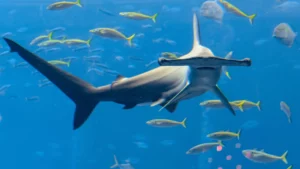 | 2.5–3.5 m (8–12 ft) | Low | Gulf of Oman offshore; juveniles inshore in the GulfHeavily fished at Chabahar and Bandar Abbas. Critically endangered globally. |
Great Hammerhead SharkSphyrna mokarran | 3.5–4.5 m (11–15 ft) | Moderate | Persian Gulf and Gulf of Oman, increasingly rareLanded occasionally on both coasts. Big but with very few incidents worldwide. |
Shortfin Mako SharkIsurus oxyrinchus | 2.5–3.5 m (8–12 ft) | Moderate | Offshore Gulf of OmanA target of the Chabahar longline fleet. Dangerous mainly on the deck of a boat. |
Whale SharkRhincodon typus | 5–10 m (16–33 ft) | Low | Chabahar Bay and the Strait of Hormuz, mostly October–AprilProtected in Iran. Harmless filter feeder; the country's only shark-watching tourism. |
Great White SharkCarcharodon carcharias | 4–6 m (13–20 ft) | n/a | Not recorded in Iranian watersListed only to answer the question. No verified record from the Persian Gulf or Gulf of Oman. |
One species on older Iranian lists needs removing. There is no verified record of a great white shark in the Persian Gulf or the Gulf of Oman; the water is far too warm for most of the year, and the claim that great whites “swim in the Persian Gulf” traces back to misidentified bull sharks and tiger sharks. If a large grey shark is reported off an Iranian beach, it is a bull, a tiger or a big blacktip. Equally, the reef-loving grey reef shark and whitetip reef shark of the Maldives and Red Sea are absent from the Persian Gulf, which has too little coral to support them.
Where to see sharks in Iran
Iran has a small but growing dive scene centred on its Persian Gulf islands, and a wilder coast on the Gulf of Oman where sharks are more a fishing-harbour spectacle than a dive-site one. These are the places that matter for anyone hoping to see a shark.
- Kish Island, HormozganIran's main dive destination, with coral patches, a shipwreck and clear water on the island's south side. Blacktip sharks and the occasional sicklefin lemon shark cruise the reef edge; Arabian carpetsharks hide under ledges. The most reliable place for a tourist to dive with sharks in Iran.
- Qeshm Island and the Hara mangrovesThe largest island in the Persian Gulf, ringed by the Hara mangrove forest, a UNESCO-listed biosphere reserve. The mangrove channels are a nursery for juvenile blacktips, milk sharks and the odd bull shark, best seen by boat at low tide.
- Hengam and Larak islandsSmall islands off Qeshm's south coast, known for dolphins and clear water. Dive operators from Qeshm report spot-tail and blacktip sharks over the rocky reefs, and whale sharks pass the Strait of Hormuz here in spring and autumn.
- Chabahar and the Makran coast, Sistan-BaluchestanIran's Gulf of Oman shore. Whale sharks feed in the bay and along the coast, and the Chabahar and Beris landing sites show what the offshore fleet meets: hammerheads, makos, silkies and oceanic whitetips laid out on the quay.
- Bandar Abbas fish marketNot a dive site, but the single best place to learn which sharks live in the Persian Gulf. Dozens of small sharks, blacktips, spot-tails, milk sharks, whitecheeks and carpetsharks, are landed and sold here every morning.
- Nayband Bay and the Bushehr coastIran's first marine national park, with mangroves and coral patches on the northern Gulf. Juvenile sharks use the creeks; bull sharks are occasionally seen off the river mouths further north toward Khuzestan.
- The Karun River at AhvazIncluded for history rather than sightings. This is where bull sharks bit and killed river bathers between the 1940s and the 1980s. Today the river is dammed, shallow and polluted, and sharks have not been confirmed here for decades.
For an organised shark encounter, Kish is the practical choice: it has the dive centres, the visibility and a reef where blacktips appear on most dives. Serious shark watchers should head for Chabahar between October and April, when whale sharks are most often reported, and spend a morning at a fishing harbour to see the pelagic species that no diver in Iran ever meets underwater.
Best time of year to see sharks in Iran
The Persian Gulf has one of the widest annual temperature swings of any tropical sea, and that drives where the sharks are.
- November to March (winter): the Gulf cools to 18–22 °C, the air is pleasant and the diving season on Kish and Qeshm is at its best, with visibility of 15–20 metres. Large sharks tend to move toward the deeper southern and eastern Gulf and the Strait of Hormuz. This is also the season when whale sharks are most often reported off Chabahar and around Hormuz.
- April to June (spring): water warming through 25–30 °C, and the pupping season for many coastal species. Juvenile blacktips, spot-tails and milk sharks flood the mangrove creeks of Qeshm and Nayband. Fishing landings of small sharks peak.
- July to September (summer): surface water of 32–35 °C and air temperatures over 45 °C on the coast. Diving is uncomfortable and many sharks retreat to deeper, cooler water. On the Gulf of Oman side the southwest monsoon brings upwelling, rougher seas and the big pelagics closer to shore, though few boats go out.
- October: the monsoon eases on the Makran coast and the Gulf begins to cool; the transition month when Chabahar's whale shark sightings start again.
Anyone planning to dive should target December to March; anyone hoping to see whale sharks should combine that with the Chabahar coast rather than the inner Gulf.
Shark attacks in Iran: what the record actually shows
Iran's shark attack record is unlike any other country's. SharkSider's database holds 30 incidents, 13 of them fatal, and all but one took place in fresh or brackish river water in Khuzestan province rather than in the sea. The six most recent are shown below; the full list, updated weekly, is on our shark attacks in Iran page.
- 1987 · Ahvaz, on the Karun River, Khuzestan Province — Foot severedSpecies: Bull shark · not fatal
- 1985 · Ramin, near AhvazFishing — FatalSpecies: Bull shark · fatal
- 1971 · Ahvaz, on the Karun River, Khuzestan Province — SurvivedSpecies not identified · not fatal
- 1971 · Ahvaz, on the Karun River, Khuzestan Province — SurvivedSpecies not identified · not fatal
- 1957 · near Band Misan in Shustar, 420 km from the sea, Karun River — SurvivedSpecies: Bull shark · not fatal
- 1957 · Hesamabad, Karun River — SurvivedSpecies: Bull shark · not fatal
The pattern is unmistakable once the records are read together. The core of the file is the Karun River at Ahvaz, 275 kilometres from the sea, where ten people were bitten between 1941 and 1946 and two more lost an arm in April 1953, one of them swimming near a sewage outlet 400 m from a slaughterhouse. Several were killed while simply standing in ankle-deep water at the river's edge: one man was washing the rear wheels of his ambulance, another slipped from the rocks, others were fishing or bathing. The cluster coincides with the Second World War, when Ahvaz was a major Allied supply base and thousands of troops and workers were using the river, and when a slaughterhouse and sewage outlets discharged into it near the town. A second group of cases sits on the Shatt al-Arab around Abadan and Bashamir in 1945–1949, mostly swimmers with severe leg and arm wounds, and two deaths, in August 1948 and July 1949. The sole coastal entry is a 1948 death at the Bandar Mahshahr sea inlet. Later cases are sparse but reach astonishingly far inland: three attacks on a single day in 1954 at Hesamabad near Shushtar, 420 kilometres from the sea, two of them fatal, two more survivors at Shushtar and Hesamabad in 1957, two survivors at Ahvaz in 1971, a fatal bite on a fisherman at Ramin near Ahvaz in 1985, and one undated record of a severed foot at Ahvaz listed only as “before 1987”.
Where a species is named, it is always the bull shark, and where it is not, the freshwater setting makes the bull shark the only realistic candidate. Nothing in the record involves a swimmer at Kish, Qeshm, Chabahar or any other beach. Since the mid-1980s the Karun has been dammed upstream, heavily abstracted for irrigation and badly polluted, and no shark has been confirmed in the river for decades. The practical advice for visitors is simple: the historic risk was in the rivers, and even there it appears to have ended; on the coast, the standard precautions about murky water, dusk and fish waste are all that is needed.
Is it safe to swim and snorkel in Iran?
On the coast and islands, yes. The Persian Gulf beaches of Kish and Qeshm are shallow and heavily used, and there is no record of a shark bite on a swimmer at any of them. The small coastal sharks that dominate the Gulf, milk sharks, spot-tails, whitecheeks and carpetsharks, are no threat to anyone. Blacktips are quick and nervous and keep their distance. Even the bull sharks that live off the northern river mouths have not been implicated in a coastal incident in the modern record; the one risk worth naming is swimming in the turbid water where the Arvand Rud and Bahmanshir meet the sea near Abadan, which is bull shark habitat and unpleasant for other reasons anyway.
Divers on Kish sometimes meet a sicklefin lemon shark or a blacktip on the reef; both are placid if left alone. On the Gulf of Oman coast the sharks that matter, hammerheads, makos, silkies and oceanic whitetips, live well offshore, and the only people who meet them are fishermen. If you join a whale shark trip off Chabahar, treat the animal as you would anywhere: whale sharks are harmless, but keep three or four metres away, never touch, and slip into the water quietly rather than jumping in beside it.
The rivers are a different question, and the honest answer is that swimming in the Karun at Ahvaz is unwise for reasons of pollution and current long before sharks come into it. Locals do swim there in the summer heat, and there has been no bite since 1985, but the river is not a place to snorkel.
Shark conservation in Iran
Sharks are a working part of Iran's fisheries, not a protected group. Along the Hormozgan and Sistan-Baluchestan coasts, artisanal dhows and small boats land blacktips, spot-tails, milk sharks and hammerheads for meat, and fins have historically been dried and traded through Gulf ports toward East Asia. Fisheries surveys since the 2000s have documented declines in the larger species, particularly hammerheads and the big requiem sharks, and the Persian Gulf as a whole is regarded as one of the most heavily fished shark habitats in the Indian Ocean, shared as it is among eight countries.
There are bright spots. The whale shark is a protected species in Iran under the Department of Environment, and deliberately catching one is illegal. Iran is a party to CITES and to the Convention on Migratory Species, which list the whale shark, the hammerheads, the oceanic whitetip, the makos and the silky shark. The Hara mangrove forests around Qeshm are a UNESCO biosphere reserve and a nursery for several coastal species, and Nayband in Bushehr is a marine national park. Yet the deeper problems are hard to fix: the northern Gulf receives the Karun and the Tigris-Euphrates system, whose flow has been cut by dams in three countries, and warming, desalination brine and oil development all press on a sea that is already at the thermal limit for many fish. Our guide to why sharks are endangered explains why slow-breeding species like these recover so slowly once fished down.
Sharks in neighbouring waters
Iran's sharks are the sharks of the whole Gulf region. Across the water, Qatar hosts the largest known whale shark gathering in the Middle East at the Al Shaheen oil field, Bahrain and Saudi Arabia share the same shallow-Gulf species, and Oman sits on the far side of the Strait of Hormuz with the same Gulf of Oman fauna that Chabahar sees. To the east, Pakistan's Makran coast is the geographic continuation of Sistan-Baluchestan, and India completes the northern Arabian Sea. Our sharks around the world hub lists every country we cover.
Frequently asked questions
Are there sharks in Iran?
Yes. Around 20 species have confirmed records on Iran's Persian Gulf and Gulf of Oman coasts, from small carpetsharks and milk sharks in the mangroves to whale sharks, hammerheads and makos off Chabahar. Blacktip and spot-tail sharks are the commonest species landed by the fishing fleet.
Have there been shark attacks in Iran?
Yes, 30 are in SharkSider's database, 13 of them fatal. Almost all happened between 1941 and 1985 in fresh water on the Karun River around Ahvaz and on the Shatt al-Arab near Abadan, not at sea. Bull sharks were responsible. The last dated case was a fisherman killed near Ahvaz in 1985.
Why did sharks attack people in rivers in Iran?
Bull sharks can live in fresh water and once swam up the Karun as far as Shushtar, 420 kilometres from the sea. During the 1940s Ahvaz was a busy wartime base with thousands of people using a river that also received slaughterhouse and sewage waste, and the sharks were drawn in. Dams and pollution have since ended the migration.
Do great white sharks live in the waters around Iran?
No. There is no verified record of a great white in the Persian Gulf or the Gulf of Oman. The water is too warm for most of the year, and reports of great whites have turned out to be bull sharks or tiger sharks, which are the large grey sharks actually present.
Is it safe to swim in the sea in Iran?
Yes. There is no recorded shark bite on a swimmer at any Iranian beach or island. The common Gulf sharks are small and harmless, and the beaches of Kish and Qeshm are used by thousands of people every year. The only water worth avoiding is the turbid river mouths near Abadan, which is bull shark habitat.
Are there bull sharks in Iran today?
Yes, in the sea. Bull sharks still live along the northern Persian Gulf coast and around the river mouths of Khuzestan. In the Karun itself, where they attacked people between the 1940s and 1980s, none has been confirmed for decades because dams, water abstraction and pollution have cut off the river.
Where can you dive with sharks in Iran?
Kish Island has the country's best dive centres and a reef where blacktip sharks, sicklefin lemon sharks and Arabian carpetsharks are seen regularly. Qeshm and its satellite islands Hengam and Larak add more reef diving, and boat trips from Chabahar on the Gulf of Oman coast look for whale sharks between October and April.
Are there whale sharks in Iran?
Yes. Whale sharks are reported off Chabahar in Sistan-Baluchestan and around the Strait of Hormuz, mostly from October to April, and they are a protected species in Iran. The largest whale shark gathering in the region is across the Gulf at Qatar's Al Shaheen field, and the same animals pass through Iranian water.
When is the best time to see sharks in Iran?
December to March, when the Persian Gulf cools to about 18–22 °C, visibility is best and diving on Kish and Qeshm is comfortable. Whale sharks are most often seen off Chabahar from October to April. Summer water of 32–35 °C pushes many sharks into deeper water and makes diving hard.
Is shark fishing legal in Iran?
Mostly yes. Sharks are landed for meat and fins along the Hormozgan and Sistan-Baluchestan coasts, with hammerheads and blacktips among the main catches. The whale shark is protected and cannot be caught, and Iran's membership of CITES and the Convention on Migratory Species regulates trade in hammerheads, makos, oceanic whitetips and silky sharks.
References

A small team focused on researching sharks and making marine biology easy to understand. Every page is reviewed against current species records and the SharkSider attack database, and updated when new incidents or research appear.
Published January 13, 2023 · Last updated September 21, 2026 · Incident data from the SharkSider attack database (30 records for Iran, 13 fatal).


