
Yes, there are sharks in Hong Kong, 17 species with solid records, and nearly all of them are small. The ones you might actually meet are the whitespotted bamboo shark, which divers find on the reefs of Sai Kung, and the spadenose, milk and grey sharpnose sharks that turn up in fishermen's nets. Tiger sharks are seasonal visitors from the South China Sea, bull sharks are rare in the Pearl River estuary, and whale sharks and hammerheads stray in occasionally.
The safety picture is a tale of two eras. The SharkSider database holds 24 records for Hong Kong between 1945 and 1995, 16 of them fatal, including refugees taken while swimming across Mirs Bay in the 1970s and the cluster of tiger shark attacks at Sai Kung beaches from 1991 to 1995. Since the shark nets went up in 1995 there has not been a single recorded incident.
- Shark species recorded17 with solid records
- ProtectionNo local shark law; trawling banned in Hong Kong waters since 2012; marine parks and one marine reserve
- Most seen from the beachNone; whitespotted bamboo shark on Sai Kung dives
- Signature encounterBamboo sharks on night dives at Hoi Ha Wan; shark nets at 30+ beaches since 1995
- Incidents in the database24 (1945–1995), 16 fatal; none since 1995
- Water temperature16–18 °C in February, 28–30 °C in August

On this page
- Where sharks live in Hong Kong waters
- List of the different types of sharks in Hong Kong
- Where to see sharks in Hong Kong
- Best time of year to see sharks in Hong Kong
- Shark attacks in Hong Kong: what the record actually shows
- Is it safe to swim and snorkel in Hong Kong?
- Shark conservation in Hong Kong
- Sharks in neighbouring waters
- Frequently asked questions
- References
Where sharks live in Hong Kong waters
Hong Kong's sea is split down the middle by the Pearl River. The western waters, around Lantau and the Sha Chau islands, are shallow, brown and half fresh, flooded every summer by the river's outflow. This is the home of the Chinese white dolphin and of the small estuarine sharks, the spadenose shark and the milk shark, that tolerate low salinity and turbid water, and it is the only part of the territory where a bull shark is at all likely. The eastern waters, from Sai Kung and Port Shelter out to Mirs Bay and the Ninepin Islands, are oceanic: clearer, saltier, rockier, with Hong Kong's coral communities, its marine parks and the drop-off into the South China Sea. Every large shark ever recorded in Hong Kong, and every one of the attacks, belongs to this eastern side.
What the territory lacks is scale. The whole of Hong Kong's sea would fit inside a single large Pacific atoll lagoon, its deepest water is barely 40 m, and it sits beside the busiest container port in the world with a population of 7.5 million on its shore. Hong Kong's sharks are therefore visitors from the wider South China Sea, arriving in summer when warm water pushes north, or small resident species that live on the bottom and are rarely seen. Fishermen call any shark sha yu; the bamboo sharks that divers know are gau pei sha, the dog-skin shark, for their rough hide.
The other thing that shapes Hong Kong's shark fauna is a century of intense fishing. Until 2012, pair trawlers dragged nets across almost every square kilometre of the seabed, and the bottom sharks that survived were the ones that could reproduce quickly and hide in rock. The trawling ban has changed that faster than anyone expected: bamboo sharks have become a regular sight for divers at Sai Kung again, and juvenile hammerheads and blacktips have been photographed in the eastern waters for the first time in decades.
List of the different types of sharks in Hong Kong
The table covers sharks with a solid Hong Kong record, drawn from the Agriculture, Fisheries and Conservation Department's species lists, the fish market landings at Aberdeen and Sai Kung, dive club sightings and the incident record. Sizes are typical adults, not the largest ever caught. The risk column concerns swimmers at Hong Kong beaches, which today means swimmers behind a net in most cases; the two species rated high are the ones that actually explain the historical record.
| Species | Adult size | Risk to swimmers | Where in Hong Kong & notes |
|---|---|---|---|
Whitespotted Bamboo SharkChiloscyllium plagiosum | 0.7–0.95 m (2.5–3 ft) | Low | Rocky reefs and coral in the eastern waters; Hoi Ha Wan, Sharp IslandThe shark Hong Kong divers actually see, hunting crabs over the reef at night. Recovering since the trawling ban. |
Slender Bamboo SharkChiloscyllium indicum | 0.5–0.65 m (1.5–2 ft) | Low | Muddy and sandy bottoms, inshoreA thin, spotted bamboo shark taken in trawls and traps. Harmless and rarely seen alive. |
Brownbanded Bamboo SharkChiloscyllium punctatum | 0.9–1.2 m (3–4 ft) | Low | Rocky shores and reefs, eastern Hong KongJuveniles are boldly banded, adults plain brown. Lays eggs in rock crevices; docile. |
Spadenose SharkScoliodon laticaudus | 0.5–0.7 m (1.5–2.5 ft) | Low | Pearl River estuary and inshore waters, common in netsA small estuarine shark at home in brackish water. The commonest shark in Hong Kong landings. |
Milk SharkRhizoprionodon acutus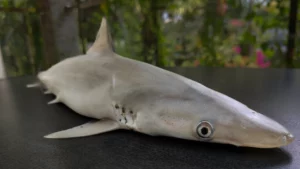 | 0.9–1.1 m (3–3.5 ft) | Low | Shallow coastal waters on both sides of the territorySlim, grey and quick, taken by gillnetters and sold fresh at Aberdeen. Harmless. |
Grey Sharpnose SharkRhizoprionodon oligolinx | 0.6–0.8 m (2–2.5 ft) | Low | Inshore shelf watersA close relative of the milk shark and often confused with it at the market. Feeds on small fish and shrimp. |
| Hardnose SharkCarcharhinus macloti | 0.8–1.1 m (2.5–3.5 ft) | Low | Eastern waters and the outer shelfNamed for the hardened cartilage in its snout. A small requiem shark recorded in South China Sea catches landed in Hong Kong. |
Whitecheek SharkCarcharhinus dussumieri | 0.8–1 m (2.5–3 ft) | Low | Coastal waters, occasional in landingsA metre-long shark with a black-tipped second dorsal fin. Common across the South China Sea; harmless. |
| Spot-tail SharkCarcharhinus sorrah | 1.2–1.6 m (4–5 ft) | Low | Outer eastern waters, summerRecognised by the black tip on the lower tail lobe. A mid-sized reef shark on the fringe of its range here. |
Blacktip SharkCarcharhinus limbatus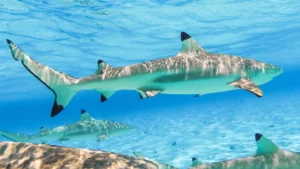 | 1.5–2.5 m (5–8 ft) | Moderate | Eastern waters; juveniles seen off Sai Kung in recent summersA fast, schooling-fish hunter. Young blacktips photographed in Port Shelter since the trawling ban. |
Blacktip Reef SharkCarcharhinus melanopterus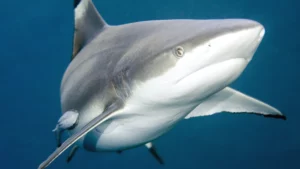 | 1.2–1.6 m (4–5 ft) | Low | Coral areas of the far east, rareHong Kong sits at the northern edge of its range; a few confirmed sightings around the eastern islands. |
Bull SharkCarcharhinus leucas | 2.2–3.2 m (7–11 ft) | High | Pearl River estuary, rare summer visitorThe estuarine shark of the South China coast; suspected in some of the older, unidentified fatalities. Very seldom seen today. |
Tiger SharkGaleocerdo cuvier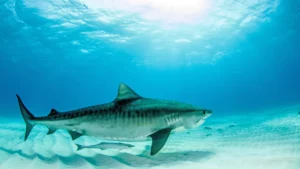 | 3–4.5 m (10–15 ft) | High | Eastern waters in summer; Port Shelter, Silverstrand, Clearwater Bay in the 1990sThe species behind the 1991–1995 deaths, arriving with warm water and drawn to fish farms. No confirmed sighting since the nets went up. |
Scalloped Hammerhead SharkSphyrna lewini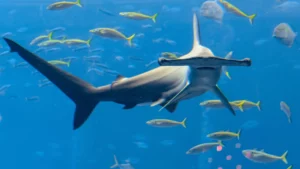 | 2.5–3.5 m (8–12 ft) | Low | Occasional; juveniles recorded in eastern watersPups have been caught and photographed off Sai Kung, hinting that the South China Sea population uses the coast as nursery ground. Critically endangered. |
Whale SharkRhincodon typus | 5–10 m (16–33 ft) | Low | Rare stray around the eastern islands and LammaSeen every few years, and occasionally stranded. Harmless; each sighting makes the news. |
Zebra Bullhead SharkHeterodontus zebra | 0.8–1.2 m (2.5–4 ft) | Low | Rocky bottoms, 50 m and deeper; trawl recordsA striped, pig-snouted bottom shark that crushes shellfish. Slow, harmless and rarely seen by divers. |
Spotless Smooth-houndMustelus griseus | 0.8–1 m (2.5–3 ft) | Low | Sandy shelf bottoms, in the cooler monthsA plain grey houndshark of the Chinese coast, taken in trawls and sold at Aberdeen. Eats crabs; no threat to anyone. |
Three sharks on older Hong Kong lists do not have a confirmed local record and have been left out. The grey reef shark is a clear-water coral reef animal of the Pacific and Indian Oceans with no reliable sighting in Hong Kong's turbid, shallow sea; the great hammerhead is a tropical species whose South China Sea records are all far to the south; and the silky shark is an open-ocean species that stays in deep water well beyond the territory's limits. The great white shark has never been recorded in Hong Kong either, though the 1995 attacks were briefly blamed on one in the local press. The sharks people see most often in Hong Kong are, in truth, in Sheung Wan's dried seafood shops and at Ocean Park.
Where to see sharks in Hong Kong
Hong Kong is not a shark-diving destination, but it has a serious local diving community, seven marine parks, a marine reserve and the best public aquarium in the region. These are the places with a real chance of a shark, and the places where the history happened.
- Hoi Ha Wan Marine Park, Sai KungA sheltered bay in the north of the Sai Kung peninsula with Hong Kong's best coral cover, protected since 1996. Night dives here are the classic way to find whitespotted bamboo sharks hunting over the coral, and it is also where the database records a 1979 fatality, back when the bay was a freedom-swimming landing point rather than a park.
- Sharp Island and Port ShelterThe dive sites closest to Sai Kung town, with rocky reefs in 5–15 m. Bamboo sharks under boulders, occasional juvenile blacktips, and the fish-farm rafts that attract larger predators in summer. Port Shelter is the stretch of water where the 1991 tiger shark was first seen.
- Basalt Island and Bluff Island, Ung Kong groupHexagonal volcanic columns that are part of the UNESCO Global Geopark, with the clearest and deepest water in the territory. Divers find bamboo sharks and sometimes hammerhead pups; Basalt Island is also where a swimmer was killed in June 1991, one of the three deaths that year.
- Tung Ping Chau Marine Park, Mirs BayThe most remote island in Hong Kong, on the far side of Mirs Bay, with sedimentary rock shelves and coral gardens. Mirs Bay is the water that freedom swimmers crossed from the mainland in the 1970s and where nine of the database's entries were recorded; today it is the best snorkelling in the territory.
- Clearwater Bay and Silverstrand beachesThe gazetted beaches of the Sai Kung coast where the 1990s attacks took place: Silverstrand in 1991 and 1993, Sheung Sze Wan in 1993 and 1995, Clearwater Bay First Beach in June 1995. All are now enclosed by shark nets during the swimming season and have been incident-free since.
- Cape D'Aguilar Marine ReserveHong Kong's only marine reserve, on the southern tip of Hong Kong Island, run with the University of Hong Kong's Swire Institute of Marine Science. No swimming or fishing is allowed, which is why the rocky shore and its bamboo sharks and rays are in the best condition anywhere on the island.
- Ocean Park, AberdeenThe Grand Aquarium and the Shark Mystique exhibit keep hammerheads, zebra sharks, bamboo sharks and rays in a walk-through tunnel. The one place in Hong Kong where a shark sighting is certain, and the park's conservation foundation funds shark research across Asia.
- Aberdeen and Sai Kung fish markets; Des Voeux Road WestThe wholesale market at Aberdeen and the seafood stalls on the Sai Kung waterfront show what local nets bring up: spadenose, milk and bamboo sharks by the basket. Des Voeux Road West in Sheung Wan, the dried seafood street, is where the global fin trade is on open display.
For a live shark in the wild, join a Sai Kung dive club on a night dive at Hoi Ha Wan or Sharp Island between May and October, when the water is warm and the bamboo sharks are active. For the big species you would have to be very lucky; a hammerhead or whale shark sighting in Hong Kong makes the newspapers.
Best time of year to see sharks in Hong Kong
Hong Kong is subtropical, with a real winter, and its shark records follow the thermometer closely.
- May to September: the sea warms from 24 °C to 28–30 °C, the south-west monsoon brings rain, and the Pearl River plume cuts visibility in the western and central waters. This is when the large visitors arrive: all but one of the 24 incidents in the database happened between late May and September (the exception is a November 1971 Mirs Bay crossing), most of them in June and August, and the tiger sharks of the 1990s were all summer animals. It is also the best season for diving in the east, where the water stays clearer, and the shark nets are in place on the gazetted beaches.
- October and November: the finest months, with warm water, north-easterly winds clearing the sky and the best visibility of the year at Basalt Island and Tung Ping Chau. Bamboo sharks are still active; the pelagic visitors have gone.
- December to April: the sea cools to 16–18 °C by February, too cold for tiger and bull sharks, and the bottom sharks become sluggish. Nets are lifted for maintenance at many beaches. Whale shark sightings, rare in any case, have come in the shoulder months rather than mid-winter.
Typhoons from July to September can close the beaches and shut down diving for days; check the Observatory's signals before planning anything on the water.
Shark attacks in Hong Kong: what the record actually shows
For a place with so little sea, Hong Kong has a long incident list, and it repays careful reading because the cases fall into three distinct chapters. SharkSider keeps the full record on the shark attacks in Hong Kong page. The database holds 24 records between 1945 and 1995, 16 of them marked as fatal, plus two further entries that almost certainly involved deaths: a swimmer missing and believed taken at Silverstrand in late May 1993, and a 1973 freedom-swimming case in which one of two men was killed. The six latest entries are rendered below; the attacks page carries all 24:
- 1995 · First Beach, Clearwater BaySwimming — Fatal, left leg & forearm severedSpecies: Though to involve a tiger shark · fatal
- 1995 · Sheung Sze Wan Beach, New TerritoriesSwimming — Fatal, right thigh bitten, femur exposed Species: 1.8 m to 2.1 m [6' to 7'] shark · fatal
- 1995 · Sai Kung Beach, New TerritoriesDiving — Fatal, right leg severed, left leg lacerated Species not identified · fatal
- 1994Playing volleyball with friends — Both legs laceratedSpecies: Tiger shark said to be 5 to 7 m [16.5' to 23'] · not fatal
- 1993 · Silverstrand, New TerritoriesSwimming — FatalSpecies not identified · fatal
- 1993 · Sheung Sz Wan, New TerritoriesSwimming — FatalSpecies not identified · fatal
The first chapter is the post-war years: a bather killed at Tweed Beach in September 1945, weeks after the Japanese surrender, and two deaths in 1954, one at Junk Bay and one of a man bathing beside a ship. The second is Mirs Bay in the 1970s, and it has nothing to do with tourism. Between 1971 and 1979 the database records nine cases labelled freedom swimming: people from Guangdong crossing Mirs Bay by night to reach Hong Kong during the last years of the Cultural Revolution, often on inner tubes, in warm water, for hours. Four of those swimmers died, two more lost a leg to amputation, and the others survived with bites to arms and feet. A separate 1976 entry records a sailor from the freighter Chieh Lee killed after the ship sank in a typhoon 200 miles out. These are shipwreck-style incidents, not beach attacks, and they ended when the border crossings did.
The third chapter is Sai Kung, 1991 to 1995, and it is the one Hong Kong remembers. In June 1991 a tiger shark of more than three metres killed a swimmer at Silverstrand, and within the month a fisherman at Sai Kung and a person at Basalt Island, 9 km from Silverstrand, were dead too. June 1993 brought two more deaths at Sheung Sze Wan and Silverstrand and a swimmer who vanished. In 1994 a man playing in the shallows had both legs lacerated. Then, between 31 May and 13 June 1995, three people died in two weeks: a diver at Sai Kung, a swimmer at Sheung Sze Wan and a swimmer at Clearwater Bay First Beach, whose leg and forearm were severed by what was thought to be a tiger shark. The government's response was the Great Shark Hunt, in which the Australian shark hunter Vic Hislop was brought in with baited lines, and, more usefully, the installation of shark prevention nets at the gazetted beaches. No shark was ever caught and identified as the culprit. The nets, on the other hand, have coincided with thirty years without a single recorded incident, which is as clear a result as shark management ever produces. The standard advice still stands for anyone swimming outside a net in summer: stay out of the water at dawn and dusk, avoid the fish-farm rafts, and leave the sea if a large shark is reported.
Is it safe to swim and snorkel in Hong Kong?
At the gazetted beaches, yes, and more so than almost anywhere in the region. The Leisure and Cultural Services Department maintains shark prevention nets at more than thirty beaches from Repulse Bay to Clearwater Bay, the nets are inspected by divers through the swimming season, and lifeguards close the beach and raise the shark warning flag if anything is reported. The record since 1995 speaks for itself. Outside the nets, at the unofficial beaches of the Sai Kung peninsula such as Tai Long Wan and Ham Tin, the risk is small but not zero in summer, and it is worth remembering that the 1990s tiger sharks were attracted by the fish-farm rafts of Port Shelter, which are still there.
For snorkellers and divers the sharks of Hong Kong are a pleasure rather than a worry. A whitespotted bamboo shark is under a metre long, lives under rocks, and will let you photograph it at arm's length before it wriggles away; the slender and brownbanded bamboo sharks behave the same way. None of the bamboo sharks has ever been known to bite an unprovoked person, though they will clamp onto a hand that grabs them. If you meet a whale shark, which has happened a handful of times off the eastern islands, treat it as a gift: it is harmless, so keep a few metres away and let it pass. The one place to be genuinely careful is the Pearl River estuary in summer, where visibility is nil and a bull shark, though rare, is possible; nobody swims there for pleasure anyway.
Shark conservation in Hong Kong
Hong Kong's importance to sharks has almost nothing to do with the sharks in its own water. The city has been the world's largest shark fin trading hub for a century, importing dried fins from more than a hundred countries and re-exporting most of them to mainland China. At its peak it handled around half of the global trade; even now it accounts for something like 40 per cent. The fins come from oceanic species, blue sharks, silky sharks, hammerheads, threshers and makos, that never enter Hong Kong waters, which makes the city's customs officers and its CITES enforcement, under the Protection of Endangered Species of Animals and Plants Ordinance, one of the most important shark conservation frontlines on Earth. Record seizures, including a 26-tonne haul from Ecuador in 2020, show both the scale of the trade and the effort to police it.
At home the picture has improved. The ban on trawling in Hong Kong waters from the end of 2012 is the single biggest gift the city has given its own sharks, and the recovery of bamboo sharks on Sai Kung reefs is the visible result. Marine parks at Hoi Ha Wan, Yan Chau Tong, Tung Ping Chau and elsewhere, and the Cape D'Aguilar reserve, protect the rocky habitat the small species need. The government stopped serving shark fin at official banquets in 2013, Cathay Pacific stopped carrying fins as cargo in 2016, and consumption at Hong Kong weddings has fallen steadily as younger diners refuse it. What Hong Kong still lacks is any law protecting a shark for its own sake inside its waters; a tiger shark that swam into Port Shelter tomorrow could legally be caught and sold. Our page on why sharks are endangered explains how the fin trade drives that decline worldwide.
Sharks in neighbouring waters
Hong Kong's sharks are a small sample of the South China Sea's. China surrounds it on three sides, with the same estuarine species in the Pearl River and the larger fauna of Hainan to the south-west; Vietnam and the Philippines share the open South China Sea and its tiger sharks, hammerheads and whale sharks. To the north-east, Japan and South Korea have the temperate species that Hong Kong's winter water is just too warm for, and to the south Malaysia has the coral reef sharks that Hong Kong's turbid sea cannot support. Every other coast we have written up is gathered on sharks around the world.
Frequently asked questions
Are there sharks in Hong Kong?
Yes, 17 species with solid records, but nearly all are small bottom-dwellers. Whitespotted bamboo sharks live on the reefs of Sai Kung, spadenose and milk sharks are common in fishermen's nets, and larger species such as tiger sharks, bull sharks, hammerheads and whale sharks are rare visitors from the South China Sea.
Have there been shark attacks in Hong Kong?
Yes. The SharkSider database lists 24 incidents from 1945 to 1995, 16 of them fatal. Nine involved refugees swimming across Mirs Bay in the 1970s, and the most notorious were the tiger shark attacks at Sai Kung and Clearwater Bay between 1991 and 1995, which killed at least eight people. There has been no recorded incident since 1995.
Is it safe to swim in Hong Kong?
At the gazetted beaches, yes. Shark prevention nets have enclosed more than thirty of them since the 1995 attacks, lifeguards inspect the nets through the swimming season, and no shark bite has been recorded anywhere in Hong Kong for thirty years. Outside the nets in summer, avoid dawn, dusk and the fish farms of Port Shelter.
Why were there shark attacks in Hong Kong in the 1990s?
Tiger sharks moved into the bays of Sai Kung during the warm summers of 1991, 1993 and 1995, most likely attracted by the fish-farm rafts in Port Shelter, and found beaches full of swimmers. After three deaths in two weeks in June 1995 the government hired the Australian shark hunter Vic Hislop and installed nets at the gazetted beaches. The attacks stopped.
Are there great white sharks in Hong Kong?
No. No great white has ever been confirmed in Hong Kong waters, although the 1995 attacks were briefly blamed on one. The evidence from the fatal bites pointed to tiger sharks, which visit the eastern waters in summer. Hong Kong's sea is too shallow, warm and turbid for white sharks.
Do the shark nets in Hong Kong still exist?
Yes. The Leisure and Cultural Services Department maintains shark prevention nets at more than thirty gazetted beaches, including Repulse Bay, Shek O, Clearwater Bay and Silverstrand, during the swimming season. Divers check them regularly, and beaches are closed with a shark warning flag whenever a sighting is reported.
Can you swim with whale sharks in Hong Kong?
No. Whale sharks are only occasional strays in Hong Kong, seen every few years around the eastern islands or Lamma and sometimes found stranded. There is no aggregation and no tour. The nearest reliable whale shark encounters are in the Philippines and southern China.
What is the most common shark in Hong Kong?
In the fishermen's catch, the spadenose shark, a small estuarine species of the Pearl River side. For divers, the whitespotted bamboo shark, which has become a regular sight on night dives at Hoi Ha Wan and Sharp Island since bottom trawling was banned in 2012.
Is shark fin legal in Hong Kong?
Yes, apart from species listed under CITES, which need permits. Hong Kong is the world's largest shark fin trading hub, handling around 40 per cent of the global trade through the dried seafood shops of Sheung Wan. The government stopped serving fin at official functions in 2013 and customs seizures of illegal fins have reached record levels.
When is the best time to see sharks in Hong Kong?
May to November, when the water is 24–30 °C and the bamboo sharks are active on the eastern reefs; October and November combine warm water with the year's best visibility. Winter water of 16–18 °C sends the bottom sharks into hiding and keeps the tropical visitors away.
References

A small team focused on researching sharks and making marine biology easy to understand. Every page is reviewed against current species records and the SharkSider attack database, and updated when new incidents or research appear.
Published January 12, 2023 · Last updated September 21, 2026 · Incident data from the SharkSider attack database (24 records for Hong Kong, 16 fatal).


