
Yes, there are sharks in Haiti, though fewer near the beaches than in neighbouring countries. Around 14 species have a reliable record in Haitian waters. Closest to shore are the nurse shark, the Caribbean reef shark, the Caribbean sharpnose shark and the lemon shark; further out, tiger, bull and blacktip sharks patrol the Gulf of Gonâve and the north coast, and the deep Windward Passage carries silky sharks, oceanic whitetips, hammerheads and the occasional whale shark.
Haiti's safety record is about as short as it gets. The SharkSider database holds just three entries for Haiti, and only one of them was a genuine attack: a fatal bite on a man who dived into a school of baitfish at Cap-Haïtien in 1921. An 1896 case of a wader losing a leg near Cap-Haïtien lies before the 1900 cut-off used in the summary below, and the 1907 Les Cayes record is marked invalid because no shark was involved. Nothing has been recorded in more than a century.
- Shark species recorded14 confirmed
- Protection statusNo shark law; first marine parks 2013–2014
- Most seen from the beachNurse shark
- Signature encounterReef sharks on the Arcadins walls
- Incidents in the database3 (1896–1921), 1 fatal
- Water temperature26–29 °C year-round

On this page
- Where sharks live in Haiti
- List of the different types of sharks in Haiti
- Where to see sharks in Haiti
- Best time of year to see sharks in Haiti
- Shark attacks in Haiti: what the record actually shows
- Is it safe to swim and snorkel in Haiti?
- Shark conservation in Haiti
- Sharks in neighbouring waters
- Frequently asked questions
- References
Where sharks live in Haiti
Haiti occupies the western third of Hispaniola, and its coast is shaped like a claw: two long peninsulas, the northern one ending at Môle-Saint-Nicolas and the southern Tiburon Peninsula (the name literally means shark in Spanish) ending at Les Irois, with the wide, shallow Gulf of Gonâve between them. Île de la Gonâve sits in the middle of the gulf, the Arcadins islets lie off the Côte des Arcadins north of Port-au-Prince, Île-à-Vache guards Les Cayes on the south coast, and Île de la Tortue, the old pirate island, faces the north coast. Together they give the country roughly 1,770 kilometres of coastline, more than any other island in the Caribbean Sea except Cuba.
The water itself changes fast. The Gulf of Gonâve is shallow, warm and muddy at the mouth of the Artibonite River, which is the sort of place bull sharks and lemon sharks favour and where Caribbean sharpnose sharks are netted by the thousand. West of Môle-Saint-Nicolas the seabed drops into the Windward Passage, the 80-kilometre strait between Haiti and Cuba that is over 1,700 metres deep and funnels Atlantic water into the Caribbean. That is the highway for silky sharks, oceanic whitetips, scalloped hammerheads and the tuna and billfish they follow. On the north coast, the reefs around Cap-Haïtien, Labadee and the Baie de l'Acul are fringing reefs on a narrow shelf, with deep water close in.
What Haiti lacks is fish. Reef surveys over the past fifteen years have found some of the lowest fish biomass in the Caribbean, the result of an artisanal fleet of tens of thousands of small boats with no closed seasons and almost no enforcement. Sharks, which need big prey and time to grow, are the first to disappear from a reef fished that hard. The species list below is therefore honest rather than generous: these are the sharks with records here, not the sharks a healthy Hispaniola reef would hold.
List of the different types of sharks in Haiti
The table gives every species with a solid record in Haitian waters, from the reef sharks of Labadee to the pelagic species of the Windward Passage. Sizes are ordinary adults. The risk column is for swimmers and snorkellers. Haitians call sharks reken in Creole, and fishermen lump the small inshore species together as ti reken.
| Species | Adult size | Risk to swimmers | Where in Haiti & notes |
|---|---|---|---|
Nurse SharkGinglymostoma cirratum | 2–3 m (7–10 ft) | Low | Reefs and seagrass at Labadee, the Arcadins, Île-à-Vache and JacmelThe shark snorkellers see in Haiti, usually asleep under a ledge. Harmless unless grabbed. |
Caribbean Reef SharkCarcharhinus perezi | 1.5–2.5 m (5–8 ft) | Low | Outer walls of the Arcadins and the north coast drop-offsScarce compared with the Bahamas or Cuba because of overfishing. Keeps its distance from divers. |
Lemon SharkNegaprion brevirostris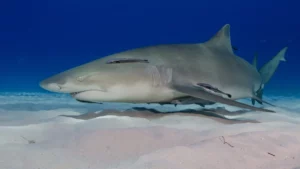 | 2.4–3 m (8–10 ft) | Low | Mangroves and seagrass of the Gulf of Gonâve, Île-à-Vache and the Three BaysJuveniles use the mangrove nurseries; adults are seen by fishermen rather than divers. |
| Caribbean Sharpnose SharkRhizoprionodon porosus | 0.8–1.1 m (2.6–3.6 ft) | Low | Shallow bays and the Gulf of Gonâve; the commonest shark in Haitian fish marketsSmall, abundant and netted in large numbers. Never a danger to people. |
Blacknose SharkCarcharhinus acronotus | 1.2–1.4 m (4–4.5 ft) | Low | Sandy and seagrass bottoms around the coastAnother small gillnet species with a dark smudge on the snout. Harmless. |
Bonnethead SharkSphyrna tiburo | 0.8–1.2 m (2.6–4 ft) | Low | Shallow mud and seagrass of the Gulf of GonâveThe smallest hammerhead, a crab and shrimp eater. Caught in artisanal nets. |
Blacktip SharkCarcharhinus limbatus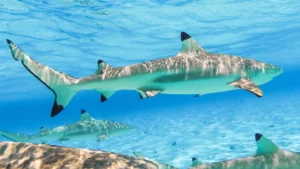 | 1.5–2.4 m (5–8 ft) | Moderate | Outer reefs of the north coast, Île de la Tortue and JacmelFast, schooling hunter of the reef edge. Responsible for minor surf-zone bites elsewhere in its range; none recorded in Haiti. |
Tiger SharkGaleocerdo cuvier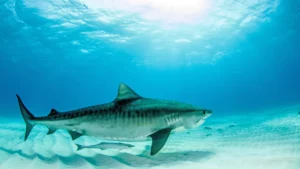 | 3–4.5 m (10–15 ft) | High | Deep water off the north coast and the Windward Passage; occasionally landed by fishermenThe likeliest species behind the 1896 and 1921 Cap-Haïtien cases, though neither record names it. |
Bull SharkCarcharhinus leucas | 2.2–3.2 m (7–10 ft) | High | Murky water of the Gulf of Gonâve and the Artibonite estuaryTolerates brackish and fresh water. Stay out of river-mouth water after rain. |
Great Hammerhead SharkSphyrna mokarran | 3.5–4.5 m (11–15 ft) | Moderate | Drop-offs of the north coast and the Windward Passage; rareSolitary, critically endangered and occasionally landed on handlines. Not a threat to swimmers in practice. |
Scalloped Hammerhead SharkSphyrna lewini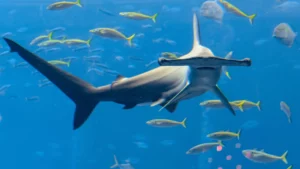 | 2.5–3.5 m (8–11 ft) | Low | Deep water of the Windward Passage and off Île de la TortueSchooling pelagic hammerhead, shy of people. Critically endangered. |
Silky SharkCarcharhinus falciformis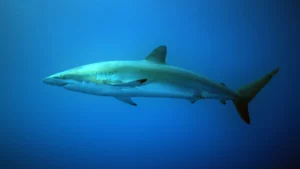 | 2–3 m (7–10 ft) | Moderate | Open water of the Windward Passage, following tunaThe pelagic shark most often hooked by sport-fishing boats off Môle-Saint-Nicolas. |
| Oceanic Whitetip SharkCarcharhinus longimanus | 2–3 m (7–10 ft) | High | Deep oceanic water beyond the shelf; never inshoreBold and persistent around anything floating in open sea; the danger is to people adrift after a wreck, never to bathers. |
Whale SharkRhincodon typus | 6–10 m (20–33 ft) | Low | Occasional passer-by in the Windward Passage and along the north coastHarmless filter feeder with no predictable season in Haiti. |
Basking SharkCetorhinus maximus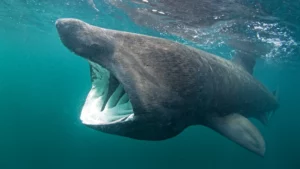 | 6–8 m (20–26 ft) | n/a | Unconfirmed: passes the deep Caribbean at depth in winter, no Haitian sightingListed on the earlier version of this page as a Haitian species. Cold-water animal; no verified surface record here. |
The older version of this page listed the basking shark as a Haitian species. That was a stretch: basking sharks are cold-temperate animals, and although tagging has shown that some winter in the deep Caribbean at several hundred metres, there is no verified surface sighting or landing from Haiti, so we list it as unconfirmed. The great white shark is likewise absent; the nearest reliable records are far to the north off the United States. Blacktip reef sharks, grey reef sharks and whitetip reef sharks are Indo-Pacific species that do not occur in the Atlantic, and the Caribbean reef shark takes their role here.
Where to see sharks in Haiti
Haiti's dive industry is small and centred on the Côte des Arcadins, and shark sightings are a bonus rather than the point of a dive. These are the places with the best chance.
- Les Arcadins, Côte des ArcadinsThree sandy islets an hour north of Port-au-Prince with wall dives dropping past 40 m. The reefs are the most intact on the west coast, and nurse sharks and the occasional Caribbean reef shark are seen along the walls. The main base for the country's dive operators.
- Labadee and the Baie de l'Acul (north coast)The private cruise-ship beach near Cap-Haïtien and the bay beside it. Snorkellers on the fringing reef sometimes see nurse sharks resting under coral heads; the reef sharks keep to the drop-off outside the bay.
- Île-à-Vache, off Les CayesA green island of fishing villages with shallow reefs and seagrass on its northern side. Nurse sharks, juvenile lemon sharks and Caribbean sharpnose sharks in the shallows; local fishermen know the sites better than any dive guide.
- Île de la Tortue (Tortuga)The steep northern side of the old buccaneer island faces open Atlantic water. Blacktips, hammerheads and the occasional tiger shark are reported by fishermen working the drop-off; access is by fishing boat from Port-de-Paix.
- The Windward Passage, off Môle-Saint-NicolasDeep blue water between Haiti and Cuba where silky sharks, oceanic whitetips and scalloped hammerheads follow the tuna. Sport-fishing boats see them; there is no organised diving.
- Île de la Gonâve and the Gulf of GonâveThe largest island and the warm, shallow gulf around it. Bull sharks and lemon sharks use the mangroves and the murky water off the Artibonite delta; small sharpnose and bonnethead sharks are the daily catch of the gulf's net fishers.
- Baie de Jacmel (south coast)Jacmel's bay has snorkelling reefs close to town and deeper water offshore. Nurse sharks inshore; blacktips along the outer reef in the calmer months.
Manage expectations. A week of diving on the Arcadins may produce one or two nurse sharks and, with luck, a Caribbean reef shark on the wall. If seeing sharks is the goal of the trip, the reefs of the Dominican Republic, the Bahamas or Cuba's Jardines de la Reina are a far better bet; Haiti is for divers who value empty sites and untouched walls over guaranteed big animals.
Best time of year to see sharks in Haiti
Haiti is tropical and the sea barely changes temperature, so the calendar is about weather rather than migration.
- December to April: the dry season and the diving season. Trade winds are steady, the Arcadins walls have their best visibility (20–30 m), and the north coast is at its calmest outside the December cold fronts. Reef shark sightings are most likely now simply because more people are in the water.
- May to November: the rainy season, with the hurricane peak from August to October. Runoff from the Artibonite clouds the Gulf of Gonâve, which is when bull sharks push closest inshore, and rough seas close the north coast for days at a time.
- Whale sharks: no predictable season. Individuals pass through the Windward Passage and along the north coast at any time of year, and sightings are recorded by fishermen rather than dive boats.
- Pelagic sharks: silky sharks and oceanic whitetips follow the tuna runs in the Windward Passage, which peak in the spring and early summer.
Water temperature holds between 26 °C in February and 29 °C in September. A 3 mm wetsuit or a rash guard is all you need.
Shark attacks in Haiti: what the record actually shows
Haiti has one of the shortest incident lists of any Caribbean country. The SharkSider database holds three entries: a fatal attack at Cap-Haïtien in 1921, an 1896 case near Cap-Haïtien that pre-dates the 1900 cut-off used in the summary line, and a 1907 record from Les Cayes that is marked invalid because the man who fell overboard was never touched by a shark. The summary line and the cards therefore show two records with one death. The complete record is kept on our shark attacks in Haiti page. These are the most recent recorded incidents:
- 1921 · Marine Dock, Cape HaitienDived into a school of baitfish — Fatal, large wound on thighSpecies: Comrades saw shark's tail appear about 5' away · fatal
- 1907 · Aux Cayes (now Les Cayes), Tiburon PeninsulaReached out to disentangle rope & fell overboard — No attack, no injurySpecies: Invalid · not fatal
The one genuine attack tells a familiar story. On 22 August 1921 a man dived from the marine dock at Cap-Haïtien straight into a school of baitfish and was bitten on the thigh; his companions saw the shark's tail break the surface a metre or two away, and he died of the wound. Jumping into a feeding frenzy at a harbour is exactly the scenario that produces bites in countries with far more sharks, and the 1896 case, a wader losing a leg below the knee off the same town, likely involved the same kind of large coastal shark, a tiger or bull, hunting in the shallows. The 1907 entry is a fisherman at Les Cayes who reached out to untangle a rope, fell in and climbed back aboard unharmed; it stays in the archive only because the press of the day reported it as a shark scare.
Nothing has been recorded since. That is partly because there are fewer sharks near Haitian beaches than a century ago, and partly because incidents involving local fishermen are rarely reported to the international files. Either way, the numbers are what they are: one fatal attack in over 125 years of records, and none at all in the modern era of cruise tourism at Labadee. For comparison, the Dominican Republic next door has recorded a handful of cases in the same period, and Cuba considerably more. Should the unlikely ever happen, our guide to surviving a shark attack explains what to do.
Is it safe to swim and snorkel in Haiti?
Sharks are not the problem. The beaches at Labadee, Côte des Arcadins, Jacmel and Île-à-Vache have never produced a recorded shark bite, and the species snorkellers actually meet, nurse sharks and small sharpnose sharks, are harmless unless handled. A nurse shark asleep under a ledge will stay asleep if you leave it alone; the few nurse shark bites on record worldwide involve people grabbing a tail or a fin.
The sensible precautions are the same as anywhere in the Caribbean, with one Haitian twist. Do not swim near fishing activity: Haiti's artisanal fishers clean fish and discard bycatch at the water's edge in many villages, and that is the one situation, the 1921 baitfish case, that has actually killed someone here. Avoid the murky water off river mouths in the Gulf of Gonâve after rain, where bull sharks feed. Stay out of the water at dusk and after dark, and if you are spearfishing on the Arcadins walls, get your catch into the boat rather than towing it on a stringer. Cruise passengers at Labadee swim inside a marked, patrolled area on a reef shelf where reef sharks are a rare sight.
Divers who do meet a Caribbean reef shark on a wall should enjoy it; the species is curious but keeps its distance in unbaited water. Whale sharks are harmless filter feeders, and if one turns up beside a fishing boat off the north coast the only rule is to keep clear of the tail and not to touch it.
Shark conservation in Haiti
Haiti has no law that specifically protects sharks, no catch limits and no finning regulation, and its fisheries ministry has few boats and fewer inspectors. Sharks are landed whenever they are caught by the country's tens of thousands of artisanal fishers, mostly small sharpnose, blacknose and bonnethead sharks in gillnets, with the occasional tiger, hammerhead or bull shark on a handline. The meat is eaten locally and dried fins have historically found their way to export. Because the fleet targets everything on the reef, from parrotfish to conch, the wider problem is a food web with the middle removed: reef surveys have found that reef fish biomass in Haiti is among the lowest measured anywhere in the Caribbean, and where there are no big fish there are no sharks to eat them.
There has been progress on paper. In 2013 Haiti declared its first marine protected areas along the south coast, at Port-Salut, Aquin and Saint-Louis-du-Sud, and in 2014 it created the Three Bays National Park (Parc National des Trois Baies) around Caracol, Fort-Liberté and the Baie de l'Acul on the north coast, covering mangroves, seagrass and reef that serve as nursery habitat for lemon and nurse sharks. International NGOs have helped train local fishers as reef monitors and pushed for gear restrictions and no-take zones, and the Arcadins reefs have been proposed for protection. Enforcement remains the missing piece, and the political and economic crisis of recent years has set the work back. The wider context is in our page on why sharks are endangered.
Sharks in neighbouring waters
Haiti shares Hispaniola with the Dominican Republic, whose east-coast reefs and the Silver Bank hold the same species in healthier numbers. Across the Windward Passage, Cuba's Jardines de la Reina has the Caribbean's densest reef shark population. To the south-west, Jamaica and the Cayman Islands share the Cayman Trench with Haiti's southern coast, Puerto Rico lies to the east beyond Hispaniola, and the Bahamas to the north is the region's shark sanctuary. Every country we cover is on our sharks around the world page.
Frequently asked questions
Are there sharks in Haiti?
Yes, about 14 species with a reliable record. Nurse sharks, Caribbean reef sharks, lemon sharks and small sharpnose sharks live on the reefs and in the bays; tiger, bull and blacktip sharks patrol deeper coastal water; and silky sharks, oceanic whitetips, hammerheads and the occasional whale shark use the deep Windward Passage between Haiti and Cuba.
Have there been shark attacks in Haiti?
Almost none. The SharkSider database has three entries: a fatal bite on a man who dived into a school of baitfish at Cap-Haïtien in 1921, an 1896 wading injury near the same town, and a 1907 case at Les Cayes that involved no shark at all. No incident has been recorded in Haiti for over a century.
Is it safe to swim in Haiti?
Sharks are not a reason to stay dry. No bather has been bitten in modern times at Labadee, the Côte des Arcadins, Jacmel or Île-à-Vache. The sensible rules are to stay away from fishing activity and fish cleaning, avoid murky river-mouth water in the Gulf of Gonâve after rain, and keep out of the sea at dusk.
Are there sharks at Labadee?
Sharks live in the waters around Labadee, as they do everywhere in the Caribbean, but they are rarely seen in the swimming and snorkelling areas. Nurse sharks sometimes rest on the fringing reef, and Caribbean reef sharks stay on the drop-off outside the bay. The swimming zones are marked and patrolled, and no incident has ever been recorded there.
Are there great white sharks in Haiti?
No. There is no confirmed great white record from Haiti or anywhere in the Greater Antilles. The species prefers cooler water and its nearest regular range is the north-east coast of the United States. Large sharks reported by Haitian fishermen are tiger sharks, bull sharks or hammerheads.
Are there basking sharks in Haiti?
Not in any verified sense. Older pages, including an earlier version of this one, listed the basking shark for Haiti, but it is a cold-water species. Satellite tagging shows some basking sharks winter in the deep Caribbean hundreds of metres down, yet no surface sighting or landing has been documented in Haitian waters.
Where is the best place to dive with sharks in Haiti?
The walls of Les Arcadins on the Côte des Arcadins, an hour north of Port-au-Prince, are the country's main dive area and the best chance of a nurse shark or a Caribbean reef shark. Île-à-Vache and the north coast near Cap-Haïtien are alternatives. Sightings are a bonus, not a guarantee, because Haiti's reefs are heavily fished.
What is the best time of year to visit Haiti for diving?
December to April, the dry season, when the trade winds are steady, the seas are calmest and visibility on the Arcadins walls reaches 20 to 30 metres. The rainy season from May to November brings hurricanes from August to October and muddy runoff in the Gulf of Gonâve. Water stays at 26 to 29 °C all year.
Are sharks protected in Haiti?
Not specifically. Haiti has no shark fishing law, no finning ban and very little enforcement, and sharks are landed by artisanal fishers whenever they are caught. The first marine protected areas were declared on the south coast in 2013 and the Three Bays National Park on the north coast in 2014, which protect nursery mangroves and reefs on paper.
References

A small team focused on researching sharks and making marine biology easy to understand. Every page is reviewed against current species records and the SharkSider attack database, and updated when new incidents or research appear.
Published January 12, 2023 · Last updated September 21, 2026 · Incident data from the SharkSider attack database (2 records for Haiti, 1 fatal).


