
Yes, there are sharks in Guatemala, 23 species across its two coasts, and almost all of the encounters happen far offshore or on a fisherman's line. On the Pacific the commonest are the Pacific sharpnose shark, the scalloped hammerhead, the silky shark and the blacktip; the sailfish charters out of Iztapa add whale sharks and oceanic whitetips. On the Caribbean the nurse shark, the lemon shark and the bull shark are the regulars.
For swimmers the record is as clean as it gets. The SharkSider database holds a single Guatemalan entry, from December 1962, when a light aircraft went into the sea with four people aboard and one body was later found to have been scavenged by a shark; investigators could not confirm any shark involvement before death. No swimmer, surfer or diver has ever been recorded as bitten in Guatemalan waters.
- Shark species recorded23 across both coasts
- ProtectionCentral American finning ban since 2011; national shark action plan; Punta de Manabique and Sipacate-Naranjo reserves
- Most seen from the beachNone regularly; Pacific sharpnose sharks in the Champerico landings
- Signature encounterWhale sharks and silky sharks on sailfish charters off Iztapa, December–May
- Incidents in the database1 (1962 air crash, shark role unconfirmed); none on a swimmer
- Water temperature27–30 °C on both coasts, year-round

On this page
- Where sharks live in Guatemalan waters
- List of the different types of sharks in Guatemala
- Where to see sharks in Guatemala
- Best time of year to see sharks in Guatemala
- Shark attacks in Guatemala: what the record actually shows
- Is it safe to swim and snorkel in Guatemala?
- Shark conservation in Guatemala
- Sharks in neighbouring waters
- Frequently asked questions
- References
Where sharks live in Guatemalan waters
The Pacific coast is the one that matters for numbers. It runs in a nearly straight line from the Mexican border at Ocós to the Salvadoran border at Las Lisas, backed by mangrove lagoons and the long Chiquimulilla Canal, with no reefs, no headlands and no islands. The shelf is broad and shallow, floored with volcanic sand and mud carried down by rivers from the highlands, and it is exactly the kind of warm, murky, food-rich shallows that requiem sharks and hammerheads use as nurseries. Beyond the shelf the seabed falls into the Middle America Trench, 6,000 m deep and less than 100 km from the beach. Upwelling along that edge supports the sailfish, dorado and tuna that make Iztapa a world billfish capital, and the same water carries silky sharks, oceanic whitetips, makos and threshers, with whale sharks arriving in the dry season to feed on the plankton and fish spawn.
The Caribbean coast is a different world. It is essentially one bay, Amatique Bay, tucked in behind Belize and Honduras, shallow and brackish, fed by the Río Dulce and fringed with mangrove and seagrass. The reef sharks of the Belize Barrier Reef stop at the Sapodilla Cayes just across the border; what Guatemala gets is the soft-bottom community, nurse sharks and lemon sharks in the mangroves of Punta de Manabique, smalltail and sharpnose sharks in the fishermen's nets at Livingston and Puerto Barrios, and the bull shark, which uses the Río Dulce as a highway into Lake Izabal, the largest lake in the country, 40 km inland. In Guatemalan Spanish a shark is a tiburón, small shark meat is sold as cazón, and a hammerhead is a cornuda.
List of the different types of sharks in Guatemala
The table covers every shark with a solid record in Guatemalan waters, on either coast, based on the landings of the artisanal fleets at Champerico, Sipacate, Puerto San José and Las Lisas, the Caribbean catches at Livingston, longline observer data and offshore charter logs. Lengths are those of ordinary adults rather than trophy fish. The risk column concerns swimmers on Guatemalan beaches, and for most of the species below the honest answer is that a swimmer will never see them.
| Species | Adult size | Risk to swimmers | Where in Guatemala & notes |
|---|---|---|---|
Scalloped Hammerhead SharkSphyrna lewini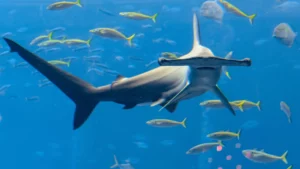 | 2.5–3.5 m (8–12 ft) | Low | Pacific shelf; pups born in the shallows off Sipacate and ChampericoThe cornuda of the Pacific fleets and the species the Guatemalan shelf matters most for. Critically endangered. |
Smooth Hammerhead SharkSphyrna zygaena | 2.5–3.5 m (8–12 ft) | Low | Pacific offshore, cooler upwelling waterSeen around bait balls on the sailfish grounds. Told from the scalloped hammerhead by its smooth, unnotched head. |
Great Hammerhead SharkSphyrna mokarran | 3.5–4.5 m (11–15 ft) | Moderate | Both coasts, uncommon; longline and Caribbean recordsThe largest hammerhead, hunting rays over sand. Rare enough in Guatemala that a landing is news at the port. |
Bonnethead SharkSphyrna tiburo | 0.8–1.2 m (2.5–4 ft) | Low | Caribbean seagrass and mangrove shallowsA small, shovel-headed hammerhead that eats crabs and, uniquely among sharks, seagrass. Harmless. |
Scoophead SharkSphyrna media | 1–1.5 m (3–5 ft) | Low | Pacific inshore shelf; artisanal gillnet catchA little-known small hammerhead of the eastern Pacific, landed at Champerico and rarely identified correctly. |
Bull SharkCarcharhinus leucas | 2.2–3.2 m (7–11 ft) | High | Amatique Bay, the Río Dulce and Lake Izabal; Pacific river mouthsThe only shark in Guatemala that enters fresh water. No recorded bite in the country, but the species to respect at Livingston. |
Tiger SharkGaleocerdo cuvier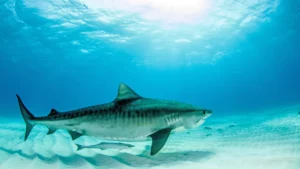 | 3–4.5 m (10–15 ft) | High | Offshore on both coasts, occasionalRecorded on Pacific longlines and off Punta de Manabique. Never implicated in a Guatemalan incident. |
Silky SharkCarcharhinus falciformis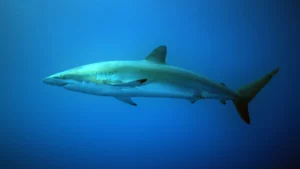 | 2–3 m (7–10 ft) | Moderate | Pacific shelf edge with tuna and sailfish; the main longline catchThe shark most often seen alive off Guatemala, following charter boats and stealing hooked fish. |
Blacktip SharkCarcharhinus limbatus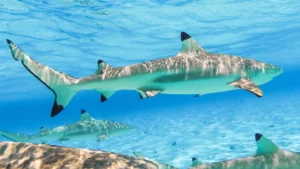 | 1.5–2.5 m (5–8 ft) | Moderate | Both coasts; juveniles in the Pacific surf zoneFast, leaping hunter of schooling fish. Landed at every Pacific port; pups use the murky shelf as a nursery. |
Pacific Sharpnose SharkRhizoprionodon longurio | 0.9–1.1 m (3–3.5 ft) | Low | Pacific inshore waters; the commonest shark in the landingsThe staple of the cazón trade, caught by the thousand in gillnets. Harmless. |
Whitenose SharkNasolamia velox | 1.2–1.5 m (4–5 ft) | Low | Pacific shelf, 15–200 mAn eastern Pacific endemic with a pale snout and close-set nostrils, regular in the Champerico catch. |
Pacific Nurse SharkGinglymostoma unami | 2–2.8 m (7–9 ft) | Low | Pacific rocky patches and estuary mouthsOnly recognised as a separate species in 2015. Sluggish bottom-dweller; bites only when grabbed. |
Nurse SharkGinglymostoma cirratum | 2.2–3 m (7–10 ft) | Low | Caribbean mangrove channels, Punta de ManabiqueThe Atlantic nurse shark, resting in the lagoon channels by day. The Caribbean species most likely to be seen by a snorkeller. |
Lemon SharkNegaprion brevirostris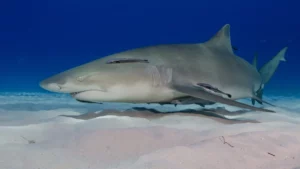 | 2.4–3 m (8–10 ft) | Low | Caribbean mangroves and seagrass; juveniles in Amatique BayYellow-brown and slow, using the mangrove roots as a nursery. Placid unless cornered. |
| Smalltail SharkCarcharhinus porosus | 0.9–1.2 m (3–4 ft) | Low | Caribbean muddy shallows and river mouthsA small requiem shark of turbid Central American coasts, netted at Livingston. Critically endangered. |
| Caribbean Sharpnose SharkRhizoprionodon porosus | 0.8–1.1 m (2.5–3.5 ft) | Low | Amatique Bay shallowsThe Caribbean counterpart of the Pacific sharpnose, sold in the same way. Harmless. |
| Oceanic Whitetip SharkCarcharhinus longimanus | 2–3 m (7–10 ft) | High | Pacific open ocean beyond the shelfA bold, slow-cruising pelagic shark that investigates anything floating. Seen from charter boats far offshore; critically endangered. |
Blue SharkPrionace glauca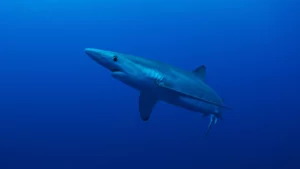 | 2–3 m (7–10 ft) | Low | Pacific offshore in the cooler upwelling monthsAn oceanic wanderer taken on longlines during the dry season. Never inshore. |
Shortfin Mako SharkIsurus oxyrinchus | 2–3 m (7–10 ft) | Moderate | Pacific shelf edge, with the billfishHooked by sailfish charters and longliners. Dangerous when hooked, otherwise never near a beach. |
Pelagic Thresher SharkAlopias pelagicus | 2.5–3.5 m (8–12 ft) incl. tail | Low | Pacific offshore; a targeted longline speciesThe most frequently landed thresher on the Guatemalan Pacific, recognised by its scythe-like tail. Harmless. |
Bigeye Thresher SharkAlopias superciliosus | 3–4 m (10–13 ft) incl. tail | Low | Deep Pacific water, taken on night longlinesIts saucer eyes are made for hunting at depth in near-darkness. Regular in the Las Lisas landings. |
Common Thresher SharkAlopias vulpinus | 3–4.5 m (10–15 ft) incl. tail | Low | Pacific offshore, less common than the other two threshersPrefers cooler water and is the rarest thresher here. Stuns fish with its tail. |
Whale SharkRhincodon typus | 5–10 m (16–33 ft) | Low | Pacific shelf edge off Iztapa, December–May; occasional in Amatique BayThe tiburón ballena, met by sailfish boats most weeks in the dry season. Harmless filter feeder; endangered. |
Two species from older Guatemalan lists have been removed. The porbeagle is a cold-water shark of the North Atlantic and the Southern Ocean and has no business in a sea that never drops below 26 °C; the thresher records from the Guatemalan Pacific belong to the pelagic, bigeye and common threshers, not to any porbeagle. The great white shark has no confirmed Guatemalan record either: white sharks that leave Mexico's Guadalupe Island head north or west into the open Pacific, not south along the Central American shelf, and Guatemalan water is too warm for them to linger. The reef sharks that people associate with the Caribbean, the Caribbean reef shark above all, live on the Belize reef and are not part of the Guatemalan fauna.
Where to see sharks in Guatemala
Nobody comes to Guatemala for sharks, and there is no dive operator that sells a shark trip. What the country does have is one of the world's great offshore fishing grounds, two mangrove reserves with resident sharks, and fishing ports where the species on this page are landed every morning. These are the places to look.
- Iztapa and Puerto San José, offshoreThe sailfish capital of the world, with charter boats running 20–60 km out to the edge of the shelf. Silky sharks follow the boats and take hooked fish, scalloped and smooth hammerheads appear around the bait balls, and from December to May whale sharks feed at the surface along the same drop-off.
- ChampericoThe main Pacific fishing port, with a long pier and an artisanal fleet that lands Pacific sharpnose sharks, blacktips, juvenile hammerheads and silky sharks. The morning landings on the beach are the easiest place in Guatemala to see a dozen shark species in an hour.
- Sipacate-Naranjo National ParkA mangrove estuary and beach reserve west of Puerto San José. The shallow canals and the surf zone outside them are nursery ground for scalloped hammerhead pups and juvenile blacktips, and the fishing village of Sipacate lands newborn hammerheads every rainy season, a sign of how important this shelf is for the species.
- Monterrico and the Chiquimulilla CanalThe country's best-known beach, black volcanic sand with a heavy shore break, backed by the Monterrico Multiple-Use Reserve and its sea turtle hatchery. Small sharks and rays are caught by canal fishermen; the surf is dangerous for rip currents, never for sharks.
- Las Lisas and the eastern Pacific coastA barrier island fishing community near the Salvadoran border, where the shelf is at its widest. Longliners from here target sharks directly, mainly silky, thresher and hammerhead, and the beach landings show the species mix of the deeper water.
- Punta de Manabique Wildlife Refuge, CaribbeanA peninsula of mangrove, lagoon and seagrass at the mouth of Amatique Bay, protected since 2005. Nurse sharks rest in the channels, juvenile lemon sharks use the mangrove roots, and bull sharks patrol the deeper water off the point. Reached by boat from Puerto Barrios or Livingston.
- Río Dulce and Lake IzabalThe river that connects the Caribbean to Guatemala's largest lake, through a limestone gorge and the Río Dulce National Park. Bull sharks have been caught in the lake and at the river mouth at Livingston for as long as anyone has fished there; they are the only sharks in the country that live in fresh water.
- Livingston and Amatique BayThe Garifuna town at the river mouth, reachable only by water. Its fishermen net smalltail sharks, Caribbean sharpnose sharks and the occasional blacktip in the bay, and the fish stalls sell them as cazón. Whale sharks stray into the outer bay from the Belize aggregation in spring.
If you want to see a large shark alive, book a sailfish charter from Iztapa between December and April: silky sharks are close to guaranteed, hammerheads are common, and whale shark encounters are frequent enough that the better boats carry snorkelling gear. For the Caribbean species, a guided boat into the Punta de Manabique lagoons is the only practical route.
Best time of year to see sharks in Guatemala
Guatemala's coasts are tropical, with sea temperatures that hardly move, so the seasons are about rain, wind and food rather than warmth.
- November to April (Pacific dry season): calm seas, clear offshore water and the peak of the sailfish run. Silky sharks, hammerheads and makos gather on the bait along the shelf edge, and whale sharks are seen from December to May, most reliably in February and March. The best months for anyone hoping to meet a shark from a boat.
- May to October (Pacific rainy season): afternoon storms, rivers running brown and the shallow shelf turning turbid. This is when the hammerheads and blacktips give birth in the shallows, and when the artisanal fleets at Sipacate and Champerico land the most newborn sharks. Sea temperature stays at 28–30 °C; surf and rip currents are at their strongest.
- Caribbean, March to June: the fish-spawning season that draws whale sharks to Gladden Spit in Belize also brings occasional whale sharks into the outer Amatique Bay, and it is the calmest window for boat trips to Punta de Manabique.
- Caribbean, September to January: the wettest months on the Izabal coast, with the Río Dulce in flood. Bull shark records from the river and lake cluster in this period.
Water temperature is 27–30 °C on both coasts in every month, which is why the cold-water sharks of North America and the Southern Ocean never appear.
Shark attacks in Guatemala: what the record actually shows
Guatemala has one of the emptiest incident records of any country with two coastlines, and SharkSider keeps it on the shark attacks in Guatemala page. The database contains one entry, dated 14 December 1962: an aircraft carrying two men and two women crashed into the sea, all four almost certainly died in the crash, and one woman's body was afterwards scavenged by a shark. The record states plainly that shark involvement before death was never confirmed, which is why the database lists it as non-fatal in shark terms. Here is the entry as it appears in the record (the attacks page carries the full detail):
- 1962Air Disaster — It is probable that all onboard (2 men & 2 women) died when the plane crashed into the sea & her body was scavenged by a sharkSpecies: Shark involvement prior to death was not confirmed · not fatal
That is the whole list. In more than a century of records there is no Guatemalan case involving a swimmer, a surfer, a diver or a fisherman, on either coast. The reasons are partly geographic and partly social. The Pacific beaches have a violent shore break and strong rips that keep most people in knee-deep water, and the sharks of that shelf are mostly small sharpnose sharks and juveniles that are fished hard; the big species live at the shelf edge, an hour or more offshore. The Caribbean coast has few beaches and little swimming; the bull sharks of the Río Dulce share the river with fishermen and boat traffic and have never been recorded biting anyone.
None of that makes the sharks harmless. Bull sharks in a murky river mouth and silky sharks around a boat with hooked fish are exactly the situations in which bites happen elsewhere in the world, and the usual advice applies: do not swim at Livingston or in the lower Río Dulce at dusk, do not get in the water next to a charter boat that is fighting or cleaning fish, and if you snorkel with a whale shark offshore, do it from a stationary boat with a crew member watching the water around you.
Is it safe to swim and snorkel in Guatemala?
Sharks are not the reason to be careful on a Guatemalan beach; the ocean is. Monterrico, Sipacate and the other Pacific beaches face the open swell of the eastern Pacific with no reef to break it, and drownings from rip currents happen every year. Swim where the local lifeguards swim, never alone, and never at dusk. The sharks in that surf zone are Pacific sharpnose sharks under a metre long and juvenile blacktips and hammerheads that flee from anything larger than themselves.
On the Caribbean side the water is warm, calm and brown, and the species that matter is the bull shark. It is present in Amatique Bay, at the Livingston river mouth and up the Río Dulce, and it hunts in low visibility, so the sensible rule is not to swim in the river channel or off the fishing docks, especially after heavy rain when the water is at its murkiest. The lagoons of Punta de Manabique are fine for snorkelling over the seagrass with a guide; the nurse sharks you might see there will stay on the bottom, and the juvenile lemon sharks will keep their distance. If you get the chance to swim with a whale shark off Iztapa, enter the water quietly, stay beside the animal rather than in front of it, and keep well away from the tail. Whale sharks are harmless, but a 10 m fish does not steer around people.
Shark conservation in Guatemala
Guatemala's sharks are managed as a fishery first and a wildlife concern second. Shark fishing is legal and important along the Pacific coast, where the artisanal fleets at Champerico, Sipacate, Puerto San José and Las Lisas land silky sharks, hammerheads, threshers and thousands of small sharpnose sharks for the domestic cazón market. The main legal protections come from the regional level: as a member of the Central American fisheries organisation OSPESCA, Guatemala has enforced the 2011 regional rule that sharks must be landed with their fins attached, ending the practice of finning at sea, and it has adopted a national plan of action for sharks that requires catch reporting and sets size limits. The hammerheads, silky shark, threshers, oceanic whitetip and whale shark are all listed under CITES, which regulates any export of their fins or meat.
The pressure is nonetheless heavy. The Pacific shelf is a nursery for scalloped hammerheads, a species now critically endangered worldwide, and the same shallow water is trawled for shrimp, which kills newborn sharks as bycatch, and gillnetted by the artisanal fleet, which lands them. Protected areas help at the edges: Sipacate-Naranjo and Monterrico protect mangrove that shelters young sharks, Punta de Manabique protects the Caribbean nursery, and the Río Dulce National Park covers the bull shark's route inland. What would help most is a closed season for the hammerhead pupping months and better data, both of which Guatemalan fisheries scientists have been pushing for. Our page on why sharks are endangered explains why slow-breeding species like hammerheads cannot absorb this kind of fishing for long.
Sharks in neighbouring waters
Guatemala shares each of its coasts with a neighbour that has more sharks. On the Pacific, Mexico to the north-west has the Chiapas shark fisheries and, much further on, the great whites of Guadalupe, while El Salvador to the south-east lands the same silky sharks and hammerheads from the same shelf. On the Caribbean, Belize has the barrier reef, the whale sharks of Gladden Spit and the Caribbean reef sharks that stop at the Guatemalan border, and Honduras has the Bay Islands with their reef sharks and whale sharks. Further south, Nicaragua is famous for the bull sharks of Lake Nicaragua, and Costa Rica for the hammerhead schools of Cocos Island. Our index of sharks around the world covers every one of them.
Frequently asked questions
Are there sharks in Guatemala?
Yes, on both coasts. Twenty-three species have solid records. The Pacific shelf holds Pacific sharpnose sharks, scalloped hammerheads, blacktips and silky sharks, with whale sharks, makos and threshers at the shelf edge; the Caribbean side has nurse sharks, lemon sharks and bull sharks, which swim up the Río Dulce into Lake Izabal.
Have there been shark attacks in Guatemala?
Not on a swimmer. The SharkSider database holds one Guatemalan entry, from December 1962, when an aircraft crashed into the sea with four people aboard and one body was later scavenged by a shark; investigators could not confirm any shark involvement before death. No bite on a swimmer, surfer, diver or fisherman has ever been recorded in the country.
Is it safe to swim in Guatemala?
Where sharks are concerned, yes. The danger on Guatemala's Pacific beaches is the surf and the rip currents, which cause drownings every year, not the small sharpnose sharks and juvenile blacktips that live in the surf zone. On the Caribbean coast, avoid swimming in the Río Dulce channel or off the Livingston docks, where bull sharks hunt in murky water.
Are there bull sharks in Lake Izabal?
Yes. Bull sharks travel up the Río Dulce from Amatique Bay into Lake Izabal, about 40 km inland, and have been caught in the lake and at the river mouth at Livingston for generations. They are the only sharks in Guatemala that live in fresh water, and none has ever been recorded biting a person there.
Can you see whale sharks in Guatemala?
Yes, from boats. Whale sharks feed along the edge of the Pacific shelf off Iztapa and Puerto San José from December to May, with February and March the most reliable months, and sailfish charters meet them regularly. There is no dedicated whale shark tour, so ask the charter to carry snorkelling gear.
Are there great white sharks in Guatemala?
No confirmed record exists. Guatemalan water stays at 27–30 °C all year, far warmer than white sharks prefer, and the white sharks of Mexico's Guadalupe Island travel north and west into the open Pacific rather than south along the Central American shelf.
What is the most common shark in Guatemala?
The Pacific sharpnose shark, a metre-long species caught by the thousand in gillnets and sold as cazón in every market from Champerico to Guatemala City. Among the larger sharks, the silky shark is the one most often seen alive, following the sailfish boats offshore.
When is the best time to see sharks in Guatemala?
December to April, the Pacific dry season, when calm seas and the sailfish run bring silky sharks, hammerheads and whale sharks to the shelf edge off Iztapa. The rainy season from May to October is when hammerheads and blacktips give birth in the shallows, but the water is murky and the surf is rough.
Is shark fishing legal in Guatemala?
Yes. Shark fishing is an important artisanal fishery on the Pacific coast, landing silky sharks, hammerheads, threshers and sharpnose sharks. Guatemala enforces the Central American ban on finning at sea, requiring fins to be landed attached, and hammerheads, threshers, silky, oceanic whitetip and whale sharks are CITES-listed, which controls their export.
Are there hammerhead sharks in Guatemala?
Yes, five species: scalloped, smooth, great, bonnethead and scoophead. The shallow Pacific shelf is a nursery for the critically endangered scalloped hammerhead, and newborn pups are landed at Sipacate and Champerico every rainy season. Adults are seen around bait balls on the offshore sailfish grounds.
References

A small team focused on researching sharks and making marine biology easy to understand. Every page is reviewed against current species records and the SharkSider attack database, and updated when new incidents or research appear.
Published January 20, 2023 · Last updated September 21, 2026 · Incident data from the SharkSider attack database (1 records for Guatemala, 0 fatal).


