
Yes, there are sharks in Guam: 17 species with solid records around the island. The ones you are most likely to see are the blacktip reef shark, the whitetip reef shark, the grey reef shark and the tawny nurse shark, with silvertips, scalloped hammerheads and tiger sharks on the deep walls and banks offshore.
The safety picture is straightforward. The SharkSider database lists four incidents for Guam between 1960 and 2013, one of them fatal, and three of the four involved spearfishing. The single death, in April 2013, is recorded simply as fatal, with no activity, location or species noted; the 2010 case at Achang Reef was a free-diving spearfisher who drowned and was bitten afterwards. No case in the record involves a snorkeller or bather in the Tumon Bay lagoon.
- Shark species recorded17 with solid records
- ProtectionFive marine preserves (1997); shark fin trade banned 2011; US federal shark law
- Most seen from the beachBlacktip reef shark in Tumon Bay
- Signature encounterGrey reef and silvertip sharks at Blue Hole and the offshore banks
- Incidents in the database4 (1960–2013), 1 fatal (2013)
- Water temperature27–30 °C year-round

On this page
- Why Guam has sharks on its doorstep
- List of the different types of sharks in Guam
- Where to see sharks in Guam
- Best time of year to see sharks in Guam
- Shark attacks in Guam: what the record actually shows
- Is it safe to swim and snorkel with sharks in Guam?
- Shark conservation in Guam
- Sharks in neighbouring waters
- Frequently asked questions
- References
Why Guam has sharks on its doorstep
Guam's geography is the reason its sharks are so close to shore. The island is the tip of a volcanic ridge rising from the Mariana Trench, and the reef that fringes it is narrow: at Tumon Bay the lagoon is a few hundred metres wide, and at Orote Point or Ritidian the reef flat ends in a wall that falls hundreds of metres within a short swim of the beach. Inshore lagoon sharks and deep-slope sharks therefore share the same square kilometre. A snorkeller on the Tumon reef flat is watching juvenile blacktip reef sharks in knee-deep water; a diver two kilometres away at Blue Hole is on a wall where grey reef sharks, silvertips and, at dawn, scalloped hammerheads rise out of the blue.
Currents do the rest. The North Equatorial Current pushes warm, clear Pacific water against the eastern side of the island, and upwelling along the drop-offs and on the offshore banks (Galvez Bank, Santa Rosa Reef and the 11-Mile Reef south-west of the island) concentrates baitfish, tuna and the sharks that follow them. Water temperature never leaves the 27–30 °C band, so there is no season in which the reef sharks leave and none in which cold-water species arrive.
The other half of the story is less flattering. Guam has been settled, fished and garrisoned for centuries, and it is the most populated island in Micronesia. Reef shark numbers around the island are a fraction of what surveys find on the uninhabited northern Marianas or on remote atolls: NOAA's Pacific reef surveys have consistently ranked Guam among the lowest in the region for grey reef and whitetip reef shark density. The five marine preserves created in 1997 have helped, and blacktips are again a daily sight in Tumon Bay, but a Guam reef is not a Palau reef. The sharks are here; there are simply fewer of them than the habitat could hold.
List of the different types of sharks in Guam
Every species below has a solid Guam record, from reef surveys, the offshore fishery and verified sightings, and leaves out the ones that appear on older lists without evidence. Lengths are typical adults. Risk is rated for a swimmer or snorkeller inside the reef, not a spearfisher on the outer wall with a stringer of fish, which is a different situation and the one behind most of Guam's record. Note the names: the nurse shark of the Marianas is the tawny nurse shark, not the Atlantic species, and the “leopard shark” on the old version of this page was a mistake explained below the table.
| Species | Adult size | Risk to swimmers | Where in Guam & notes |
|---|---|---|---|
Blacktip Reef SharkCarcharhinus melanopterus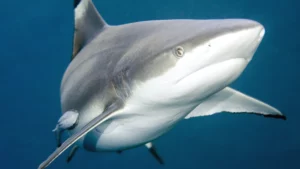 | 1.2–1.6 m (4–5 ft) | Low | Tumon Bay, Piti, Achang and every reef flat, in knee-deep water at high tideThe shark every visitor sees. Shy; bites elsewhere are minor nips to the ankles of waders. |
Whitetip Reef SharkTriaenodon obesus | 1.2–1.6 m (4–5 ft) | Low | Under the Apra Harbor wrecks and on ledges at Blue HoleSleeps by day, hunts in packs at night. Tolerates divers at close range. |
Grey Reef SharkCarcharhinus amblyrhynchos | 1.5–2.5 m (5–8 ft) | Moderate | Outer walls at Blue Hole, Pati Point and the offshore banksGuam's signature wall shark, far scarcer here than on the northern Marianas. Has a territorial warning display; back off when you see it. |
Tawny Nurse SharkNebrius ferrugineus | 2.5–3.2 m (8–10 ft) | Low | Caves and ledges in Apra Harbor and on the southern reefsThe Pacific nurse shark, not the Atlantic species. Docile unless food is in the water. |
Silvertip SharkCarcharhinus albimarginatus | 2–2.5 m (7–8 ft) | Moderate | Deep drop-offs at Pati Point, Ritidian and Galvez BankA big, confident shark with white-edged fins that approaches divers to look. Curious, not aggressive. |
Galapagos SharkCarcharhinus galapagensis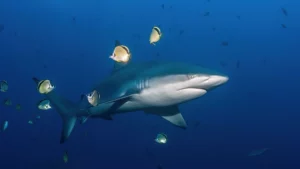 | 2.5–3 m (8–10 ft) | Moderate | Offshore banks and seamounts around the MarianasAn oceanic-island shark that takes the place of the bull shark in fishermen's stories. Bold around boats; rarely inside the reef. |
Tiger SharkGaleocerdo cuvier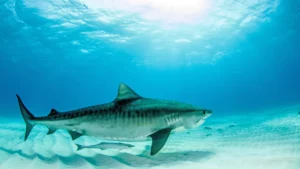 | 3–4.5 m (10–15 ft) | High | Outer slopes, Pati Point and the harbour mouth at nightSeen a few times a year by divers and fishermen. Not identified in any Guam incident, but the species to respect. |
Scalloped Hammerhead SharkSphyrna lewini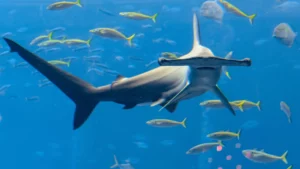 | 2.5–3.5 m (8–12 ft) | Low | Blue Hole at dawn; Galvez Bank and 11-Mile ReefCritically endangered and protected under the US Endangered Species Act. Schools pass in the blue; timid with divers. |
Silky SharkCarcharhinus falciformis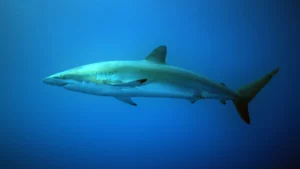 | 2–3 m (7–10 ft) | Moderate | Open water over the offshore banks, with tunaFollows the skipjack and yellowfin schools; the main shark bycatch of the surrounding longline fisheries. |
| Oceanic Whitetip SharkCarcharhinus longimanus | 2–3 m (7–10 ft) | High | Deep blue water beyond the banksThreatened under the Endangered Species Act. A danger to people adrift in open ocean, never to reef swimmers. |
Blacktip SharkCarcharhinus limbatus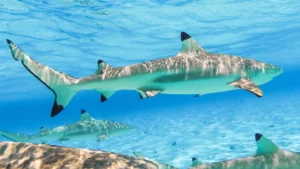 | 1.5–2.5 m (5–8 ft) | Moderate | Outer reef and channels, more offshore than the blacktip reef sharkThe four-foot shark speared at Ritidian in 2009 was recorded as this species. Fast, jumping fish-hunter; no black tip on the anal fin. |
Whale SharkRhincodon typus | 6–10 m (20–33 ft) | Low | Occasional on the offshore banks and along the western drop-offSeen a few times a year, not seasonally. Filter feeder; harmless. |
Pelagic Thresher SharkAlopias pelagicus | 2.5–3.5 m (8–12 ft) including tail | Low | Deep water off the banks; occasional on the walls at dawnThe upper tail lobe is as long as the rest of the shark and is used to stun small fish. Endangered; harmless. |
Shortfin Mako SharkIsurus oxyrinchus | 2.5–3.5 m (8–11 ft) | Moderate | Offshore, hooked by sport-fishing boats trolling for marlinFast open-ocean predator that never comes inside the reef. |
Blue SharkPrionace glauca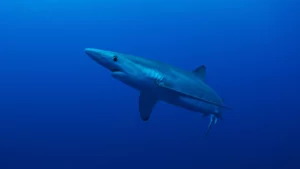 | 2–3 m (7–10 ft) | Moderate | Deep oceanic water far from the islandA longline bycatch species in the surrounding Pacific; not part of Guam's reef life. |
Bluntnose Sixgill SharkHexanchus griseus | 3–4.5 m (10–15 ft) | Low | Deep slopes below 300 m off the islandA primitive deep-sea shark filmed by research submersibles in the Marianas. Never within reach of divers. |
| Shortspine SpurdogSqualus mitsukurii | 0.7–1 m (2.5–3.5 ft) | Low | Deep slopes and seamounts of the MarianasA small deep-water dogfish taken on bottom longlines. Two mildly venomous spines; irrelevant to swimmers. |
Three sharks have been dropped from the old list. The leopard shark is a Californian species that has never been recorded in the tropical Pacific; if the name was meant to cover the Indo-Pacific zebra shark, which dive guides also call a leopard shark, that animal is at best an extremely rare stray in the Marianas and has no confirmed Guam record. The bull shark needs estuaries and river mouths, which Guam barely has; there is no verified record from the island, and the “bull sharks” reported by fishermen are almost always grey reef or Galapagos sharks. The great white shark has never been documented in the Marianas: the island sits in 28 °C water thousands of kilometres from the nearest known white shark population, and the question comes up only because of the species' fame.
Where to see sharks in Guam
Guam has no baited shark dives. What it has is a lagoon where reef sharks are guaranteed at dusk, a set of wall dives where the bigger species pass, and offshore banks that few visitors reach. These are the sites local dive shops and fishermen rely on.
- Tumon Bay Marine PreserveThe hotel strip's lagoon, protected since 1997. Juvenile and adult blacktip reef sharks patrol the reef flat in half a metre of water at high tide and gather near the channel at dusk. Free, visible from the beach, and the best first shark for children.
- Blue Hole, Orote PointA vertical shaft in the reef that opens onto a wall dropping past 90 m. Grey reef sharks cruise the mouth, whitetips rest on the ledges, and scalloped hammerheads and eagle rays pass in the blue on early dives. Guam's signature shark dive.
- Apra Harbor wrecks: SMS Cormoran and Tokai MaruThe only place in the world where a First World War and a Second World War wreck lie touching. Whitetip reef sharks sleep under the hulls, and the harbour mouth at Gab Gab has blacktips and the occasional tawny nurse shark.
- Achang Reef Flat Preserve and Cocos Island, MerizoThe southern reef flat and lagoon, a marine preserve since 1997, with blacktip reef sharks in the shallows and grey reef sharks on the outer edge toward Cocos. The 2010 spearfishing case in the database happened on this reef.
- Ritidian Point and the Guam National Wildlife RefugeThe wild northern tip, where strong currents sweep the reef and blacktip sharks, grey reef sharks and, in deeper water, silvertips hunt. The 2009 record, a speared blacktip biting its attacker, comes from here. Swimming is dangerous for reasons that have nothing to do with sharks.
- Piti Bomb Holes PreserveDeep sinkholes in the reef flat at Piti, home to the Fish Eye underwater observatory. Juvenile blacktip reef sharks visit the holes, and the preserve is one of the easiest reefs on the island to snorkel.
- Pati Point Preserve, north-east coastA remote preserve below Andersen Air Force Base, reached by boat in calm weather only. Grey reef sharks, silvertips and the occasional tiger shark on the drop-off, with almost no diver pressure.
- Galvez Bank and 11-Mile ReefOffshore seamounts south-west of the island that rise from deep water to within 20–30 m of the surface. Grey reef sharks in numbers, silvertips, scalloped hammerheads and, on the surface above, silky and oceanic whitetip sharks following the tuna. Sport-fishing boats out of Agat also hook makos and blue sharks here.
If you want certainty rather than luck, Underwater World in Tumon has a walk-through tunnel with reef and nurse sharks. In the wild, an hour at the Tumon reef edge at sunset will nearly always produce blacktips, and Blue Hole on a morning dive is the place for something bigger.
Best time of year to see sharks in Guam
Guam's water is warm all year, so the sharks do not migrate away; what changes is whether you can get to them.
- January to June, the dry season: steady north-east trade winds, calm western coasts and the clearest water of the year, often 30 m or more at Blue Hole. The best months for diving the walls and the offshore banks, and the peak for hammerhead sightings on early dives.
- July to December, the wet season: heavier rain, runoff that clouds the lagoons after storms, and typhoon risk, highest from August to November. Diving continues on the sheltered western and southern coasts, and the reef sharks are as present as ever; boat trips to Pati Point and the banks are less reliable.
- Whale sharks: occasional rather than seasonal. Sightings are reported by fishermen and dive boats in ones and twos through the year, most often on the offshore banks.
- Blacktips in Tumon: every month, best at high tide around sunset, when the adults come onto the reef flat to hunt.
Sea temperature is 27–28 °C in the cooler months and touches 30 °C from July to October. Coral bleaching in 2013, 2014, 2016 and 2017 hit Guam's reefs hard, which matters for sharks because a dead reef feeds fewer fish.
Shark attacks in Guam: what the record actually shows
Guam's incident list is short and unusually specific. SharkSider keeps every case on the shark attacks in Guam page. The database holds four records between 1960 and 2013, one of them fatal, and all four are shown here (the attacks page carries the same list, updated weekly):
- 2013 — FatalSpecies not identified · fatal
- 2010 · Achang Reef, MerizoSpearfishing (free diving) — Shark bites were post-mortemSpecies: Invalid · not fatal
- 2009 · Ritidian Point, North RegionSpearfishing — Speared shark bit his forearm provoked incidentSpecies: Blacktip shark, 4' · not fatal
- 1960Spearfishing, carrying fish on belt — Thigh bittenSpecies: 1.2 m [4'] shark · not fatal
Three of the four cases share one activity: spearfishing. In March 1960 a spearfisher carrying his catch on his belt was bitten on the thigh by a 1.2 m shark, the textbook scenario of a shark going for the fish and finding a leg. In May 2009 at Ritidian Point a spearfisher shot a four-foot blacktip and was bitten on the forearm by the shark he had just speared, which the database correctly marks as provoked. In February 2010 at Achang Reef off Merizo a free-diving spearfisher drowned, and the shark bites found on his body were post-mortem; the database lists the case as invalid because no shark caused the death. None of the three would have happened to a swimmer.
The one true fatality is the April 2013 case. The database records it simply as fatal, a 40-year-old man, with no activity, location or species noted, and nothing in the record explains what he was doing or where. It remains the only death in Guam's record and the only case not tied to spearfishing. Set against the number of people who swim and snorkel in Tumon Bay every year, the island's record is one of the cleanest in the tropical Pacific. The standard advice applies with one Guam-specific addition: if you spear fish on the outer reef, get the catch out of the water fast and never carry it on your body.
Is it safe to swim and snorkel with sharks in Guam?
Inside the reef, yes. The blacktip reef sharks of Tumon Bay and Piti are wary of people and will not let a snorkeller within a few metres; standing still in the shallows at high tide is the way to watch them. Whitetips on the Apra Harbor wrecks are asleep by day and will tolerate a careful diver at arm's length. The tawny nurse shark is docile unless food is in the water.
The grey reef shark deserves respect on the walls. It is the one reef species with a known territorial display, back arched, pectoral fins down, swimming in stiff, exaggerated curves, and Blue Hole and the offshore banks are exactly where divers see it. The display means back off along the wall, slowly, and it almost never appears when divers keep a sensible distance. Silvertips are bold and will come close to look; that is curiosity, not aggression. Tiger sharks are seen from time to time on the outer slopes and at Pati Point, and Guam's dive operators treat a tiger sighting as a reason to end the dive calmly rather than a reason to panic.
The real hazards in Guam's water are current and surf. Ritidian Point, Pati Point and the reef passes have rip currents that kill swimmers most years, and the east coast is exposed to Pacific swell. A visitor who confines swimming to the protected western lagoons, stays out of the water at dusk near fishing activity, and never spearfishes with the catch on a belt has removed essentially all of Guam's shark risk. If a whale shark turns up on a boat trip, it is harmless; give it a few metres of room at the flank and a good deal more at the tail.
Shark conservation in Guam
Guam is a United States territory, so federal law applies: the Shark Conservation Act of 2010 requires sharks to be landed with fins attached in US waters, and the oceanic whitetip and scalloped hammerhead are listed under the Endangered Species Act. Guam went further on its own. In March 2011 the territory banned the possession, sale and trade of shark fins, one of the first US jurisdictions to follow Hawaii's lead, and the law has stood since. Earlier, in 1997, the Guam legislature created five marine preserves, at Tumon Bay, Piti Bomb Holes, Sasa Bay, Achang Reef Flat and Pati Point, where fishing is banned or tightly restricted; enforcement began in earnest in 2001, and the preserves are where the island's reef sharks are now most visible. The Guam National Wildlife Refuge at Ritidian protects the northern reef, and the Marianas Trench Marine National Monument, declared in 2009, covers the waters of the three northernmost islands and the trench itself, though not Guam.
The threats are the ones that come with 170,000 people and a large military presence on a small island. Reef sharks around Guam sit at a small fraction of the density found on the uninhabited islands to the north, the legacy of decades of unrestricted reef fishing before the preserves. Poaching inside the preserves continues, coral bleaching between 2013 and 2017 killed a large share of the shallow coral, and the expansion of the Marine Corps base in the north has raised concerns about runoff and dredging. Offshore, the small local fishery is not the problem; foreign longline fleets working the surrounding high seas are, and that is where Guam's silkies, oceanic whitetips and hammerheads die.
Visitors help most by diving and fishing inside the rules: respect the preserve boundaries, do not buy shark products, report shark sightings to the Guam Division of Aquatic and Wildlife Resources, and choose operators who anchor on moorings rather than coral. Our guide on why sharks are endangered explains why a reef shark population that has been fished down takes decades, not years, to recover.
Sharks in neighbouring waters
Guam's sharks are the sharks of the whole tropical western Pacific. To the west, the Philippines has the same reef species in far greater numbers, plus the thresher sharks of Malapascua and whale sharks at Donsol. North, Japan's Ogasawara and Ryukyu islands share Guam's hammerheads, silvertips and tiger sharks and add the great white that Guam lacks. South and east, Papua New Guinea, Vanuatu, Fiji and Samoa show what Pacific reef shark populations look like with less fishing pressure, and Fiji's Beqa Lagoon is the region's best-known shark dive. All the countries we cover are listed on sharks around the world.
Frequently asked questions
Are there sharks in Guam?
Yes. Seventeen species have solid records around the island. Blacktip reef sharks live in the Tumon Bay lagoon, whitetips rest on the Apra Harbor wrecks, grey reef sharks patrol the walls at Blue Hole, and silvertips, hammerheads, tiger sharks and the occasional whale shark are seen on the deep slopes and offshore banks.
Have there been shark attacks in Guam?
Four cases since 1960, one fatal. Three involved spearfishing: a diver bitten on the thigh in 1960, a spearfisher bitten by the blacktip he had speared in 2009, and a 2010 drowning at Achang Reef where the bites were post-mortem. The 2013 fatality is recorded with no activity, location or species.
Are there great white sharks in Guam?
No. There has never been a documented great white in the Mariana Islands. Guam sits in 27–30 °C water thousands of kilometres from the nearest known white shark population, and the large sharks seen on its outer slopes are tiger, Galapagos and silvertip sharks.
Is it safe to swim in Tumon Bay?
Yes. The lagoon is a marine preserve full of blacktip reef sharks that flee from people, and no swimmer or snorkeller has ever been hurt by a shark there. The real dangers around Guam are rip currents and surf on the exposed northern and eastern coasts, which claim lives most years.
Are there sharks in Shark Bay, Guam?
Not many, despite the name. The beaches around the spot known as Shark Bay see the same occasional blacktip reef shark as any Guam reef flat, and sharks are not often observed there. The reliable places to watch them are Tumon Bay at sunset and Blue Hole on a morning dive.
Are there tiger sharks in Guam?
Yes. Tiger sharks are seen a few times a year on the outer slopes, at Pati Point and around the harbour mouth at night, and fishermen hook them offshore. None has been identified in a Guam incident. Dive operators treat a sighting as a reason to end the dive calmly.
What is the most common shark in Guam?
The blacktip reef shark. It lives on every reef flat around the island and is easiest to see in the Tumon Bay and Piti preserves at high tide near sunset. Underwater, whitetip reef sharks are the most frequently met species on the wrecks and ledges.
When is the best time to see sharks in Guam?
The sharks are present all year in 27–30 °C water, so the best time is when conditions are best: the dry season from January to June, with calm western coasts, the clearest water at Blue Hole and the most reliable boat trips to the offshore banks. The wet season from July to December brings storms and typhoon risk.
Is shark finning illegal in Guam?
Yes. Guam banned the possession, sale and trade of shark fins in March 2011, one of the first US jurisdictions to do so after Hawaii, and federal law requires sharks landed in US waters to have their fins attached. The five marine preserves created in 1997 also ban or restrict fishing on the main reef flats.
What does halu'u mean?
Halu'u is the CHamoru word for shark. Sharks appear in traditional CHamoru fishing lore and the name is still used on the island for the reef sharks of the lagoons and the bigger species offshore.
References

A small team focused on researching sharks and making marine biology easy to understand. Every page is reviewed against current species records and the SharkSider attack database, and updated when new incidents or research appear.
Published February 3, 2023 · Last updated September 21, 2026 · Incident data from the SharkSider attack database (4 records for Guam, 1 fatal).


