
Yes, Ghana has sharks, and more species than most visitors imagine. Around 22 have solid records in Ghanaian waters. The ones landed most often are the scalloped hammerhead, the blue shark, the shortfin mako, the silky shark and the milk shark; bull sharks and nurse sharks live close to shore around the Volta estuary and the rocky headlands, and whale sharks pass along the coast in the cooler upwelling months.
The safety picture is as reassuring as it gets. SharkSider's database contains one incident for Ghana, a bather killed at Cape Coast in about November 1826, and no record of any kind in the two centuries since. The beaches at Busua, Kokrobite and Labadi have never produced a shark bite, and the risks a swimmer should worry about in Ghana are rip currents and the heavy Atlantic shore break.
- Shark species recorded22 with solid records
- ProtectionFisheries Act 2002; CITES and CMS party; no shark-specific ban
- Most seen from the beachHammerheads and blue sharks at canoe landings
- Signature encounterDawn landings at Elmina and Axim; whale sharks off Cape Three Points
- Incidents in the database1 (1826), fatal; none since
- Water temperature27–29 °C most of the year; 20–24 °C in the July–September upwelling

On this page
- Why Ghana's coast has so many sharks
- List of the different types of sharks in Ghana
- Where to see sharks in Ghana
- Best time of year to see sharks in Ghana
- Shark attacks in Ghana: what the record actually shows
- Is it safe to swim and snorkel in Ghana?
- Shark conservation in Ghana
- Sharks in neighbouring waters
- Frequently asked questions
- References
Why Ghana's coast has so many sharks
Ghana sits on the northern shore of the Gulf of Guinea, the great bight of the Atlantic that curves under West Africa. Its coast runs east to west from the Côte d'Ivoire border at Half Assini to the Togo border beyond Keta, and it changes character along the way: rocky headlands and small bays in the west around Axim, Cape Three Points and Busua, a long sandy shore past Cape Coast and Accra, and in the east the huge Volta estuary at Ada Foah and the Keta lagoon. The continental shelf is narrow, only 20 to 90 kilometres wide, so deep oceanic water lies close inshore and the pelagic sharks of the open Atlantic are never far from the beach.
The engine behind Ghana's fish, and therefore its sharks, is upwelling. Twice a year, in a major season from roughly July to September and a weaker one around January and February, the warm surface layer is pushed aside and cold, nutrient-rich water rises along the coast, dropping temperatures from 28 °C to as low as 20 °C. Sardinella and anchovy bloom, the canoe fleet works around the clock, and the sharks that follow the baitfish, hammerheads, blacktips, spinners, silkies and makos, move in with them. The rest of the year the water sits at 27–29 °C, the reefs and estuaries hold the resident species, and the offshore longliners keep meeting blue sharks and threshers over the slope.
Ghana's fishery is the other reason we know so much about its sharks. More than ten thousand dugout canoes, some of them 20 metres long, fish from over 300 landing beaches, and a fleet of larger canoes and semi-industrial vessels sets drift nets and longlines far offshore. Sharks are landed deliberately as well as by accident, the meat is smoked and sold inland, and the fins have for decades been exported through Tema. Ghana has been one of the biggest shark-landing countries in West Africa as a result, and the landing beaches double as the best natural-history museum of the Gulf of Guinea's sharks.
List of the different types of sharks in Ghana
The list below draws on fisheries surveys of the Ghanaian canoe and longline landings, the FAO's Gulf of Guinea species records and the few diver and boat observations that exist. Sizes are typical adults, and the risk column judges the danger to a swimmer or surfer, not to a fisherman untangling the animal from a net. Two notes on names: the nurse shark here is the Atlantic nurse shark, the same species as in the Caribbean, and the thresher most often landed at Tema is the bigeye thresher, though the common thresher occurs as well. The oceanic whitetip on older Ghanaian lists is a real Gulf of Guinea species, but it reaches 3 metres rather than the 1.5 to 2.5 metres sometimes quoted.
| Species | Adult size | Risk to swimmers | Where in Ghana & notes |
|---|---|---|---|
Scalloped Hammerhead SharkSphyrna lewini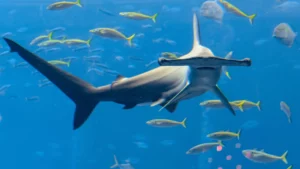 | 2.5–3.5 m (8–12 ft) | Low | Shelf waters along the whole coast; the most-landed large sharkSchools during the upwelling; juveniles common inshore. Critically endangered and still fished hard here. |
Smooth Hammerhead SharkSphyrna zygaena | 2.5–3.5 m (8–12 ft) | Low | Cooler upwelling water, July–SeptemberAppears in landings when the sea cools; otherwise offshore. Few bites on record anywhere. |
Great Hammerhead SharkSphyrna mokarran | 3.5–4.5 m (11–15 ft) | Moderate | Shelf edge and deeper coastal waterLanded occasionally at Tema and Elmina; now scarce. Impressive but rarely involved in incidents. |
Blue SharkPrionace glauca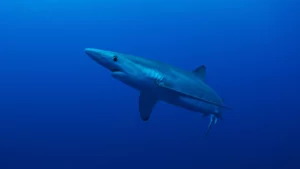 | 2–3 m (7–10 ft) | Low | Offshore, over the slope; the main longline catchGhana's most numerous pelagic shark by landings. Never comes onto the beaches. |
Shortfin Mako SharkIsurus oxyrinchus | 2.5–3.5 m (8–12 ft) | Moderate | Open ocean beyond the shelfA regular at Tema harbour from the longline canoes. Endangered globally. |
Silky SharkCarcharhinus falciformis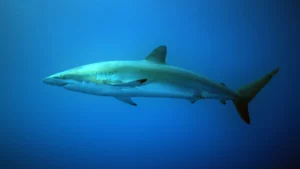 | 2–3 m (7–10 ft) | Moderate | Offshore around tuna schools and drifting objectsHeavily taken by the tuna fleet; one of the most common sharks on the Elmina sand. |
| Oceanic Whitetip SharkCarcharhinus longimanus | 2–3 m (7–10 ft) | High | Deep blue water far offshoreBigger than older Ghanaian tables suggest. A danger to people adrift at sea, irrelevant at the beach. Critically endangered. |
Bigeye Thresher SharkAlopias superciliosus | 3–4 m (10–13 ft) incl. tail | Low | Deep offshore water; a longline bycatchThe thresher most often seen at Tema, recognised by its huge upward-looking eyes. Harmless. |
Common Thresher SharkAlopias vulpinus | 3–5 m (10–16 ft) incl. tail | Low | Offshore and, in the upwelling, over the shelfFollows sardinella shoals and stuns them with its tail. No threat to swimmers. |
Blacktip SharkCarcharhinus limbatus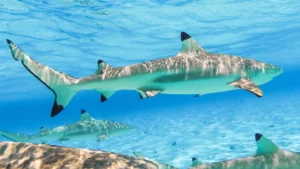 | 1.5–2.2 m (5–7 ft) | Moderate | Inshore during the baitfish runs; juveniles in estuariesFast and jumpy, common in canoe catches. Minor bites on waders elsewhere; none in Ghana. |
Spinner SharkCarcharhinus brevipinna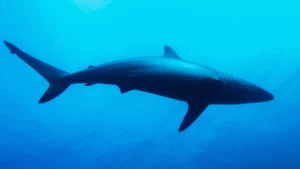 | 2–2.5 m (7–8 ft) | Moderate | Coastal water chasing sardinella, July–SeptemberLeaps clear of the water while feeding. Landed in numbers during the upwelling. |
Sandbar SharkCarcharhinus plumbeus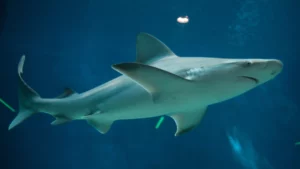 | 1.8–2.4 m (6–8 ft) | Low | Sandy shelf bottomsTall-finned, slow to mature, a regular in drift-net catches. Very few incidents worldwide. |
Dusky SharkCarcharhinus obscurus | 2.5–3.5 m (8–12 ft) | Moderate | Shelf and slope watersOne of the slowest-breeding requiem sharks; landed occasionally. Endangered. |
Bull SharkCarcharhinus leucas | 2.2–3.2 m (7–10 ft) | High | Volta estuary, lagoon mouths and turbid inshore waterThe species to respect in Ghana's brackish channels. No recorded bite here, but the habitat is classic bull shark ground. |
Tiger SharkGaleocerdo cuvier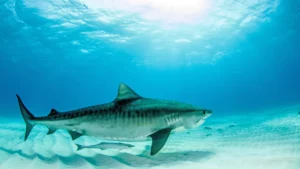 | 3–4.5 m (10–15 ft) | High | Deeper coastal water; occasionally landedPresent along the Gulf of Guinea but rarely seen. Never implicated in a Ghanaian incident. |
Nurse SharkGinglymostoma cirratum | 2.5–3 m (8–10 ft) | Low | Rocky reefs and ledges of the western coastThe Atlantic nurse shark, the same species as in the Caribbean. Docile unless grabbed. |
Sand Tiger SharkCarcharias taurus | 2.2–3 m (7–10 ft) | Low | Inshore reefs and sandy bottoms, uncommonFierce-looking with its ragged teeth but placid. Recorded along the Gulf of Guinea coast; critically endangered. |
Milk SharkRhizoprionodon acutus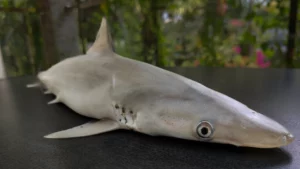 | 0.9–1.1 m (3–3.5 ft) | Low | Shallow inshore water everywhereThe small shark in every canoe. Completely harmless; smoked and eaten throughout the country. |
Atlantic Weasel SharkParagaleus pectoralis | 1–1.3 m (3.3–4.3 ft) | Low | Inshore over sand and mud, 10–100 mA slim, yellow-striped West African speciality that eats squid. Harmless. |
| West African CatsharkScyliorhinus cervigoni | 0.6–0.8 m (2–2.6 ft) | Low | Rocky and muddy bottoms of the outer shelfA spotted bottom-dweller found only in the Gulf of Guinea region; taken in trawls. |
| Smoothback AngelsharkSquatina oculata | 1–1.4 m (3.3–4.6 ft) | Low | Sandy shelf bottoms, 20–200 mA flattened ambush hunter that lies buried in sand. Critically endangered across West Africa. |
Whale SharkRhincodon typus | 5–10 m (16–33 ft) | Low | Along the coast in the upwelling; off Cape Three PointsHarmless filter feeder seen from whale-watching boats August–November. |
Great White SharkCarcharodon carcharias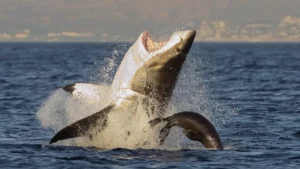 | 4–6 m (13–20 ft) | n/a | Not recorded off GhanaListed to answer the question. No confirmed Gulf of Guinea record; the water is too warm. |
The species people ask about first, the great white shark, has never been confirmed off Ghana. The Gulf of Guinea is among the warmest stretches of the Atlantic, and even the cooler upwelling months do not bring the water into the great white's range; the nearest reliable records on this side of the ocean are in Senegal and Mauritania to the north and southern Angola to the south. A large grey shark reported off a Ghanaian beach will be a bull, a dusky, a sandbar or a big blacktip. Reef-dwelling species of the Indo-Pacific such as the blacktip reef shark and grey reef shark are absent too, since the Atlantic has none of them.
Where to see sharks in Ghana
Ghana has almost no dive tourism and no shark-diving industry; visibility is often poor and the shore break is heavy. That does not mean sharks are hard to find. They are seen from boats off the western headlands, in the estuaries, and above all on the landing beaches, where the canoe catch is sorted in the open every morning.
- Elmina fishing harbourThe busiest canoe harbour in the Central Region, beside the 15th-century castle. Come at first light to see hammerheads, blue sharks, silkies, threshers and milk sharks unloaded and carried up to the smoking ovens. The most reliable place in Ghana to see a dozen shark species in one hour.
- Tema fishing harbourGhana's industrial port east of Accra, home to the tuna fleet and the larger longline canoes. Big pelagic sharks, makos, oceanic whitetips, bigeye threshers, are landed here, and the harbour is the historic centre of the fin trade.
- Axim and Dixcove, Western RegionSmaller canoe ports on the rocky western coast. Nurse sharks and blacktips are caught close to the headlands, and boat trips from Axim occasionally see hammerheads at the surface during the upwelling.
- Cape Three PointsGhana's southernmost headland, with the country's best-preserved coast and a forest reserve behind it. Whale-watching boats from Akwidaa and Busua run for humpback whales from August to November and meet whale sharks, hammerheads and dolphins on the same trips.
- Busua and Kokrobite beachesThe two beaches most visitors swim and surf at. Sharks are almost never seen from the sand, but both sit near canoe landings where the catch, including small sharks, is brought in; a reminder that the animals are close by even when invisible.
- Ada Foah and the Volta estuaryThe mouth of the Volta River, with mangroves, sand spits and brackish channels. This is bull shark habitat and the place where juvenile blacktips and milk sharks shelter; boat trips from Ada sometimes glimpse a dorsal fin in the channels.
- Offshore, the shelf edgeTwenty to forty kilometres out, over water that drops to 1,000 metres or more. Longline canoes working here take blue sharks, makos, silkies and bigeye threshers, and this is the only realistic place to see Ghana's oceanic species alive.
For the visitor with one morning, Elmina at dawn is the answer: it costs nothing, the fishers are used to onlookers, and the variety of sharks on the sand is astonishing. For live animals, a whale-watching trip from Cape Three Points between August and November offers the best chance of a whale shark or a hammerhead at the surface.
Best time of year to see sharks in Ghana
Ghana's ocean runs on two clocks: the rains, which shape the sea state, and the upwelling, which shapes where the sharks are.
- July to September (major upwelling): the sea cools to 20–24 °C, the sardinella season is at its height and the canoe fleet lands the most sharks of the year, especially hammerheads, blacktips and spinners feeding on the baitfish. Humpback whales and whale sharks are off Cape Three Points. Seas are rougher and skies grey, but this is the shark season.
- October to November: the water warms again, the whale-watching season continues, and the offshore longline catch of blue sharks and makos stays strong.
- December to February (dry season and minor upwelling): the harmattan haze blows off the Sahara, seas are calmest and the water is at its clearest, 25–27 °C. The best months for boat trips and for swimming, with a short second flush of upwelling around January that brings sharks inshore again briefly.
- March to June (warm season and main rains): surface water of 28–29 °C, heavy rain from May. Sharks disperse, landings fall, and the resident inshore species, nurse sharks, bull sharks in the estuaries, milk sharks, are the ones still met.
Temperature is never a barrier to sharks here; even the coldest upwelling water is warmer than a Mediterranean summer, which is why the fauna is tropical all year and why cold-water species such as the porbeagle and the great white are missing.
Shark attacks in Ghana: what the record actually shows
Ghana's shark file is about as short as a file can be. SharkSider's database holds exactly one entry for the country, and because it dates from before 1900 it falls outside the modern incident list below, which is why that list reads as empty. The record is kept on our shark attacks in Ghana page and updated weekly.
No incidents are recorded in the SharkSider database for this country.
That one record is a bather killed at Cape Coast in about November 1826, in the years when the town was the British headquarters on the Gold Coast and its castle beach was a working anchorage. No species was identified and no details survive beyond the bare fact of a fatal bite while bathing. Cape Coast's beach then, as now, sat beside a canoe landing where fish were gutted at the water's edge, which is precisely the setting that draws bull sharks and tiger sharks into shallow water. Nothing has been recorded in the 200 years since: no bite on a swimmer at Labadi or Kokrobite, none on a surfer at Busua, none on the tens of thousands of fishers who handle live sharks in canoes every year.
The absence is partly a reporting gap, since incidents in small fishing communities do not always reach international databases, but it is also real. Ghanaians swim at the beach in large numbers on weekends and holidays, and if bites were happening they would be known. The species with the capacity to hurt people, bull sharks in the estuaries, tiger sharks and oceanic whitetips offshore, exist here, but the crowded, shallow, surf-washed beaches where people swim are not where they hunt. The standard precautions are enough: avoid swimming beside canoe landings when the catch is being cleaned, stay out of the murky Volta channels at dusk, and treat rip currents as the genuine danger on this coast, because they are.
Is it safe to swim and snorkel in Ghana?
As far as sharks are concerned, yes. Two centuries without a recorded incident is a stronger guarantee than most tropical coastlines can offer. The real hazards in the Ghanaian surf are the rip currents that form along the long, steep beaches of the Central and Greater Accra regions, the shore break that dumps heavily at high tide, and the lack of lifeguards outside a handful of resort beaches. Drownings are a yearly problem; shark bites are not.
The inshore sharks a swimmer might conceivably meet are the nurse shark, a placid bottom-dweller that only bites if handled, the small milk shark and Atlantic weasel shark, which are no threat to anyone, and blacktips and spinners feeding on baitfish, which will occasionally nip a wader in murky water elsewhere in the world but have no such record in Ghana. Bull sharks are the one species that warrants respect, and their habitat is specific: the brackish channels of the Volta estuary and the lagoon mouths, particularly in poor visibility. Swim there at midday in clear water if at all, never at dusk, and never near fishing activity. Snorkelling is limited in Ghana by the visibility, but on the rocky western coast around Axim and Cape Three Points there are calm coves where a nurse shark under a ledge is a possibility.
Anyone who joins a whale-watching trip and finds a whale shark alongside should remember that whale sharks are harmless, but that a 10-metre animal deserves space; keep a few metres from the body and well clear of the tail, and enter the water quietly if the skipper allows it at all.
Shark conservation in Ghana
Ghana has no law that protects sharks as a group. They are managed as part of the general catch under the Fisheries Act of 2002 and the regulations that followed it, and they are landed, smoked and sold like any other fish; the fins have been exported through Tema for decades. Ghana is a party to CITES, which now regulates trade in hammerheads, oceanic whitetips, silky sharks, makos, threshers and whale sharks, and to the Convention on Migratory Species, which lists most of the same species. In practice, enforcement at 300 landing beaches is thin, and surveys of the canoe fishery have recorded steep declines in hammerheads and in the average size of the sharks landed since the 1990s.
The larger threat to Ghana's marine life is the collapse of the small pelagic fishery that everything else depends on. Sardinella catches have fallen dramatically since the early 2000s, driven by overcapacity in the canoe fleet and by industrial trawlers, many of them foreign-owned, that catch juvenile fish and sell them back to canoes at sea in the illegal saiko trade. Fewer sardinella mean fewer of the sharks that follow them. There are hopeful signs: the government has run closed seasons for the canoe and industrial fleets since 2019, fishing communities in the Western Region have set up local management committees, and sea turtles and marine mammals already have legal protection that could be extended to the most threatened sharks. Visitors can help by refusing shark meat and fin, choosing whale-watching operators that keep their distance from wildlife, and reading our page on why sharks are endangered to understand why a hammerhead population takes decades to recover once fished down.
Sharks in neighbouring waters
Ghana's sharks are the sharks of the whole Gulf of Guinea and the tropical eastern Atlantic. Nigeria, along the coast to the east, has the same landing-beach fauna plus the vast Niger delta with its bull sharks. To the north-west, Senegal and the Gambia mark the transition to cooler Saharan upwelling, with hammerheads, sand tigers and even the occasional great white, and Morocco completes the run to the Strait of Gibraltar. Southward the coast warms through Angola before the cold Benguela of Namibia and the great white grounds of South Africa. The full list of countries is on our sharks around the world hub.
Frequently asked questions
Are there sharks in Ghana?
Yes, around 22 species. Scalloped hammerheads, blue sharks, makos, silky sharks and milk sharks are landed by the canoe fleet almost daily, nurse sharks and blacktips live on the inshore reefs, bull sharks use the Volta estuary, and whale sharks pass the coast in the cooler months from July to November.
Have there been shark attacks in Ghana?
Only one is recorded: a bather killed at Cape Coast in about November 1826, with no species identified and no further details. Nothing has been reported in the two centuries since, at any of Ghana's beaches or among the thousands of fishers who handle sharks every day.
Is it safe to swim in Ghana?
From sharks, yes; there has been no recorded bite since 1826. The real dangers on Ghana's beaches are strong rip currents, a heavy shore break at high tide and a lack of lifeguards outside resorts. Swim at patrolled beaches like Busua or Kokrobite and avoid the murky estuary channels at dusk.
Can you go diving with sharks in Ghana?
Not in any organised way. Ghana has no shark-diving industry and very little scuba diving, because visibility is poor and the surf is heavy. The best live sightings come from whale-watching boats off Cape Three Points, and the easiest way to see many species is the dawn canoe landing at Elmina.
Are there great white sharks in Ghana?
No. There is no confirmed record of a great white in the Gulf of Guinea. The water stays at 27–29 °C for most of the year and only cools to about 20 °C in the upwelling, still warmer than the species prefers. The nearest reliable eastern Atlantic records are in Senegal and southern Angola.
What is the most common shark in Ghana?
By numbers landed, the blue shark offshore and the milk shark inshore. The scalloped hammerhead is the large shark seen most often on the landing beaches, especially during the July to September upwelling, when schools follow the sardinella toward the coast.
Are there bull sharks in Ghana?
Yes. Bull sharks live along the Gulf of Guinea coast and use the brackish channels of the Volta estuary at Ada Foah and the lagoon mouths. None has been involved in a recorded incident in Ghana, but their habitat is exactly where swimmers should be cautious, particularly in murky water at dusk.
When is the best time to see sharks in Ghana?
July to September, the major upwelling, when the sea cools to 20–24 °C, the sardinella run and the canoe fleet lands the most hammerheads, spinners and blacktips. Whale sharks and humpback whales are off Cape Three Points from August to November. December to February has the calmest, clearest water for boat trips.
Are there whale sharks in Ghana?
Yes. Whale sharks move along the Ghanaian coast during the cooler upwelling months and are seen from whale-watching boats out of Akwidaa and Busua near Cape Three Points, mostly between August and November. They are harmless filter feeders, and sightings are a bonus rather than a guarantee.
Is shark fishing legal in Ghana?
Yes. Sharks are landed under the general Fisheries Act of 2002 with no shark-specific ban; the meat is smoked and sold inland and fins have long been exported through Tema. Ghana is a party to CITES and the Convention on Migratory Species, which regulate trade in hammerheads, makos, threshers, silky and oceanic whitetip sharks.
References

A small team focused on researching sharks and making marine biology easy to understand. Every page is reviewed against current species records and the SharkSider attack database, and updated when new incidents or research appear.
Published January 20, 2023 · Last updated September 21, 2026 · Incident data from the SharkSider attack database (0 records for Ghana, 0 fatal).


