
Yes, French Polynesia has more sharks per lagoon than almost anywhere in the Pacific. Eighteen species have solid records across the five archipelagos. The ones you will meet without trying are the blacktip reef shark, the grey reef shark, the whitetip reef shark and the sicklefin lemon shark; divers add silvertips, great and scalloped hammerheads and tiger sharks at the atoll passes.
The safety picture is better than the length of the list suggests. The SharkSider database holds 38 dated records from 1924 to 2025, none of them fatal, plus two 19th-century deaths (an 1834 swimmer off Tahiti and an 1893 murder at sea). Most of the modern injuries went to spearfishers carrying bleeding fish, to people hand-feeding sharks for tourists, and to kitesurfers and surfers on the reef; only a handful involved swimmers.
- Shark species recorded18 confirmed
- Protected since2006, all species from 2012 (whole EEZ)
- Most seen from the beachBlacktip reef shark
- Signature encounterFakarava south pass wall of grey reef sharks
- Incidents in the database38 (1924–2025), 0 fatal; 2 deaths in the 1800s
- Water temperature26–29 °C (Australs 22–26 °C)

On this page
- Why French Polynesia has so many sharks
- List of the different types of sharks in French Polynesia
- Where to see sharks in French Polynesia
- Best time of year to see sharks in French Polynesia
- Shark attacks in French Polynesia: what the record actually shows
- Is it safe to swim and snorkel with sharks in French Polynesia?
- Shark conservation in French Polynesia
- Sharks in neighbouring waters
- Frequently asked questions
- References
Why French Polynesia has so many sharks
Start with the map. French Polynesia is not one destination but five archipelagos spread over 4.8 million square kilometres of ocean: the high volcanic Society Islands (Tahiti, Moorea, Bora Bora), the 76 low atolls of the Tuamotus, the rugged Marquesas with no lagoons at all, the cool Austral Islands in the south and the tiny Gambier group in the south-east. Each is a different shark habitat. The Tuamotu atolls are rings of coral around deep lagoons, breached by one or two passes through which the whole lagoon drains and refills twice a day. Those passes, the ava in Tahitian, concentrate fish, plankton and current in a channel a few hundred metres wide, and reef sharks line up in them like trout in a river. The Society Islands offer something different: broad, shallow lagoons ringed by barrier reef, perfect nursery ground for blacktips and lemon sharks. The Marquesas drop straight into 3,000 m of blue water, which is why they carry the big pelagic sharks and the country's only recent cluster of serious bites.
The second reason is that the sharks were never fished out. Polynesian culture treats the shark, ma'o, as an ancestral guardian, and there was never a large-scale fin fishery here. What little targeted fishing existed was closed in 2006, when the territorial government protected every shark species except the shortfin mako, and in April 2012 the mako joined the list, making the entire exclusive economic zone a sanctuary. It remains the largest in the world. In 2018 the whole zone was additionally designated a managed marine area, Tainui Atea, and Fakarava and six neighbouring atolls form a UNESCO biosphere reserve. Long-running tagging studies in Moorea and Fakarava show what protection looks like in numbers: reef shark densities in the Tuamotu passes are among the highest ever measured, with the Fakarava south pass alone holding an estimated 700 grey reef sharks at peak, a biomass that scientists once assumed a coral reef could not support.
List of the different types of sharks in French Polynesia
Every species in the table has a solid record in French Polynesian waters, from lagoon surveys, dive-site counts, the longline fishery's observer logs or the incident database itself. Sizes are typical adults. The risk column rates the danger to a swimmer or snorkeller in a lagoon, not to a diver who goes looking for a hammerhead in a pass. Two naming points matter here. The lemon shark of Polynesia is the sicklefin lemon shark (Negaprion acutidens), an Indo-Pacific species, not the Caribbean lemon shark, and the nurse shark under the ledges is the tawny nurse shark, not the Atlantic one. Tahitians have their own names too: the blacktip reef shark is ma'o mauri, the grey reef shark raira, and the lemon shark arava.
| Species | Adult size | Risk to swimmers | Where in French Polynesia & notes |
|---|---|---|---|
Blacktip Reef SharkCarcharhinus melanopterus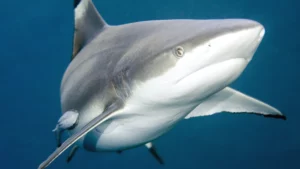 | 1.2–1.6 m (4–5 ft) | Low | Every lagoon and reef flat; newborns in ankle-deep shallowsThe ma'o mauri, the shark you see from the bungalow. Responsible for most of the minor bites in the record, almost all at feeding sites. |
Grey Reef SharkCarcharhinus amblyrhynchos | 1.5–2.4 m (5–8 ft) | Moderate | Atoll passes: Fakarava, Rangiroa, Tikehau, MakemoForms the famous Fakarava wall. Territorial towards divers who crowd it; the Makemo spearfishing injuries were this species. |
Whitetip Reef SharkTriaenodon obesus | 1.2–1.6 m (4–5 ft) | Low | Ledges and coral heads on the outer reef, resting by daySlim, placid and nocturnal. Hunts in groups over the reef after dark. |
Sicklefin Lemon SharkNegaprion acutidens | 2.5–3.1 m (8–10 ft) | Low | Moorea and Bora Bora lagoons, Tahiti west coastThe arava. The Indo-Pacific lemon shark, not the Caribbean one. Bulky but slow; its three bites on record went to a spearfisher, a scuba diver and a surfer, never a swimmer. |
Tawny Nurse SharkNebrius ferrugineus | 2.5–3.2 m (8–10 ft) | Low | Caves and overhangs on lagoon reefs and outer slopesPolynesia's nurse shark; the Atlantic nurse shark is a different species. Harmless unless grabbed. |
Tiger SharkGaleocerdo cuvier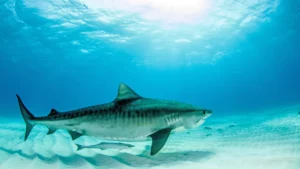 | 3–4.5 m (10–15 ft) | High | Tahiti west coast (Vallée Blanche), Bora Bora outer reef, MarquesasThe largest predatory shark here. The 2022 Punaauia record was a 2–2.5 m tiger. Dive it with a guide, never near fish waste. |
Silvertip SharkCarcharhinus albimarginatus | 2–2.5 m (7–8 ft) | Moderate | Outer walls and pass mouths at Rangiroa, Fakarava, TikehauBig, confident, white-edged fins. Approaches divers closely; a 2007 Rangiroa scratch to a diver's face was this species. |
Great Hammerhead SharkSphyrna mokarran | 3.5–4.5 m (11–15 ft) | Moderate | Rangiroa and Tikehau passes, December–MarchLarge females come up the outer slope to hunt eagle rays in the southern summer. Critically endangered worldwide. |
Scalloped Hammerhead SharkSphyrna lewini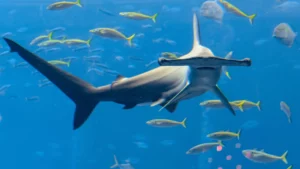 | 2.5–3.5 m (8–12 ft) | Low | Schools off Nuku Hiva and the Tuamotu outer slopesShy and deep by day. The Marquesas hold some of the best schooling sightings in Polynesia. |
| Oceanic Whitetip SharkCarcharhinus longimanus | 2–3 m (7–10 ft) | High | Open ocean between islands; occasionally into deep baysBold pelagic shark that investigates anything at the surface. The severe 2019 Opunohu Bay injury on Moorea was this species. |
Silky SharkCarcharhinus falciformis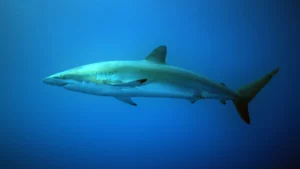 | 2–3 m (7–10 ft) | Moderate | Blue water off the Marquesas and around fish-aggregating buoysFollows the tuna schools and the fishing boats. The main shark bycatch of the local longline fleet. |
Galapagos SharkCarcharhinus galapagensis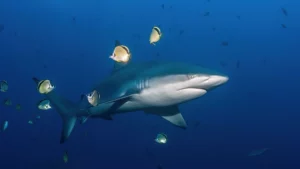 | 2.5–3 m (8–10 ft) | Moderate | Rocky slopes of the Marquesas and Austral IslandsA shark of isolated oceanic islands. Replaces the grey reef shark around the cooler, reef-less Australs and Rapa. |
Shortfin Mako SharkIsurus oxyrinchus | 2.5–3.5 m (8–12 ft) | Moderate | Offshore, on the tuna and swordfish groundsThe last species to gain protection, in 2012. Never seen on the reefs; a longline-only animal here. |
Longfin Mako SharkIsurus paucus | 2.5–4 m (8–13 ft) | Low | Deep tropical water far offshoreRecorded by fishery observers, never by divers. Slower and rarer than its shortfin cousin, and not aggressive as the old list claimed. |
Blue SharkPrionace glauca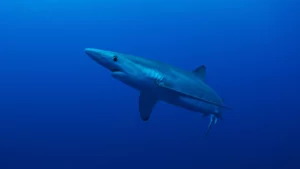 | 2–3 m (7–10 ft) | Low | Open ocean, especially the cooler southern watersThe most common pelagic shark on Polynesian longlines. Released alive under the sanctuary rules. |
Pelagic Thresher SharkAlopias pelagicus | 2.5–3.5 m (8–12 ft) incl. tail | Low | Deep water beyond the reef drop-offsThe thresher of the tropical Pacific, with a tail as long as its body. Harmless; tiny mouth. |
Bigeye Thresher SharkAlopias superciliosus | 3–4 m (10–13 ft) incl. tail | Low | Deep offshore water, rising at nightKnown only from the longline catch. Its oversized eyes point upward to spot prey silhouetted against the surface. |
Whale SharkRhincodon typus | 5–10 m (16–33 ft) | Low | Occasional at Rangiroa, Fakarava and off TahitiNo reliable season; a lucky sighting rather than a target. Filter feeder, completely harmless. |
Great White SharkCarcharodon carcharias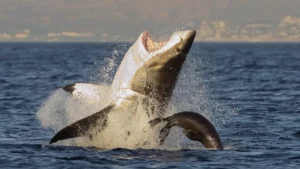 | 4–6 m (13–20 ft) | n/a | Not recorded in French PolynesiaListed because it is the question everyone asks. A temperate species; the closest population is around New Zealand. |
Two species from the old version of this list needed correcting. The “black fin reef shark” and the “blacktip shark” were the same animal counted twice: the blacktip shark of the Atlantic and continental coasts (Carcharhinus limbatus) has no reliable record from these isolated islands, and every “blacktip” in the Polynesian incident record, including the feeding-site bites in Moorea and Bora Bora, refers to the blacktip reef shark. The great white has never been confirmed here either; it is a temperate-water animal and the nearest population is around New Zealand and southern Australia. The bull shark, common in Fiji, has no confirmed French Polynesian record, and a swimmer who reports a “bull shark” in a Tuamotu lagoon has almost always seen a lemon shark, which is chunky, yellowish and just as blunt-nosed.
Where to see sharks in French Polynesia
Sharks are visible from the overwater bungalow steps on most islands, but the celebrated encounters are in the Tuamotu passes and on a few specific Society Island sites. These are the places with the most consistent sightings and what each one delivers.
- Fakarava south pass (Tumakohua)The most famous shark dive in the Pacific. Several hundred grey reef sharks hang in the current along the pass wall, densest during the June and July full moons when thousands of camouflage groupers gather to spawn and the sharks hunt them at night. Whitetips, blacktips and the odd great hammerhead join in.
- Fakarava north pass (Garuae)The widest pass in the Tuamotus, 1.6 km across, dived on the incoming tide as a drift. Grey reef sharks in the hundreds, silvertips and hammerheads on the outer edge, and mantas on the way in. The 2013 kiteboard bite in the database happened at the surface here.
- Tiputa pass, RangiroaA narrow, fast pass on the world's second-largest atoll. Grey reef sharks and silvertips year-round, and from December to March great hammerheads rise from the deep on the outer slope. Bottlenose dolphins ride the same current.
- Moorea lagoon (Tiahura, Opunohu, Afareitu)Sicklefin lemon sharks up to 3 m and blacktip reef sharks in a few metres of water on the north-west side, visible on snorkelling trips from the beach. Two of the database's feeding-related bites and the 2019 oceanic whitetip incident were here, so choose a boat that does not bait.
- Tahiti: Vallée Blanche and PunaauiaA sandy slope off the west coast where tiger sharks, lemon sharks and blacktips gather over a former feeding site. The most accessible tiger shark encounter in Polynesia, twenty minutes from Papeete, and the site of the 2020 and 2022 records.
- Bora Bora (Anau, Tapu, Toopua)Lemon sharks and blacktip reef sharks in the lagoon, grey reef sharks and the occasional tiger on the outer reef at Tapu. Bora Bora invented the tourist shark-feeding show and the injury record reflects it.
- Tikehau atollA single pass (Tuheiava) with grey reef sharks, great hammerheads in the southern summer and a resident manta cleaning station inside the lagoon. Quieter than Rangiroa.
- Marquesas: Nuku Hiva and Ua PouNo lagoons, no barrier reef, just volcanic cliffs into deep water. Scalloped hammerheads school off Nuku Hiva, silky sharks follow the boats, and the murky bays are where the 2021 and 2025 swimming injuries occurred.
If you have one week and one goal, go to Fakarava in June or July: the grouper spawning at the south pass is the densest concentration of reef sharks a diver can see anywhere. Rangiroa in the southern summer is the choice for hammerheads, Moorea for a lagoon snorkel with lemon sharks from the beach, and Tahiti for tiger sharks without a long transfer.
Best time of year to see sharks in French Polynesia
The tropical islands have two seasons and the shark calendar follows them, with the Australs running colder than everything else.
- May to October, the dry season (mata'i ma'a): south-east trade winds, drier air, lagoon water of 26–27 °C and the best visibility in the passes, often 40 m and beyond. The June and July full moons trigger the camouflage grouper spawning at Fakarava, which is the single best shark event of the year. Humpback whales are off Moorea and Rurutu from July to November.
- November to April, the wet season: hotter, more humid, water of 28–29 °C, occasional storms. The compensation is that the great hammerheads arrive: Rangiroa's Tiputa pass and Tikehau see the big females from December to March, when they come in to feed on eagle rays.
- Tiger sharks off Tahiti: present in every month, with more animals in the warmer half of the year.
- Lemon and blacktip reef sharks in the lagoons: resident all year. Newborn blacktips appear in the shallows of Moorea and the Tuamotu lagoons from October to January, when the surface is warmest.
- Australs (Rurutu, Tubuai, Rapa): the cool outliers, 22–26 °C, closer to a subtropical climate. Galapagos sharks and grey reef sharks rather than lagoon species.
Tides matter more than months in the Tuamotus. Shark dives in the passes run on the incoming tide, when clear ocean water pours into the lagoon and the sharks face the current in ranks; on the outgoing tide the visibility collapses and the passes are dangerous to dive at all.
Shark attacks in French Polynesia: what the record actually shows
For a country with this many sharks, the record is reassuring once you read the details. SharkSider lists every case on its shark attacks in French Polynesia page. The database holds 40 entries in total: 38 dated between 1924 and 2025 (one of them a Rangiroa fishing case with no exact date, filed before 1995), and not one of those 38 was fatal. The only two deaths are from the 19th century, an 1834 swimmer off Tahiti in a case reported to involve a hammerhead, and an 1893 murder in which two brothers threw a man overboard to sharks a week out of Papeete. These are the six most recent dated records (the full list, updated weekly, is on the attacks page):
- 2025 · Hakahau Bay, Marquesas IslandsSwimming — Deep gash to bicepSpecies: 3m shark · not fatal
- 2025 · Taiohae Bay, Nuku HivaSwimming — Injuries to right forearm left hand and calf was missingSpecies: Undetermined · not fatal
- 2024 · Mangareva Atoll, Gambier IslandsFreediving — Bite left forearm several ripped tendons severed nerves deep muscle woundsSpecies: 2.5m shark · not fatal
- 2023 · Matavai Bay, Arue, Papetee, TahitiKite surfing — Buttock bittenSpecies: Grey reef shark, 2 m · not fatal
- 2022 · To'opua, Bora Bora — Hand bittenSpecies not identified · not fatal
- 2022 · Pointe des pêcheurs, Punaahuia, Tahiti — Cut to kneeSpecies: Tiger shark, 2 to 2.5m · not fatal
The pattern is unusually clear. Roughly a quarter of the modern cases involved spearfishing, from a Hikueru diver's bitten thumb in 1951 to the two grey reef shark injuries at Makemo in April 2016, both flagged in the record as provoked because the sharks had been speared. A second group is shark feeding: the Tiahura lagoon in 2014, Anau on Bora Bora in 2015 and the Afareitu “Lagoonarium” in 2019, all blacktip reef sharks nipping a hand that had been holding food. A third is board sports on the reef: kitesurfers at Fakarava in 2013, Huahine in 2014 and Matavai Bay in 2023, surfers at Teahupoo in 2011, Hiva Oa in 2017 and Makemo in 2018, all struck at the surface where a fast-moving board looks like fleeing prey. Swimmers make up a small minority, and the record even contains one 2015 Bora Bora case whose parallel cuts were judged inconsistent with a shark.
The worrying entries are the recent ones. Since 2019 the serious injuries have shifted to the Marquesas and Gambier islands: the 2019 Opunohu Bay case on Moorea was an oceanic whitetip, a bold open-water species, and the 2021 and 2025 swimming injuries at Ua Pou and Nuku Hiva, plus the 2024 freediving bite at Mangareva, happened in deep, murky volcanic bays with no protective lagoon, and where the shark was seen it was a 2.5–3 m animal. A swimmer in the Marquesas is in a different environment from a swimmer in the Bora Bora lagoon, and should treat it that way: stay close to shore, avoid river mouths after rain, and never swim near a fish-cleaning station or a returning fishing boat. The general rules for avoiding a bite apply everywhere in the territory, but they are doubly important on islands without a reef.
Is it safe to swim and snorkel with sharks in French Polynesia?
In the lagoons, yes, and it is one of the joys of the place. Blacktip reef sharks patrol the shallows in front of most resorts and will circle a snorkeller once out of curiosity before drifting off. Sicklefin lemon sharks in Moorea and Bora Bora look alarming, thick-bodied and up to 3 m, but they are slow, bottom-oriented animals that simply do not regard a floating human as food; the three lemon shark bites in the database, at Kaukura in 2012, Tapu in 2013 and Makemo in 2018, involved a spearfisher, a scuba diver and a surfer on the outer reef, not swimmers. Grey reef sharks in the passes are for divers with a guide and a reef hook: they are territorial, and a shark that hunches its back and swims in stiff, exaggerated curves is warning you to leave its patch of current. Back away along the wall, not up into open water.
The one rule that separates a good operator from a bad one is baiting. Shark feeding became a Bora Bora and Moorea tourist staple in the 1990s, and the territory has since restricted it, but the database shows where it leads: sharks conditioned to associate boats and hands with food. Pick trips that watch rather than feed, keep your hands closed and your fins moving slowly, and get out of the water if the crew starts throwing fish scraps. Spearfishers should tow their catch on a long float line, never on a belt, and should leave the water as soon as a shark starts circling. Tiger shark dives off Tahiti and hammerhead dives at Rangiroa are run under briefings for a reason; follow them and the animals are among the most rewarding in the Pacific.
Shark conservation in French Polynesia
The legal framework is as strong as any in the world. Shark fishing, possession and sale have been banned in territorial waters since 2006, the shortfin mako was added in 2012, and the whole 4.8-million-square-kilometre exclusive economic zone is closed to shark fishing and to foreign longliners. The local tuna fleet still catches sharks on its lines, mostly blue sharks, silkies and oceanic whitetips, but they must be released and the fin trade is illegal. Fakarava, Aratika, Kauehi, Niau, Raraka, Taiaro and Toau form a UNESCO biosphere reserve, and traditional rahui closures, in which a community shuts a stretch of reef to fishing for a period, have been revived on Tahiti, Moorea and in the Australs.
The science backs the policy up. Acoustic tagging at Fakarava and Moorea has shown that grey reef and lemon sharks stay faithful to their passes and lagoons for years, so a protected atoll really does keep its sharks rather than exporting them to be caught elsewhere. The remaining pressures are indirect: coral bleaching hit the Society Islands hard in 2019, warming lagoons stress the newborn blacktips in their shallow nurseries, and tourism at the famous passes needs limits on divers and on feeding. The wider picture for sharks globally is far bleaker, which is exactly why Polynesia matters: it is one of the few places where scientists can measure what a reef with its full complement of sharks looks like.
Sharks in neighbouring waters
The same reef species run right across the South Pacific, with local specialities. The Cook Islands, directly west, declared their own sanctuary in 2012 and share the Tuamotu-style lagoon fauna. Samoa and Tonga have the same blacktips and grey reef sharks around high volcanic islands, while Fiji adds bull sharks, which Polynesia lacks, on its famous Beqa Lagoon dives. Vanuatu lies further west on the same latitude, and New Zealand, 4,000 km to the south-west, is where the cold-water great whites that never reach Tahiti actually live. The full list of countries is on our sharks around the world page.
Frequently asked questions
Are there sharks in French Polynesia?
Yes, in remarkable numbers. Eighteen species are recorded across the archipelagos, and reef sharks are part of everyday lagoon life on Tahiti, Moorea, Bora Bora and the Tuamotus. Blacktip reef sharks, grey reef sharks, whitetip reef sharks and sicklefin lemon sharks are the everyday species; hammerheads, silvertips and tiger sharks appear at the passes and drop-offs.
Have there been shark attacks in French Polynesia?
Yes, but none fatal in modern times. The SharkSider database lists 38 dated incidents between 1924 and 2025 with no deaths, plus two 19th-century fatalities. Most modern injuries involved spearfishers, people hand-feeding sharks, or kitesurfers and surfers on the reef. Since 2019 the more serious bites have come from the Marquesas and Gambier islands, which have no protective lagoons.
Is it safe to swim with sharks in French Polynesia?
In the lagoons, yes. Blacktip reef sharks and lemon sharks are used to people and ignore swimmers who keep their hands to themselves. Avoid feeding sites, fish-cleaning areas and dusk, tow speared fish on a float, and in the Marquesas stay close to shore in the deep murky bays. Pass dives with grey reef sharks or hammerheads should be done with a guide.
Are there great white sharks in Tahiti or French Polynesia?
No. There is no confirmed record of a great white anywhere in French Polynesia. It is a cool-water species and the nearest population lives around New Zealand and southern Australia. The large grey sharks people report at Tahiti are tiger sharks, lemon sharks or occasionally an oceanic whitetip.
Where is the best place to dive with sharks in French Polynesia?
Fakarava's south pass, where several hundred grey reef sharks hold station in the current, is the benchmark shark dive in the Pacific, at its densest during the June and July grouper spawning. Rangiroa's Tiputa pass is the place for great hammerheads from December to March, and Tahiti's Vallée Blanche offers tiger sharks close to Papeete.
Are there tiger sharks in Bora Bora?
Yes, on the outer reef, though they are far less common than the lemon sharks and blacktip reef sharks inside the lagoon. Tiger sharks are seen most reliably off the west coast of Tahiti at Vallée Blanche, and the incident record includes a small tiger shark at Punaauia in 2022. They rarely enter the shallow lagoons where visitors swim.
Can you swim with lemon sharks in Moorea?
Yes. The north-west lagoon of Moorea holds sicklefin lemon sharks up to 3 m long, and snorkelling trips see them in water only a few metres deep. Choose an operator that does not feed the sharks; the feeding-related bites in the database all came from conditioned animals at baited sites.
When is the best time to see sharks in French Polynesia?
May to October brings the calmest seas and clearest passes, with the Fakarava grouper spawning in June and July as the highlight. December to March is hammerhead season at Rangiroa and Tikehau. Lagoon reef sharks are present every month, and pass dives always run on the incoming tide regardless of season.
Is shark fishing legal in French Polynesia?
No. French Polynesia banned the fishing, possession and sale of all sharks except the shortfin mako in 2006 and extended full protection to the mako in 2012, creating the world's largest shark sanctuary across its entire exclusive economic zone. Longline bycatch must be released and the fin trade is prohibited.
What is the most common shark in French Polynesia?
The blacktip reef shark, known locally as ma'o mauri. It lives in every lagoon and on every reef flat, nurses its young in the shallows, and is the species visitors see from the beach or the bungalow steps. Below the surface at the atoll passes, the grey reef shark is the most numerous animal by a wide margin.
References

A small team focused on researching sharks and making marine biology easy to understand. Every page is reviewed against current species records and the SharkSider attack database, and updated when new incidents or research appear.
Published January 3, 2023 · Last updated September 21, 2026 · Incident data from the SharkSider attack database (38 records for French Polynesia, 0 fatal).


