Yes, Fiji has a great many sharks, roughly 20 species with solid records in its waters. The species you are likeliest to meet are the blacktip reef shark on the reef flats, the whitetip and grey reef sharks on the outer reefs, the bull shark in Beqa Lagoon and in the big river mouths of Viti Levu, and, if you dive Beqa or Taveuni, the tiger shark.
The safety picture is more mixed than in the Maldives or French Polynesia, but still reassuring for ordinary visitors. SharkSider's database holds 71 Fijian records going back to 1839, 23 of them fatal; 61 are dated from 1912 onward, with 20 deaths. The great majority involve local spearfishermen carrying their catch, divers collecting sea cucumbers, or people in the water after a boat accident. Resort swimmers and snorkellers appear only a handful of times in nearly two centuries, and the last fatality (2016) was a commercial bêche-de-mer diver off Vanua Levu.
- Shark species recorded20 with solid records
- ProtectionShark Reef Marine Reserve, national marine park since 2014; no nationwide ban
- Most seen from the beachBlacktip reef shark
- Signature encounterBeqa Lagoon bull shark dive, up to 8 species
- Incidents in the database71 (1839–2026), 23 fatal; 61 since 1912, 20 fatal
- Water temperature24–26 °C May–Oct, 28–30 °C Dec–Mar

On this page
- Why Fiji has so many sharks
- List of the different types of sharks in Fiji
- Where to see sharks in Fiji
- Best time of year to see sharks in Fiji
- Shark attacks in Fiji: what the record actually shows
- Is it safe to swim and snorkel with sharks in Fiji?
- Shark conservation in Fiji
- Sharks in neighbouring waters
- Frequently asked questions
- References
Why Fiji has so many sharks
Fiji sits where three things sharks need come together: warm water, an enormous amount of reef, and rivers. The two main islands, Viti Levu and Vanua Levu, are big, mountainous and wet, and they drain through rivers such as the Rewa, the Navua and the Sigatoka into muddy deltas that bull sharks use as nurseries. Around them lies more coral than almost any other Pacific nation: the Great Sea Reef (Cakaulevu) runs for more than 200 km along the north of Vanua Levu and is the third-longest barrier reef on the planet, and the Great Astrolabe Reef wraps around Kadavu in the south. Between the reefs, deep passages such as the Somosomo Strait and the Naiqoro Passage funnel current and bait fish past drop-offs, which is exactly where grey reef sharks, silvertips and hammerheads like to hold station.
Culture matters here too. In Fijian tradition the shark god Dakuwaqa guards the reef passages, and several island communities still regard sharks as ancestral protectors rather than prey. That belief did not stop commercial finning in the 1990s and 2000s, when Fijian ports handled a large fin trade for the Asian market, but it did make it easier for a handful of dive operators and villages to set aside reefs where sharks are left alone. The best known is Shark Reef off Pacific Harbour, where the village of Galoa gave up its fishing rights in 2004 in exchange for a levy paid by every diver; in 2014 it became Fiji's first national marine park. The bull sharks that were scarce there in the early 2000s now number in the dozens on any given morning.
List of the different types of sharks in Fiji
Fijian reefs hold the full Indo-Pacific reef shark set plus the two big requiem species that make Beqa famous, and the open ocean beyond the reefs adds the pelagic sharks that the tuna fleet meets. The list below keeps to species with confirmed records; sizes are typical adults rather than record fish, and the risk rating describes what a swimmer or snorkeller, not a guided diver, should expect. One naming note: the “leopard shark” that Fijian guides point out resting on the sand is the zebra shark (Stegostoma tigrinum), and the local lemon shark is the sicklefin species, not the Caribbean one.
| Species | Adult size | Risk to swimmers | Where in Fiji & notes |
|---|---|---|---|
Bull SharkCarcharhinus leucas | 2.2–3.4 m (7–11 ft) | High | Beqa Lagoon, Kuata; the Rewa, Navua and Sigatoka river mouthsThe star of Fiji's shark dives and the species behind its river incidents. Pups in the estuaries of Viti Levu. |
Tiger SharkGaleocerdo cuvier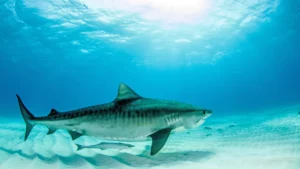 | 3–4.5 m (10–15 ft) | High | Beqa Lagoon feeding sites; outer reefs of Taveuni and Vanua LevuThe species named in most of Fiji's serious bites, nearly all on spearfishermen. Regular at Shark Reef. |
Grey Reef SharkCarcharhinus amblyrhynchos | 1.5–2.4 m (5–8 ft) | Moderate | Outer reef passes: Somosomo Strait, Namena, Great Astrolabe ReefTerritorial on the drop-offs; responsible for the 2019 and 2026 spearfishing bites. Ignores snorkellers on the flats. |
Blacktip Reef SharkCarcharhinus melanopterus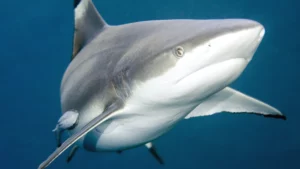 | 1.2–1.6 m (4–5 ft) | Low | Lagoon flats and reef crests on virtually every islandThe shark seen from resort beaches. Skittish; the rare nip is to a wader's ankle in murky water. |
Whitetip Reef SharkTriaenodon obesus | 1.2–1.6 m (4–5 ft) | Low | Ledges and caves on the Rainbow Reef, Mamanucas, KadavuRests by day, hunts in the reef at night. Placid around people. |
Silvertip SharkCarcharhinus albimarginatus | 2–2.5 m (7–8 ft) | Moderate | Deep reef corners at Beqa and NamenaHeavy-bodied and confident; the third large shark at Shark Reef after the bulls and tigers. |
Sicklefin Lemon SharkNegaprion acutidens | 2.2–3 m (7–10 ft) | Low | Sandy lagoons, mangrove edges, Beqa and the YasawasThe Indo-Pacific lemon shark (the Atlantic species on the old page does not occur here). Slow and tolerant. |
Tawny Nurse SharkNebrius ferrugineus | 2.5–3.2 m (8–10 ft) | Low | Reef caves by day; joins the Beqa feedsDocile bottom-dweller. The 2018 Cakau Levu abrasion happened when a diver kicked one. |
Scalloped Hammerhead SharkSphyrna lewini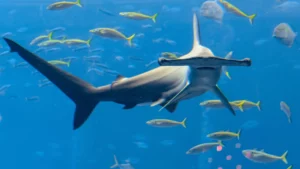 | 2.5–3.5 m (8–12 ft) | Low | Deep passes at Namena and Kadavu; juveniles in the Rewa deltaFiji's estuaries are a documented nursery. Adults keep to depth and shy away from divers. |
Great Hammerhead SharkSphyrna mokarran | 3.5–4.5 m (11–15 ft) | Moderate | Occasional visitor to Beqa Lagoon and the outer reefsSeen a few times a season on the Beqa dives. A 3 m hammerhead bit a diver's arm at Wakaya in 1992. |
Zebra Shark ('Leopard Shark' locally)Stegostoma tigrinum | 2–2.5 m (7–8 ft) | Low | Sand patches beside reefs, Mamanucas and BeqaNot related to the Californian leopard shark. Spotted adults, striped pups; harmless. |
Blacktip SharkCarcharhinus limbatus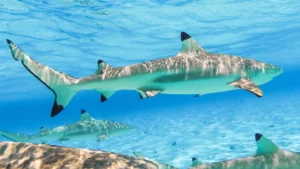 | 1.5–2.5 m (5–8 ft) | Moderate | Open lagoons and reef slopes, more offshore than the reef blacktipFast schooling-fish hunter; told from its reef cousin by the plain anal fin. |
Silky SharkCarcharhinus falciformis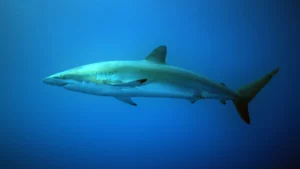 | 2–3 m (7–10 ft) | Moderate | Blue water beyond the reefs, with the tuna schoolsMain shark bycatch of Fiji's tuna longliners; retention is banned. |
| Oceanic Whitetip SharkCarcharhinus longimanus | 2–3 m (7–10 ft) | High | Open ocean, far from the reefsA real danger to people adrift after a boat accident, which is how it appears in Fiji's older records. Never on the reef. |
Blue SharkPrionace glauca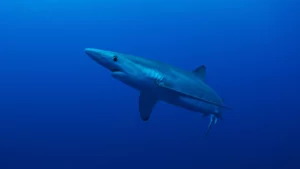 | 2–3 m (7–10 ft) | Low | Offshore, cooler water south of the islandsCaught on longlines; almost never seen by divers in Fiji. |
Shortfin Mako SharkIsurus oxyrinchus | 2.5–3.5 m (8–11 ft) | Moderate | Deep offshore water, mostly in the cooler monthsPelagic longline catch; not a reef species. |
Pelagic Thresher SharkAlopias pelagicus | 2.5–3.3 m (8–11 ft) incl. tail | Low | Offshore; occasional sightings on deep outer wallsRecorded by the tuna fishery. Harmless. |
Bigeye Thresher SharkAlopias superciliosus | 3–4 m (10–13 ft) incl. tail | Low | Deep oceanic water around the archipelagoKnown from longline bycatch only. |
Whale SharkRhincodon typus | 5–10 m (16–33 ft) | Low | Occasional offshore sightings, mostly off western Viti LevuNo reliable aggregation; a lucky encounter rather than a bookable one. |
Great White SharkCarcharodon carcharias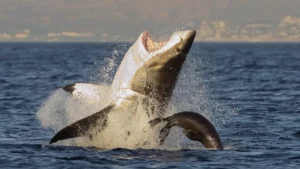 | 4–6 m (13–20 ft) | n/a | No verified record in FijiListed only because it is asked about. The 1963 Gau Island 'white shark' entry is almost certainly a misidentification. |
Two species people expect to find here are missing. There is no verified record of a great white shark in Fiji: the water is too warm all year for a species that hunts seals in 12–20 °C seas, and the one 1963 database entry that names a 2.1 m “white shark” off Gau Island is far more likely to have been a bull or grey reef shark identified by a frightened spearfisherman. The oceanic whitetip does occur, but only far offshore where longliners work, so it is not a reef-goer's concern. Nor should you expect the Caribbean reef shark or the Atlantic nurse shark from the resort brochures; their Fijian counterparts are the grey reef shark and the tawny nurse shark.
Where to see sharks in Fiji
Fiji's shark diving is concentrated in a few well-run places, and the difference between them is mostly about which species you want and whether you are happy with a baited dive or prefer to find sharks on their own terms.
- Shark Reef Marine Reserve, Beqa LagoonThe most famous shark dive in the Pacific. Divers kneel behind a coral wall at about 30 m while bull sharks, often 40 to 70 of them, take tuna heads from a feeder. Tiger sharks, silvertips, grey reef, blacktip reef and whitetip reef sharks, sicklefin lemons and tawny nurse sharks share the site, so eight species on one dive is routine.
- The Bistro and Cathedral, Beqa LagoonA second set of feeding sites in the same lagoon run from Pacific Harbour. Bull sharks dominate, with tiger sharks appearing on a fair share of dives and the occasional great hammerhead cruising past in the blue.
- Barefoot Kuata, Yasawa IslandsA newer bull shark dive off Kuata Island, shallower and calmer than Beqa, often with blacktip reef and sicklefin lemon sharks in the shallows on the way back.
- Somosomo Strait and the Rainbow Reef, TaveuniFast current dives along the Great White Wall and Annie's Bommie. Whitetip and grey reef sharks are the regulars, and Taveuni's outer reefs are also where most of Fiji's tiger shark incidents have happened, so guides keep a close eye on the blue.
- Namena Marine Reserve, Vanua LevuA community-protected reef with pinnacles called Grand Central Station and the Chimneys. Grey reef sharks patrol the drop-off, scalloped hammerheads pass through in the cooler months, and silvertips appear on the deeper corners.
- Great Astrolabe Reef, KadavuThe Naiqoro Passage and the outer wall bring grey reef sharks, hammerheads and manta rays through on the tide. Little boat traffic, few divers and a chance of bigger pelagics.
- The Supermarket, Mamanuca IslandsA cluster of coral heads near Mana Island where grey reef and whitetip reef sharks gather naturally; a good option from the Nadi-side resorts without a long crossing.
- Any resort house reef or lagoon flatBlacktip reef sharks work the reef crest in water that barely covers them at high tide, and juveniles linger in sandy shallows. This is the shark most families see, and it is entirely safe to watch from the beach.
If you want one dive that shows everything, book Shark Reef and go on the morning session, when the bull sharks are most numerous. For sharks without bait, Taveuni's Rainbow Reef and Namena are the strongest choices. Snorkellers who stay on the reef flats around the Mamanucas and Yasawas will see blacktip reef sharks almost daily.
Best time of year to see sharks in Fiji
Fiji has a dry season and a wet season, and both the sharks and the visibility follow them.
- May to October (dry season): south-east trade winds, cooler water of 24–26 °C and the clearest conditions of the year, often 30 m or more on the outer reefs. Bull shark counts at Beqa are at their highest through the middle of this period, and the hammerhead sightings at Namena and Kadavu cluster in these cooler months.
- November to April (wet season): 28–30 °C, heavy rain on the big islands, river run-off that clouds the inshore reefs, and a cyclone risk that peaks from January to March. Diving continues, but visibility inside the lagoons drops.
- Bull sharks: present at Beqa in every month, but the largest pregnant females leave the reserve for several weeks around November to January to pup in the river mouths of Viti Levu, so counts dip and then recover.
- Tiger sharks: seen on Beqa dives all year with no strong season; the largest individuals appear most often between about August and December.
- Blacktip reef sharks: year-round on every reef flat, easiest to see on a rising tide in the late afternoon.
Sea temperature never falls below about 23 °C even in the coolest weeks, which is why the reef and requiem sharks stay resident and why the cold-water lamnids of New Zealand never reach Fiji.
Shark attacks in Fiji: what the record actually shows
Fiji has one of the longest shark incident histories in the Pacific, partly because the British colonial records were good and partly because Fijians have always fished, dived and speared in shark-rich water. SharkSider's database holds 71 entries for the country, of which 61 carry a date from 1912 onward; the older ten come from the 1839–1898 period of canoe wrecks and river incidents on the Rewa. Below are the six most recent records; the complete, weekly-updated list is on our shark attacks in Fiji page.
- 2026Spearfishing — Bite to lower right leg (calf)Species: Gray Reef Shark · not fatal
- 2023 · Ura Estate, Taveuni IslandSpearfishing — QuestionableSpecies not identified · not fatal
- 2020 · Tawake, Cakaudrove, Vanua LevuSpearfishing — Lacerations to right elbowSpecies not identified · not fatal
- 2019 · reef 40km east Vanua LevuSpearfishing — Right arm bittenSpecies: Grey reef shark 1.5m · not fatal
- 2019 · BeqaScuba diving — Laceration to head and shark bit diver's tankSpecies: Tiger shark, 4m to 5m · not fatal
- 2018 · Cakau Levu, Vanua LevuDiving — Abrasion to leg when he kicked the shark provoked incidentSpecies: Nurse shark · not fatal
Read as a whole, the record tells a clear story. Of the 61 dated cases, 20 were fatal, and since the year 2000 there have been 20 records with 7 deaths. Almost every one of those deaths involved someone working in the water: a spearfisherman carrying his catch (Taveuni 2001) or spearfishing in shark-rich passages (Naviti and Natewa Bay, both 1964), bêche-de-mer divers off Vanua Levu (2016, 2010), a night diver in the Yasawas (2008), or a man wading ashore from his boat at Welagi on Taveuni (2003). Taveuni and the reefs off Vanua Levu account for a disproportionate share, and where a species is named it is nearly always a tiger shark, including the 2.7 m animal that took a snorkeller's leg near Garden Island Resort in 1997 and the 4–5 m tiger that bit a diver's head and scuba tank at Beqa in 2019. The 2026 case, a spearfisher bitten on the calf by a grey reef shark, fits the same pattern: a speared fish, a small shark, a defensive bite.
Then there are the river cases. The Rewa River produced fatalities in 1921 and injuries in 1894, 1963 and 1877, and there are entries for the Tamavua, Navua and Sigatoka rivers too. Those are bull sharks, which push far up Fiji's rivers and pup in the estuaries; local advice not to swim in the lower Rewa has a sound basis. Surfers appear only twice (Sigatoka, 2006 and 2010, both minor), and there is no fatal attack on a tourist swimming from a resort beach anywhere in the database. The practical rules are the ones on our shark attack survival guide: keep speared fish on the boat rather than on your belt, stay out of river mouths and murky water, avoid dusk and night swimming, and treat any tiger shark that shows persistent interest as a reason to leave the water calmly.
Is it safe to swim and snorkel with sharks in Fiji?
On the resort reefs, yes. The blacktip reef sharks that patrol the lagoons of the Mamanucas, Yasawas and the Coral Coast are timid animals that flinch away from a splash, and whitetip reef sharks spend the day lying under ledges. Grey reef sharks live on the outer reef edge rather than in the swimming areas, and even there their famous hunched, fin-dropping threat display is aimed at divers who corner them in a passage, not at snorkellers drifting overhead. Sicklefin lemon sharks and tawny nurse sharks are placid unless someone puts food in the water.
The baited dives are a different activity and should be treated as one. At Shark Reef you are 30 m down behind a wall with a trained feeder and safety divers carrying poles; the operators have run the site since 2004 with a single serious injury on record, and that discipline is the reason. Do not try to replicate it: swimming or snorkelling anywhere that fish are being cleaned, near a jetty where scraps are thrown, or in the outflow of a river is the surest way to meet a bull shark in conditions where it cannot see you properly. Fiji's incident list shows that spearfishing with a catch on your body is the single riskiest thing you can do in these waters, and a tiger shark that has followed a spearfisherman does not distinguish the fish from the person holding it.
Whale sharks turn up offshore only occasionally, mostly on the leeward side of Viti Levu, so Fiji is not a whale shark destination; if one does cross your path, the same no-touch, no-chase rules apply as anywhere else.
Shark conservation in Fiji
Fiji has never declared a blanket shark sanctuary the way Palau, the Maldives or French Polynesia did, and that remains the biggest gap in its protection. What it has instead is a patchwork that works better than it looks. Shark Reef was declared Fiji's first National Marine Park in 2014, with the village of Galoa compensated through diver levies for giving up its traditional qoliqoli fishing rights there. Community-managed tabu areas, where reefs are closed to fishing under customary law, now cover hundreds of sites across the islands, and the Namena and Kadavu reserves are among the best-enforced. On the high seas, Fiji applies the regional tuna commission's rules that forbid keeping oceanic whitetip and silky sharks, and shark finning at sea is banned; fins must arrive attached to the carcass. Fiji is also a signatory to the Convention on Migratory Species shark agreement, which covers the whale shark, the hammerheads, the makos and the threshers.
Science has driven much of the progress. Long-term tagging at Shark Reef has shown that the same individual bull sharks return year after year, that the females travel to the Rewa and Navua river mouths to give birth, and that juvenile bull sharks spend their first years in the estuaries, which is why river sand-mining and mangrove clearance are now recognised as shark issues. Juvenile scalloped hammerheads have been found using the Rewa delta as a nursery as well, a rare piece of good news for a species in steep decline worldwide. The threats have not gone away: artisanal net fishing in the estuaries still catches young bull sharks and hammerheads, longline bycatch offshore takes blue, silky and mako sharks, and a shark fin export trade persists through Suva. Visitors can help simply by choosing operators that pay into the marine park levies and by never buying shark products. Our explainer on why sharks are endangered covers the wider problem.
Sharks in neighbouring waters
Fiji is the hub of the South Pacific, and its shark fauna is shared with the island groups around it. Tonga to the east has the same reef sharks and a humpback whale season, Samoa to the north-east has quieter reefs with fewer dive operators, and Vanuatu to the west is known for wreck dives with grey reef sharks in attendance. Further out, French Polynesia is the region's great shark sanctuary, Papua New Guinea holds the richest reef diversity in the Pacific, and New Zealand to the south is where the cold-water species, great whites and makos included, take over. See our full list of sharks around the world for every country we cover.
Frequently asked questions
Are there sharks in Fiji?
Yes, around 20 species with confirmed records. Blacktip reef sharks live on the lagoon flats of nearly every island, whitetip and grey reef sharks patrol the outer reefs, and Beqa Lagoon holds one of the densest bull shark populations in the world, with tiger sharks and silvertips alongside them.
Can you dive with sharks in Fiji?
Yes. Shark Reef Marine Reserve in Beqa Lagoon, reached from Pacific Harbour, is the best-known bull shark dive on Earth, and a similar baited dive runs from Kuata in the Yasawas. For sharks without bait, the Rainbow Reef off Taveuni, Namena and the Great Astrolabe Reef off Kadavu are the strongest sites.
Have there been shark attacks in Fiji?
Yes. SharkSider's database lists 71 incidents back to 1839, 23 of them fatal; 61 are dated from 1912 onward with 20 deaths. Most involved spearfishermen, sea-cucumber divers or people in the water after boat accidents. Since 2000 there have been 20 records and 7 deaths, the last in 2016.
Are there great white sharks in Fiji?
No verified record exists. Fiji's water stays above 23 °C all year, far warmer than great whites prefer. A single 1963 database entry describes a 2.1 m 'white shark' at Gau Island, but an animal that small in tropical water was almost certainly a bull or grey reef shark misidentified in the moment.
Are there bull sharks in Fiji?
Yes, in large numbers. Beqa Lagoon's Shark Reef regularly has 40 or more on a single dive, and bull sharks also enter the Rewa, Navua and Sigatoka rivers, where females give birth and juveniles spend their first years. That is why locals advise against swimming in the lower river reaches.
Is it safe to swim in Fiji with sharks around?
On resort beaches and reef flats, yes. Blacktip and whitetip reef sharks are timid, and no tourist swimming from a resort beach has been killed in the database. The risks are specific: spearfishing with a catch on your belt, river mouths, murky water, dusk and night swimming, and areas where fish scraps are thrown.
What is the most common shark in Fiji?
The blacktip reef shark. It hunts along the reef crest and in the lagoon shallows, so it is the species most visitors see from the beach or a kayak. Among divers, the whitetip and grey reef sharks are the everyday sightings, and the bull shark dominates Beqa Lagoon.
When is the best time to see sharks in Fiji?
May to October, the dry season, brings cooler water, the clearest visibility and the highest bull shark counts at Beqa; hammerheads at Namena and Kadavu also favour these months. Sharks are present all year, but wet-season run-off from November to April clouds the inshore reefs and cyclones can interrupt diving.
Are there tiger sharks in Fiji?
Yes. Tiger sharks appear on Beqa Lagoon dives in every month and patrol the outer reefs of Taveuni and Vanua Levu. They are the species named in most of Fiji's serious incidents, almost all involving spearfishermen, which is why the baited dives use trained feeders, safety divers and strict protocols.
Is shark fishing banned in Fiji?
Not nationwide. Fiji bans finning at sea and prohibits keeping oceanic whitetip and silky sharks under regional tuna rules, and Shark Reef has been a national marine park since 2014, backed by many community tabu areas. Targeted shark fishing and a fin export trade still exist, which conservation groups are working to close.
References

A small team focused on researching sharks and making marine biology easy to understand. Every page is reviewed against current species records and the SharkSider attack database, and updated when new incidents or research appear.
Published December 28, 2022 · Last updated September 21, 2026 · Incident data from the SharkSider attack database (61 records for Fiji, 20 fatal).


