
Yes, there are sharks in Ecuador, and in the Galápagos they are the main attraction. Twenty-five species have solid records across the islands and the mainland. In the Galápagos the everyday sharks are the Galápagos shark, the scalloped hammerhead, the whitetip reef shark and the blacktip shark, joined by whale sharks at Darwin from June to November; on the mainland coast the common ones are the silky shark, the blue shark, the Pacific sharpnose and, in the Gulf of Guayaquil, the bull shark.
Incidents are rare and have never been fatal. SharkSider's database holds 11 records for Ecuador between 1954 and 2023, none of them deaths; eight are modern Galápagos cases, mostly surfers and snorkellers bitten once on the leg by a Galápagos shark, one is from a mainland surf beach in 2011, and the two oldest were tuna fishermen off the islands in the 1950s. Nobody has been killed by a shark in Ecuadorian waters in the modern record.
- Shark species recorded25 with solid records
- ProtectionGalápagos Marine Reserve 1998, Hermandad reserve 2022; shark fishing banned in the islands
- Most seen from the beachBlacktip and whitetip reef sharks (Tortuga Bay, Las Tintoreras)
- Signature encounterHammerhead schools and whale sharks at Darwin and Wolf
- Incidents in the database11 (1954–2023), 0 fatal
- Water temperature18–22 °C Galápagos Jul–Dec, 24–28 °C Jan–May; mainland 22–27 °C

On this page
- Why Ecuador and the Galápagos have so many sharks
- List of the different types of sharks in Ecuador
- Where to see sharks in Ecuador
- Best time of year to see sharks in Ecuador
- Shark attacks in Ecuador: what the record actually shows
- Is it safe to swim and snorkel with sharks in Ecuador?
- Shark conservation in Ecuador
- Sharks in neighbouring waters
- Frequently asked questions
- References
Why Ecuador and the Galápagos have so many sharks
The Galápagos sit where three ocean currents collide. The cold Humboldt Current sweeps up from Chile and Peru, the warm Panama Current comes down from the north, and the Cromwell Current, an undercurrent flowing east along the equator, hits the western flanks of Isabela and Fernandina and surges to the surface loaded with nutrients. The mixing produces plankton blooms, dense schools of fish and a food web that can carry an unusual number of large predators. Volcanic islands rising steeply from deep water give sharks the walls, seamounts and cleaning stations they gather on, and the isolation, 1,000 km from the mainland, has kept fishing pressure lower than anywhere else in the Eastern Pacific.
The numbers are extraordinary even by the standards of remote reefs. When scientists from the Charles Darwin Foundation and the Galápagos National Park surveyed Darwin and Wolf in 2013 and 2014, they found a fish biomass of around 17.5 tonnes per hectare, of which more than 12 tonnes were sharks, the highest ever recorded. Most of that weight was scalloped hammerheads, schooling by the hundred on the current-swept sides of the islands, with Galápagos sharks, silky sharks, blacktips and, in season, whale sharks making up the rest. The Galápagos shark itself, first described from these islands in 1905, is the archipelago's signature species and is found on almost every rocky point.
The mainland coast is a different ecosystem. From Esmeraldas in the north to the Gulf of Guayaquil in the south, Ecuador's shore alternates between long surf beaches, rocky headlands like Isla de la Plata and the largest mangrove estuary on the Pacific coast of South America, where the Guayas river system meets the sea. Cool Humboldt water reaches this coast from June to November and warm tropical water takes over from December to May, so the shark fauna is a mix of both: tropical estuarine species such as bull sharks, scoopheads and smalltails in the mangroves, and pelagic sharks, silkies, blues, makos and threshers, over the deep water beyond Manta and Salinas. That richness is also why Ecuador's fishing ports land tens of thousands of tonnes of shark a year, a story picked up in the conservation section below.
List of the different types of sharks in Ecuador
Ecuador's full list runs to around forty species when deep-water dogfish and rare pelagic strays are included; the table below sticks to the twenty-five with solid, repeated records that a visitor or a fisher might plausibly meet. Lengths are ordinary adults; the risk column rates danger to swimmers and snorkellers. Two corrections to the previous version of this page are important for anyone diving the islands. The blacktip reef shark and the grey reef shark are Indo-Pacific species that do not occur in the Eastern Pacific at all: the shark with black fin tips in Galápagos shallows is the blacktip shark, Carcharhinus limbatus, and the “reef shark” on the walls is the Galápagos shark. The whitetip reef shark, however, is genuinely here, and so common in the lava channels of Isabela that the islets there are named after it.
| Species | Adult size | Risk to swimmers | Where in Ecuador & notes |
|---|---|---|---|
Galápagos SharkCarcharhinus galapagensis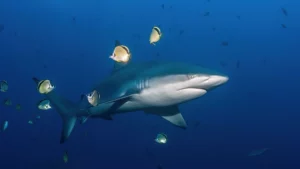 | 2.2–3 m (7–10 ft) | Moderate | Every rocky point in the Galápagos; Isla de la Plata on the mainlandThe islands' signature shark and the species behind most of the recorded bites. Curious, confident, and best met by divers rather than surfers. |
Scalloped Hammerhead SharkSphyrna lewini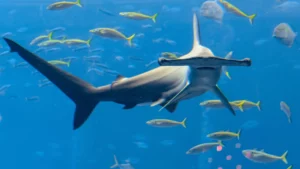 | 2.5–3.5 m (8–12 ft) | Low | Darwin, Wolf, Gordon Rocks, Kicker Rock; mainland offshoreSchools of hundreds in the Galápagos, the largest left anywhere. Critically endangered and heavily fished on the mainland. |
Whale SharkRhincodon typus | 8–14 m at Darwin (adults elsewhere 6–12 m) | Low | Darwin and Wolf, June–November; Isla de la Plata, June–SeptemberThe Galápagos animals are almost all very large, apparently pregnant females, a mystery still being studied. Harmless filter feeder. |
Whitetip Reef SharkTriaenodon obesus | 1.2–1.6 m (4–5 ft) | Low | Lava channels and ledges on every island: Las Tintoreras, Los Túneles, Gordon RocksThe tintorera of Isabela. Rests in rows by day; the easiest shark to see in Ecuador. |
Blacktip SharkCarcharhinus limbatus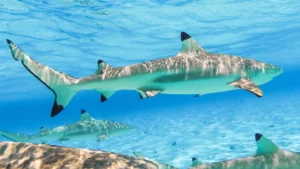 | 1.5–2.5 m (5–8 ft) | Moderate | Mangrove lagoons and shallows (Tortuga Bay, Los Túneles); mainland surf beachesThe black-tipped shark of the Galápagos shallows; the Indo-Pacific blacktip reef shark does not occur here. Juveniles nurse in the lagoons. |
Silky SharkCarcharhinus falciformis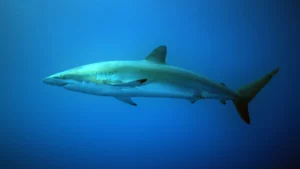 | 2–3 m (7–10 ft) | Moderate | Blue water at Darwin and Wolf; the main shark of the mainland tuna groundsSleek and bold around boats. The most heavily landed shark in Ecuador's ports. |
Tiger SharkGaleocerdo cuvier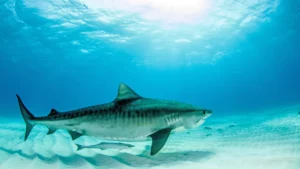 | 3–4.5 m (10–15 ft) | High | Wolf, Darwin, Isabela's north; increasingly seen since the 2000sSightings have risen with the recovery of green turtle nesting. Not implicated in any Ecuadorian incident. |
Silvertip SharkCarcharhinus albimarginatus | 2–2.5 m (7–8 ft) | Moderate | Deep walls at Wolf and DarwinWhite-edged fins; approaches divers closely. Less common than the Galápagos shark. |
Dusky SharkCarcharhinus obscurus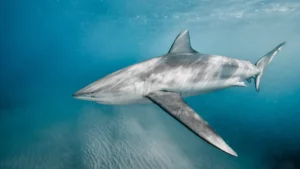 | 3–3.6 m (10–12 ft) | Moderate | Outer islands and the mainland shelf edgeLarge, slow-growing and endangered; easily confused with the Galápagos shark, which has a taller dorsal fin. |
Bull SharkCarcharhinus leucas | 2–3.4 m (7–11 ft) | High | Gulf of Guayaquil mangroves and river mouths; rare in the GalápagosThe estuarine shark of the mainland, entering the Guayas system. Seldom seen by visitors. |
Smooth Hammerhead SharkSphyrna zygaena | 2.5–4 m (8–13 ft) | Low | Cooler water off the mainland and the western GalápagosThe temperate hammerhead, common in the mainland catch; occasional at Cabo Marshall. |
Great Hammerhead SharkSphyrna mokarran | 3.5–4.5 m (11–15 ft) | Low | Rare; mainland offshore and occasional Galápagos recordsSolitary and critically endangered. A rare sight anywhere in Ecuador. |
Pacific BonnetheadSphyrna tiburo | 0.9–1.2 m (3–4 ft) | Low | Mainland mangroves and estuariesThe Eastern Pacific population is sometimes treated as its own species. Small crab-eater, harmless. |
Scoophead SharkSphyrna media | 1–1.5 m (3–5 ft) | Low | Muddy estuaries of the Gulf of GuayaquilA poorly known small hammerhead, critically endangered through gillnet fishing. |
Galápagos Bullhead SharkHeterodontus quoyi | 0.6–1 m (2–3.5 ft) | Low | Rocky reefs of the Galápagos and Peru, resting under ledgesA spotted, pig-snouted endemic that crushes sea urchins. Divers find it at Santa Fe and Floreana. |
Pacific Nurse SharkGinglymostoma unami | 2–2.8 m (7–9 ft) | Low | Mainland rocky reefs and mangroves from Esmeraldas to Santa ElenaDescribed as a species distinct from the Atlantic nurse shark in 2015. Sluggish and harmless. |
Lemon SharkNegaprion brevirostris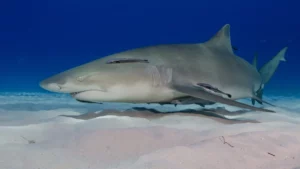 | 2.4–3 m (8–10 ft) | Low | Mainland mangrove coast; occasionalThe Eastern Pacific population of the Atlantic lemon shark. Rare in Ecuador compared with Mexico. |
Pacific Sharpnose SharkRhizoprionodon longurio | 0.9–1.1 m (3–3.5 ft) | Low | Mainland inshore shelf; abundant in the artisanal catchThe commonest small shark on the mainland coast. No risk to people. |
Whitenose SharkNasolamia velox | 1.2–1.5 m (4–5 ft) | Low | Mainland coastal watersFound only in the eastern Pacific, with a whitish patch on the snout tip. Landed at Manta and Santa Rosa. |
| Smalltail SharkCarcharhinus porosus | 0.9–1.2 m (3–4 ft) | Low | Gulf of Guayaquil estuariesSmall estuarine shark, critically endangered across its range. |
Pacific AngelsharkSquatina californica | 1–1.5 m (3–5 ft) | Low | Sandy bottoms off the mainlandFlat ambush predator buried in sand. Bites only when stepped on or handled. |
Blue SharkPrionace glauca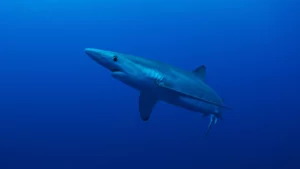 | 2–3 m (7–10 ft) | Low | Open ocean between the mainland and the islandsOne of the two most landed sharks in Ecuador's ports. Never inshore. |
Shortfin Mako SharkIsurus oxyrinchus | 2.5–3.5 m (8–12 ft) | Moderate | Deep offshore water; longline catchFast pelagic hunter. The longfin mako is also taken offshore. |
Pelagic Thresher SharkAlopias pelagicus | 2.5–3.5 m (8–12 ft) incl. tail | Low | Offshore; the most landed thresher at MantaHarmless. Ecuador's fishery lands more threshers than almost any other country. |
Bigeye Thresher SharkAlopias superciliosus | 3–4 m (10–13 ft) incl. tail | Low | Deep offshore waterEnormous eyes for hunting at depth. Longline bycatch; the common thresher is also recorded. |
Great white sharks are the question everyone asks and the answer is: not in any meaningful sense. The Eastern Pacific white shark population ranges from California to the Gulf of California and Guadalupe Island, and although satellite tags have shown occasional animals travelling far offshore, there is no confirmed white shark record from Galápagos dive sites or Ecuadorian beaches. The large grey sharks reported as “great whites” by surfers at Montañita or Tortuga Bay are Galápagos sharks, blacktips or bull sharks. Oceanic whitetips and crocodile sharks live in the open ocean between the islands and the mainland and are met by the tuna fleet, not by swimmers.
Where to see sharks in Ecuador
The Galápagos are the reason people come, but the islands split into two very different experiences: liveaboard diving at Darwin and Wolf, and land-based snorkelling from the inhabited islands that anyone can do. The mainland adds one site of its own. These are the places that deliver.
- Darwin Island (Darwin's Arch), GalápagosThe most shark-dense dive site on Earth. Hundreds of scalloped hammerheads, Galápagos sharks and silkies on every dive, and from June to November whale sharks, almost all huge pregnant females, cruise past the arch. Liveaboard only, advanced divers, 14 hours north of Santa Cruz.
- Wolf Island, GalápagosDarwin's twin, with the same hammerhead schools plus Galápagos sharks under the boat, blacktips in the shallows and occasional tiger sharks and silvertips at Shark Bay and Landslide. Divers hook into the current and let the sharks come to them.
- Gordon Rocks, Santa CruzA collapsed volcanic crater a short boat ride from Puerto Ayora and the best day-trip hammerhead dive in the islands. Schools of scalloped hammerheads, Galápagos sharks and whitetips in strong current. Advanced divers only; the site of the 2021 bite in the record.
- Kicker Rock (León Dormido), San CristóbalA split rock rising 150 m from the sea with a channel between the halves. Snorkellers as well as divers see Galápagos sharks, blacktips, whitetips and hammerheads in the channel. Day trips from Puerto Baquerizo Moreno.
- Las Tintoreras and Los Túneles, IsabelaLava channels where whitetip reef sharks, the tintoreras of the name, rest in rows in a metre of water, visible from the walkway without getting wet. Los Túneles adds snorkelling with whitetips, juvenile blacktips and Galápagos sharks under lava arches.
- Punta Vicente Roca and Cabo Marshall, IsabelaThe cold-water western side, fed by the Cromwell upwelling: mola mola, penguins and, at Cabo Marshall, hammerheads and mantas. Punta Vicente Roca is a snorkel and dive site and appears in the record for a 2015 bite.
- Tortuga Bay, Santa CruzA white-sand beach a 45-minute walk from Puerto Ayora, with a lagoon where juvenile blacktips and whitetips patrol the mangrove edge. Swim in the calm Playa Mansa; Playa Brava, the surf beach, is where a surfer was bitten in 2014.
- Isla de la Plata, Machalilla National Park (mainland)The mainland's best chance: a rocky island off Puerto López with whale sharks and humpback whales from June to September, blacktips and Galápagos sharks on the drop-offs. Day trips from Puerto López, with manta rays as a bonus in the same months.
If you dive, a liveaboard to Darwin and Wolf is the single best shark trip in the Americas and needs advanced certification and experience in current. If you snorkel, base yourself on Santa Cruz or Isabela: Las Tintoreras, Los Túneles, Kicker Rock and Tortuga Bay put you next to sharks in shallow, calm water with no training required. On the mainland, Isla de la Plata in July or August is the one site that competes.
Best time of year to see sharks in Ecuador
The Galápagos have two seasons and each favours a different shark.
- Cool season (garúa), June to November: the Humboldt Current dominates, water drops to 18–22 °C, seas are choppier and visibility lower, but the nutrients bring the biggest animals. Whale sharks are at Darwin and Wolf, hammerhead schools are at their densest, and mola mola appear on the western side. Divers need a 7 mm suit or more.
- Warm season, December to May: the Panama Current takes over, water reaches 24–28 °C, seas are calm and visibility is best. Hammerheads are still present at Darwin, Wolf and Gordon Rocks in smaller numbers, whale sharks are absent, and this is the best period for snorkellers around the central islands.
- Mainland coast, June to September: humpback whale and whale shark season at Isla de la Plata and Puerto López; cooler, greener water inshore.
- Mainland coast, December to April: warm, clear water and the surf season at Montañita and the Santa Elena beaches, when blacktips and bull sharks are closer to shore.
There is no month without sharks in the Galápagos. Whitetip reef sharks, Galápagos sharks and blacktips are resident, and Las Tintoreras shows its rows of sleeping whitetips every day of the year.
Shark attacks in Ecuador: what the record actually shows
For a country whose islands hold the densest shark population on record, Ecuador's incident list is short and entirely non-fatal. The shark attacks in Ecuador page carries the whole file. The database holds 11 records between 1954 and 2023 and not one of them is a death; the newest six are listed below:
- 2023 · Mosquera Islet, Galapagos IslandsSnorkeling — Serious injury to right legSpecies not identified · not fatal
- 2021 · GalapagosDiving — Single bite to right thigh Species: Galapagos shark · not fatal
- 2018 · Santa Fe Island, Galapagos IslandsSnorkeling — Injuries to right footSpecies: Galapagos shark? · not fatal
- 2015 · Punta Vicente Roca, Isabella Island, Galapagos IslandsSnorkeling — Lacerations to left calfSpecies: Galapagos shark · not fatal
- 2014 · Playa Brava, Turtle Bay, Santa Cruz IslandSurfing — Superficial injury to left calfSpecies: Galapagos shark · not fatal
- 2011 · Barandúa Beach, Santa ElenaSurfing — Lacerations to left thigh and calfSpecies not identified · not fatal
The pattern is unusually consistent. Ten of the eleven cases are from the Galápagos, and the eight modern ones follow a single script: a surfer or snorkeller in shallow water near a rocky point, a single bite to the lower leg, foot or thigh, and a shark that leaves immediately. The species, where it could be identified, was the Galápagos shark, at Punta Vicente Roca in 2015, Playa Brava in 2014, the 2021 diving case and probably Santa Fe in 2018. Surfers account for the 2007 San Cristóbal, 2009 Isabela and 2014 Santa Cruz cases and the only mainland entry, at Barandúa Beach in Santa Elena in 2011; snorkellers for Punta Vicente Roca 2015, Santa Fe 2018 and Mosquera Islet 2023, the latter a serious leg injury. The two oldest entries belong to a different world: crewmen of American tuna clippers in 1954 and 1959, one standing on a stern platform that the waves had submerged, and one washed overboard into a school of feeding fish and bitten by several 1.8 m sharks chasing the same bait.
What the record does not contain is any incident at Darwin or Wolf, where divers spend hours a day surrounded by hundreds of sharks, or any injury at Las Tintoreras, Los Túneles or Kicker Rock, the snorkelling sites that thousands of families visit every year. Bites happen where a person is alone at the surface in murky or surging water near a hunting shark, and almost never in clear water with a group. The standard advice applies to the surf beaches: do not surf alone at dawn or dusk, avoid river mouths after rain on the mainland, and get out calmly if a Galápagos shark starts circling in the shallows.
Is it safe to swim and snorkel with sharks in Ecuador?
In the Galápagos, yes, with the caveat that the sharks here are bigger and bolder than reef sharks elsewhere. The Galápagos shark grows to 3 m and is inquisitive; it will approach a snorkeller to look, and the correct response is to face it, stay vertical and calm, and move slowly back towards the boat or the rocks. It has bitten people who were splashing at the surface in surge, never a snorkeller who was watching it. Whitetip reef sharks at Las Tintoreras are so sedate that the rule is simply not to block the channel they use. Blacktips in Tortuga Bay's lagoon are juveniles and bolt at the first shadow. Hammerheads are the shyest fish in the islands and give divers a wide berth unless they hold still and breathe quietly.
Whale sharks at Darwin are harmless but enormous, 12 m or more, and encountered in current at depth; the park requires that divers stay clear of the animal and never touch it, and the guides enforce it. On the mainland, whale shark trips from Puerto López follow the usual rules: enter quietly, keep 3 to 4 m away, no flash, no chasing. Galápagos National Park rules prohibit shark feeding anywhere in the islands, and there are no baited shark dives, which is one reason the sharks here remain uninterested in people.
Cold water is the real hazard for many visitors. The garúa-season Galápagos can be 18 °C with strong current, and the majority of dive emergencies at Darwin and Wolf involve exhaustion, separation from the group or decompression problems, not sharks. Choose an operator with experienced guides, use a surface marker and a reef hook, and treat the sharks as the safest part of the trip.
Shark conservation in Ecuador
Ecuador contains both the best and some of the worst shark news in the Pacific. The best is the Galápagos Marine Reserve, created in 1998 around the islands that UNESCO had already listed as the first World Heritage Site in 1978. It covers about 138,000 square kilometres, bans industrial fishing and all shark fishing, and in January 2022 it was joined by the Hermandad Marine Reserve, a further 60,000 square kilometres extending north-east along the Cocos Ridge towards Costa Rica so that migrating hammerheads, whale sharks and turtles are protected along the corridor they actually use. A 2023 debt-for-nature agreement, the largest ever signed, converted around 1.6 billion dollars of Ecuadorian debt into long-term funding for the reserve's management.
The worst is the mainland fishery. A 2007 presidential decree banned targeted shark fishing but allowed “incidental” catch to be landed and sold, and the loophole is wide enough that Ecuador is consistently among the top exporters of shark fins in the world, with tens of thousands of tonnes of shark landed each year at Manta, Santa Rosa and Esmeraldas, much of it thresher, blue, silky, mako and hammerhead. Foreign fleets add to the pressure: in 2017 the Chinese reefer Fu Yuan Yu Leng 999 was seized inside the Galápagos reserve with more than 6,000 sharks aboard, including juveniles and CITES-listed hammerheads, and its crew were jailed. Hammerheads, silky sharks, threshers, makos and whale sharks are now all on CITES Appendix II, which obliges Ecuador to prove exports are sustainable, and the country has expanded observer coverage and satellite monitoring since. Visitors help by choosing Galápagos operators that follow park rules, reporting tagged sharks and illegal fishing to the park, and never buying shark products in mainland markets. Our guide to why sharks are endangered explains why the slow-breeding hammerhead has so little margin for error.
Sharks in neighbouring waters
The Galápagos sit at one corner of the Eastern Tropical Pacific's shark triangle. Costa Rica's Cocos Island and Colombia's Malpelo are the other two hammerhead strongholds, and the same tagged sharks are recorded moving between all three. Panama's Coiba lies on the same migration corridor. On the mainland side, Peru shares the Humboldt Current and a large shark fishery, Chile continues the cold-water fauna south, and Mexico holds the great white sharks at Guadalupe that Ecuador does not have. Browse the complete list of countries on sharks around the world.
Frequently asked questions
Are there sharks in Ecuador?
Yes, and the Galápagos have more sharks by weight than any reef ever surveyed. Twenty-five species have solid records. In the islands the everyday sharks are Galápagos sharks, scalloped hammerheads, whitetip reef sharks and blacktips, with whale sharks at Darwin and Wolf from June to November; the mainland has silky, blue and sharpnose sharks offshore and bull sharks in the Gulf of Guayaquil.
Have there been shark attacks in Ecuador?
Eleven are recorded between 1954 and 2023 and none was fatal. Eight modern cases happened in the Galápagos, mostly single bites to the leg of a surfer or snorkeller by a Galápagos shark, one on a mainland surf beach in Santa Elena in 2011, and the two oldest involved tuna fishermen off the islands in the 1950s.
Are there great white sharks in the Galápagos?
No confirmed record exists. The Eastern Pacific white shark population lives between California and Mexico's Guadalupe Island, and although tagged animals sometimes roam far offshore, none has been documented at a Galápagos dive site or an Ecuadorian beach. Large grey sharks reported as great whites have been Galápagos sharks or bull sharks.
Is it safe to snorkel with sharks in the Galápagos?
Yes. Thousands of visitors snorkel with whitetip reef sharks at Las Tintoreras, blacktips at Tortuga Bay and Galápagos sharks and hammerheads at Kicker Rock every year without incident. Stay with your group, keep calm and vertical if a Galápagos shark approaches, and avoid surfing alone at dawn or dusk, which is when the few recorded bites happened.
When is the best time to see hammerheads in the Galápagos?
They are present all year, but the schools at Darwin, Wolf and Gordon Rocks are densest in the cool season from June to November, when the Humboldt Current brings nutrient-rich 18 to 22 degree water. The warm season from December to May has calmer seas, better visibility and smaller but still reliable groups.
When can you see whale sharks in Ecuador?
At Darwin and Wolf in the Galápagos from June to November, on liveaboard dives, where almost every whale shark is a very large female. On the mainland, Isla de la Plata off Puerto López has whale sharks and humpback whales from June to September on day trips that also see manta rays.
Can you dive with sharks on the mainland of Ecuador?
Yes, though it is quieter than the islands. Isla de la Plata in Machalilla National Park has blacktips, Galápagos sharks, mantas and seasonal whale sharks from June to September, reached by boat from Puerto López. Elsewhere the mainland's sharks are mostly offshore pelagic species seen by fishermen rather than divers.
Is shark fishing legal in Ecuador?
In the Galápagos Marine Reserve, no; all shark fishing has been banned there for decades and the reserve was extended in 2022. On the mainland a 2007 decree banned targeted shark fishing but allows incidental catch to be landed, and through that loophole Ecuador remains one of the world's largest shark and fin exporters. CITES-listed species now need export permits.
What sharks live in the Galápagos that live nowhere else?
The Galápagos bullhead shark, a small spotted species found only around the islands and coastal Peru, is the true local. The Galápagos shark, despite its name, occurs at oceanic islands worldwide, but the archipelago is where it was first described in 1905 and where it is most abundant. Whitetip reef sharks, hammerheads and whale sharks are wide-ranging species that simply gather here in unusual numbers.
Is the Galápagos shark dangerous?
It is a large, inquisitive shark that will approach people, and it is the species behind most of Ecuador's recorded bites, all single, non-fatal wounds to surfers or snorkellers at the surface. Divers meet it constantly at Darwin, Wolf and Gordon Rocks without trouble. Treat it with respect, do not splash or flee, and it loses interest quickly.
References

A small team focused on researching sharks and making marine biology easy to understand. Every page is reviewed against current species records and the SharkSider attack database, and updated when new incidents or research appear.
Published January 11, 2023 · Last updated September 21, 2026 · Incident data from the SharkSider attack database (11 records for Ecuador, 0 fatal).


