
Yes, there are sharks in the Dominican Republic, 19 species, but the beaches of Punta Cana and Bayahibe sit behind reefs that keep the larger ones outside. The nurse shark is by far the most common and is the species snorkellers see; Caribbean reef sharks patrol the outer walls, blacktips and lemon sharks use the shallows and mangroves, bull sharks live around the river mouths, and tiger, silky and hammerhead sharks stay in deep water offshore.
The safety record is short. SharkSider's database holds seven entries between 1963 and 2016, two of them flagged as fatal: two swimmers swept out at the port of Haina in 1963 and a diver at Boca Chica in 2010. Two further entries are maritime disasters, the 1987 ferry fire in the Mona Passage and the 1996 Birgenair crash off Puerto Plata, in which sharks reached people who were already in the water. The most recent case is a leg injury to a woman wading at Bávaro Beach in 2016.
- Shark species recorded19 with solid records
- ProtectionShark and ray capture banned 2017; marine parks since 1975
- Most seen from the beachNurse shark (tiburón gata)
- Signature encounterNurse and reef sharks at Bayahibe and Catalina Island
- Incidents in the database7 (1963–2016), 2 fatal; last case 2016
- Water temperature26–27 °C in winter, 28–29 °C in late summer

On this page
- Where sharks live in Dominican waters
- List of the different types of sharks in the Dominican Republic
- Where to see sharks in the Dominican Republic
- Best time of year to see sharks in the Dominican Republic
- Shark attacks in the Dominican Republic: what the record actually shows
- Is it safe to swim and snorkel in the Dominican Republic?
- Shark conservation in the Dominican Republic
- Sharks in neighbouring waters
- Frequently asked questions
- References
Where sharks live in Dominican waters
Hispaniola is a big, mountainous island with a narrow shelf, and that shapes where its sharks are. Along the south coast a fringing reef runs from Santo Domingo east past La Romana and Bayahibe to Punta Cana, with the shelf dropping to several hundred metres within a kilometre or two of the beach. Inside the reef the water is shallow, warm and sandy, which is nurse shark and juvenile blacktip territory; outside it the wall belongs to Caribbean reef sharks, and the blue water beyond to silky sharks, makos and the occasional tiger. The Punta Cana and Bávaro beaches are protected by one of the longest continuous reef lines in the country, which is exactly why large sharks so rarely turn up in the swimming zone there.
The north coast is Atlantic and rougher. The Samaná Peninsula juts out into water that drops straight into the deep, and beyond it lie the Silver Bank and Navidad Bank, two shallow coral banks in open ocean where most of the North Atlantic's humpback whales come to breed each winter. Silky sharks, tiger sharks and oceanic whitetips are the animals of those banks and of the Mona Passage, the 130 km strait between the Dominican Republic and Puerto Rico that is one of the deepest and most turbulent channels in the Caribbean. Both maritime disasters in the database happened in that stretch of open water.
The third habitat is the one tourists never see: the river mouths and mangrove lagoons. The Haina, Ozama, Yaque del Norte and Yuna rivers all pour fresh water into the sea, and the mangroves of Monte Cristi, Samaná Bay and the Saona lagoons are where bull sharks push into brackish water and where lemon sharks, blacktips and bonnetheads drop their pups. Dominican fishermen have always known these animals; the smaller ones reach the markets as cazón, the bull shark is the tiburón toro, and the nurse shark is the tiburón gata.
List of the different types of sharks in the Dominican Republic
Every shark in the table has a solid Dominican record, drawn from fisheries landings, research and dive-centre sightings on both coasts. Lengths are ordinary adults rather than record fish, and the risk column is judged for a swimmer or snorkeller at a Dominican beach, not a diver who has gone looking for the species on an outer wall or an offshore bank. One name to clear up: the “reef shark” of Dominican dive briefings is the Caribbean reef shark (Carcharhinus perezi), not the blacktip reef shark of the Indo-Pacific, which does not occur in the Atlantic.
| Species | Adult size | Risk to swimmers | Where in Dominican Republic & notes |
|---|---|---|---|
Nurse SharkGinglymostoma cirratum | 2.2–3 m (7–10 ft) | Low | Every reef on both coasts: Bayahibe, Punta Cana, Catalina, SosúaThe tiburón gata, the shark snorkellers actually see. Docile bottom-dweller; bites only when grabbed or fed. |
Caribbean Reef SharkCarcharhinus perezi | 2–2.5 m (7–8 ft) | Moderate | Outer reef walls: Catalina, Cabo Cabrón, JaraguaThe region's signature reef shark, cautious and usually seen at a distance on the drop-off. |
Blacktip SharkCarcharhinus limbatus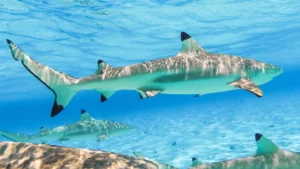 | 1.5–2.5 m (5–8 ft) | Moderate | Shallow coastal water, surf zones and bays; pups in the Monte Cristi mangrovesFast, jumping fish-hunter. Responsible for minor bites on waders elsewhere in the Atlantic; nervous around people. |
Bull SharkCarcharhinus leucas | 2.2–3.2 m (7–10 ft) | High | River mouths (Haina, Ozama, Yaque del Norte), Samaná Bay, mangrove lagoonsThe tiburón toro, at home in brackish water. The species most likely behind the 1963 Haina case. |
Tiger SharkGaleocerdo cuvier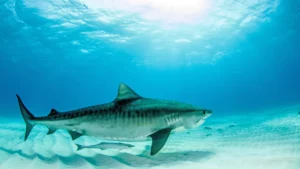 | 3–4.5 m (10–15 ft) | High | Deep reef edges, Silver Bank, Mona PassageRarely inside the reefs. Seen by liveaboards on the Silver Bank and by longliners offshore. |
Lemon SharkNegaprion brevirostris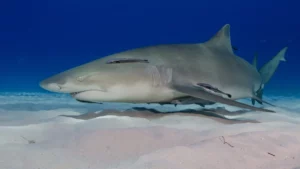 | 2.4–3 m (8–10 ft) | Low | Mangroves and sandy lagoons: Monte Cristi, Saona, JaraguaYellow-brown, slow and easy to see in knee-deep water. Juveniles spend years in the mangrove nurseries. |
Great Hammerhead SharkSphyrna mokarran | 3.5–4.5 m (11–15 ft) | Moderate | Deep reef edges and banks; uncommonHunts stingrays over sand. Critically endangered; a rare sight for divers off Samaná and the south-west. |
Scalloped Hammerhead SharkSphyrna lewini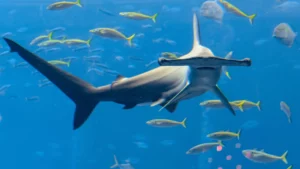 | 2.5–3.5 m (8–12 ft) | Low | Offshore and the Mona Passage; occasional on deep wallsSchooling deep-water hammerhead, still landed by longliners despite its CITES listing. |
Bonnethead SharkSphyrna tiburo | 0.9–1.2 m (3–4 ft) | Low | Seagrass and shallow bays in the north-westA small, shovel-headed hammerhead that eats crabs and even seagrass. Harmless and skittish. |
Silky SharkCarcharhinus falciformis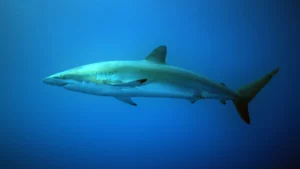 | 2–3 m (7–10 ft) | Moderate | Open water beyond the shelf; Silver Bank; with tuna and dolphinsThe commonest large shark offshore and a frequent visitor to liveaboards on the banks. Bold around bait, not around swimmers. |
| Oceanic Whitetip SharkCarcharhinus longimanus | 2–3 m (7–10 ft) | High | Deep open water: Mona Passage, north of the Silver BankThe shark of shipwrecks and open-ocean disasters, and the likely species in the 1987 ferry case. Never on the beaches. |
Dusky SharkCarcharhinus obscurus | 3–3.6 m (10–12 ft) | Moderate | Shelf edge and offshore, mostly the Atlantic sideA big, slow-growing coastal-pelagic shark, endangered across the western Atlantic. |
Sandbar SharkCarcharhinus plumbeus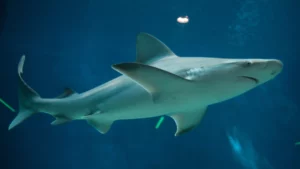 | 1.8–2.4 m (6–8 ft) | Low | Shelf waters and deeper bays on both coastsTall-finned, bottom-oriented and timid. Pups use the same estuaries as the bull sharks. |
| Caribbean Sharpnose SharkRhizoprionodon porosus | 0.7–1 m (2.5–3.5 ft) | Low | Shallow coastal water everywhere; the main cazón of the marketsA small, abundant shark that fishermen land by the crate. Too small to hurt anyone. |
Shortfin Mako SharkIsurus oxyrinchus | 2–3 m (7–10 ft) | Moderate | Offshore sportfishing grounds off Punta Cana and the north coastFast pelagic hunter taken on marlin and tuna trips. Endangered and now protected nationally. |
Blue SharkPrionace glauca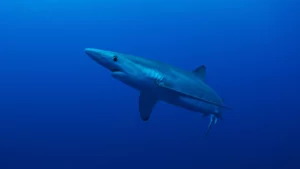 | 2–3 m (7–10 ft) | Low | Deep Atlantic water north of the island, mostly in the cooler monthsA cool-water pelagic at the southern edge of its range; rare inside the Caribbean Sea. |
Bigeye Thresher SharkAlopias superciliosus | 3–4 m (10–13 ft) incl. tail | Low | Deep oceanic water; longline bycatchHuge eyes for hunting squid at depth. Harmless and almost never seen alive by anyone but fishermen. |
Common Thresher SharkAlopias vulpinus | 3–5 m (10–16 ft) incl. tail | Low | Offshore, mostly the Atlantic side; uncommonStuns schooling fish with its scythe-shaped tail. A sportfishing record rather than a diving one. |
Whale SharkRhincodon typus | 6–10 m here (adults to 12 m+) | Low | Occasional sightings along the south-east and north coastsHarmless plankton feeder; a few reports a year, no reliable season. |
Great White SharkCarcharodon carcharias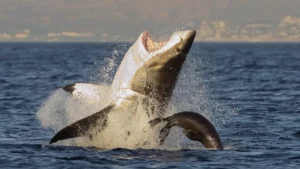 | 4–6 m (13–20 ft) | n/a | Not recorded in the Dominican RepublicListed only because it is the most-asked question. No confirmed Dominican record; the water is too warm for it to stay. |
The great white is the question every visitor asks, and the answer is that there is no confirmed record of a great white shark in Dominican waters. Tagged white sharks have been tracked through the Bahamas and the Gulf of Mexico in winter, but the warm water south of Hispaniola is outside their normal range, and every “great white” reported by a Punta Cana tourist has turned out to be a bull, tiger or silky shark. The oceanic whitetip, which is real here, is the one species in the table that genuinely earns its reputation, and it earns it only in open water far from any beach.
Where to see sharks in the Dominican Republic
The Dominican Republic is not a shark-diving destination in the way the Bahamas is, and nobody runs baited shark dives here. What it has is a long reef line with resident nurse sharks, a few outer walls with Caribbean reef sharks, and offshore banks where the big animals live. These are the places with the most reliable sightings.
- Bayahibe and Cotubanamá National ParkThe country's main dive area, on the south-east coast between La Romana and Saona Island. Nurse sharks rest under ledges on almost every reef, and Caribbean reef sharks appear on the deeper sites. The mangrove lagoons of Saona hold juvenile lemon sharks.
- Catalina Island wallA small island off La Romana with a sheer wall dropping from 12 m to well over 100 m. The best chance on the south coast of a Caribbean reef shark cruising the drop-off, with nurse sharks on the shallow shelf above.
- Punta Cana and Bávaro reefThe resort coast. Nurse sharks and southern stingrays live on the reef a few hundred metres off the beach and are the target of snorkel tours; a fenced ocean enclosure at Cap Cana keeps nurse sharks for guaranteed encounters. Large sharks are rare inside the reef, and the 2016 wading injury at Bávaro is the only record on this coast.
- Cabo Cabrón and Las Galeras, SamanáThe tip of the Samaná Peninsula, where a wall drops into Atlantic deep water within swimming distance of shore. Caribbean reef sharks and, occasionally, hammerheads on the deep sites; humpback whales pass close by from January to March.
- Silver Bank (Banco de la Plata)A coral bank 100 km north of Puerto Plata, protected since 1986 as part of the Marine Mammal Sanctuary. Liveaboards visit for humpback whales in winter; silky and tiger sharks are seen around the boats and the shallow coral heads.
- Monte Cristi and Cayos Siete HermanosThe dry north-west corner, with the country's largest mangrove system and a string of low sand cays. A nursery for lemon, blacktip and bull sharks, and the place to see bonnetheads over seagrass. Visited by boat from Monte Cristi town.
- La Caleta Underwater National ParkThe country's first underwater park, created in 1986 next to Santo Domingo's airport. The wreck of the Hickory and the reef beyond it hold nurse sharks; the record's 2010 Boca Chica fatality happened a few kilometres east.
- Bahía de las Águilas and Jaragua National ParkThe remote south-west, close to the Haitian border, with the least fished reefs in the country. Nurse sharks, Caribbean reef sharks and lemon sharks on the shallow platform, accessed by boat from Cabo Rojo or La Cueva.
For a first shark, Bayahibe is the safe bet: a two-tank morning almost always includes a nurse shark, and the Catalina wall adds the chance of a reef shark. For big animals, a winter liveaboard to the Silver Bank is the only realistic route, and the sharks there are a side-show to the whales.
Best time of year to see sharks in the Dominican Republic
Water temperature barely changes, so the seasons are about weather and sea state rather than the sharks moving.
- December to April, the dry season: the coolest water of the year at 26–27 °C, low rainfall and the best visibility on the south coast. Trade winds and Atlantic swell make the north coast rough, which is when Samaná and Sosúa diving is most often blown out. Humpback whales are on the Silver Bank and in Samaná Bay from mid-January to late March, and the liveaboards that follow them report silky and tiger sharks.
- May to July: the sea warms to 28 °C, the north coast settles and the reefs at Samaná and Monte Cristi become diveable. Nurse sharks are mating on the shallow reefs in early summer, which is when snorkellers at Bayahibe and Punta Cana see them out in the open rather than under ledges.
- August to November, hurricane season: the warmest water at 28–29 °C and the calmest seas between storms, with excellent visibility on both coasts. The risk is a hurricane closing everything for a week; September and October are the peak months.
- Whale sharks: irregular. A few sightings a year are reported along the south-east coast and off the north coast, with no fixed season and no operator that can promise one.
The offshore sharks, silky, mako and oceanic whitetip, are present all year in the Mona Passage and beyond the shelf; sportfishing boats out of Punta Cana and Cabeza de Toro meet them in every month.
Shark attacks in the Dominican Republic: what the record actually shows
The Dominican Republic hosts more than ten million visitors a year, most of them on beaches, and its incident record fits on a single screen. Each case lives on the shark attacks in the Dominican Republic page. The database holds seven entries between 1963 and 2016, two of them flagged as fatal, and these are the six most recent (the full list, updated weekly, is on the attacks page):
- 2016 · Bavaro Beach, Punta Cana, Altagracia ProvinceWading — Avulsion injury to lower legSpecies not identified · not fatal
- 2011 · Playa Jackson, Samaná ProvinceFishing — Severe injuries to left arm provoked incidentSpecies not identified · not fatal
- 2010 · Boca ChicaDiving — FatalSpecies not identified · fatal
- 1996 · Boeing 757 enroute from Porta Plata, 12 miles off the north coastBoeing 757 enroute from Porta Plata plunged into the sea — 106 bodies were recovered, some had been bitten by sharksSpecies not identified · not fatal
- 1987 · Mona Passage, Between DR and Puerto RicoVessel caught fire & capsized, survivors in the water — Of 160 people on board, >100 missingSpecies: 40 to 50 sharks attacked survivors in the water · not fatal
- 1969SurfingSpecies not identified · not fatal
Read them one at a time and a pattern appears. Two entries are not attacks on swimmers at all but disasters at sea. In October 1987 a vessel carrying about 160 people caught fire and capsized in the Mona Passage, and the record notes that 40 to 50 sharks moved in on the survivors; more than 100 people were never found. In February 1996 the Birgenair Boeing 757 that had just left Puerto Plata went into the sea 12 miles off the north coast with 189 people on board, and some of the 106 bodies recovered had been bitten. Neither is counted as a shark fatality, because the deaths could not be attributed to the sharks, but both show what the oceanic species of the Mona Passage do when people end up in deep water.
The two fatal entries are half a century apart. In August 1963 two young men swimming at the port of Río Haina, west of Santo Domingo, were caught in heavy seas and attacked by a group of sharks; an eyewitness described one man being thrown into the air. In November 2010 a 21-year-old diver was killed at Boca Chica, the beach resort east of the capital. The remaining three are minor or unclear: a surfer in 1969 with no location or injury recorded, a fisherman at Playa Jackson in Samaná who suffered severe arm injuries in 2011 in an incident the database marks as provoked, and a woman wading at Bávaro Beach in Punta Cana in February 2016 who lost tissue from her lower leg. That last case is the only one on the resort coast in more than fifty years of mass tourism. The standard advice covers all of it: swim inside the reef in daylight, stay away from river mouths, fishing boats and fish-cleaning stations, and never swim in the open sea beyond the shelf.
Is it safe to swim and snorkel in the Dominican Republic?
On the resort beaches, yes. Punta Cana, Bávaro, Bayahibe, Juan Dolio and Boca Chica all sit inside a reef or a natural breakwater, in water that is shallow, sandy and constantly used by thousands of people. The nurse sharks that live on those reefs are bottom-dwelling suction feeders with small mouths; they bite only when grabbed, cornered or hand-fed, and even then the injury is a hold rather than a slash. Every nurse shark bite on record anywhere in the Caribbean involved someone touching the animal first, and Dominican snorkel guides now brief guests not to.
Caribbean reef sharks on the outer walls are cautious and keep to the drop-off. If one approaches a diver it is usually curiosity about a camera or a speared fish; stay upright, keep it in view and it will turn away. Blacktips and lemon sharks in the shallows are more nervous than you are. The animals to respect are the bull shark, which uses the river mouths and the murky water off Santo Domingo, Haina and the Yaque del Norte, and the tiger and oceanic whitetip, which live offshore. That translates into three practical rules: do not swim near river mouths or in brown water after rain, do not swim at dusk or at night, and do not swim from boats in deep water off the north coast or in the Mona Passage.
The actual hazards on Dominican beaches are the ones lifeguards deal with every week: rip currents on the exposed north-coast beaches at Cabarete and Playa Grande, boat traffic in the swimming zones, sunburn, and the occasional jellyfish bloom. The sea urchins on the reef flats hurt more people in a season than sharks have in sixty years.
Shark conservation in the Dominican Republic
The Dominican Republic moved earlier than most of the Caribbean. In 2017 the Ministry of Environment and Natural Resources issued a resolution prohibiting the capture, retention, sale and trade of sharks and rays in Dominican waters, turning every species on this page into a protected animal on paper. That built on a long history of marine parks: Cotubanamá (formerly Parque Nacional del Este) has covered the Bayahibe and Saona reefs since 1975, Jaragua has protected the south-west since 1983, La Caleta became the first underwater national park in 1986, and the Silver and Navidad Banks were declared a humpback whale sanctuary the same year and extended to Samaná Bay in 1996. The country has also listed hammerheads, oceanic whitetips and silky sharks under CITES alongside the rest of the region, which regulates the export of fins.
Enforcement is the weak point. The artisanal fleet is large, gillnets set in mangrove channels still take juvenile lemon, blacktip and bull sharks, longliners working the Mona Passage still land silky and hammerhead sharks as cazón, and on the Haitian side of the island fishing pressure is far heavier. Mangrove clearing for resorts along the east coast removes the nurseries the coastal species depend on, the invasive lionfish has changed the reef food web since it arrived in 2008, and hurricane damage and coral bleaching have thinned the reefs that feed everything. The positive signs are real: nurse sharks are as common as they have been in decades on the protected Bayahibe reefs, Caribbean reef sharks are being seen again on walls where they had disappeared, and dive operators now report sightings to national monitoring programmes. Our guide to why sharks are endangered sets out the regional picture.
Sharks in neighbouring waters
The Dominican Republic shares Hispaniola with Haiti, whose waters hold the same species under far heavier fishing pressure. Across the Mona Passage, Puerto Rico has the same offshore sharks and a longer incident list; Cuba to the west has the best-protected reefs in the Caribbean at Gardens of the Queen, where Caribbean reef sharks and silky sharks are abundant; and Jamaica lies south-west across the Jamaica Channel. To the north, the Bahamas is the region's shark-diving capital and a sanctuary since 2011, and the US Virgin Islands continue the Antilles chain east. The rest of the countries are on our sharks around the world index.
Frequently asked questions
Are there sharks in the Dominican Republic?
Yes. Nineteen species have solid records around the island. Nurse sharks live on every reef and are the ones snorkellers see, Caribbean reef sharks patrol the outer walls, blacktip and lemon sharks use the shallows and mangroves, bull sharks live around river mouths, and silky, tiger and hammerhead sharks stay in deep water offshore.
Are there sharks in Punta Cana?
Yes, mostly nurse sharks and southern stingrays on the reef that runs a few hundred metres off Bávaro Beach, which is why snorkel tours go there. The reef keeps larger sharks outside the swimming zone. The only incident on this coast in the database is a leg injury to a woman wading at Bávaro in February 2016.
Have there been shark attacks in the Dominican Republic?
Rarely. SharkSider's database lists seven entries from 1963 to 2016, two flagged as fatal: two swimmers at the port of Haina in 1963 and a diver at Boca Chica in 2010. Two further entries are the 1987 Mona Passage ferry fire and the 1996 Birgenair crash, where sharks reached people already in the water. The last case was in 2016.
Is it safe to swim in the Dominican Republic?
Yes. The resort beaches at Punta Cana, Bayahibe, Juan Dolio and Boca Chica lie inside reefs or breakwaters, and no swimmer at any of them has been killed by a shark. Stay inside the reef, avoid river mouths and murky water after rain, do not swim at dusk, and never swim from boats in deep water off the north coast.
Are there great white sharks in the Dominican Republic?
No. Not one confirmed great white has ever been documented in Dominican waters. Tagged white sharks reach the Bahamas and the Gulf of Mexico in winter, but the warm sea around Hispaniola is outside their normal range. Reports from tourists have always turned out to be bull, tiger or silky sharks.
Are there bull sharks in the Dominican Republic?
Yes. Bull sharks use the river mouths of the Haina, Ozama and Yaque del Norte, Samaná Bay and the mangrove lagoons of Monte Cristi, and they tolerate brackish water. They are the reason to avoid swimming near river outflows or in brown water after heavy rain, especially around Santo Domingo.
Can you swim with sharks in the Dominican Republic?
Yes, with nurse sharks. Snorkel tours from Punta Cana and Bayahibe visit reefs where nurse sharks and stingrays rest, and a fenced ocean enclosure at Cap Cana offers guaranteed encounters. Divers see Caribbean reef sharks on the Catalina and Cabo Cabrón walls. Nobody runs baited dives for large sharks in the country.
What is the most common shark in the Dominican Republic?
The nurse shark, or tiburón gata, which rests under ledges on reefs along both coasts and is the shark almost every snorkeller and diver meets. In the fish markets the Caribbean sharpnose shark, sold as cazón, is the most landed species, and offshore the silky shark is the most frequently seen large shark.
When is the best time to see sharks in the Dominican Republic?
December to April for the calmest south-coast diving and the Silver Bank liveaboards, when silky and tiger sharks are seen around the humpback whales. May to July is when nurse sharks are most active on the shallow reefs and the north coast settles. Water stays at 26–29 °C all year, so reef sharks never leave.
Is shark fishing legal in the Dominican Republic?
No. A 2017 resolution from the Ministry of Environment banned the capture, retention, sale and trade of sharks and rays in Dominican waters, and hammerheads, silky and oceanic whitetip sharks are also CITES-listed. Enforcement is uneven, and small sharks still appear in markets as cazón, but targeted shark fishing is prohibited.
References

A small team focused on researching sharks and making marine biology easy to understand. Every page is reviewed against current species records and the SharkSider attack database, and updated when new incidents or research appear.
Published December 13, 2022 · Last updated September 21, 2026 · Incident data from the SharkSider attack database (7 records for Dominican Republic, 2 fatal).


