
Yes, there are sharks in Dominica, but you have to look for them. Fifteen species have solid records around the island. The one divers actually meet is the nurse shark, resting under ledges at Champagne Reef and Scotts Head; Caribbean reef sharks and blacktip sharks turn up on the deeper pinnacles now and then, and scalloped hammerheads, silky sharks, shortfin makos and whale sharks live in the deep water offshore where the fishermen's fish-aggregating devices are anchored.
The safety record could not be cleaner. The SharkSider attack database, compiled from the International Shark Attack File and press reports worldwide, has no recorded shark incident in Dominica, ever. The dangerous open-ocean species stay in the deep channels between the islands, and the steep volcanic coast gives them no reason to come into the bays where people swim.
- Shark species recorded15 confirmed
- Protection statusMarine reserves at Soufriere-Scotts Head and Cabrits; sperm whale reserve 2023; no shark-specific law
- Most seen by diversNurse shark
- Signature encounterNurse sharks among the volcanic bubbles at Champagne Reef
- Incidents in the database0, none ever recorded
- Water temperature26–29 °C year-round

On this page
- Where Dominica's sharks live: a volcano in deep water
- List of the different types of sharks in Dominica
- Where to see sharks in Dominica
- Best time of year to see sharks in Dominica
- Shark attacks in Dominica: why the count is zero
- Is it safe to swim and snorkel in Dominica?
- Shark conservation in Dominica
- Sharks in neighbouring waters
- Frequently asked questions
- References
Where Dominica's sharks live: a volcano in deep water
Dominica is the youngest and most mountainous island in the Lesser Antilles, a stack of nine volcanoes rising to almost 1,500 m, and the slope does not stop at the shoreline. Along most of the sheltered Caribbean coast the sea floor falls away within a few hundred metres of the beach to depths of 500 m and more; the channels separating Dominica from Guadeloupe to the north and Martinique to the south are more than a kilometre deep. There is no barrier reef, no atoll lagoon and, apart from a few river mouths, no mangrove. The whole island has perhaps a tenth of the shallow reef area of a low limestone island such as Barbados.
That shapes the shark fauna in two ways. The shallow-water specialists of the wider Caribbean, the lemon sharks of the mangrove nurseries and the bonnetheads of the seagrass flats, are essentially absent. The species that do well are the ones that either tuck into volcanic ledges, which is the nurse shark, or hunt along steep drop-offs, which is the Caribbean reef shark and the blacktip shark. And the deep water that comes so close to shore brings the pelagic species close too. The same upwelling and current edges that keep a resident population of sperm whales in Dominica's lee all year round also carry silky sharks, hammerheads, makos and whale sharks along the west coast, usually well below the surface and well beyond the reef.
The island's 365 rivers add one more habitat. Their mouths, particularly the Layou, the Roseau and the Indian River at Portsmouth, carry sediment and freshwater into the sea after rain, and it is at those brackish river mouths that Dominican fishermen have occasionally caught bull sharks. They are rare here, with none of the resident estuary populations found on bigger islands, but the record is real enough to keep them in the table.
List of the different types of sharks in Dominica
The table below lists the species with reliable records in Dominican waters, from the reef ledges to the deep channels. Lengths are typical adults, not record fish; the risk rating is for swimmers and snorkellers, not for divers or fishermen who go looking for a species. A few of the ratings will look severe for an island with no attack history: they reflect what a species has done elsewhere in the world, not anything it has done here.
| Species | Adult size | Risk to swimmers | Where in Dominica & notes |
|---|---|---|---|
Nurse SharkGinglymostoma cirratum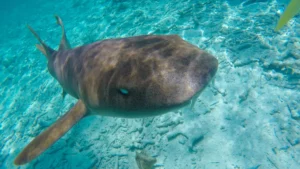 | 2–2.6 m (7–8.5 ft) | Low | Ledges and caves at Champagne Reef, Scotts Head, Toucari and Douglas BayThe shark every Dominican diver knows. Sleeps by day, hunts at night; bites only when grabbed or cornered. |
Caribbean Reef SharkCarcharhinus perezi | 1.5–2.5 m (5–8 ft) | Moderate | Deep walls and pinnacles: Scotts Head, Dangleben's, L'AbymAn occasional visitor rather than a resident on Dominica's steep reefs. Curious but not aggressive to divers who stay calm. |
Blacktip SharkCarcharhinus limbatus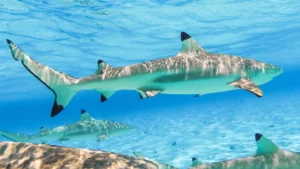 | 1.5–2.2 m (5–7 ft) | Moderate | Over sand and along the drop-offs, chasing baitfishSeen a few times a year on the west-coast sites. A fast fish-eater; the rare bites elsewhere are minor. |
| Caribbean Sharpnose SharkRhizoprionodon porosus | 0.8–1.1 m (2.5–3.5 ft) | Low | Shallow sandy bays and river mouthsA small inshore shark landed occasionally by net fishermen. Harmless. |
Tiger SharkGaleocerdo cuvier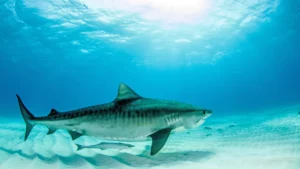 | 3–4.5 m (10–15 ft) | High | Deep water offshore; rarely seen, occasionally caughtRecorded around the island but with no shallow bank to hold it. Never involved in an incident here. |
Bull SharkCarcharhinus leucas | 2.2–3.2 m (7–10.5 ft) | High | River mouths after rain: Layou, Roseau, Indian RiverRare; an occasional catch by fishermen rather than a resident. Dominica has no estuary large enough for a population. |
Scalloped Hammerhead SharkSphyrna lewini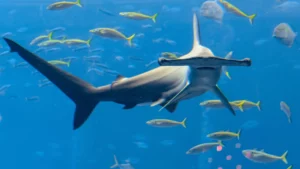 | 2.5–3.5 m (8–12 ft) | Low | Deep channels off the west coast, seen from whale-watching boatsThe hammerhead of Dominica's deep water. Critically endangered globally; caught occasionally on FAD longlines. |
Great Hammerhead SharkSphyrna mokarran | 3.5–4.5 m (11–15 ft) | Moderate | Deep water and the outer slopes; rareA solitary ray-hunter recorded around the island a few times. Not the 'highly aggressive' animal of the old table; no incident involves it here. |
Silky SharkCarcharhinus falciformis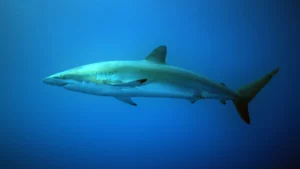 | 2–3 m (7–10 ft) | Moderate | Under the FADs and with tuna schools offshoreThe most frequently landed pelagic shark in Dominica's fish markets. Stays in deep water. |
| Oceanic Whitetip SharkCarcharhinus longimanus | 2–3 m (7–10 ft) | High | The open channels between the islandsA bold open-ocean shark that follows boats and whales. Irrelevant to beach swimmers; critically endangered. |
Shortfin Mako SharkIsurus oxyrinchus | 2.5–3.5 m (8–11 ft) | Moderate | Deep offshore water; hooked by sport-fishing chartersThe fastest shark, almost never near the reef. A danger to anglers on deck, not to swimmers. |
Blue SharkPrionace glauca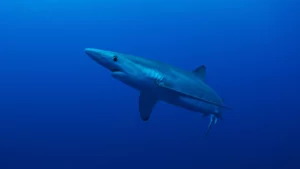 | 2–3 m (7–10 ft) | Low | Open ocean, mainly in the cooler monthsRecorded on longlines well offshore; not seen from the island. |
Bigeye Thresher SharkAlopias superciliosus | 3–4 m (10–13 ft) incl. tail | Low | Deep water under the FADsA deep-living shark with huge eyes, landed occasionally by FAD fishermen. Harmless. |
Whale SharkRhincodon typus | 6–10 m (20–33 ft) | Low | Passing along the west coast, mainly December–AprilSeen a few times each season from the whale-watching boats. A harmless filter feeder. |
Lemon SharkNegaprion brevirostris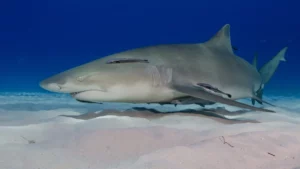 | 2.4–3 m (8–10 ft) | Low | Shallow sandy bays; very rareA wide-ranging Caribbean species with only scattered Dominican records, since the island lacks the mangrove nurseries it prefers. |
Smooth Hammerhead SharkSphyrna zygaena | 2.5–3.5 m (8–12 ft) | n/a | Unconfirmed in DominicaA temperate species listed on the old page; no verified eastern Caribbean record. Hammerhead sightings here are scalloped or great hammerheads. |
Great White SharkCarcharodon carcharias | 4–6 m (13–20 ft) | n/a | Not recorded in DominicaHere only because so many people ask. A cool-water species with no confirmed sighting this far south in the Caribbean. |
Two corrections to the older version of this page. The nurse shark was listed at “18–32 feet”, which is the size of a whale shark; a big Dominican nurse shark is about 2.5 m, or 8 feet, and most are smaller. And the smooth hammerhead, a species of cool temperate seas, has no verified record in the eastern Caribbean and is listed below only as unconfirmed; the hammerheads seen from the whale-watching boats are scalloped hammerheads, and occasionally a great hammerhead. The great white shark is not recorded either. White sharks do stray into the northern Caribbean from the Atlantic in winter, but 27 °C water this far south is outside their comfort zone and no Dominican sighting has ever been confirmed.
Where to see sharks in Dominica
Dominica's diving is about walls, pinnacles, volcanic bubbles and small creatures, and most dive briefings do not promise sharks. These are the sites where they are seen most often, and what to realistically expect.
- Champagne Reef, Pointe MichelThe island's signature snorkel, where volcanic gas bubbles rise through the sand like a glass of champagne. Nurse sharks rest under the boulders on the southern edge, and the shallow warm water is the easiest place on the island for a family to see one.
- Scotts Head Pinnacle and Drop-offThe tip of the Soufriere-Scotts Head Marine Reserve, where a submerged volcanic crater meets the open Caribbean. Nurse sharks in the ledges, and the best chance on the island of a Caribbean reef shark or a blacktip passing along the wall in the blue.
- Soufriere Pinnacles and L'AbymSteep walls inside the crater that drop past 60 m. Sharks are occasional here rather than regular, but the depth and current bring the reef sharks and, very rarely, a hammerhead up from below.
- Dangleben's Pinnacles and Crater's EdgeFive coral-covered pinnacles at the crater rim with barracuda, jacks and, on a running current, reef sharks. One of the two or three places where Dominican dive guides most often log a shark.
- Toucari Caves and Douglas Bay, PortsmouthThe north coast inside the Cabrits National Park marine section. Nurse sharks sleep in the caves and swim-throughs, and juveniles are seen in the shallow bay.
- Salisbury: Rina's Hole and Nose ReefMid-island sites with big sponges and the occasional nurse shark under the overhangs; blacktips are seen a few times a year over the sand.
- The whale-watching grounds off Roseau and LayouThe deep water two to five kilometres off the west coast where the sperm whales live. Whale sharks, silky sharks and hammerheads are seen from the boats a handful of times each season, usually in the calm winter months, and a boat trip is the one realistic chance a visitor has of meeting a pelagic shark alive.
- The FAD fishing groundsThe moored fish-aggregating devices off the west and south coasts where Dominican fishermen catch dolphinfish and tuna. Silky sharks, makos and threshers gather under them, and sport-fishing charters occasionally hook one.
If seeing a shark matters to you, tell your dive centre and ask for Scotts Head or Dangleben's on a day with current, and book a whale-watching trip in the January to March window, when the seas are calmest and pelagic sightings peak.
Best time of year to see sharks in Dominica
Sea temperature barely changes, 26 °C in late winter and 29 °C in early autumn, so the reef and nurse sharks are present all year. The weather and the sea state decide what you will actually see.
- Dry season, December to May: the calmest seas on the Caribbean coast, visibility of 20–30 m on the walls, and the peak of the whale-watching season from November to March. This is when whale sharks, hammerheads and silkies are most often reported from the boats and when the Scotts Head sites dive best.
- Wet season, June to November: warmer water, heavier rain, river plumes that reduce visibility near the river mouths and the hurricane season, which peaks from August to October. Diving continues on the sheltered west coast, but pelagic sightings are fewer and boats stay closer to shore.
- Nurse sharks: resident all year at Champagne Reef, Scotts Head and the northern caves; more active at dusk and at night, which is when a night dive at Champagne shows them hunting instead of sleeping.
- The rough Atlantic coast: the east side of the island faces the open ocean and trade-wind swell in every season; it is fished from shore but is not dived or snorkelled.
Shark attacks in Dominica: why the count is zero
SharkSider maintains its own database of every shark incident reported worldwide, updated weekly and feeding the site's shark attack pages. It contains no entry for Dominica at any date, and no case has ever appeared in the International Shark Attack File or the Dominican press recording a shark bite on a swimmer, diver, surfer or fisherman here. The complete record is shown below:
No incidents are recorded in the SharkSider database for this country.
An empty list is a strong statement when the island has had a resident population, a port and coastal fishing for three centuries and a dive and whale-watching industry for four decades. The explanation is in everything above. The sharks people could meet in the shallows are nurse sharks, which sleep by day and would rather leave than bite; the reef sharks and blacktips are passers-by on deep walls, not residents of the swimming beaches; and the genuinely dangerous species, tiger sharks, bull sharks, oceanic whitetips and silkies, are deep-water animals here with no shallow bank or estuary to draw them inshore. The steepness that makes Dominica poor shark habitat also makes it exceptionally safe.
The only realistic way to be bitten in Dominica is to provoke it: to grab a sleeping nurse shark's tail on a night dive, or to spearfish along the drop-off with a bleeding catch on a belt while a reef shark is around. Both happen on other islands and both are avoidable. The standard safety rules, stay out of murky river mouths after rain, do not swim at dusk near fish-cleaning at the landing sites, and never touch a shark, cover everything a visitor needs to know.
Is it safe to swim and snorkel in Dominica?
Yes. The west-coast bays at Mero, Batalie, Toucari, Soufriere and Champagne are calm, clear and shark-safe by any reasonable measure, and the island's real water hazards are elsewhere: strong currents and swell on the Atlantic side, slippery river rocks at the waterfalls and gorges, and the occasional jellyfish. Snorkellers at Champagne Reef who find a nurse shark should keep a couple of metres away and let it be. Nurse sharks are so placid that most divers barely glance at them, but a cornered or handled one clamps on with a vacuum-like grip that is difficult to release, and almost every nurse shark injury in the Caribbean comes from someone touching it.
On the deep sites, a Caribbean reef shark or blacktip that appears along the wall will usually take one look and continue on its way. Stay near the reef rather than drifting into open blue water, keep your group together and let the shark decide the distance; if one begins circling closely or arching its back, it is time to move calmly up the wall and end the dive. Divers who carry speared fish should not do so in Dominica's marine reserves in any case, where spearfishing is prohibited.
If a whale shark shows up beside a whale-watching boat, it is harmless, but the animal is enormous and is usually passing through rather than feeding. Enter the water only if the captain allows it, slip in quietly at the side, keep three or four metres off, and never touch or block it. Dominica's whale-watching rules on approach distance and time apply to whale sharks too.
Shark conservation in Dominica
Dominica calls itself the Nature Island and has backed the name at sea more than most of its neighbours. The Soufriere-Scotts Head Marine Reserve, established in the late 1990s, closes the crater and its walls to spearfishing and anchoring and zones the bay between fishing, diving and swimming; the Cabrits National Park protects Douglas Bay and the northern reefs; and in November 2023 the government announced the world's first sperm whale reserve, close to 800 square kilometres of the western waters where the whales, and the pelagic sharks that share their habitat, are protected from shipping lanes and fishing gear. The island is also a party to CITES, so the international trade in hammerhead, silky, thresher, mako and whale shark products is controlled.
There is no shark-specific law, however, and no ban on catching them. Dominican fishing is small-scale and mostly aimed at dolphinfish, tuna, wahoo and flying fish around the FADs, but silky sharks, threshers and the occasional mako are landed as bycatch and sold in the Roseau and Portsmouth markets, and nurse and reef sharks are sometimes taken by spearfishers outside the reserves. Hurricane Maria in September 2017 stripped coral from many west-coast reefs and destroyed most of the fishing fleet; the reefs have been recovering since, and the nurse shark population appears to have come through intact.
Visitors can help by diving with operators that respect the reserve rules, by choosing whale-watching companies that keep to approach limits, and by not buying shark meat or jaws. Our guide to why sharks are endangered explains why the slow-breeding pelagic species caught under the FADs matter so much more than their small numbers suggest.
Sharks in neighbouring waters
Dominica sits between the French islands of Guadeloupe and Martinique, which share its steep volcanic coasts and its deep-water sharks. Further down the chain, Saint Lucia and Grenada have the same nurse and reef sharks with rather more shallow reef to hold them, while low-lying Barbados, out in the Atlantic, adds a proper shelf and a longer species list. To the north-west, Puerto Rico and the Dominican Republic show what the Greater Antilles' wide banks do for sharks, and Trinidad and Tobago at the southern end of the arc brings in the river-influenced sharks of the South American coast. Every country we cover is on the sharks around the world page.
Frequently asked questions
Are there sharks in Dominica?
Yes, 15 species have reliable records, but most live in deep water. Nurse sharks are the only species divers see regularly, resting under ledges at Champagne Reef, Scotts Head and the northern caves. Caribbean reef sharks and blacktips pass the deep walls occasionally, and hammerheads, silkies, makos and whale sharks live offshore.
Have there been shark attacks in Dominica?
No. Nothing for Dominica exists in the SharkSider database, which is assembled from the International Shark Attack File and press reports worldwide. No bite on a swimmer, diver or fisherman has ever been documented on the island.
Is it safe to swim in Dominica?
Yes. The sheltered west-coast bays have never had a shark incident, and the sharks that could be met in the shallows are nurse sharks, which avoid people unless handled. The island's real water risks are Atlantic-side currents and slippery river rocks, not sharks.
Can I see sharks while snorkelling at Champagne Reef?
Often, yes. Nurse sharks rest under the boulders on the southern edge of the reef and are the easiest shark on the island to find from the surface. Keep a couple of metres away and never touch one; a handled nurse shark can clamp on with a grip that is hard to release.
Are there great white sharks in Dominica?
No confirmed record exists. Great whites are cool-water animals and although they stray into the northern Caribbean from the Atlantic in winter, 27 °C water this far south is outside their normal range. Large grey sharks reported by fishermen are tiger, bull or mako sharks.
Can you see whale sharks in Dominica?
Occasionally. Whale sharks pass along the deep west coast and are spotted a few times each season from the whale-watching boats out of Roseau, most often between December and April. There is no reliable aggregation and no dedicated whale shark tour, so treat a sighting as a bonus to a sperm whale trip.
What is the most common shark in Dominica?
The nurse shark. It is resident on the west-coast reefs all year, sleeps by day in the volcanic ledges and caves at Champagne Reef, Scotts Head, Toucari and Douglas Bay, and hunts at night. It is the only shark most visitors to Dominica will ever see.
When is the best time to see sharks in Dominica?
December to May, when the Caribbean coast is calmest, visibility is best on the deep walls and the whale-watching boats are out most often, which is when pelagic sharks such as hammerheads, silkies and whale sharks are usually reported. Nurse sharks are present in every month.
Is shark fishing legal in Dominica?
There is no shark-specific ban. Dominica's small-scale fishery targets dolphinfish, tuna and flying fish around moored FADs, and silky sharks, threshers and the odd mako are landed as bycatch. Spearfishing is prohibited inside the Soufriere-Scotts Head and Cabrits marine reserves, and CITES rules control trade in hammerhead, silky, thresher and mako products.
Are there bull sharks in Dominica?
Rarely. Dominican fishermen have occasionally caught bull sharks at river mouths such as the Layou and the Indian River after heavy rain, but the island has no large estuary or lagoon to support a resident population, and no bull shark has ever been involved in an incident here.
References

A small team focused on researching sharks and making marine biology easy to understand. Every page is reviewed against current species records and the SharkSider attack database, and updated when new incidents or research appear.
Published January 30, 2023 · Last updated September 21, 2026 · Incident data from the SharkSider attack database (0 records for Dominica, 0 fatal).


