
Yes, sharks live in the British Virgin Islands, and 14 species have reliable records here. The everyday ones are the nurse shark, the Caribbean reef shark, the lemon shark and the blacktip shark; Anegada's reef edge adds tiger sharks, and the deep Anegada Passage offshore carries silky sharks, oceanic whitetips and hammerheads.
The safety picture could hardly be better. SharkSider's database contains one entry for the territory, from December 2007, in which the shark bites on a scuba diver at Green Bay were found to have been inflicted after death; it is classed as invalid, not as an attack. No living person has a recorded shark bite in BVI waters, and no fatality has ever been attributed to a shark here.
- Shark species recorded14 with solid records
- ProtectionWhole-EEZ shark sanctuary since 2014; RMS Rhone Marine Park 1980
- Most seen from the beachNurse shark; lemon sharks on the Anegada flats
- Signature encounterNurse sharks on the wreck of the RMS Rhone
- Incidents in the database1 (2007, post-mortem, invalid), 0 fatal
- Water temperature26–29 °C (79–84 °F) year-round

On this page
- Where sharks live in the British Virgin Islands
- List of the different types of sharks in the British Virgin Islands
- Where to see sharks in the British Virgin Islands
- Best time of year to see sharks in the British Virgin Islands
- Shark attacks in the British Virgin Islands: what the record actually shows
- Is it safe to swim and snorkel in the British Virgin Islands?
- Shark conservation in the British Virgin Islands
- Sharks in neighbouring waters
- Frequently asked questions
- References
Where sharks live in the British Virgin Islands
Almost all of the BVI sits on the eastern half of the Puerto Rico shelf, a submerged limestone platform that Tortola, Virgin Gorda, Jost Van Dyke and the string of small islands along the Sir Francis Drake Channel rise from like the tops of drowned hills. The channel itself is sheltered, 20 to 40 m deep and floored with sand and patch reef, which is why it is the best sailing ground in the Caribbean and also why its sharks are mostly the bottom-dwelling and reef-edge kinds: nurse sharks under every wreck and ledge, Caribbean reef sharks along the outer drop-offs of the Dogs and Ginger Island, blacktips and the small sharpnose and blacknose sharks over the sand. Lemon sharks pup in the mangrove creeks of Tortola's east end and Beef Island.
Anegada is the exception and the prize. It is a flat coral island 25 km north of Virgin Gorda, barely 8 m above the sea, fringed on its south and east by Horseshoe Reef, the longest barrier reef in the eastern Caribbean. Inside the reef are kilometres of turtle-grass flats and salt ponds, the territory's great nursery for lemon sharks, nurse sharks and bonefish. Outside it the shelf ends in a wall that falls into the Anegada Passage, a 2,000-metre gap between the Virgin Islands and Anguilla that is one of the main gateways between the Atlantic and the Caribbean. Tiger sharks work the reef edge for green turtles, and oceanic whitetips, silky sharks and hammerheads follow the deep water past the island. To the north of the whole group lies the Puerto Rico Trench, the deepest point in the Atlantic, and the sportfishing boats that run to its edge, the North Drop, meet the same pelagic sharks that the marlin do.
Since 2014 all of this has been protected on paper. The BVI government declared its entire exclusive economic zone, some 80,000 km², a sanctuary for sharks and rays, banning their commercial capture and the export of fins, one of the first such declarations in the Caribbean. On top of that sit the older marine parks, led by the Wreck of the RMS Rhone Marine Park off Salt Island, the territory's first national marine park from 1980, and the fisheries protected areas around Horseshoe Reef, where anchoring and most fishing are banned.
List of the different types of sharks in the British Virgin Islands
Every species in the table has a dependable record in BVI waters, from the territory's Conservation and Fisheries Department surveys, the dive operators who log the same sites daily, the Anegada bonefishing guides, and the offshore fleet. Lengths are typical adults. The risk figure is for a swimmer or snorkeller in the shallow water where visitors actually are, not for a diver on an offshore wall. The older version of this table rated the silky shark and the great hammerhead as “highly aggressive”; neither has any record of biting a person in the BVI, and the hammerhead in particular is a timid animal that flees from divers.
| Species | Adult size | Risk to swimmers | Where in the British Virgin Islands & notes |
|---|---|---|---|
Nurse SharkGinglymostoma cirratum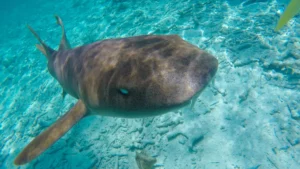 | 2.2–3 m (7–10 ft) | Low | The Rhone, the Dogs, the Indians, Anegada flats; under every ledgeThe shark everyone in the BVI has seen. Sleeps by day, feeds at night; harmless unless handled. |
Caribbean Reef SharkCarcharhinus perezi | 1.5–2.5 m (5–8 ft) | Moderate | Outer reef slopes: the Chikuzen, Ginger Island, the outside of the DogsThe Atlantic's reef shark and the BVI's most-seen large shark on dives. Inquisitive, not aggressive. |
Lemon SharkNegaprion brevirostris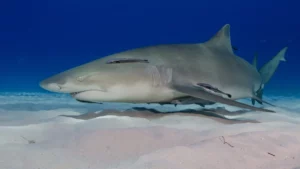 | 2.4–3 m (8–10 ft) | Low | Anegada's turtle-grass flats and salt ponds; Tortola mangrovesJuveniles grow up on the flats for years. Wary of waders; a favourite of bonefishing guides. |
Blacktip SharkCarcharhinus limbatus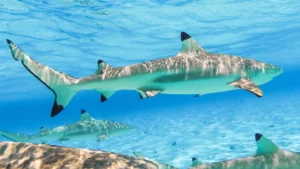 | 1.5–2 m (5–6.5 ft) | Moderate | Sand channels and bay mouths across the shelfA quick, nervous baitfish hunter that jumps clear of the water when feeding. No BVI bite on record. |
Tiger SharkGaleocerdo cuvier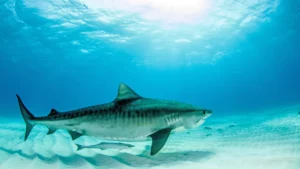 | 3–4.5 m (10–15 ft) | High | Outside Horseshoe Reef, Anegada; deep shelf edgesHunts turtles on the reef edge. The species to give room to, though it has never bitten anyone here. |
Great Hammerhead SharkSphyrna mokarran | 3–4.5 m (10–15 ft) | Moderate | Rare; sand flats and drop-offs off AnegadaWrongly called “highly aggressive” in older lists; it is shy and critically endangered. Hunts rays on the flats. |
Scalloped Hammerhead SharkSphyrna lewini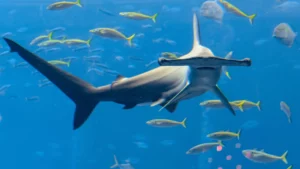 | 2.5–3.5 m (8–12 ft) | Low | The Chikuzen wreck and the Anegada wall, occasionallyPasses the open-sand wreck north of Tortola a few times a year. Avoids divers. |
Bull SharkCarcharhinus leucas | 2.2–3.4 m (7–11 ft) | High | Rare; harbours and murky baysRecorded, but scarce in a territory without rivers. Most reports are misidentified reef sharks. |
Silky SharkCarcharhinus falciformis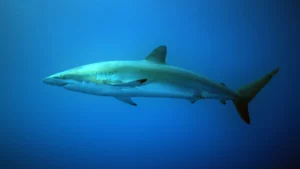 | 2–3 m (7–10 ft) | Moderate | The Anegada Passage and the North DropAn offshore shark that trails tuna and boats. Not “highly aggressive”; no inshore records. |
| Oceanic Whitetip SharkCarcharhinus longimanus | 2–3 m (7–10 ft) | High | Blue water of the Anegada PassagePersistent and bold around anything floating far offshore. A concern for people in the water mid-passage, not at a beach. |
Shortfin Mako SharkIsurus oxyrinchus | 2–3 m (7–10 ft) | Moderate | Offshore, with the marlin and tunaCaught and released by the Virgin Gorda sportfishing boats. Endangered and CITES-listed. |
Blacknose SharkCarcharhinus acronotus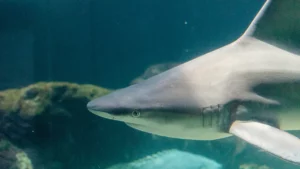 | 1–1.3 m (3–4 ft) | Low | Sand and seagrass of the Drake Channel, 10–40 mA small, fast shark with a dark smudge on the snout. Turns up in fish traps; harmless. |
| Caribbean Sharpnose SharkRhizoprionodon porosus | 0.8–1.1 m (2.5–3.5 ft) | Low | Shallow bays and creeks, all islandsProbably the most numerous shark in the territory and the least noticed. Completely harmless. |
Whale SharkRhincodon typus | 6–12 m (20–40 ft) | Low | Offshore passages, late summer and autumnSeen a few times a year by fishing boats; no regular gathering. Harmless filter feeder. |
Great White SharkCarcharodon carcharias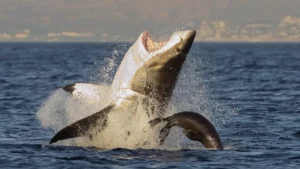 | 4–6 m (13–20 ft) | n/a | No confirmed record anywhere in the Virgin IslandsIncluded for the searchers who ask. No confirmed record anywhere in the Lesser Antilles. |
Three sharks people ask about are absent or nearly so. The great white has no confirmed record in the Virgin Islands; the warmest documented winter wanderings of tagged Atlantic white sharks stop at the Bahamas and the Florida Straits. The bull shark is recorded but rare, because the BVI has no rivers or muddy estuaries for it to work; Paraquita Bay's mangroves on Tortola are the closest thing, and lemon sharks, not bulls, are what live there. And the Indo-Pacific reef sharks that appear on some visitor lists, the grey reef, the blacktip reef and the whitetip reef shark, do not occur anywhere in the Atlantic. The reef shark of the BVI is the Caribbean reef shark, full stop.
Where to see sharks in the British Virgin Islands
The BVI is a sailing and diving destination rather than a shark-diving one, and no operator baits sharks. The sightings come from a handful of wrecks, walls and flats that hold sharks day in, day out.
- Wreck of the RMS Rhone, Salt IslandThe Royal Mail steamer that sank in the hurricane of 1867 lies in 10–25 m and has been a marine park since 1980. Nurse sharks rest in the bow section and under the boilers; Caribbean reef sharks pass along the stern in the early morning.
- Anegada flats and Horseshoe ReefWade the turtle-grass flats at Setting Point or Loblolly Bay with a bonefishing guide and you will see juvenile lemon sharks and nurse sharks in water below the knee. Boat trips outside the reef add tiger sharks along the drop-off and eagle rays in the cuts.
- The Chikuzen, north of TortolaA 75-metre refrigeration ship scuttled in 1981 on open sand 10 km off Camanoe, in 20–25 m. The only structure for miles, it draws big schools of jacks and barracuda, Caribbean reef sharks, and occasional scalloped hammerheads and cobia. Boat dive, weather permitting.
- The Dogs, off Virgin GordaGreat Dog, George Dog and West Dog have caves, swim-throughs and ledges (the Chimney, Coral Gardens) where nurse sharks sleep and reef sharks patrol the outer side. Easy dives with reliable sightings.
- Blonde Rock and Wreck Alley, Cooper IslandA pinnacle between Salt and Dead Chest islands rising from 20 m, and a row of small scuttled wrecks nearby. Nurse sharks on the wrecks, Caribbean reef sharks around the pinnacle when the current runs.
- The Indians and Pelican Island, off Norman IslandFour rock spires on the west side of the Drake Channel, the territory's busiest snorkel stop. Nurse sharks under the ledges on the outer face; blacktips occasionally over the sand towards Pelican.
- Alice in Wonderland, Ginger IslandA gently sloping reef of giant mushroom-shaped star corals on the south side of Ginger Island, 12–30 m. Nurse sharks and reef sharks are regular; it is also one of the best places in the BVI to see the reef itself recovering from the 2017 hurricanes.
- The Anegada Passage and North DropBluewater fishing runs out of Virgin Gorda and Tortola to the 2,000-metre passage and the trench edge. Silky sharks, oceanic whitetips, shortfin makos and, in late summer, whale sharks turn up beside the boats. For anglers and pelagic specialists, not snorkellers.
For most visitors the answer is a day on Anegada. A morning on the flats gives lemon and nurse sharks in ankle-deep water with no diving involved, and an afternoon snorkel at Loblolly Bay puts you on the inside of Horseshoe Reef. Divers should add the Rhone and the Chikuzen, the two sites in the territory where a shark is close to guaranteed.
Best time of year to see sharks in the British Virgin Islands
The BVI has no shark season in the sense of animals arriving and leaving; the shelf sharks stay all year in water that varies only from about 26 °C in late winter to 29 °C in early autumn. What the calendar changes is the sea state, which decides whether you can reach the sites.
- December to April: the high season, with steady trade winds, dry weather and the clearest water. The Christmas winds in December and January can make the Chikuzen and the north side of Anegada unreachable for days; the sheltered Drake Channel sites, the Rhone, the Dogs and the Indians, are diveable almost every day.
- May and June: the calm shoulder months and the best time for Anegada. The flats are glassy at dawn, lemon shark pups are appearing in the nursery grounds, and nurse sharks are in the shallows to mate.
- July to November: hurricane season, peaking in September. Between systems the sea is flat and warm and the offshore sharks are closest to the shelf; whale sharks and hammerheads are reported most often from August to October. Irma, on 6 September 2017, was the strongest storm ever to hit the territory and closed most sites for months.
Visibility on the Drake Channel sites runs 15–25 m most of the year and drops after heavy rain; on the outer reefs and the Anegada wall it is routinely 30 m.
Shark attacks in the British Virgin Islands: what the record actually shows
The honest summary is that nothing has happened. SharkSider's database, which collects documented shark incidents from every country back to the 1800s, holds one entry for the British Virgin Islands, and it is not an attack. It is rendered below from the database; the shark attacks in the British Virgin Islands page keeps the record and is updated whenever a new case is documented anywhere in the territory.
- 2007 · Green BayScuba diving — Shark bites were post-mortemSpecies: Invalid · not fatal
The 2007 case is the kind of entry that shark databases keep for completeness. A scuba diver died at Green Bay in December of that year, and when the body was recovered it carried shark bites. The investigation found that the bites were inflicted after death, which is why the species field reads “invalid”: a shark scavenged a body, it did not cause a death. Cases like this are logged so that they cannot be counted twice by someone else later as a fatal attack. The earlier version of this page said the BVI had never reported a shark attack; that remains true in the sense that matters, since no living person has been bitten, but the record is not empty, and we prefer to show it.
Why so quiet, in a territory that hosts hundreds of thousands of sailors, snorkellers and divers a year? Partly because the sharks here are the wrong kind: nurse sharks, small requiem sharks and reef sharks on offshore walls, with the tiger sharks concentrated around Anegada's reef edge where few people swim. Partly because the water is clear and the shelf is shallow, so the pelagic species that cause most serious bites elsewhere in the world have no reason to come inshore. And partly because the fishing pressure that draws sharks to beaches in some countries is absent here. The usual precautions cost nothing: swim in daylight, keep clear of fish-cleaning at the docks and of anyone spearfishing, and do not handle a nurse shark however sleepy it looks.
Is it safe to swim and snorkel in the British Virgin Islands?
As safe as anywhere in the Caribbean. What actually sends visitors to the clinic at Road Town is sunburn, dehydration, dinghy propellers in the crowded anchorages, sea urchin spines at the Baths and the Indians, fire coral, and the ground swell that can turn Anegada's north-shore beaches dangerous for a few days each winter. Sharks do not feature in the local injury statistics at all.
The animals you will meet are gentle by nature. Nurse sharks, the species visitors most often see, spend their days lying still under ledges and wrecks and will tolerate a snorkeller hovering above them for as long as they are left alone; almost every nurse shark bite ever recorded involved a person grabbing, poking or trying to ride one. Lemon sharks on the Anegada flats are wary of wading humans and keep a boat-length away. Caribbean reef sharks are curious about divers on the outer reefs, approach once, and leave. Blacktips are fast and nervous and are gone before most people have identified them.
The two species to respect are the tiger shark and the oceanic whitetip. Tigers hunt the outside of Horseshoe Reef, where turtles come to feed, and the sensible rule for Anegada is to snorkel inside the reef and leave the outer wall to boat-based divers. Oceanic whitetips belong to the deep passage and are met only by people who fall or jump off boats in blue water miles offshore; if you sail across the Anegada Passage, swim near the shore at either end, not in the middle. Whale sharks, if you are lucky enough to see one, are harmless; our guidelines for swimming with them apply here as anywhere.
Shark conservation in the British Virgin Islands
The BVI made its big move in 2014, when the government declared the territory's whole exclusive economic zone a shark and ray sanctuary. Commercial fishing for sharks and rays is prohibited, the export and sale of shark fins is banned, and long-lining, the fishing method that kills most pelagic sharks worldwide, is not permitted in territorial waters. As a British Overseas Territory the BVI is also covered by the UK's Blue Belt programme, which funds marine surveys and enforcement in the overseas territories, and the shortfin mako, silky shark and hammerheads that pass through the Anegada Passage carry the extra protection of their CITES listings when it comes to trade.
The local fishery is small-scale, working traps, handlines and nets from open boats for snapper, grouper, lobster and conch. Sharks are caught by accident in traps and on lines and are not marketed, so the direct pressure on them is low. The pressures that matter are on their habitat. Hurricanes Irma and Maria in September 2017 stripped coral from the shallow reefs of the Drake Channel and broke up the elkhorn stands on Horseshoe Reef; stony coral tissue loss disease arrived in 2019 and has killed many of the large brain and star corals that survived; and the marine heatwave of 2023 bleached what was left across the whole shelf. Mangrove loss to marina and road building around Tortola and Beef Island eats into the lemon shark nursery grounds. The Anegada flats and salt ponds are the most important shark nursery in the territory and are still largely intact, which is why their protected status matters more than any single dive site. For the global picture, read our piece on why sharks are endangered.
Sharks in neighbouring waters
The BVI shares a shelf, a species list and most of its sharks with its neighbours. The U.S. Virgin Islands begin a few hundred metres west of Jost Van Dyke and add the deep St Croix wall to the same fauna. Puerto Rico is the western end of the platform, with Mona Island's hammerheads and the trench to the north. East across the Anegada Passage, Anguilla is the next stop for the pelagic sharks that pass Anegada, and further down the chain Dominica and Saint Lucia have steep volcanic drop-offs with reef sharks and, occasionally, whale sharks. The Dominican Republic, west past Puerto Rico, is the region's whale shark and humpback destination. Every other coast is indexed on sharks around the world.
Frequently asked questions
Are there sharks in the British Virgin Islands?
Yes. Fourteen species are reliably recorded, led by the nurse shark, the Caribbean reef shark, the lemon shark and the blacktip shark. Tiger sharks hunt turtles outside Anegada's Horseshoe Reef, and the deep Anegada Passage offshore carries silky sharks, oceanic whitetips and hammerheads. The whole territory has been a shark sanctuary since 2014.
Have there been shark attacks in the British Virgin Islands?
No attack on a living person has ever been recorded. The SharkSider database holds one entry, from December 2007 at Green Bay, where a scuba diver's body showed shark bites that were found to have been inflicted after death; it is classed as invalid. No swimmer, snorkeller or diver has been bitten by a shark in BVI waters.
Can I swim with sharks in the British Virgin Islands?
Yes, without a special tour. Nurse sharks rest on the wreck of the RMS Rhone and under the ledges at the Dogs and the Indians, and lemon and nurse sharks cruise the Anegada flats in knee-deep water. Divers see Caribbean reef sharks on the Chikuzen wreck and the outer reefs. No operator baits sharks in the territory.
Is it safe to swim in the British Virgin Islands?
Yes. Sharks have never injured a swimmer here, and the real beach hazards are sunburn, sea urchins, fire coral, dinghy traffic in the anchorages and winter ground swell on Anegada's north shore. Swim in daylight, avoid docks where fish are being cleaned, and snorkel inside Horseshoe Reef rather than on its outer wall.
Are there great white sharks in the British Virgin Islands?
No. There is no verified record of a great white anywhere in the Virgin Islands or the Lesser Antilles. Tagged white sharks from the US east coast travel no further south in winter than the Bahamas and the Florida Straits. Any large grey shark reported near a BVI beach is a tiger, bull or Caribbean reef shark.
Are there tiger sharks in the British Virgin Islands?
Yes. Tiger sharks patrol the outside of Horseshoe Reef at Anegada, where green and hawksbill turtles feed, and the deep shelf edges elsewhere. They are seen by divers and fishing crews a handful of times a year and have never been involved in an incident in the territory.
Where is the best place to see sharks in the BVI?
Anegada for lemon and nurse sharks on the flats, seen while wading with a bonefishing guide, and the wreck of the RMS Rhone off Salt Island for nurse sharks and passing reef sharks. The Chikuzen wreck north of Tortola is the dive for Caribbean reef sharks and, occasionally, scalloped hammerheads.
When is the best time to see sharks in the British Virgin Islands?
There is no off-season for the shelf sharks; the water holds 26–29 °C all year. May and June give the calmest conditions for Anegada's flats and the pupping season for lemon sharks; December to April has the best visibility on the Drake Channel wrecks; the warm months from August to October bring hammerheads and whale sharks closest to the shelf, with hurricane risk attached.
Is shark fishing legal in the British Virgin Islands?
No. In 2014 the BVI declared its entire exclusive economic zone a sanctuary for sharks and rays, prohibiting their commercial capture and the sale or export of fins. Sharks caught by accident in traps or on handlines must be released, and long-lining is not permitted in territorial waters.
Are there bull sharks in the British Virgin Islands?
Rarely. Bull sharks have been recorded in the Virgin Islands but they prefer river mouths and turbid estuaries, and the BVI offers neither. The sharks visitors report as bull sharks in Road Harbour or the Drake Channel are almost always Caribbean reef sharks or blacktips.
References

A small team focused on researching sharks and making marine biology easy to understand. Every page is reviewed against current species records and the SharkSider attack database, and updated when new incidents or research appear.
Published January 30, 2023 · Last updated September 21, 2026 · Incident data from the SharkSider attack database (1 records for the British Virgin Islands, 0 fatal).


