
Yes, Belize has sharks, and few Caribbean countries make them easier to see. Twelve species have solid records. The ones you will almost certainly meet are the nurse shark at Hol Chan and Shark Ray Alley, the Caribbean reef shark on the atoll walls and in the Blue Hole, and the blacktip and lemon sharks of the shallow cayes; bull sharks, hammerheads and, from March to June, whale sharks live in the deeper water outside the reef.
The incident record is small and mostly minor. The SharkSider database holds eight entries for Belize, one of them fatal, and that death dates from the early 1930s. The modern cases are mostly nurse sharks nipping snorkellers' feet and sharks biting the hands of people who were spearfishing or baiting them; the one serious injury, a diver who lost part of a leg in the Gulf of Honduras in 2024, is the exception in ninety years.
- Shark species recorded12 with solid records
- ProtectionWhale sharks protected 2003; gillnets banned 2020; reef reserves since 1982
- Most seen from the beachNurse shark (Ambergris Caye, Caye Caulker)
- Signature encounterShark Ray Alley; whale sharks at Gladden Spit
- Incidents in the database8 (1930s–2024), 1 fatal
- Water temperature26–30 °C year-round

On this page
- Why Belize has so many sharks
- List of the different types of sharks in Belize
- Where to see sharks in Belize
- Best time of year to see sharks in Belize
- Shark attacks in Belize: what the record actually shows
- Is it safe to swim and snorkel with sharks in Belize?
- Shark conservation in Belize
- Sharks in neighbouring waters
- Frequently asked questions
- References
Why Belize has so many sharks
The Belize Barrier Reef is the longest in the western hemisphere and the centrepiece of the Mesoamerican Reef that runs from Mexico's Yucatán down to Honduras. It sits 15 to 40 kilometres off the mainland, and the water between reef and shore is a shallow lagoon of seagrass, sand and mangrove cayes: the perfect nursery for young lemon, blacktip and nurse sharks, which is exactly what the tagging studies at Turneffe and Glover's Reef have shown. Outside the reef the seabed drops to more than a thousand metres, and standing in that deep water are three atolls found almost nowhere else in the Atlantic: Turneffe, Lighthouse Reef with its Great Blue Hole, and Glover's Reef. Their walls are where the Caribbean reef sharks live, where hammerheads and silky sharks come in from the blue, and where a 300 m sinkhole gives divers the surreal sight of reef sharks circling above the stalactites.
The mainland side adds the third habitat. The Belize, Sibun, Monkey and Sarstoon rivers and the wide, murky Gulf of Honduras in the far south are bull shark country, and the rivers themselves are known to carry bull sharks well inland. Then there is Gladden Spit, a bend in the outer reef off Placencia where a dozen snapper species gather to spawn around the full moons of spring. The eggs draw whale sharks from across the western Caribbean, and for a few days each month the biggest fish in the sea feed at the surface within sight of the reef.
Protection has been layered on this geography for forty years. Half Moon Caye became the country's first marine protected area in 1982, Hol Chan Marine Reserve followed in 1987, the whole barrier reef system was inscribed as a UNESCO World Heritage Site in 1996, and Belize has since added Glover's Reef, Gladden Spit and Silk Cayes, the Blue Hole and Turneffe Atoll marine reserves. Whale sharks have been fully protected since 2003, and a nationwide ban on gillnets took effect in 2020, removing the gear that killed more juvenile sharks in the lagoon than any other.
List of the different types of sharks in Belize
Every species below has a reliable record from Belizean waters, whether from the long-running tagging programmes on the atolls, from fishermen's landings or from dive logs. Sizes are typical adults. The risk column is written for swimmers and snorkellers rather than divers, so the nurse shark, which has caused more minor injuries here than any other species, still rates low: its bites are the result of feeding and handling, not hunting. The older version of this page labelled the great hammerhead, the silky shark and the mako “highly aggressive”, which does not match the Belize record, where none of the three has ever hurt anyone.
| Species | Adult size | Risk to swimmers | Where in Belize & notes |
|---|---|---|---|
Nurse SharkGinglymostoma cirratum | 2.2–3 m (7–10 ft) | Low | Hol Chan, Shark Ray Alley, the cayes and every reefBelize's signature shark. Placid; the two snorkeller injuries on record were feet nipped at feeding sites. |
Caribbean Reef SharkCarcharhinus perezi | 1.5–2.5 m (5–8 ft) | Moderate | Atoll walls, the Blue Hole, Half Moon Caye, Glover's ReefThe shark of the Blue Hole. Confident around divers, rarely in snorkelling depths. |
Lemon SharkNegaprion brevirostris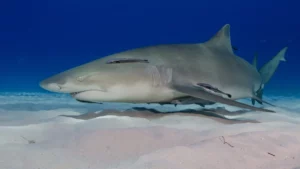 | 2.4–3 m (8–10 ft) | Low | Mangrove lagoons of Turneffe and the cayes; pups in the shallowsBelize's mangroves are a documented nursery. Slow and yellowish, easy to see from a dock. |
Blacktip SharkCarcharhinus limbatus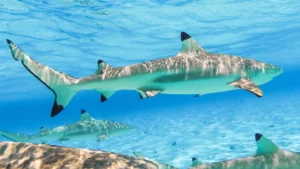 | 1.5–2.5 m (5–8 ft) | Moderate | Seagrass flats and reef edges around Ambergris and Caye CaulkerFast, nervous hunter of bait fish. Juveniles common on the flats. |
Bull SharkCarcharhinus leucas | 2.2–3.4 m (7–11 ft) | High | River mouths, the Gulf of Honduras, deep atoll passes and the Blue HoleThe species to respect. Enters the Belize and Sibun rivers; rarely on the snorkelling reefs. |
Whale SharkRhincodon typus | 5–9 m here (adults to 12 m+) | Low | Gladden Spit, March to June, around the full moonFeeds on snapper spawn at the surface. Fully protected since 2003. |
Great Hammerhead SharkSphyrna mokarran | 3–4.5 m (10–15 ft) | Moderate | Outer atoll walls and the Blue Hole; hunts rays on the sand flatsSeen a few times a season by divers. No Belizean record of harming anyone. |
Scalloped Hammerhead SharkSphyrna lewini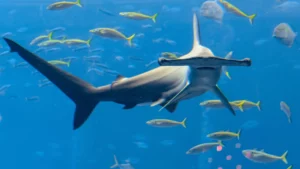 | 2.5–3.5 m (8–12 ft) | Low | Deep water off Turneffe, Lighthouse and Glover'sSchools in the blue off the walls; taken by the licensed fishery. Critically endangered. |
Tiger SharkGaleocerdo cuvier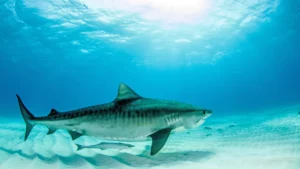 | 3–4.5 m (10–15 ft) | High | Rare on the deep outer reefs and atollsPresent but seldom seen. Blamed for the country's only fatality, in the early 1930s. |
Silky SharkCarcharhinus falciformis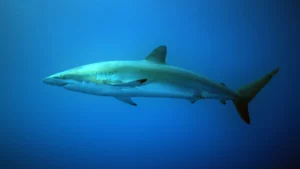 | 2–3 m (7–10 ft) | Moderate | Open water beyond Glover's Reef and Lighthouse ReefPelagic; approaches divers on the outer walls in late summer. Never near the cayes. |
Shortfin Mako SharkIsurus oxyrinchus | 2–3.2 m (7–10 ft) | Moderate | Offshore blue water east of the atolls, mostly from sport-fishing boatsRare and never on the reef. Listed as 'highly aggressive' on the old page; no Belize incident involves one. |
| Caribbean Sharpnose SharkRhizoprionodon porosus | 0.8–1.1 m (2.5–3.5 ft) | Low | Coastal shallows and the mainland lagoonSmall, harmless and common in fishermen's nets before the gillnet ban. |
The great white shark does not occur in Belize. It is a temperate species and the water off the atolls never falls below about 26 °C; the “great white in the Blue Hole” that appears in forum posts is always a large Caribbean reef shark or bull shark seen in the gloom at 40 m. Oceanic whitetips exist in the open sea far beyond the atolls but have no place in a swimmer's calculations. Tiger sharks are genuinely present but rare, a few sightings a year on the deep outer walls, and the single fatality in the record, in the early 1930s, was attributed to one.
Where to see sharks in Belize
Belize is unusual in that its most famous shark encounter needs a mask and snorkel rather than a dive certificate, and its most famous dive is a hole in the reef. These are the sites that deliver.
- Shark Ray Alley, Hol Chan Marine ReserveA shallow cut off Ambergris Caye where fishermen once cleaned their catch. Nurse sharks and southern stingrays gather as soon as a boat arrives; you snorkel in 2–3 m of water among a dozen or more. The busiest, easiest shark encounter in the country.
- Great Blue Hole, Lighthouse ReefThe 300 m-wide sinkhole made famous by Cousteau. Caribbean reef sharks circle in the blue at 30–40 m above the stalactites, with bull sharks and the occasional hammerhead on the deeper passes. A deep, dark, unforgettable dive.
- Half Moon Caye Wall, Lighthouse ReefThe reef most divers actually enjoy more than the Blue Hole: a sheer wall with Caribbean reef sharks, eagle rays and, in season, hammerheads in the blue. Nurse sharks sleep on the sand behind the wall.
- Gladden Spit and Silk Cayes Marine ReserveOff Placencia. Whale sharks feed on snapper spawn for a few days around the full moons of March to June. Snorkelling only, licensed guides, strict limits on boats and swimmers.
- Turneffe AtollThe largest atoll, with mangrove lagoons that serve as a nursery for lemon sharks and a channel called the Elbow where reef sharks and eagle rays ride the current. Bull sharks are seen on the deeper sides.
- Glover's ReefThe most remote atoll, a marine reserve and a long-term shark research site. Caribbean reef sharks are abundant on the outer walls, and silky sharks and hammerheads come in off the deep water.
- Caye Caulker and the Ambergris flatsNurse sharks and juvenile lemon and blacktip sharks cruise the seagrass shallows off the cayes and are often visible from a dock or a kayak at dawn.
- Southern reef: South Water Caye and Sapodilla CayesQuieter reefs near the Gulf of Honduras with nurse and reef sharks, and the transition to bull shark territory in the murkier water further south.
If you have one day, Hol Chan and Shark Ray Alley from San Pedro or Caye Caulker will give you sharks within arm's reach; if you have a week, add a liveaboard or day trip to Lighthouse Reef, and time a spring visit to Placencia for the whale sharks.
Best time of year to see sharks in Belize
The reef sharks, nurse sharks and lemon sharks are resident and seen in every month. What the calendar controls is the whale sharks, the weather and the visibility.
- March to June: whale shark season at Gladden Spit, tied to the snapper spawning that peaks from about three days before to three days after the full moon. April and May are the most reliable months. This is also the dry season, with calm seas and 30 m visibility on the atolls.
- June to November: the wet season and, from August, the hurricane season. Rain muddies the mainland coast and the lagoon, but the atolls usually stay clear and the reef sharks do not care. Late summer is when silky sharks and hammerheads turn up most often along the outer walls.
- December to February: cool fronts from the north bring wind and chop, and the water dips to 26 °C. Diving continues on the sheltered sides; nurse shark encounters at Hol Chan are unaffected.
- Lemon shark pups: born in the Turneffe mangroves in spring and early summer, when tagging teams work the lagoons.
Sea temperature stays between 26 °C in January and 30 °C in September, warm enough for a shorty wetsuit all year and far too warm for any cold-water shark.
Shark attacks in Belize: what the record actually shows
For a country where thousands of people snorkel among sharks every day, Belize's list is short. SharkSider logs every Belizean case on the shark attacks in Belize page. The database holds eight entries, one of them fatal, and two of them so old or vague that they carry no date beyond “early 1930s” and “prior to 1988”. The six most recent entries appear below; the complete list, updated weekly, lives on the attacks page:
- 2024 · Central America, Gulf of HondurasSwimming - Diving — Right lower leg amputated after serious biteSpecies: Reef shark 6ft (1.8m) · not fatal
- 2023 · San Pedro , Ambergris Caye, Belize DistrictSnorkeling — Foot injuredSpecies: Nurse shark, 5' to 6' · not fatal
- 2022 · Off San Pedro, Ambergris CaySpearfishing — Right hand and forearm bitten provoked incidentSpecies: 5' shark · not fatal
- 2021 · Ambergris KeyBaiting sharks — Right hand bittenSpecies: 8 ft shark · not fatal
- 2013Snorkeling — Toe injuredSpecies: Nurse shark · not fatal
- 2006 · Near Ramon's Village, Ambergris CayeSpearfishing — Shark involvement prior to death not confirmedSpecies: Shark involvement prior to death was not confirmed · not fatal
The one death is the oldest entry: a person standing in the water some time in the early 1930s, killed by what was reported as a 12-foot tiger shark. Nothing fatal has happened since. The entry from before 1988 has no details at all, and the 2006 case at Ramon's Village on Ambergris Caye, a spearfisher who died, was never confirmed as a shark incident; the injuries may have come after death. That leaves five modern cases, and they sort neatly into two groups. Nurse sharks and feet: a snorkeller's toe in March 2013 and another snorkeller's foot at San Pedro in October 2023, both at or near the feeding sites where nurse sharks have learned to associate people with food. Hands and fish: a spearfisher off San Pedro bitten on the right hand and forearm by a 5-foot shark in May 2022, recorded as provoked, and a person baiting sharks off Ambergris in May 2021 bitten on the hand by an 8-foot animal.
The serious one is the most recent. In August 2024 a diver in the Gulf of Honduras, the murky water in the far south of the country, suffered a bite from a shark recorded as a 6-foot reef shark that led to the amputation of the lower right leg. It is the only life-changing injury in the modern record and it happened well away from the tourist reefs. The pattern for everyone else is simple: keep your hands away from sharks that are being fed, do not carry speared fish through shark water, and read our guide to surviving a shark attack if you plan to spearfish.
Is it safe to swim and snorkel with sharks in Belize?
Yes, and Belize has been proving it for decades. The nurse sharks of Hol Chan and Shark Ray Alley are as close to tame as a wild shark gets, and the entire modern injury list for snorkellers consists of two nipped feet. Both happened at feeding-influenced sites, which is the one thing to understand about nurse sharks: they are placid grazers with small mouths and a powerful suction bite, and when there is fish scent in the water they investigate anything pale that moves. Keep your fins still, keep your hands to yourself, never touch or ride one, and choose a guide who does not throw chum in among the swimmers.
Caribbean reef sharks on the atolls are curious but calm around divers who behave. Give them the wall, do not corner one under a ledge and keep a horizontal position in the water. Bull sharks are the species that deserve real caution, and they live where you would expect: river mouths, the muddy southern coast and the deep passes of the atolls, not the snorkelling shallows.
The whale sharks at Gladden Spit are managed more tightly than almost anywhere else in the Caribbean. Licensed boats, limited numbers, no touching, no flash, no free-diving underneath the animal. They cannot hurt you deliberately, but a feeding whale shark rolls and turns without warning and its tail is the size of a door. Enter quietly, stay to the side, keep 3 m away and follow the guide; our page on swimming safely with whale sharks has the full etiquette.
Shark conservation in Belize
Belize is a small country that has made big decisions about its sea. Whale sharks have been legally protected since 2003, with a seasonal whale shark zone at Gladden Spit that caps boats and swimmers. The marine reserve network now covers all three atolls, the Blue Hole, Hol Chan, Gladden Spit and a chain of cayes down the barrier reef, and several of these reserves have no-take zones where no shark can legally be landed. In 2017 the government imposed a permanent moratorium on offshore oil exploration across its entire maritime zone, which is why UNESCO took the reef off its danger list in 2018, and in 2020 it banned gillnets nationwide, the gear responsible for most of the juvenile shark deaths in the lagoon.
Shark fishing itself is still legal under licence, and a real fishery exists: dozens of small boats land sharks, mostly to supply the Guatemalan market for dried shark meat at Lent, and the catch has included hammerheads and reef sharks from the atolls. Long-term tagging by the research teams at Glover's Reef and Turneffe has shown that reef shark numbers inside the reserves are healthy while those on unprotected reefs have thinned, which is the best argument for extending the closures. Coral bleaching in 2023, the worst on record for the Mesoamerican Reef, and the sediment and nutrients coming down the mainland rivers threaten the habitat the sharks depend on. Visitors help most by paying reserve fees, choosing guides who follow the no-chum rules at Hol Chan, and never buying shark products. For the bigger picture, read our explainer on why sharks are endangered.
Sharks in neighbouring waters
Belize sits in the middle of the Mesoamerican Reef, and its sharks swim across every border. Mexico's Yucatán coast to the north has the same reef species, the bull sharks of Playa del Carmen and the whale shark aggregation off Isla Mujeres that follows the Gladden Spit season. Honduras to the south shares the Gulf of Honduras' bull sharks and has its own whale sharks off Utila, and Guatemala shares the same gulf. Across the deep water to the east, the Cayman Islands, Jamaica and Cuba hold the same Caribbean reef, nurse and hammerhead sharks on their own walls. Our sharks around the world hub links to every country guide on the site.
Frequently asked questions
Are there sharks in Belize?
Yes. Twelve species have solid records. Nurse sharks are everywhere on the reef and are the stars of Shark Ray Alley, Caribbean reef sharks patrol the atoll walls and the Blue Hole, lemon and blacktip sharks live on the flats, and whale sharks visit Gladden Spit from March to June.
Have there been shark attacks in Belize?
Eight entries are in the SharkSider database, one fatal, from the early 1930s. The modern cases are two snorkellers nipped on the foot by nurse sharks, two people bitten on the hand while spearfishing or baiting sharks, an unconfirmed 2006 case and a serious 2024 leg injury to a diver in the Gulf of Honduras.
Is it safe to snorkel at Shark Ray Alley?
Yes. Thousands of people snorkel with the nurse sharks there every week, and the only injuries on record are a toe in 2013 and a foot in 2023, both at feeding-influenced sites. Keep your hands and feet still, never touch a shark, and pick a guide who does not chum among the swimmers.
Do sharks live in the Great Blue Hole?
Yes. Caribbean reef sharks are seen on almost every dive, circling in the blue at 30 to 40 metres near the stalactites. Bull sharks and hammerheads appear occasionally in the deeper passes. There are no great whites; the sinkhole is far too warm for them.
When can you see whale sharks in Belize?
From March to June at Gladden Spit off Placencia, when snapper spawn around the full moon and the whale sharks come to feed on the eggs. The window is roughly three days either side of each full moon, with April and May the most dependable months. Trips are snorkel-only with licensed guides.
Are there great white sharks in Belize?
No. Great whites are temperate animals, and Belizean water never falls below about 26 °C. Nothing confirmed has ever been recorded in Belize or anywhere on the Mesoamerican Reef. Large grey sharks seen at depth in the Blue Hole are Caribbean reef sharks or bull sharks.
Are there tiger sharks in Belize?
Yes, but they are rare. Tiger sharks are occasionally seen on the deep outer walls of the atolls and were blamed for the country's only recorded fatality in the early 1930s. Nothing involving a tiger shark has been recorded since, and snorkellers on the inner reef will not meet one.
Are there bull sharks in Belize?
Yes. Bull sharks live in the river mouths, the murky Gulf of Honduras in the south and the deep passes of the atolls, and they are the species that deserves caution. They are rarely seen in the shallow snorkelling areas at Hol Chan or off the cayes.
Are sharks protected in Belize?
Partly. Whale sharks have been fully protected since 2003, the marine reserves around the atolls and the barrier reef include no-take zones, and gillnets were banned nationwide in 2020. A licensed shark fishery still operates outside the reserves, mostly supplying Guatemala with dried shark for Lent.
Can you dive with sharks in Belize?
Yes. The Blue Hole and Half Moon Caye Wall on Lighthouse Reef are the classic Caribbean reef shark dives, Glover's Reef and Turneffe add hammerheads and silky sharks on the outer walls, and nurse sharks are on nearly every dive in the country. Whale shark encounters at Gladden Spit are snorkelling only.
References

A small team focused on researching sharks and making marine biology easy to understand. Every page is reviewed against current species records and the SharkSider attack database, and updated when new incidents or research appear.
Published December 10, 2022 · Last updated September 21, 2026 · Incident data from the SharkSider attack database (8 records for Belize, 1 fatal).


