Yes, there are sharks in Bahrain: 23 species with solid records, and most of them are small. The sharks Bahraini fishermen catch every day are the milk shark, the whitecheek shark, the spot-tail shark, the grey sharpnose shark and the Arabian carpetshark, none of them longer than a person's arm and a half. The larger sharks of the Gulf, the bull shark, the great and scalloped hammerheads, the tiger shark and the whale shark, are all recorded but are seen far less often, mostly in the deeper water toward Qatar.
The safety record is spotless. The SharkSider database contains no shark incident of any kind for Bahrain, and the International Shark Attack File lists none either. In a country where people have fished, pearled and swum these waters for five thousand years, nobody has ever been recorded as bitten by a shark. The Gulf's genuine hazards are heat, jellyfish, stingrays on the sand flats and, for boaters, the sudden shamal wind.
- Shark species recorded23 with solid records
- ProtectionHawar Islands reserve 1996 (Ramsar 1997), Tubli Bay Ramsar site; no blanket shark ban
- Most seen from the beachJuvenile milk and whitecheek sharks over the sand flats; Arabian carpetsharks under reef ledges
- Signature encounterWhale sharks in the northern Gulf in summer; zebra and tawny nurse sharks on Fasht Al Adhm
- Incidents in the database0, none ever recorded
- Water temperature15–18 °C in January, 33–35 °C in August; salinity 42–45 ‰

On this page
- Where sharks live in Bahraini waters
- List of the different types of sharks in Bahrain
- Where to see sharks in Bahrain
- Best time of year to see sharks in Bahrain
- Shark attacks in Bahrain: what the record actually shows
- Is it safe to swim and snorkel in Bahrain?
- Shark conservation in Bahrain
- Sharks in neighbouring waters
- Frequently asked questions
- References
Where sharks live in Bahraini waters
Nothing about the Arabian Gulf is ordinary, and Bahrain sits in its most extreme part. The whole Gulf is a shallow shelf sea, on average only 35 m deep, and the water around Bahrain is shallower still: the channel between the main island and Saudi Arabia is a few metres deep for much of its width, the Gulf of Salwa to the south is a dead-end lagoon where evaporation pushes salinity past 50 ‰, and even the open water toward Qatar rarely reaches 20 m. Summer surface temperatures hit 33–35 °C, among the hottest of any sea on Earth; winter cools to 15–18 °C. Sharks that live here have to be tolerant of all of that, which is why the Bahraini list is dominated by small, hardy coastal requiem sharks rather than the big oceanic species.
The habitat is richer than the numbers suggest. The fasht, the coral and rock shoals that ring the islands, are the key. Fasht Al Adhm, east of the main island, is the largest reef in the country, a maze of coral, seagrass and sand that shelters zebra sharks, tawny nurse sharks and young requiem sharks. Fasht Al Jarim to the north is another, and the famous pearl oyster beds, the hayrat that built Bahrain's economy for millennia, lie on the same northern shelf. Between the reefs are vast seagrass meadows and sand flats, some of the most extensive in the Gulf, which feed the dugongs of the Hawar Islands and the green turtles, and which are the nursery grounds where milk sharks, whitecheek sharks and spot-tail sharks give birth in spring. Tubli Bay on the east coast, with the last surviving mangroves at Ras Sanad, is the shrimp and juvenile-fish nursery of the whole island.
Deeper water, and the bigger sharks, lie to the north and east. Beyond Fasht Al Jarim the shelf slopes gently toward the central Gulf basin, and it is in this direction, toward Qatar's northern waters and the offshore oil fields, that hammerheads, bull sharks, tiger sharks and whale sharks are met. A fisherman setting gargoor wire traps on the Hawar reefs may see a juvenile hammerhead; a crew on an offshore platform in July may see a whale shark. Nobody swimming at a resort beach on the west coast, in a metre of bath-warm water over sand, will see either.
List of the different types of sharks in Bahrain
The table covers every shark with a solid record from Bahraini waters, drawn from fisheries landings at Manama and Muharraq, regional checklists of the Gulf's sharks and verified sightings. Sizes are realistic adult lengths, and the risk column concerns a swimmer at a Bahraini beach, not a fisherman handling a live shark on deck. A note on names: the nurse shark of the Gulf is the tawny nurse shark, not its Atlantic namesake; the “leopard shark” of local dive briefings is the zebra shark; and the Arabian carpetshark and Arabian smooth-hound are species found almost nowhere else on Earth.
| Species | Adult size | Risk to swimmers | Where in Bahrain & notes |
|---|---|---|---|
Milk SharkRhizoprionodon acutus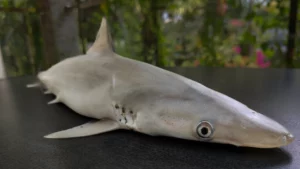 | 0.9–1.1 m (3–3.5 ft) | Low | Shallow sand and seagrass flats all around the islands; the commonest shark in the marketsA slim, fast little shark that pups in the bays in spring. The jarjur of everyday Bahraini cooking; harmless to people. |
Whitecheek SharkCarcharhinus dussumieri | 0.8–1 m (2.5–3.3 ft) | Low | Inshore over sand and mud, Tubli Bay to the Hawar channelsOne of the most abundant sharks in the Gulf, told by the black spot on its second dorsal fin. Feeds on small fish and squid. |
| Spot-tail SharkCarcharhinus sorrah | 1.2–1.6 m (4–5 ft) | Low | Reef edges and open shelf; the main commercial shark of the GulfBlack-tipped second dorsal and lower tail lobe. Timid around swimmers, heavily fished across the region. |
Grey Sharpnose SharkRhizoprionodon oligolinx | 0.6–0.9 m (2–3 ft) | Low | Shallow coastal water and the shoals; landed with the milk sharkSmaller and greyer than the milk shark, with a long pointed snout. Common, harmless and mostly seen on ice at the market. |
| Arabian CarpetsharkChiloscyllium arabicum | 0.6–0.8 m (2–2.5 ft) | Low | Coral ledges and seagrass on Fasht Al Adhm and the Hawar reefsA slender bottom shark found only in the Gulf and adjacent Arabian seas. Lays egg cases on the reef; the shark divers see most often here. |
| Arabian Smooth-houndMustelus mosis | 1–1.5 m (3–5 ft) | Low | Sandy shelf and the deeper water north of the islandsThe Gulf's houndshark, with flat teeth for crabs and shellfish. Landed regularly; never a threat to bathers. |
| Sliteye SharkLoxodon macrorhinus | 0.7–0.9 m (2.5–3 ft) | Low | Clear water over the shoals and reef edgesThe slit-like notch behind each eye gives it its name. A small, delicate shark that feeds on shrimp and little fish. |
| Hardnose SharkCarcharhinus macloti | 0.8–1.1 m (2.5–3.5 ft) | Low | Inshore shelf; occasional in the traps and netsA small requiem shark with a hard, calcified snout. Common across the Gulf, harmless. |
Hooktooth SharkChaenogaleus macrostoma | 0.8–1 m (2.5–3.3 ft) | Low | Shallow shelf; a regular in the fisheryA weasel shark with hooked lower teeth for slippery fish. Small, timid and often mistaken for a milk shark at the market. |
| Slender Weasel SharkParagaleus randalli | 0.6–0.8 m (2–2.5 ft) | Low | Inshore over sand and mud; Gulf and Arabian Sea onlyDescribed as a new species only in 1996 from Gulf specimens. One of the smallest sharks in Bahraini water, feeding on squid and small fish. |
Snaggletooth SharkHemipristis elongata | 1.8–2.4 m (6–8 ft) | Low | Deeper shelf north of the islands; occasional landingsA big weasel shark with protruding, hooked teeth and a reputation far worse than its record. Its fins were once among the most valuable in the trade. |
Blacktip SharkCarcharhinus limbatus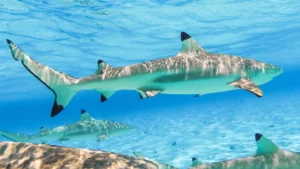 | 1.5–2.5 m (5–8 ft) | Moderate | Reef edges and open shelf; often near fish trapsA fast, jumping hunter of schooling fish. Responsible for minor bites on waders elsewhere, but no Bahraini record. |
Spinner SharkCarcharhinus brevipinna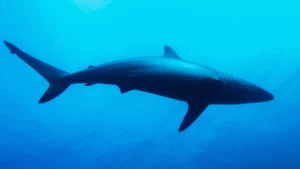 | 2–2.5 m (7–8 ft) | Moderate | Open water over the northern shelf, following sardine and mackerel schoolsLeaps and spins through baitfish. Its rare bites worldwide involve fishermen and nets rather than bathers. |
Sandbar SharkCarcharhinus plumbeus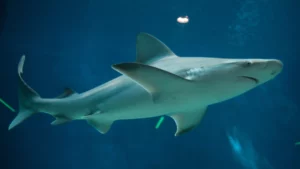 | 1.8–2.4 m (6–8 ft) | Low | Sandy shelf and channels north and east of the islandsTall dorsal fin, small mouth, bottom-feeding habits. Slow-growing and heavily fished across the Gulf. |
Pigeye SharkCarcharhinus amboinensis | 1.9–2.5 m (6–8 ft) | Moderate | Turbid inshore water and channels; uncommonA bull shark look-alike with a smaller second dorsal fin. Stocky and powerful, and treated with the same respect by Gulf fishermen. |
Bull SharkCarcharhinus leucas | 2.2–3.2 m (7–11 ft) | High | Deeper channels around the Hawar Islands and the northern shelf; uncommonThe most dangerous shark recorded in Bahrain, at home in murky, warm water. Rare enough that most local fishermen see one or two in a career. |
Tiger SharkGaleocerdo cuvier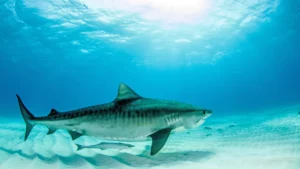 | 3–4.5 m (10–15 ft) | High | Rare visitor to the deeper northern watersRecorded across the Gulf and occasionally in Bahraini landings. A scavenger of turtles and dugong carcasses around the Hawar meadows; never involved in a local incident. |
Great Hammerhead SharkSphyrna mokarran | 3–4.5 m (10–15 ft) | Moderate | Deeper shelf toward Qatar; juveniles in the Hawar channelsA ray-hunter with a straight-edged head. Critically endangered worldwide and still landed in the Gulf; no confirmed unprovoked bite in the region. |
Scalloped Hammerhead SharkSphyrna lewini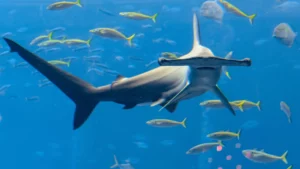 | 2.5–3.5 m (8–12 ft) | Low | Northern shelf in the cooler months; juveniles inshoreThe scalloped front edge of the head sets it apart. Schools in the Gulf are small and the species is critically endangered. |
Winghead SharkEusphyra blochii | 1.2–1.5 m (4–5 ft) | Low | Shallow shelf and bays; occasional in the trapsThe hammerhead with the widest head of all, nearly half its body length. Small, harmless and endangered. |
Tawny Nurse SharkNebrius ferrugineus | 2.5–3.2 m (8–10 ft) | Low | Reef caves and ledges on Fasht Al Adhm and the Hawar reefsThe Gulf's nurse shark, docile by day and a suction-feeder by night. Will only bite if grabbed or fed. |
Zebra Shark ('Leopard Shark' locally)Stegostoma tigrinum | 2–2.5 m (7–8 ft) | Low | Sand patches beside the reefs, resting by daySpotted as an adult, striped as a pup. Placid to the point of indifference, and the shark most divers hope to photograph here. Endangered. |
Whale SharkRhincodon typus | 6–10 m here (adults to 12 m+) | Low | Offshore northern waters toward Qatar, May to SeptemberFilter feeder, harmless. The northern Gulf holds one of the world's great summer gatherings and Bahraini boats meet stragglers from it. |
Smoothtooth Blacktip SharkCarcharhinus leiodon | 1–1.3 m (3.5–4.5 ft) | n/a | Known from Kuwait and the northern Gulf; not yet confirmed in BahrainA Gulf near-endemic rediscovered in 2008. Listed as unconfirmed; likely to be added once Bahraini landings are properly surveyed. |
Great White SharkCarcharodon carcharias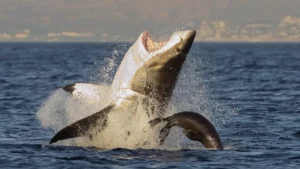 | 4–6 m (13–20 ft) | n/a | Not recorded in the Arabian GulfListed here purely to answer the commonest question: a temperate species with no Gulf record of any kind. |
The questions people ask most are about species that are not here. The great white shark has never been recorded in the Arabian Gulf; it is a temperate animal and the nearest confirmed records are in the southern Indian Ocean. Blacktip reef sharks, the beach sharks of the Maldives and the Red Sea, have scattered Gulf records from the Emirates and Qatar but are not part of the Bahraini fauna, and the oceanic whitetip, silky shark and reef sharks of the Indian Ocean stop at the Strait of Hormuz. One Gulf shark that may yet be added to the list is the smoothtooth blacktip, a species known only from the northern Gulf and Yemen and rediscovered in a Kuwaiti fish market in 2008; it is included in the table as unconfirmed.
Where to see sharks in Bahrain
Bahrain has a small but growing diving scene and no shark tourism as such, so most encounters are incidental: a shark on a reef dive, a shark in a trap, a shark on a market slab. These are the places where they actually turn up.
- Hawar IslandsA protected archipelago 20 km south-east of the main island, next to Qatar. Its seagrass meadows hold one of the world's largest dugong herds, and the fringing reefs and channels are where fishermen record juvenile hammerheads, spot-tail sharks and the occasional bull shark.
- Fasht Al AdhmThe largest coral reef in Bahrain, east of the main island. Zebra sharks resting on sand patches, tawny nurse sharks under ledges and Arabian carpetsharks in the coral are the reliable sightings on dives here.
- Fasht Al Jarim and the northern pearl bedsThe northern shoal and the historic oyster beds of the UNESCO-listed pearling route, Hayr Bu-l-Thamah among them. Deeper, clearer water where hammerheads and larger requiem sharks pass, and the closest Bahraini ground to the whale sharks of the northern Gulf.
- Tubli Bay and the Ras Sanad mangrovesA Ramsar-listed bay on the east coast with Bahrain's last mangroves. A nursery for shrimp and juvenile fish, and the kind of shallow, muddy water where small milk sharks and whitecheek sharks hunt on the tide.
- Dive Bahrain, off Diyar Al MuharraqThe world's largest underwater theme park, built around a sunken Boeing 747 in about 20 m of water off the north coast. Opened in 2019, its artificial reef has drawn fish life and, with it, the odd visiting shark for divers.
- Jarada IslandA sandbank that appears at low tide off the east coast, a popular day trip by boat. The shallow, clear flats around it are where snorkellers most often glimpse small requiem sharks and rays.
- Offshore waters toward QatarThe deeper water north-east of Bahrain, around the oil and gas platforms. The northern Gulf has one of the largest known whale shark gatherings in the world in summer, and animals from it are seen from Bahraini boats and platforms between May and September.
- Manama Central Market fish hallThe surest place in the country to see a Bahraini shark. Milk sharks, whitecheek sharks, spot-tails, Arabian carpetsharks and, occasionally, a hammerhead or bull shark are landed and sold here as jarjur, and a morning walk through the hall is a lesson in the Gulf's shark fauna.
For divers, Fasht Al Adhm in the cooler months is the best bet for a live shark, with zebra sharks the most photogenic. For the big animals, a boat trip toward the northern Gulf in summer offers a genuine, if unpredictable, chance of a whale shark. For everyone else, the fish market at dawn beats any aquarium.
Best time of year to see sharks in Bahrain
Bahrain's sea has two extremes and a short, pleasant middle, and the sharks move with the temperature.
- November to March: the water cools from 28 °C to 15–18 °C by January and visibility on the reefs is at its best. Diving on Fasht Al Adhm and the northern shoals is most comfortable now, and hammerheads and larger requiem sharks are landed more often as they follow the cooler water onto the shelf.
- April and May: the sea warms fast, through 22–26 °C. This is pupping season for the small coastal sharks: newborn milk, whitecheek and spot-tail sharks appear in the shallow bays and over the seagrass, and shrimp trawling is closed to protect the nursery grounds.
- June to September: surface temperatures of 33–35 °C, sometimes higher in the enclosed bays. Many larger sharks retreat to deeper, cooler water to the north, but this is exactly when the whale sharks gather in the northern Gulf, so the offshore waters toward Qatar are at their best for the biggest fish in the sea.
- October: the water begins to fall back below 30 °C and the reef fish and their predators return to the shoals. A good transitional month for divers before the winter shamal winds start to blow.
Bahrain's salinity barely changes through the year, but the summer heat is now extreme enough to bleach the corals on Fasht Al Adhm, as it did in 1996, 1998 and 2017, and the reef sharks depend on those corals recovering.
Shark attacks in Bahrain: what the record actually shows
There is nothing on it. SharkSider's database, which records every documented shark incident worldwide, has no entry for Bahrain: no attack, no bite, no boat struck, no doubtful case, at any date. The International Shark Attack File reports the same. That is the complete record for a country whose people have been in and on the water since the Dilmun civilisation, and whose pearl divers spent centuries free-diving the northern oyster beds among the very sharks in the table above.
No incidents are recorded in the SharkSider database for this country.
The reasons are worth spelling out because they apply across the Gulf. The sharks a swimmer might actually meet in Bahrain are small: a milk shark or a whitecheek shark is around a metre long, feeds on small fish and shrimp, and flees from people. The medium-sized sharks, spot-tail, spinner, sandbar and blacktip, live over the deeper shoals and are caught far more often than they are seen. The three species with a real bite history elsewhere, the bull shark, the tiger shark and the great hammerhead, are all recorded in Bahraini water but are uncommon and are met in the deeper channels and offshore, not at the beach. The pearl divers of the past reported sharks as a nuisance that stole their catch, not as a killer.
The precautions that matter are the standard ones for the region. Do not swim near fishermen cleaning their catch or near the hadrah tidal traps that concentrate fish at low water; avoid swimming at dusk in the deeper channels around the Hawar Islands, where bull sharks are most often recorded; and if you spearfish, do not tow bleeding fish on your belt. Our guide to surviving a shark attack covers the rest, but in Bahrain the more useful guide is the one about heat exhaustion and jellyfish.
Is it safe to swim and snorkel in Bahrain?
Yes, and sharks are the least of the reasons to take care. Bahrain's swimming is mostly in shallow, warm water off resort beaches on the west and north coasts and around the Amwaj and Durrat developments, where the only sharks are the occasional juvenile requiem shark passing over the sand. Snorkellers on the reefs at Fasht Al Adhm or around Jarada may see an Arabian carpetshark under a ledge or a zebra shark on the bottom; both are among the most placid sharks in the world and will either ignore you or move off slowly.
The whale shark is the one large shark you might deliberately get in the water with, and it is completely harmless. If you find one from a boat in the northern Gulf, the rules are the ones used everywhere: slip in quietly, stay a few metres from the body and well clear of the tail, never touch, never block its path, and do not let the boat drive over it. There is no organised whale shark tourism in Bahrain, so it is on the skipper and the swimmer to behave.
What actually sends people to hospital on the Bahraini coast is heat: a 35 °C sea does not cool you, and dehydration and sunstroke on a boat in August are real risks. Stingrays lie buried on the sand flats and are the most common cause of a marine injury in the Gulf; shuffle your feet when wading. Jellyfish blooms arrive in the warm months, and the winter shamal can turn a calm sea into a dangerous one for small boats within an hour. Sharks are nowhere on that list.
Shark conservation in Bahrain
Bahrain's sharks are protected mainly by habitat rules rather than species rules. The Hawar Islands have been a protected area since 1996 and a Ramsar wetland of international importance since 1997, chiefly for their dugongs, cormorants and turtles, and Tubli Bay's mangroves carry the same Ramsar status. The Supreme Council for Environment and the Directorate of Fisheries regulate fishing through licensing, gear restrictions and the annual closed season for shrimp trawling that protects the nursery grounds the small sharks share. There is no nationwide ban on catching sharks, no ban on the fin trade of the kind the Maldives or Bahamas have adopted, and jarjur remains an everyday item in the markets.
The pressures are unusually concentrated. Bahrain has enlarged its land area by more than a tenth through reclamation since the 1960s, and dredging and infilling have buried reefs, seagrass and much of the mangrove that once fringed the main island. The Gulf's corals sit at the edge of their thermal tolerance and have bleached repeatedly, most severely in 1996, 1998 and 2017. Shrimp trawls and traps take small sharks in numbers that have never been properly counted, and the regional Red List assessment of the Gulf's sharks and rays, completed in 2017, found a higher share of threatened species than in almost any other sea. Species such as the great hammerhead, the whale shark and the zebra shark are listed as endangered globally, and Gulf populations are small and partly isolated from the Indian Ocean by the Strait of Hormuz.
There are hopeful signs. Bahrain joined CITES in 2012, which now covers the hammerheads, whale shark, silky shark and thresher sharks in international trade; the pearling route's oyster beds gained UNESCO World Heritage status the same year, giving the northern shelf a new reason for protection; and the Dive Bahrain artificial reef shows a willingness to invest in the sea as an attraction rather than as land in waiting. The bigger picture, of why slow-breeding sharks cannot absorb the losses that shrimp and fish can, is on our page about why sharks are endangered.
Sharks in neighbouring waters
Every Gulf state shares essentially the same shark fauna, with the numbers rising as the water gets deeper and cooler toward the Strait of Hormuz. Qatar, a short boat ride east of the Hawar Islands, has the northern Gulf's great whale shark aggregation in its offshore waters. Saudi Arabia, joined to Bahrain by the King Fahd Causeway, shares the shallow Gulf of Salwa on one side and has the very different Red Sea on the other. Iran holds the deep northern shore of the Gulf and most of its shark landings. Beyond Hormuz, Oman has whale sharks, hammerheads and reef sharks in real numbers, and Pakistan and India continue the Arabian Sea coast eastward. The full set of country pages is on the sharks around the world index.
Frequently asked questions
Are there sharks in Bahrain?
Yes. Twenty-three species have solid records around the islands, most of them small coastal requiem sharks such as the milk shark, whitecheek shark, spot-tail shark and grey sharpnose shark, plus reef species like the Arabian carpetshark, zebra shark and tawny nurse shark. Larger bull sharks, hammerheads, tiger sharks and whale sharks are recorded but seen far less often.
Have there been shark attacks in Bahrain?
No. The SharkSider database has no recorded shark incident of any kind for Bahrain, at any date, and the International Shark Attack File reports none either. In thousands of years of fishing, pearl diving and swimming around the islands, nobody has ever been documented as bitten by a shark.
Is it safe to swim in the sea in Bahrain?
Yes. Sharks are not a practical concern on Bahraini beaches; the real hazards are heat and dehydration in summer, stingrays buried on the sand flats, seasonal jellyfish and, for boaters, the sudden shamal wind. The few larger sharks live in the deeper channels and offshore water, not in the shallow bays where people swim.
Are there great white sharks in Bahrain?
No. The great white shark has never been recorded anywhere in the Arabian Gulf. It is a temperate-water species, and Bahrain's summer sea of 33–35 °C is far outside its range. Reports of great whites in the Gulf have always turned out to be bull sharks, large requiem sharks or tiger sharks.
Are there bull sharks in Bahrain?
Yes, but they are uncommon. Bull sharks are recorded across the Gulf and occasionally in Bahraini landings, mostly from the deeper channels around the Hawar Islands and the northern shelf. They are the most dangerous species on the Bahraini list, yet no incident involving one has ever been recorded in the country.
Can you see whale sharks in Bahrain?
Sometimes. The northern Arabian Gulf holds one of the largest known summer gatherings of whale sharks, centred on the offshore waters toward Qatar, and animals from it are seen from Bahraini boats and oil platforms between May and September. There is no organised whale shark tourism in Bahrain, so sightings depend on luck and a good skipper.
What is the most common shark in Bahrain?
The milk shark, followed closely by the whitecheek shark and the spot-tail shark. All three are small requiem sharks of the sand and seagrass flats that pup in the bays in spring and are landed daily at the Manama and Muharraq fish markets, where any shark is sold as jarjur.
Where can I dive with sharks in Bahrain?
Fasht Al Adhm, the largest reef east of the main island, is the most reliable site, with zebra sharks on the sand, tawny nurse sharks under ledges and Arabian carpetsharks in the coral. The Hawar Islands reefs and the Dive Bahrain artificial reef off the north coast produce occasional sightings. November to March gives the clearest water.
When is the best time to see sharks in Bahrain?
November to March for reef diving, when the water cools to 15–22 °C and visibility is best, and when hammerheads and larger requiem sharks come onto the shelf. May to September is whale shark season in the northern Gulf. April and May are when newborn milk and whitecheek sharks fill the shallow bays.
Is shark fishing legal in Bahrain?
Yes. Bahrain regulates fishing through licences, gear rules and a closed season for shrimp trawling, but has no nationwide ban on catching sharks or trading their fins. Small sharks are landed and sold every day as jarjur. The Hawar Islands and Tubli Bay are protected areas, and Bahrain's 2012 accession to CITES restricts international trade in hammerheads and whale sharks.
References

A small team focused on researching sharks and making marine biology easy to understand. Every page is reviewed against current species records and the SharkSider attack database, and updated when new incidents or research appear.
Published January 30, 2023 · Last updated September 21, 2026 · Incident data from the SharkSider attack database (0 records for Bahrain, 0 fatal).


