
Yes, Virginia has sharks, and the Chesapeake Bay is one of the reasons the whole East Coast has sandbar sharks at all. This list covers 22 species with a dependable record in the state. Near the beaches and in the lower Bay the sharks you are most likely to meet are the sandbar shark, the Atlantic sharpnose, the smooth dogfish, the dusky shark and, on the wrecks, the sand tiger. Bull sharks, blacktips and hammerheads arrive in high summer; makos, blues and threshers stay offshore.
The record is short. SharkSider's database holds 19 Virginia entries from 1852 to 2010 (16 dated 1900 or later), 5 of them fatal, 3 since 1900. Two of those three deaths were shipwreck victims far out at sea in 1928 and 1939; the only beach fatality in the modern era is the 10-year-old boy killed by a bull shark at Sandbridge Beach in September 2001. Since 2000 there have been just three records, and the last one, a surfer bitten on the ankle at Sandbridge in 2010, was more than a decade ago.
- Shark species in this list22 recorded
- Protected speciesSand tiger & white (1997), dusky (2000), sandbar (2008)
- Most seen from the beachSandbar & Atlantic sharpnose
- Signature encounterSand tigers on the Virginia Beach wrecks
- Incidents in the database19 (1852–2010), 5 fatal
- Water temperature6–8 °C in Feb, 25–27 °C in Aug

On this page
- Why Virginia has so many sharks
- List of the different types of sharks in Virginia
- Where to see sharks in Virginia
- Best time of year to see sharks in Virginia
- Shark attacks in Virginia: what the record shows
- Is it safe to swim at Virginia's beaches?
- Shark conservation in Virginia
- Sharks in nearby states
- Frequently asked questions
- References
Why Virginia has so many sharks
Everything starts with the Bay. The Chesapeake drains six states through a mouth only 30 kilometres wide between Cape Charles and Cape Henry, and on every ebb tide it pours warm, murky, food-rich water past Virginia Beach. Inside that mouth the water in summer is brackish, shallow and packed with menhaden, croaker, spot and blue crab, which is exactly what a newborn shark needs. Female sandbar sharks that grew up here come back to drop their pups in the lower Bay between June and August, and the young sharks stay in the estuary for their first few summers before moving out along the coast. The Virginia Institute of Marine Science (VIMS) has been setting longlines in these waters since 1973, the longest-running shark survey of its kind anywhere, and its catches show that the sandbar shark is by a wide margin the most common large shark in Virginia, followed by the Atlantic sharpnose, the smooth dogfish and the dusky shark. Sand tigers, once thought of as a rare visitor, turn out to use the Bay too, and juveniles are caught there every summer.
Offshore, the continental shelf off Virginia is wide and gently sloping, then falls away suddenly into the Norfolk Canyon roughly 110 kilometres east of Rudee Inlet. That edge is where the Gulf Stream meanders past in summer, and it brings a completely different set of animals: shortfin makos, blue sharks, common threshers and the occasional silky or tiger shark that would never come inside the Bay. In winter the same shelf cools sharply and the pelagic species drop south or move into deeper water, while spiny dogfish and porbeagles push down from New England. The result is a state that hosts a tropical-leaning shark fauna in August and a boreal one in February.
The Eastern Shore adds a third habitat. The barrier islands between Cape Charles and Chincoteague, most of them owned by The Nature Conservancy or the federal government, are the least developed stretch of Atlantic coast between Maine and Florida. Their inlets and marsh creeks are nurseries for smooth dogfish, sharpnose and young sandbar sharks, and the surf outside them is where blacktips and spinners chase mullet in September. Very few people swim there, which is one reason the state's incident list is so short compared with the crowds at the oceanfront.
Protection is layered. The federal prohibited list has covered sand tiger and white sharks since 1997, dusky sharks since 2000 and, for recreational anglers, sandbar sharks since 2008; any of those caught in Virginia must go back in the water. The Virginia Marine Resources Commission sets its own limits on top: a daily bag of one shark per angler for the species that may be kept, minimum sizes, and a closed season for large coastal sharks that keeps commercial longlines off the pupping grounds in May and June. The commercial sandbar fishery that once landed thousands of animals a year is now limited to a small research quota, and the VIMS survey has recorded a slow recovery in the numbers of adult sandbar sharks since the early 2000s.
List of the different types of sharks in Virginia
The table below lists every species with a solid record in Virginia, from the surf at Sandbridge to the edge of the Norfolk Canyon. Sizes are typical adult lengths rather than the largest fish ever landed. The risk column rates the threat to a swimmer or surfer in Virginia's own conditions rather than a species' reputation elsewhere: a mako that lives 100 kilometres offshore poses no risk to a bather at 14th Street, whatever its teeth look like. Two names need a note. The “sand shark” that appears in old Virginia records is a catch-all that could mean a sand tiger, a sandbar or a smooth dogfish, and the two dogfish species that anglers pull up all winter are true sharks, even if they rarely get called that.
| Species | Adult size | Risk to swimmers | Where in Virginia & notes |
|---|---|---|---|
Sandbar SharkCarcharhinus plumbeus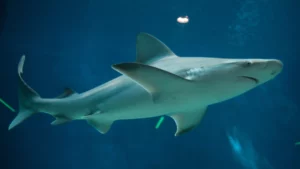 | 1.8–2.4 m (6–8 ft) | Low | Lower Chesapeake Bay, the surf zone and every pier, June–OctoberVirginia's most common large shark; the Bay is the East Coast's main nursery. Prohibited for anglers since 2008. Small mouth, fish diet, no serious Virginia bite on record. |
Atlantic Sharpnose SharkRhizoprionodon terraenovae | 0.8–1.1 m (2.5–3.5 ft) | Low | Surf zone, inlets and the lower Bay all summerThe small shark pier anglers catch by the dozen. Marked 'moderately aggressive' on the old page; it is harmless to people. |
| Smooth DogfishMustelus canis | 0.9–1.3 m (3–4 ft) | Low | Chesapeake Bay and the Eastern Shore creeks, spring to autumnFlat, crushing teeth for crabs; the most numerous shark in the Bay by far. Completely harmless. |
| Spiny DogfishSqualus acanthias | 0.8–1.2 m (2.5–4 ft) | Low | Coastal shelf in winter, November–AprilArrives in cold-water schools and supports a winter trawl fishery. The two dorsal spines are the only thing that can hurt you. |
Dusky SharkCarcharhinus obscurus | 3–3.6 m (10–12 ft) | Low | Bay mouth and the coastal shelf in summer; juveniles inshoreProhibited since 2000 and still recovering. One Virginia record, a 12-foot dusky that bit a spearfisher's hand in 1998. |
Sand Tiger SharkCarcharias taurus | 2.2–3 m (7–10 ft) | Low | Virginia Beach wrecks and the lower Bay, June–OctoberThe star of the wreck dives. Fearsome teeth, placid nature; the state's two 'sand shark' bites were on fishermen handling netted animals. |
Blacknose SharkCarcharhinus acronotus | 1–1.4 m (3.5–4.5 ft) | Low | Surf zone and inlets in the warmest monthsA small southern shark near the northern edge of its range in Virginia; a common pier catch in August. |
Spinner SharkCarcharhinus brevipinna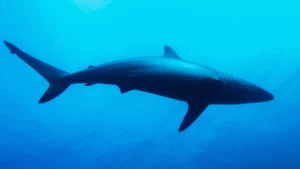 | 2–2.5 m (6.5–8 ft) | Moderate | Surf at Sandbridge and the Eastern Shore during the autumn mullet runLeaps clear of the water while feeding. Bites on people are hit-and-run mistakes in murky surf, none confirmed in Virginia. |
Blacktip SharkCarcharhinus limbatus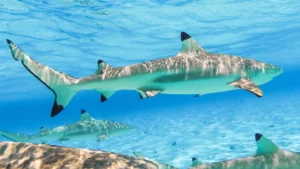 | 1.5–2 m (5–6.5 ft) | Moderate | Surf zone and Bay mouth, July–OctoberIdentified in one Virginia record: a 5–6 ft blacktip that bit a crabber's elbow at False Cape in 1973. |
Scalloped Hammerhead SharkSphyrna lewini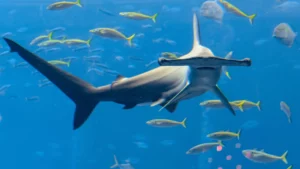 | 2.5–3.5 m (8–11.5 ft) | Low | Coastal shelf and Bay mouth in summer; juveniles in the lower BayCritically endangered worldwide. Small juveniles turn up in the VIMS survey most summers. |
Smooth Hammerhead SharkSphyrna zygaena | 2.5–3.5 m (8–11.5 ft) | Low | Offshore shelf waters, late spring to autumnThe cooler-water hammerhead, seen at the surface by offshore boats. No Virginia incident. |
Bull SharkCarcharhinus leucas | 2.1–3.4 m (7–11 ft) | High | Lower Chesapeake Bay and the surf at Sandbridge in late summerUncommon but present in the warmest months, and responsible for the state's only modern beach fatality at Sandbridge in 2001. |
Tiger SharkGaleocerdo cuvier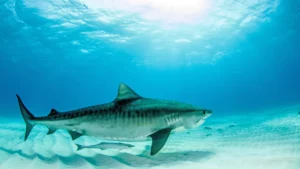 | 3–4.5 m (10–15 ft) | High | Offshore shelf and canyon edge in summer; rarely inshoreHooked by the Rudee Inlet charter fleet in August. No Virginia incident on record. |
Great White SharkCarcharodon carcharias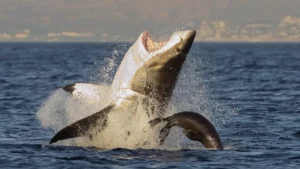 | 4–6 m (13–20 ft) | High | Passing offshore between October and April on the New England–Carolinas migrationSatellite-tagged whites ping off Virginia Beach and the Eastern Shore most winters. Never recorded biting anyone in the state. |
Shortfin Mako SharkIsurus oxyrinchus | 2.5–3.5 m (8–11.5 ft) | Low | Norfolk Canyon edge, May–JulyThe fastest shark, and the target of Virginia's early-summer offshore charters. Endangered; now release-only in the Atlantic. |
Common Thresher SharkAlopias vulpinus | 3–4.5 m (10–15 ft) incl. tail | Low | Coastal shelf in spring and early summer, following bluefishIts scythe-like upper tail lobe is as long as its body. Seen at the surface off Chincoteague in May; harmless to swimmers. |
Blue SharkPrionace glauca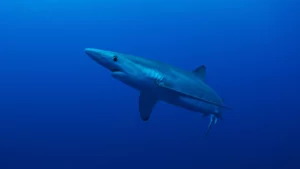 | 2.5–3.5 m (8–11.5 ft) | Low | Far offshore over the canyon, spring and autumnThe commonest big shark in the open Atlantic, never near beaches. |
Silky SharkCarcharhinus falciformis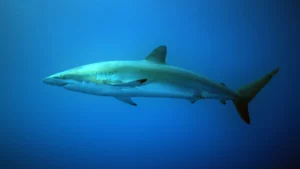 | 2–3 m (7–10 ft) | Low | Gulf Stream water beyond the shelf edge in late summerA tropical pelagic shark that follows warm water north. 'Highly aggressive' on the old page was wrong for Virginia; it never reaches the beaches. |
Porbeagle SharkLamna nasus | 1.8–2.5 m (6–8 ft) | Low | Cold offshore water, December–MarchA New England shark at the southern end of its winter range. Warm-blooded, deep, and never seen from shore. |
Finetooth SharkCarcharhinus isodon | 1.3–1.6 m (4–5 ft) | Low | Surf zone and Bay mouth in July and AugustA small, fast menhaden-eater that reaches Virginia at the top of its range in warm summers. |
Basking SharkCetorhinus maximus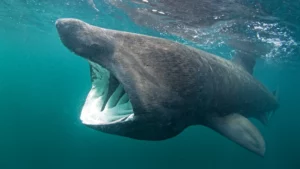 | 6–8 m (20–26 ft) | Low | Off the Eastern Shore in April and MayPlankton feeder, harmless. Occasionally strands on the barrier islands in spring. |
Lemon SharkNegaprion brevirostris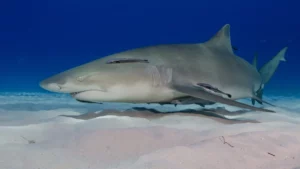 | 2.4–3 m (8–10 ft) | Low | Occasional in the surf and inlets in the warmest weeksVirginia is the northern limit of its range; a summer visitor, not a resident. |
Nurse SharkGinglymostoma cirratum | 2.2–3 m (7–10 ft) | n/a | Rare straggler; no established populationListed at 18–32 feet on the original page, which is a whale shark's size. A southern reef shark that only occasionally wanders this far north. |
Three species people ask about are missing or barely present. The nurse shark was listed on the original version of this page at 18–32 feet, which is a whale shark's measurement, not a nurse shark's; adults are 2.2–3 m, and in Virginia they are a rare straggler from the south with no resident population. Lemon sharks reach the state in the warmest months, but Virginia is the northern edge of their range and sightings are occasional rather than routine. And there are no reef sharks: blacktip reef, whitetip reef and grey reef sharks live in the Indo-Pacific, and the only one ever recorded biting anyone in Virginia was a captive animal at the Virginia Aquarium in 2007 that nipped the shin of a keeper reviving it after sedation. The silky shark was marked “highly aggressive” on the old page; it is a pelagic species that stays at the shelf edge and has never been involved in a Virginia incident.
Where to see sharks in Virginia
Virginia is not a shark-diving destination in the Florida sense, but it offers wreck dives with sand tigers, some of the best shore and pier shark fishing on the East Coast, and a large aquarium built around the Norfolk Canyon. These are the places that produce sharks reliably.
- The Virginia Beach wrecks (Tiger, Gulf Hustler, Chesapeake Light Tower)The Tiger, a tanker torpedoed in 1942, lies in about 25 m of water off Virginia Beach and holds sand tiger sharks from June to October, sometimes a dozen at a time hanging in the current above the hull. The Gulf Hustler and the reef around the decommissioned Chesapeake Light Tower, 20 km off the coast, add sandbar and dusky sharks. Charters run from Rudee Inlet and Lynnhaven; visibility is best in late summer.
- Virginia Beach Fishing Pier (14th Street) and Little Island Pier, SandbridgeThe oceanfront pier is where sandbar sharks, sharpnose and smooth dogfish are hooked on almost every summer night, and the Little Island Park pier at Sandbridge sees blacktips and spinners when the mullet run in September. Fishing for sharks is allowed; landing them on the pier deck is not, so anglers walk them to the beach for release.
- Chesapeake Bay Bridge-Tunnel and the lower BayThe 28-kilometre bridge-tunnel crosses the mouth of the Bay, and its four rock islands and thousands of pilings are structure for sandbar sharks, sand tigers and, in August, the odd bull shark. Boat anglers drift the channel edges at night. This is also the water where the VIMS survey sets most of its lines.
- Virginia Aquarium & Marine Science Center, Virginia BeachThe 300,000-gallon Norfolk Canyon exhibit holds sand tiger, sandbar and nurse sharks alongside sea turtles and rays, and the aquarium's stranding team is the one that examines any shark that washes up in the state. It is the easiest place in Virginia to see a sand tiger face to face, and the only place to do it in February.
- Chincoteague and the Virginia end of Assateague IslandThe surf along Assateague Island National Seashore and Tom's Cove is uncrowded, drive-on in places, and popular with shark anglers after sandbar, sharpnose and dusky sharks. Kayakers in the back bays see smooth dogfish and juvenile sandbars in the marsh channels on summer high tides.
- The Eastern Shore barrier islands (Cobb, Hog, Smith)Reachable only by boat, these islands are the wildest coast in the mid-Atlantic. The inlets between them are shark nurseries and the surf holds blacktips and spinners in early autumn. Hog Island is also where one of the state's provoked incidents happened in 1960, when a fisherman was bitten tossing a netted “sand shark” aboard.
- Rudee Inlet charter fleet to the Norfolk CanyonFrom late May to July the offshore boats run 100 kilometres east to the canyon edge for shortfin mako, blue shark and common thresher, with the occasional tiger or great hammerhead in August. It is a long day and the water is 800 m deep at the drop-off, but it is the only way to see Virginia's pelagic sharks alive.
- Westmoreland State Park, Chippokes State Park and York River State ParkVirginia's fossil beaches. The Miocene cliffs on the Potomac at Westmoreland and Stratford Hall, the James River shore at Chippokes and Fossil Beach on the York all give up shark teeth after every storm, from tiny sand tiger teeth to the occasional megalodon. Our guide to finding shark teeth covers where to look and what you are allowed to keep.
Divers should book the Tiger wreck between July and September, when the sand tigers are thickest and the water clearest. Everyone else gets the most reliable show from the oceanfront pier on an August night: a sandbar shark on someone's line within an hour is close to a certainty.
Best time of year to see sharks in Virginia
Water temperature runs the calendar, and Virginia's swings hard. The surf at Virginia Beach bottoms out at 6–8 °C in February and peaks at 25–27 °C in August; inside the Bay the summer water is a degree or two warmer and the winter water a degree colder.
- December to March: the coastal sharks are gone. Spiny dogfish move through in dense winter schools and porbeagles and blue sharks sit far offshore in the deeper, warmer shelf water. This is also the window in which satellite-tagged great whites from New England pass Virginia on their way to and from the Carolinas, usually well out of sight of land.
- April and May: the turnover. Basking sharks sometimes appear off the Eastern Shore feeding on the spring plankton bloom, smooth dogfish flood back into the Bay, and the first sandbar sharks arrive as the water passes 15 °C.
- June to September: the season. Pregnant sandbar sharks pup in the lower Bay, sand tigers settle onto the wrecks, sharpnose and blacknose sharks fill the surf zone, and bull sharks, blacktips, spinners and hammerheads move in with the warmest water. Every record in the state's incident list that involves a swimmer or surfer falls between mid-July and late September.
- October and November: the mullet run pulls blacktips and spinners into the surf at Sandbridge and Chincoteague for a last feed before they head south. The Bay's juvenile sandbars leave in October as the water drops through 18 °C.
For divers, the wreck season is effectively July to early October; for anglers and pier watchers, June to September; for fossil hunters, any winter day after a nor'easter has scoured the cliffs.
Shark attacks in Virginia: what the record shows
Virginia has a short incident list for a state with a resort city of half a million people and more than a million summer visitors. The SharkSider database holds 19 records, the earliest a swimmer killed at Norfolk in 1852 and the most recent a surfer bitten on the ankle and knee at Sandbridge in September 2010. Sixteen of them are dated 1900 or later, and five in total were fatal, three since 1900. Every case is listed on the shark attacks in Virginia page, updated weekly. The six most recent records are shown here:
- 2010 · Sandridge BeachSurfing — Bite to left ankle and kneeSpecies not identified
- 2007 · Virginia Aquarium & Marine Science Center, Virginia BeachReviving a sedated shark — Left shin bitten by captive shark provoked incidentA 10-year-old 94-pound pregnant blacktip reef shark
- 2001 · Sandbridge Beach, Princess Anne CountySwimming — Fatal, thigh bittenbull shark · fatal
- 1999 · Sandridge Beach, Virginia Beach, Princess Anne CountyBody surfing — AbrasionsShark involvement not confirmed
- 1998 · Virginia BeachSpearfishing — Lacerations to left handDusky shark, 12'
- 1998 · Wreck of the Navy Barge, 22 miles SE of RudeeSpearfishing on scuba & transferring fish onto a stringer — Shark grasped diver's gloved hand. glove was soaked with fish blood & slimesandtiger shark
The first thing the record shows is that Virginia's deaths are mostly not beach stories. The 1928 fatality was a passenger from the liner Vestris, which sank 200 miles off Hampton Roads; the 1939 case was a seaman washed off a freighter by a freak wave several hundred miles south-east of Cape Henry. The 1852 and 1891 Norfolk cases are too old to verify in detail, and in the 1891 case the record itself notes the man may simply have drowned after falling from a shark-fishing boat. That leaves one death in the modern era: David Peltier, aged 10, bitten on the thigh by a bull shark while wading with his father in chest-deep water at Sandbridge Beach on 1 September 2001. It remains the only fatal shark bite on a Virginia beach in the database.
The second pattern is that the injuries are split almost evenly between people in the water for fun and people handling sharks on purpose. Surfers and bodyboarders account for 5 records and swimmers and waders for 5; divers and spearfishers for 4 and anglers on boats for 3. Of the non-swimming cases, nearly every one was provoked: a spearfisher off Chincoteague in 1989 trailing a string of bleeding fish, another in 1998 on a Navy barge wreck with a glove soaked in fish blood, a fisherman removing a sand shark from a net in 1956. Where a species was named, sand sharks (probably sand tigers) appear twice and the bull shark, dusky, sand tiger and blacktip once each. Two of the surf cases from Croatan Beach in 1991 and Sandbridge in 1999 are marked in the record as not confirmed to involve a shark at all.
Third, the numbers are falling. The 1990s were the busiest decade with four records, the 2000s had two and the 2010s one, and there has been nothing since 2010. Almost every incident is inside Princess Anne County, the old name for the Virginia Beach shoreline, because that is where the people are. Read our guide on how to survive a shark attack for what to do in the unlikely event a bite happens.
Is it safe to swim at Virginia's beaches?
Yes, by any reasonable measure. Virginia Beach lifeguards watch tens of millions of swims each decade against a record of one bite a decade or less. The sandbar sharks and sharpnose that share the surf zone with bathers are fish-eaters with small mouths that have never caused a serious injury in the state, and the dogfish in the Bay are harmless. The species worth respecting are the ones that arrive in high summer: the bull shark, which hunts in exactly the murky, brackish shallows where people wade at Sandbridge and in the lower Bay, and the fast blacktip and spinner sharks that hit bait schools in the surf during the autumn mullet run.
The practical rules follow from the record. Stay out of the water at dawn, dusk and after dark, when the 2001 and 1983 swimmer bites both happened. Avoid swimming next to fishing piers or where anglers are chumming for sharks; the 14th Street pier is a shark fishing spot for good reason. Leave the water if you see bait fish jumping or birds diving, which means a predator is feeding. Do not wade the Bay's marsh creeks and inlets on a September evening, and never handle a hooked or netted shark, which is the single most common cause of injury in the Virginia record. Divers on the wrecks should treat sand tigers as the placid animals they are: keep off the bottom, do not chase, and never spear fish with sharks in view, which is how the two spearfishing incidents in 1989 and 1998 came about.
Shark conservation in Virginia
Virginia has watched its sharks decline and partly recover within a single scientist's career. When the VIMS survey began in 1973 the lower Bay was thick with adult sandbar sharks; by the early 1990s, after two decades of commercial longlining for the fin and meat trade, the catch of large sandbars had fallen by more than two-thirds and dusky sharks had almost vanished from the survey. Federal management started in 1993, sand tigers and white sharks were put on the prohibited list in 1997, dusky sharks followed in 2000, and the commercial sandbar fishery was cut to a small research quota in 2008. The survey now shows juvenile sandbars at healthy levels and adults slowly climbing back, while the dusky shark, which does not mature until around 20 years old, is still a fraction of its former abundance and is listed as endangered by the IUCN.
None of that has removed the pressures. The Bay's forage base depends on menhaden, and the reduction fishery at Reedville takes the largest single share of that fish on the coast. Nutrient pollution creates a summer dead zone in the deeper Bay that squeezes sharks and their prey into the shallows. Warmer summers are pushing bull sharks and blacktips further north into the estuary, and the Eastern Shore barrier islands are eroding faster than they rebuild. What helps is unglamorous: release every prohibited species quickly and in the water, use non-offset circle hooks when targeting sharks, report tagged sharks to VIMS or NOAA, and never buy shark fin products anywhere. Our guide on why sharks are endangered sets out the wider picture, and what eats sharks explains why an adult sandbar shark in the Bay has almost no natural predators.
Sharks in nearby states
Virginia's sharks are shared with the whole mid-Atlantic. Across the Bay mouth, Maryland holds the upper Chesapeake and the Ocean City canyons where the mako and thresher charters run; Delaware has the East Coast's other great sand tiger and sandbar nursery in Delaware Bay. To the south, North Carolina adds the Outer Banks wrecks, a bull shark nursery in Pamlico Sound and a far longer incident list, and South Carolina continues the same beach species south to Georgia. Further up the coast, New Jersey and New York receive the same summer migrants a few weeks later. Across the Gulf Stream, Bermuda lies on the migration path of the tagged white sharks and tiger sharks that pass Virginia in autumn. See sharks around the world for every country and state on the site.
Frequently asked questions
Are there sharks in Virginia?
Yes. At least 22 species are recorded in Virginia's waters, and the mouth of the Chesapeake Bay is the most important sandbar shark nursery on the US East Coast. Sandbar, Atlantic sharpnose, smooth dogfish and dusky sharks are the common ones near shore, sand tigers gather on the Virginia Beach wrecks in summer, and makos, blues and threshers live offshore near the Norfolk Canyon.
Are there sharks in the Chesapeake Bay?
Yes, in large numbers every summer. The lower Bay is a nursery where sandbar sharks give birth between June and August, and the VIMS longline survey has caught sandbar, sand tiger, smooth dogfish, sharpnose, dusky and occasional bull sharks there every year since 1973. Most leave the Bay in October as the water cools.
Was there a shark attack in Virginia Beach?
Yes. The only fatal beach bite in the state's record happened at Sandbridge Beach on 1 September 2001, when 10-year-old David Peltier was bitten on the thigh by a bull shark while wading with his father. Other Virginia Beach records are minor: a swimmer's foot in 1983, a spearfisher's hand in 1998 and a surfer's ankle at Sandbridge in 2010.
How many shark attacks have there been in Virginia?
The SharkSider database lists 19 Virginia records between 1852 and 2010, 16 of them dated 1900 or later. Five were fatal, but two of those were shipwreck victims far out at sea in 1928 and 1939 and two are 19th-century Norfolk cases. Since 2000 there have been three records and one death, and nothing at all since 2010.
Are there great white sharks in Virginia Beach?
Occasionally, and only offshore. White sharks tagged by OCEARCH and by scientists in Massachusetts migrate past Virginia between October and April on their way between New England and the Carolinas, and several have pinged off Virginia Beach and the Eastern Shore. None has ever been recorded biting anyone in Virginia, and they do not come into the surf in summer.
Are there bull sharks in Virginia?
Yes, but they are uncommon. Bull sharks enter the lower Chesapeake Bay and the surf at Sandbridge in the warmest weeks of late summer, and one was responsible for the 2001 Sandbridge fatality. Warmer summers are pushing them further north, and juveniles have been documented in North Carolina's Pamlico Sound, but Virginia has no known nursery.
Is it safe to swim at Virginia Beach?
Yes. Virginia Beach hosts millions of swims every summer against a record of one shark bite per decade or fewer. Swim during the day near lifeguards, stay away from fishing piers and anglers chumming for sharks, leave the water when bait fish are jumping, and avoid wading the Bay's inlets at dusk in August and September.
When is the best time to see sharks in Virginia?
July to September. That is when sand tigers are on the Virginia Beach wrecks for divers, sandbar sharks are hooked nightly from the oceanfront piers, and the Bay is full of young sharks. The offshore mako and thresher season runs from late May to July, and basking sharks pass the Eastern Shore in April and May.
Can you find shark teeth in Virginia?
Yes, and some of the best fossil beaches on the East Coast are here. Westmoreland State Park and Stratford Hall on the Potomac, Chippokes State Park on the James and Fossil Beach in York River State Park all expose Miocene deposits that give up sand tiger, mako and occasionally megalodon teeth, especially after winter storms.
Is shark fishing legal in Virginia?
Yes, with limits. Anglers may keep one shark per person per day from the allowed species, but sand tiger, white, dusky and sandbar sharks are prohibited and must be released in the water, and the commercial sandbar fishery is limited to a small research quota. Sharks may be hooked from the Virginia Beach piers but not landed on the deck.
References

A small team focused on researching sharks and making marine biology easy to understand. Every page is reviewed against current species records and the SharkSider attack database, and updated when new incidents or research appear.
Published November 30, 2022 · Last updated September 22, 2026 · Incident data from the SharkSider attack database (16 records for Virginia, 3 fatal).


