
Yes, there are sharks in South Carolina, and the shallow, warm, marsh-fed coast holds them in numbers. Twenty species have a solid record in the state's waters. The ones swimmers actually share the water with are the blacktip, Atlantic sharpnose, bonnethead, finetooth and sandbar shark, with bull sharks in the sounds and estuaries and sand tigers on the offshore ledges. Tiger sharks and great whites are seasonal and mostly stay offshore.
The record is long but light on tragedy. The SharkSider database holds 177 South Carolina records from 1803 to 2026, 160 of them since 1900, and 10 deaths, only 4 since 1900. The last was a surfer at Folly Beach in September 2005. Since 2000 the state has logged 97 records with that single fatality, and the busiest decade on file, the 2010s with 49 records, had none. Almost every modern case is a quick bite to a foot or lower leg in murky surf at Myrtle Beach, the Isle of Palms or Hilton Head.
- Shark species in this list20 recorded
- Protected speciesSand tiger, white & dusky (federal); 1 shark/day state limit
- Most seen from the beachBlacktip & Atlantic sharpnose
- Signature encounterNewborn sharks in the Lowcountry creeks
- Incidents in the database177 (1803–2026), 10 fatal
- Water temperature10–14 °C in Jan, 27–29 °C in Aug

On this page
- Why South Carolina has so many sharks
- List of the different types of sharks in South Carolina
- Where to see sharks in South Carolina
- Best time of year to see sharks in South Carolina
- Shark attacks in South Carolina: the record explained
- Is it safe to swim at South Carolina beaches?
- Shark conservation in South Carolina
- Sharks in nearby states
- Frequently asked questions
- References
Why South Carolina has so many sharks
The South Carolina coast is not a straight line of sand. Below the Grand Strand it breaks into a maze of sea islands, tidal creeks and sounds, and behind almost every beach lies a belt of Spartina marsh that floods twice a day. Roughly 140,000 hectares of it, more than any other Atlantic state. That marsh is a fish factory: menhaden, mullet, shrimp and blue crab breed in it, and the sharks that eat them follow the tide in and out through inlets such as Breach, Stono, North Edisto and Port Royal. The South Carolina Department of Natural Resources has been netting the creeks for young sharks every summer since the late 1990s, and its surveys show the estuaries from Winyah Bay to Port Royal Sound acting as nurseries for at least ten species, including the Carolina hammerhead, a species that was only recognised as distinct in 2013 after specimens from these very waters were examined.
Offshore the shelf is wide and gentle. The bottom slopes so slowly that you are 100 km out before the water is 200 m deep, and the Gulf Stream runs along that edge, well beyond the horizon from the beach. Scattered across the shelf are rock ledges and artificial reefs, the “live bottom” that spearfishers and charter boats work, and these hold sandbar sharks, sand tigers and the occasional tiger shark in water that stays above 20 °C most of the year. The famous shark teeth of the Lowcountry come from the same geology: the Charleston area was sea floor for tens of millions of years, and the phosphate beds under Summerville and the black-sand beaches of Edisto give up megalodon teeth to anyone who looks.
Management is shared between Washington and Columbia. The federal prohibited list (sand tiger, white, dusky, bigeye sand tiger and others) applies in state water, and South Carolina adds its own rule of one shark per person per day for the coastal species, with a 137 cm fork-length minimum for the large ones. Several beach towns have gone further: Folly Beach banned shark fishing from its beach in 2019 after complaints about chumming beside swimmers, and Hilton Head and Myrtle Beach restrict fishing on lifeguarded stretches in summer. The effect is a coast where the small and medium-sized sharks are thriving and the big ones are slowly returning.
List of the different types of sharks in South Carolina
Every species below has a reliable record in South Carolina, most of them from the state's own nursery surveys and the Charleston charter fleet. Sizes are the usual adult range, not the record. Risk refers to swimmers and waders at the beach, which is why the blacktip, a shark that will never trouble a diver, is rated higher than the tiger shark that stays out on the ledges. The earlier version of this page listed the nurse shark at 18–32 feet, which is a whale shark's size: a real nurse shark is 2–3 m and only just reaches South Carolina at the northern edge of its range.
| Species | Adult size | Risk to swimmers | Where in South Carolina & notes |
|---|---|---|---|
Blacktip SharkCarcharhinus limbatus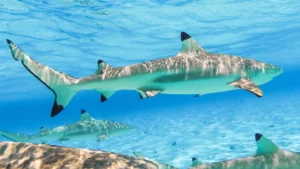 | 1.5–2.5 m (5–8 ft) | Moderate | Surf zone and inlets from Myrtle Beach to Hilton Head, May to OctoberThe species most often identified in South Carolina bites (5 records), all minor. Pups born in the creeks each May. |
Bull SharkCarcharhinus leucas | 2.1–3.4 m (7–11 ft) | High | Charleston Harbor, the rivers and Port Royal Sound in summerThe estuary predator. Three state records name it. Avoid murky river swims at dusk. |
Atlantic Sharpnose SharkRhizoprionodon terraenovae | 0.8–1.1 m (2.5–3.5 ft) | Low | Every pier, beach and creek mouth from spring to autumnThe most abundant shark in the state. Harmless; the commonest catch from the Grand Strand piers. |
Finetooth SharkCarcharhinus isodon | 1.4–1.9 m (4.5–6 ft) | Low | Nearshore and the sounds, following menhaden schoolsSouth Carolina is the core of its nursery range. Rarely bothers people. |
Sandbar SharkCarcharhinus plumbeus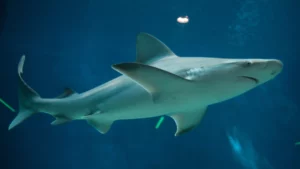 | 1.8–2.4 m (6–8 ft) | Low | Bays and the offshore ledges; young in the estuariesA 3 m sandbar bit a spearfisher on the Y-73 ledge in 2024, an exception for a normally placid shark. Must be released. |
Bonnethead SharkSphyrna tiburo | 0.9–1.2 m (3–4 ft) | Low | Grass flats and creeks behind every barrier islandThe shovel-headed shark kayakers see in a hand's depth of water. Eats crabs and seagrass. |
Spinner SharkCarcharhinus brevipinna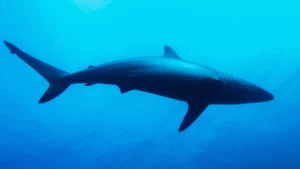 | 1.8–2.5 m (6–8 ft) | Moderate | Beyond the breakers in summer and during the October mullet runThe leaping shark. Indistinguishable from a blacktip at a glance; treat surf bites as either. |
Blacknose SharkCarcharhinus acronotus | 1.2–1.4 m (4–4.5 ft) | Low | Nearshore sand bottoms along the whole coastSmall, fast, with a dusky snout. A pier catch, not a swimmer's concern. |
Scalloped Hammerhead SharkSphyrna lewini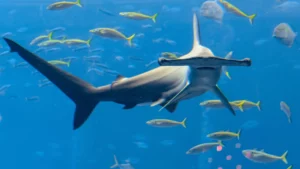 | 2.5–3.5 m (8–12 ft) | Low | Offshore ledges in summer; pups in the soundsShy and threatened; must be released. Never implicated in a state bite. |
| Carolina HammerheadSphyrna gilberti | 2–3 m (7–10 ft) | Low | Bulls Bay and the Charleston estuaries, where it was first recognisedDescribed in 2013 from South Carolina specimens. Identical to the scalloped hammerhead to the eye. |
Great Hammerhead SharkSphyrna mokarran | 3–4.5 m (10–15 ft) | Moderate | Offshore reefs and inlets in late summerThe original page's 15–20 ft was an exaggeration; 4.5 m is a very large fish. Hunts rays in the shallows, ignores people. |
Lemon SharkNegaprion brevirostris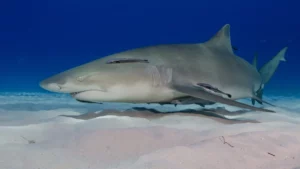 | 2.4–3 m (8–10 ft) | Low | Sea-island beaches and sounds in midsummerSlow, yellow-brown, sometimes seen from Hilton Head piers. Near its northern limit. |
Nurse SharkGinglymostoma cirratum | 2.2–3 m (7–10 ft) | Low | Offshore ledges in the warmest months; uncommonNot 18–32 feet as the old table said. A bottom-dwelling sucker of crabs and fish at the edge of its range. |
Tiger SharkGaleocerdo cuvier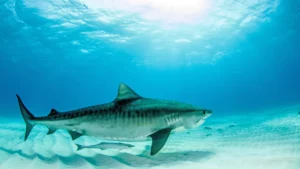 | 3–4.5 m (10–15 ft) | High | Deeper offshore reefs and Port Royal Sound, July to OctoberTwo state records name it, the older one an 1853 Charleston Harbor death. Tagged animals winter in the Bahamas. |
Sand Tiger SharkCarcharias taurus | 2–3.2 m (6.5–10.5 ft) | Low | Charleston wrecks and artificial reefs, late spring to autumnProtected since 1997. Docile on the wrecks; occasionally nips a wader's foot in the surf. |
Dusky SharkCarcharhinus obscurus | 3–3.6 m (10–12 ft) | Low | Migrates past the coast in spring and autumnProhibited since 2000 after the fin fishery collapse. Release if hooked. |
Great White SharkCarcharodon carcharias | 4–6 m (13–20 ft) | High | Winter and early spring along the shelf off Charleston and Hilton HeadTagged animals overwinter here; the 4 m male Breton pinged off the Grand Strand in summer 2022. Three state records name a white shark. |
Shortfin Mako SharkIsurus oxyrinchus | 2.5–3.5 m (8–11 ft) | Low | Gulf Stream edge, 100 km offshoreA blue-water sport fish; retention has been banned since 2022. Never inshore. |
| Smooth DogfishMustelus canis | 0.9–1.5 m (3–5 ft) | Low | Nearshore in the cooler monthsCrushing teeth for crabs; incapable of a damaging bite. |
| Spiny DogfishSqualus acanthias | 0.8–1.2 m (2.5–4 ft) | Low | Winter visitor from the north, December to MarchReaches the Carolinas at the southern end of its migration. Harmless apart from two dorsal spines. |
The sharks that are not here matter too. Reef sharks of the kind seen on Caribbean holidays do not occur north of Florida. Whale sharks are recorded off Charleston perhaps once a decade, following the Gulf Stream in late summer. Basking sharks pass far offshore in the cool months. Shortfin makos and blue sharks live along the Gulf Stream edge 100 km out and are not part of the beach picture at all. The scalloped hammerhead in the original table was called “moderately aggressive”; in reality it is one of the shyest large sharks in the Atlantic and has never been implicated in a South Carolina bite.
Where to see sharks in South Carolina
Most people who see a shark in South Carolina see it from a pier or a kayak, not underwater: the inshore water is green and the visibility is measured in centimetres. These are the places where the sighting is close to guaranteed.
- Apache Pier and Cherry Grove Pier, Myrtle BeachThe longest piers on the East Coast reach past the breakers into water where blacktips, sharpnose and the occasional sandbar shark feed on the bait schools. Summer evenings are best; you will see sharks hooked, photographed and released within an hour.
- Murrells Inlet and the Grand Strand inletsThe inshore charter fleet targets sharks here from May to September: blacktip, sandbar, bull and finetooth on light tackle in the inlet mouths and just off the beach. Bonnetheads swarm the grass flats at the top of the tide.
- Charleston Harbor and the Wando and Cooper riversBull sharks push far up the rivers in summer, and the harbour's shrimp-boat wakes attract sharpnose and finetooth sharks. A 3 m sandbar shark bit a spearfisher on the Y-73 ledge off the Charleston coast in May 2024, a reminder that the offshore ledges hold big animals.
- The Charleston offshore ledges and artificial reefsRock outcrops and sunk vessels 20–40 km out in 20–35 m of water. Sand tigers gather on the wrecks from late spring, sandbar sharks work the ledges, and tiger sharks are seen on the deeper sites in late summer. Visibility is best from June to October.
- Folly Beach and the WashoutThe state's surf capital and the site of its only modern fatality (2005). Blacktips and spinners feed close to the sandbar in summer; surfers see fins most weeks in July and August.
- Port Royal Sound and Hilton Head IslandOne of the deepest natural sounds on the coast, with strong tides that draw large bull sharks and, in late summer, tiger sharks. Coligny Beach and Sea Pines have recorded several minor bites in recent years, all on swimmers' feet and legs.
- Edisto Beach and the ACE BasinThe best fossil-shark-tooth beach in the state, and a shark nursery behind it. Kayak the creeks at first light and you will see the fins of newborn blacktips and bonnetheads in water a hand deep. Our guide on how to find shark teeth shows what to look for on the tide line.
- South Carolina Aquarium (Charleston) and Ripley's Aquarium (Myrtle Beach)The Great Ocean Tank in Charleston holds sand tiger and sandbar sharks with local reef fish; Ripley's has a 100 m tunnel through a tank of sand tigers and nurse sharks. Both are the reliable option for a family in winter.
For a wild sighting with no boat, walk to the end of Apache Pier on a July evening. For the sharks themselves, the Charleston wrecks in August are the choice, though they are a real dive at 30 m with current. The nursery creeks at dawn are a different kind of experience: small sharks, no danger, and a sense of why this coast matters.
Best time of year to see sharks in South Carolina
South Carolina's sharks are seasonal migrants, and the season is set by the water. Inshore temperatures drop to 10–14 °C in January and rise to 27–29 °C by August, with the estuaries a couple of degrees warmer than the open beach.
- November to March: the beach species are gone south. Spiny dogfish and, in the milder years, smooth dogfish move through the nearshore, and satellite-tagged great whites from New England overwinter along the shelf off Charleston and Hilton Head. Sightings from shore are almost unknown.
- April and May: the return. Blacktips and sandbar sharks arrive as the water passes 20 °C, followed by sharpnose, bonnetheads and finetooth. Pregnant females head for the creeks to give birth, which is why the nursery surveys begin in May.
- June to September: peak abundance inshore and the peak of the bite record: nearly every one of the state's incidents falls in these months. Bull sharks are in the rivers, hammerheads on the ledges, tiger sharks on the deeper reefs from July.
- October: the mullet run and the last warm water. Big blacktips and spinners feed along the beaches on their way south, and the offshore visibility is often the best of the year.
For most visitors the answer is simple: July and August, from a pier at dusk or a boat at dawn.
Shark attacks in South Carolina: the record explained
South Carolina's incident list runs back further than any other state's on this site, to a boat off Charleston in 1803. The SharkSider database holds 177 records for the state up to July 2026, of which 160 date from 1900 onwards. Ten were fatal, but six of those deaths happened before 1900, several of them to sailors thrown into Charleston Harbor, and only four since. Every case is listed on the shark attacks in South Carolina page, which is updated weekly. These are the six most recent records:
- 2026 · Murrells InletSwimming — Bite just above the ankleUnknown small shark
- 2025 · Coligny Beach Hilton Head IslandSwimming — Laceration to lower right legSmall shark
- 2025 · Beach Marker 24 Hilton Head IslandSwimming — Laceration to lower right legSpecies not identified
- 2024 · Y-73' Ledge reef Chareston CoastSpearfishing — Bitten on left arm3m Sandbar shark
- 2023 · Myrtle Beach, Horry CountySwimming — Non-lifethreatening injuriesSpecies not identified
- 2023 · Sea Pines Beach, Hilton Head Island, Beaufort CountyBoogie boarding — Right foot injured8' shark
Where the bites happen is not a mystery: they happen where the crowds are. Horry County, which is Myrtle Beach and the Grand Strand, accounts for 43 records with no deaths, and Myrtle Beach alone for 24. Charleston County has 40, including three of the four post-1900 fatalities, and the Isle of Palms alone has 18. Beaufort County, which is Hilton Head and Parris Island, has 25. Georgetown County, with Pawleys Island and Murrells Inlet, adds 10. Swimmers and waders make up 72 of the records and surfers and boarders 33; fishing and boating, 13. Where a species was identified, the blacktip leads with five cases, followed by the bull shark and white shark with three each and the tiger shark with two.
The four deaths since 1900 tell you how rare a serious case is. A passenger who fell overboard from a steamship off Charleston in 1911, a person in Charleston in 1913, a swimmer from a camp at Parris Island in 1960 and a surfer at Folly Beach in 2005. In the more than sixty years since Parris Island, with tens of millions of beach visits every summer, there has been one death. The rest of the modern record is minor: 2017 was the busiest single year with 11 records, all survived, and in the 2015 cluster of eight cases the injuries were lacerations to feet, calves and forearms from sharks estimated at 1–2 m. That profile, a small shark, a single bite, a lower limb, is the blacktip signature. The first-aid steps for a shark bite matter more here than any deterrent.
Is it safe to swim at South Carolina beaches?
It is, provided you understand what you are sharing the water with. The bite risk at Myrtle Beach or Hilton Head comes from small, fast sharks feeding on bait fish in surf where they cannot see you. Almost every injury is a mistaken grab that the shark releases immediately. That gives you a clear set of rules. Stay out of the water at dawn, dusk and after dark, when blacktips and bull sharks move inshore to feed. Do not swim near piers, near people fishing, or in the inlet mouths on a falling tide, when the marsh empties its bait into the sea. If you see menhaden flipping at the surface or pelicans diving, that is a feeding school, and a shark is probably in it. Keep splashing to a minimum in murky water and leave the shiny watch on the towel.
The estuaries are a separate case. The creeks are wonderful for kayaking and you will see young sharks, but they are also where adult bull sharks hunt in water with no visibility. Swimming in the Wando, the Ashley or Port Royal Sound in midsummer is not something the locals do casually. On the ledges and wrecks offshore the picture flips: divers are surrounded by sand tigers and sandbar sharks and are almost never bothered, because the water is clear and the sharks can see exactly what you are. Spearfishers carrying bleeding fish are the exception, as the 2024 Y-73 record shows.
Snorkelling in South Carolina is honestly not worth it for sharks; the inshore visibility rarely exceeds a metre. If you want to be in the water with sharks, book a dive on the Charleston reefs from June to October, and if you want to see them from dry land, the piers of the Grand Strand at dusk are the best free show on the coast.
Shark conservation in South Carolina
The state's nursery habitat is its contribution to the whole Atlantic. Blacktip, sandbar, sharpnose, finetooth, bonnethead, scalloped and Carolina hammerhead pups born in South Carolina's creeks spread along the entire eastern seaboard as adults, which is why the Department of Natural Resources has run its coastal shark survey here since 1998 and why the ACE Basin, Cape Romain and Winyah Bay are protected as national estuarine reserves and wildlife refuges. Development pressure on the marsh edge, dock building and stormwater are the day-to-day threats; the sharks themselves are doing well.
The larger species are still recovering from the fin-driven fisheries of the 1980s and 1990s. Sandbar sharks, once the backbone of the commercial catch out of Charleston, are under a research-only federal quota; dusky sharks are prohibited and will take decades to rebuild; sand tiger sharks have been protected since 1997 and are again a regular sight on the offshore wrecks. Tiger sharks and great whites tagged off the state have been tracked to the Bahamas, Nova Scotia and the Gulf of Mexico, which shows that local rules are only part of the answer. As an angler you can help by using circle hooks, releasing prohibited species in the water, and never landing a shark you cannot identify. Our page on why sharks are endangered explains what is at stake for the slow-breeding species.
Sharks in nearby states
The Lowcountry fauna continues in both directions. Georgia's Golden Isles have the same marsh nurseries and the great hammerhead grounds off Savannah, and Florida, where many of South Carolina's summer sharks spend the winter, has the highest bite count in the world. To the north, North Carolina adds the sand tiger wreck dives of the Outer Banks and the winter great whites, Virginia has the Chesapeake sandbar nursery, and Maryland and Delaware are where the offshore mako fishery begins. Tiger sharks tagged off Charleston regularly winter in the Bahamas. Every other coast we cover is listed in our guide to sharks around the world.
Frequently asked questions
Are there sharks in South Carolina?
Yes, twenty species have a solid record in the state and the coast is one of the most important shark nursery areas on the Atlantic seaboard. Blacktip, Atlantic sharpnose, bonnethead, finetooth and sandbar sharks are the ones swimmers and pier anglers meet; bull sharks use the rivers and sounds, and sand tigers gather on the offshore wrecks.
How many shark attacks have happened in South Carolina?
The SharkSider database holds 177 records for South Carolina from 1803 to 2026, 160 of them since 1900. Ten were fatal, but only four since 1900, the last a surfer at Folly Beach in 2005. Since 2000 there have been 97 records with that one death; the 2010s were the busiest decade with 49 records and none fatal.
Is it safe to swim at Myrtle Beach?
Yes. Myrtle Beach has the most records of any spot in the state, 24, because it has the most people in the water, and none of them was fatal. Nearly all were single bites to a foot or leg by a small blacktip or similar shark feeding in murky surf. Avoid dawn, dusk, piers, anglers and bait schools and the risk becomes negligible.
Are there great white sharks in South Carolina?
Yes, seasonally. Great whites tagged in New England and Canada overwinter along the continental shelf off Charleston and Hilton Head from about December to April, mostly well offshore. The 4 m male Breton was tracked off the Grand Strand in summer 2022. Sightings from the beach are extremely rare.
Are there bull sharks in South Carolina rivers?
Yes. Bull sharks tolerate brackish and fresh water and enter Charleston Harbor, the Cooper, Wando and Ashley rivers and Port Royal Sound every summer, sometimes far upstream. Three South Carolina records name the species. Locals avoid swimming in the tidal rivers at dusk for that reason.
What is the shark fishing season in South Carolina?
Inshore shark fishing runs from roughly May to October, when blacktip, sandbar, bull, finetooth and sharpnose sharks are in the inlets and just off the beaches; Murrells Inlet, Little River and Charleston Harbor are the main charter grounds. State rules allow one shark per person per day, prohibited species must be released, and Folly Beach bans shark fishing from the sand.
What is the most common shark in South Carolina?
The Atlantic sharpnose shark, a metre-long species that is the commonest catch from every pier and creek mouth in the state from spring to autumn. Among the larger sharks the blacktip is the most numerous in the surf and the sandbar the most numerous on the offshore ledges.
Where can I find shark teeth in South Carolina?
Edisto Beach, the Myrtle Beach state park shoreline after storms, Folly Beach and the creek banks around Summerville, where phosphate beds give up megalodon teeth. Look on the tide line for black or brown triangles. Collecting from the beach is legal; digging in the rivers requires a hobby licence.
When is the best time to see sharks in South Carolina?
June to September, when the water is 26–29 °C and the blacktips, sharpnose, bonnetheads and bull sharks are all inshore. Evening on the Grand Strand piers or dawn in the nursery creeks gives the most sightings; the Charleston wrecks are best for sand tigers from June to October. Great whites are offshore in winter.
Can you dive with sharks in South Carolina?
Yes, on the ledges and wrecks 20–40 km off Charleston, where sand tiger and sandbar sharks gather in 20–35 m of water from late spring to autumn. Visibility is variable and the sites are for experienced divers. There is no cage diving in the state; the aquariums in Charleston and Myrtle Beach are the alternative.
References

A small team focused on researching sharks and making marine biology easy to understand. Every page is reviewed against current species records and the SharkSider attack database, and updated when new incidents or research appear.
Published November 30, 2022 · Last updated September 22, 2026 · Incident data from the SharkSider attack database (160 records for South Carolina, 4 fatal).


