
Effectively no, there are no sharks in Pennsylvania. The state has no coastline, and the only water connected to the sea without a dam in the way is the tidal Delaware River below Philadelphia, which is fresh to faintly brackish. The bull shark is the single species physiologically able to swim that far up an estuary, and while old accounts describe sharks caught near Philadelphia and Chester, there is no verified modern record of one in Pennsylvania water. The sandbar sharks, sand tigers, smooth dogfish and spiny dogfish that the previous version of this page listed are real animals of Delaware Bay, 60 to 100 kilometres downstream in the state of Delaware.
The safety record is correspondingly empty. SharkSider's database holds one Pennsylvania entry, from 17 February 1961, and it happened indoors: a keeper cleaning a tank at the Fairmount Park Aquarium in Philadelphia had his thumb cut by a captive shark. It is marked provoked and it was not fatal. No swimmer, angler or boater has ever been bitten by a shark in a Pennsylvania river or in the state's stretch of Lake Erie.
- Wild shark species1 possible (bull shark), none resident
- Salt-water accessTidal Delaware River, Marcus Hook to Trenton
- Where Pennsylvanians see sharksAdventure Aquarium, Camden; Jersey & Delaware beaches
- Signature storyThe 2020 Susquehanna bull shark April Fools' story
- Incidents in the database1 (1961, aquarium, provoked), 0 fatal
- Water temperatureDelaware at Philadelphia 1–3 °C in Feb, 26–28 °C in Aug

On this page
- Where a shark could live in Pennsylvania, and why none do
- List of the different types of sharks in Pennsylvania
- Where to see sharks in Pennsylvania
- Best time of year to see sharks in Pennsylvania
- Shark attacks in Pennsylvania: what the record shows
- Is it safe to swim in Pennsylvania's rivers and lakes?
- Shark conservation and Pennsylvania
- Sharks in nearby states
- Frequently asked questions
- References
Where a shark could live in Pennsylvania, and why none do
Pennsylvania touches three big bodies of water and only one of them is open to the sea. The Delaware River forms the whole eastern border, and from the fall line at Trenton down to the Delaware state line it is a tidal estuary: the water is pushed upstream by every flood tide, the current reverses, and the river at Philadelphia rises and falls about two metres a day. Salt, however, does not travel as far as the tide. The salt front, the point where the water becomes measurably brackish, normally sits somewhere between the Delaware Memorial Bridge and Wilmington, below the Pennsylvania line, and only in severe droughts has it crept up toward the Philadelphia water intakes. For most of the year, therefore, the Pennsylvania Delaware is fresh water with a tide, which suits striped bass, shad and Atlantic sturgeon and rules out almost every shark.
The exception is the bull shark, whose kidneys and rectal gland let it hold salt in fresh water for months. Bull sharks live in Delaware Bay in small numbers in summer, and in the 19th and early 20th centuries newspapers occasionally reported sharks caught in the river off Chester, Marcus Hook and even the Philadelphia wharves. None of those accounts was verified by a museum, and there is no modern specimen or photograph of a bull shark in Pennsylvania water. Biologists at the Delaware Estuary programmes and the state's Fish and Boat Commission treat a shark above Marcus Hook as possible in a hot, dry summer but undocumented. The honest description is: the door is open a crack, and nothing has been seen to walk through it in living memory.
The other two waters are sealed. The Susquehanna, which drains half the state to Chesapeake Bay, is blocked 16 km above the Bay by the Conowingo Dam in Maryland, built in 1928, with fish lifts designed for shad and no possible passage for a shark. The much-shared 2020 story of a 400-pound bull shark hauled from the West Branch Susquehanna, which the old version of this page repeated as fact, was an April Fools' Day joke: it ran in a Williamsport weekly newspaper on 1 April 2020, the same paper had printed an earlier version of it on 1 April 2017, and other websites then copied it as fact. There was no fish. Lake Erie, where Pennsylvania has 77 km of shoreline around Erie and Presque Isle, is fresh, iced over in winter, and separated from the Atlantic by Niagara Falls and the locks of the Welland Canal and St. Lawrence Seaway. No shark has ever been recorded in Lake Erie or any of the Great Lakes. The old page's claim that Chesapeake Bay “covers a part of Pennsylvania” was also wrong: the Bay's watershed reaches into the state, but the Bay itself stops at the Maryland line.
List of the different types of sharks in Pennsylvania
One rated row and five unrated ones. The bull shark is rated because it is the only species with any realistic chance of entering Pennsylvania water; its risk is set low because the chance is so small, not because bull sharks are gentle. The four Delaware Bay species that the earlier list attributed to Pennsylvania are kept here so that readers who arrive looking for them get the right answer, with the place they actually live. The last row is a fossil, because the sharks Pennsylvania is genuinely famous for are 300 million years old.
| Species | Adult size | Risk to swimmers | Where in Pennsylvania & notes |
|---|---|---|---|
Bull SharkCarcharhinus leucas | 2.2–3.4 m (7–11 ft) | Low | Tidal Delaware River below Philadelphia, theoretically, in hot summers; no verified modern recordThe only shark able to live in fresh water and the only one that could enter Pennsylvania. Present in Delaware Bay in summer; historic newspaper reports near Chester and Philadelphia are unverified. |
Sandbar SharkCarcharhinus plumbeus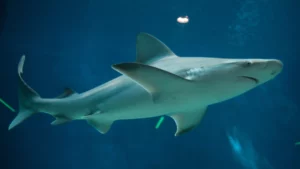 | 1.8–2.4 m (6–8 ft) | n/a | Not in Pennsylvania: Delaware Bay nursery, 60–100 km below the state lineThe most important shark of the Delaware estuary, but it needs salt water and stops well short of Marcus Hook. Listed here because the old page attributed it to Pennsylvania. |
Sand Tiger SharkCarcharias taurus | 2.2–3 m (7–10 ft) | n/a | Not in Pennsylvania: lower Delaware Bay and the Cape May and Indian River inlets in summerHundreds summer in Delaware Bay, none above the salt front. Federally protected since 1997. |
| Smooth DogfishMustelus canis | 0.9–1.3 m (3–4 ft) | n/a | Not in Pennsylvania: Delaware Bay and the ocean beaches, May–OctoberThe commonest shark in the estuary's salty half, with flat crab-crushing teeth. Never recorded in the fresh tidal river. |
| Spiny DogfishSqualus acanthias | 0.8–1.2 m (2.5–4 ft) | n/a | Not in Pennsylvania: cold shelf water off Delaware and New Jersey in winterA cold-water schooling shark that fills the Bay mouth from November to April and has no reason to enter fresh water. |
| Xenacanth sharks (Orthacanthus, extinct)Orthacanthus spp. | Up to 3 m (10 ft) | n/a | Fossils only: the coal measures of the Pennsylvanian Period, 323–299 million years agoFreshwater sharks of the coal swamps that gave the Pennsylvanian Period its name; teeth and head spines occur in the shales above the state's coal seams. |
Species people search for that are not here at all: the great white shark migrates past the mouth of Delaware Bay in spring and autumn and never enters rivers; the nurse shark is a tropical animal that reaches no further north than the Carolinas in any numbers; makos, threshers, blue sharks and hammerheads are open-shelf species that Pennsylvanians meet only on charter boats out of Cape May or Indian River. Lake Erie has no shark of any kind, whatever the summer rumours at Presque Isle say. And the 2020 Susquehanna bull shark, to repeat it once more, did not exist.
Where to see sharks in Pennsylvania
A state with no wild sharks can still be a good place to see them. Pennsylvania has one of the largest shark exhibits on the East Coast a few hundred metres from its border, a zoo aquarium in Pittsburgh, two of the country's great natural history museums, and beaches ninety minutes away where sharks are an everyday summer presence. These are the places that work.
- Adventure Aquarium, Camden (across the river from Penn's Landing)Technically in New Jersey, but reached from Philadelphia by the RiverLink ferry or a walk over the Ben Franklin Bridge, and the place most Pennsylvanians see their first shark. The 2.9 million-litre Ocean Realm holds sand tiger sharks, sandbar sharks and nurse sharks under a rope Shark Bridge that visitors cross above the water, and a separate tunnel puts the sharks overhead.
- Pittsburgh Zoo & PPG AquariumWestern Pennsylvania's aquarium, inside the zoo in Highland Park. Its large ocean tank keeps sharks alongside rays and reef fish, with a viewing tunnel and a shallow touch pool where children handle small rays and bamboo sharks under a keeper's eye. The species mix changes, so check the current exhibit list before a long drive.
- Academy of Natural Sciences of Drexel University, PhiladelphiaThe oldest natural history museum in the Americas, on Logan Square. Its fish collection, built by Edward Drinker Cope and his successors, includes historic shark specimens and fossil teeth, and its dinosaur hall explains the Devonian and Carboniferous seas that once covered the state.
- Carnegie Museum of Natural History, PittsburghHome to the fossils of the coal measures that gave the Pennsylvanian Period its name. The freshwater xenacanth sharks that hunted in those swamps 300 million years ago, along with Devonian shark teeth and fin spines from sites such as the Red Hill roadcut near Hyner in Clinton County, are part of the vertebrate collection.
- Fairmount Water Works, PhiladelphiaThe neoclassical pump house below the Art Museum was the Fairmount Park Aquarium from 1911 until 1962, and it is where the state's only recorded shark injury happened, a keeper's thumb cut by a captive shark in February 1961. Today it is an interpretive centre for the Delaware and Schuylkill rivers, with no sharks, but the history is on the walls.
- The tidal Delaware: Marcus Hook, Fort Mifflin and Neshaminy State ParkThe only Pennsylvania water a wild shark could enter. Walk the fishing piers at Neshaminy or the seawall at Fort Mifflin on a summer evening and you will see striped bass anglers, shad in spring, the occasional Atlantic sturgeon breaching, and, if a bull shark ever does come up the estuary again, this is where it would be. Nobody has documented one.
- Presque Isle State Park, EriePennsylvania's beach, a sand spit curling into Lake Erie with eleven swimming beaches and four million visitors a year. There are no sharks in Lake Erie and never have been; the biggest predators here are muskellunge and lake trout. Listed so that the summer rumour can be laid to rest.
- The Jersey and Delaware beaches: Cape May, Wildwood, RehobothWhere Pennsylvanians really meet sharks. Ninety minutes from Philadelphia, the beaches from Cape May to Rehoboth sit on the sandbar shark nursery of Delaware Bay, with sand tigers off the Cape May reef and smooth dogfish in every surf cast. Our New Jersey and Delaware pages cover them.
For a guaranteed shark in an afternoon, cross the river to Camden. For the sharks that make Pennsylvania matter to science, the Carnegie's coal-swamp fossils are the real prize. And for sharks in the wild, the answer is the same one Philadelphians have given for a century: drive to the shore.
Best time of year to see sharks in Pennsylvania
The state's water runs from ice to bathwater, and the one shark that could visit follows the heat. The Delaware at Philadelphia is 1–3 °C in February and 26–28 °C in August; Lake Erie at Presque Isle freezes in most winters and reaches 22–25 °C by late summer.
- December to April: no chance of any wild shark. The Delaware is too cold for a bull shark to survive, let alone feed, and Delaware Bay's own sharks have all migrated to the Carolinas. Aquaria are the only option.
- May and June: shad and striped bass run up the tidal Delaware and the Bay's sandbar sharks return to the lower estuary. The salt front is at its lowest after spring rains, which keeps the Pennsylvania stretch fully fresh.
- July to September: the only window in which a bull shark could plausibly push above Marcus Hook, in a hot, dry summer when river flow drops and the salt front creeps upstream. It has not been documented in modern times, but if it ever is, it will be in these months. The same weeks are peak season on the Jersey and Delaware beaches, where sharks are certain.
- October and November: the estuary cools through 18 °C, the Bay empties of sharks, and the window closes.
Aquaria run all year; Adventure Aquarium's shark feeds are scheduled daily, and winter weekdays are the quietest time at the Shark Bridge.
Shark attacks in Pennsylvania: what the record shows
The SharkSider database holds exactly one Pennsylvania record, and it is not an attack in any ordinary sense. On 17 February 1961 a keeper cleaning a tank at the Fairmount Park Aquarium in Philadelphia had his thumb lacerated by a captive shark. The entry is marked provoked, the man survived, and the species is not recorded. Nothing before it, nothing after it, and nothing since 2000. That single entry is shown below, and the national picture is on our shark attacks in the USA page.
- 1961 · Fairmount Park Aquarium, PhiladelphiaCleaning a tank — Thumb lacerated by captive shark provoked incidentSpecies not identified
The old version of this page called this “the only recorded shark attack in the state”, which is accurate as far as it goes, but the framing matters: it belongs with the aquarium accidents in other inland states, such as Missouri's 1996 fish-tank case, not with the beach bites of the coast. The aquarium itself closed the following year, in 1962, and Philadelphia has had no public shark tank on the Pennsylvania side of the river since.
For comparison, the neighbours Pennsylvanians actually swim with have real records. Delaware has eight entries between 1909 and 2020, none fatal, half of them anglers bitten by sharks they had caught. New Jersey carries the most famous file in the country, the July 1916 attacks at Beach Haven, Spring Lake and Matawan Creek, and Matawan is the reason the bull shark is on this page at all: a creek 16 km from the open sea, brackish and warm, where a shark killed two people and injured a third, and which showed that a bull shark can hunt in water much like the lower Delaware. Nothing comparable has ever happened in Pennsylvania, and the physical odds are stacked against it: cooler water, a salt front that stays below the state line, and a river full of far easier prey than people. For the beach trips, our guide on how to survive a shark attack covers the genuinely rare bad case.
Is it safe to swim in Pennsylvania's rivers and lakes?
Sharks are not a factor anywhere in the state. Lake Erie's beaches at Presque Isle, the Allegheny and Monongahela at Pittsburgh, the Susquehanna, the Lehigh, the Poconos lakes and every reservoir are fresh, dammed or both, and no shark has ever entered them. The tidal Delaware is the one body of water where a bull shark is theoretically possible, and the probability of meeting one while swimming there is so close to zero that it does not register beside the river's real hazards: commercial shipping, strong tidal currents, poor visibility, submerged pilings and, in the city, water quality after heavy rain. The Delaware between Philadelphia and Marcus Hook is not a swimming river for those reasons, not because of sharks.
Where Pennsylvanians do swim with sharks is on the ocean beaches of New Jersey, Delaware and Maryland, and there the advice is the ordinary East Coast list. Stay out of the water at dawn and dusk, avoid swimming beside fishing piers and jetties where bait is in the water, get out when bait fish are showering or birds are diving close to shore, and do not swim in the turbid mouths of inlets where bull sharks and sandbars feed. The sharks that share the surf with bathers on those beaches, sandbar sharks, smooth dogfish and Atlantic sharpnose, are fish-eaters with almost no history of hurting people, and the sand tigers that alarm anglers on the Cape May and Indian River rocks are slow, docile animals. Anglers who catch a shark on the Delaware Bay shore should cut the leader in the water; in Delaware's file, hooked sharks account for half of all injuries.
Shark conservation and Pennsylvania
Pennsylvania cannot protect sharks in its own water because it has none, but its rivers shape the estuary where the mid-Atlantic's most important shark nursery lies. The Delaware carries the runoff, sewage and industrial history of Philadelphia, Chester and Trenton into Delaware Bay, where pregnant sandbar sharks give birth every June and hundreds of adult sand tigers summer on the shoals. The river's recovery since the Clean Water Act is one of the reasons those populations have rebuilt: the dissolved-oxygen dead zone that stretched from Philadelphia to Wilmington in the 1950s and 1960s has largely gone, shad and sturgeon have returned, and the Bay's juvenile sandbar counts have held steady or risen since sandbar sharks became release-only in 2008. Pennsylvania's share in that is water quality, and the state has a direct stake in the Delaware River Basin Commission's flow rules, which also decide how far the salt front travels in a drought.
Pennsylvania's other contribution is to the deep past. The Pennsylvanian Period, 323 to 299 million years ago, is named for the state's coal measures, and those swamps were full of freshwater sharks: the xenacanths, eel-like animals with a spine behind the head and forked teeth, whose remains turn up in the shales above the coal seams of the west and centre of the state. Older still, the Devonian roadcut at Red Hill near Hyner has yielded teeth and fin spines from some of the earliest sharks alongside the lobe-finned fishes that were beginning to walk. These fossils are protected on state land, and collecting on state forest and game lands requires permission; roadcuts on private land need the owner's consent. The state has no marine Miocene deposits, so the megalodon teeth Pennsylvanians collect come from Maryland's Calvert Cliffs, and our guide on how to find shark teeth explains where and how. Why any of this matters for living sharks is set out on our page about why sharks are endangered.
Sharks in nearby states
Every shark associated with Pennsylvania lives in a neighbouring state. Delaware holds Delaware Bay, the sandbar nursery and the sand tiger aggregation that the old version of this page borrowed. New Jersey has the other shore of the same bay, the Cape May charter fleet and the 1916 attacks that put the bull shark in the public mind. Maryland continues the barrier beach to Ocean City and adds the megalodon teeth of Calvert Cliffs, and Virginia holds the Chesapeake nursery that the Susquehanna feeds but no shark can climb past Conowingo to reach. To the north, New York shares Lake Erie's empty shark record and has the Long Island sandbar and sand tiger summer, while Connecticut shows what Long Island Sound adds. The index of all states is at sharks in the US, and the world list is under sharks around the world.
Frequently asked questions
Are there sharks in Pennsylvania?
Not in any practical sense. Pennsylvania has no coast, and the only water connected to the sea without a dam is the tidal Delaware River below Philadelphia. A bull shark could in theory swim that far up the estuary in a hot summer, but there is no verified modern record of one. Sandbar sharks, sand tigers and dogfish live in Delaware Bay, downstream in the state of Delaware.
Was a bull shark really caught in the Susquehanna River in 2020?
No. The story of a 400-pound bull shark pulled from the West Branch Susquehanna was an April Fools' Day article, printed by a Williamsport weekly on 1 April 2020 and then copied by other websites, including the old version of this page, as fact. The Susquehanna is blocked from Chesapeake Bay by the Conowingo Dam, which no shark can pass.
Has there ever been a shark attack in Pennsylvania?
One, and it was indoors. On 17 February 1961 a keeper cleaning a tank at the Fairmount Park Aquarium in Philadelphia had his thumb cut by a captive shark. The database marks it provoked and non-fatal. No one has ever been bitten by a shark in a Pennsylvania river or in Lake Erie.
Can sharks swim up the Delaware River to Philadelphia?
Only a bull shark could, because it tolerates fresh water. The tide reaches Trenton, but the salt front normally stays near Wilmington, below the Pennsylvania line, so the Philadelphia stretch is fresh water. Old newspaper reports mention sharks near Chester and the city wharves, but none has been confirmed, and nothing has been documented in modern times.
Are there sharks in Lake Erie?
No. Lake Erie is fresh, freezes in most winters and is cut off from the Atlantic by Niagara Falls and the locks of the Welland Canal and St. Lawrence Seaway. No shark has ever been recorded in Lake Erie or any of the Great Lakes, and the beaches at Presque Isle State Park have never had a shark sighting that turned out to be real.
Where can I see sharks near Philadelphia?
Adventure Aquarium in Camden, directly across the Delaware from Penn's Landing, keeps sand tiger, sandbar and nurse sharks in a 2.9 million-litre tank with a rope bridge over the water and a walk-through tunnel. In western Pennsylvania, the PPG Aquarium at the Pittsburgh Zoo has a shark tank and a touch pool.
Which sharks do Pennsylvanians meet at the beach?
On the Jersey and Delaware beaches, ninety minutes from Philadelphia, the common summer sharks are sandbar sharks, smooth dogfish and Atlantic sharpnose, with sand tigers around the Cape May reef and the Indian River Inlet. All are fish-eaters with little history of hurting people; bull sharks and great whites are rare and pass through rather than stay.
Does Pennsylvania have shark fossils?
Yes, some of the oldest in the country. The coal swamps of the Pennsylvanian Period, named for the state, held freshwater xenacanth sharks whose teeth and spines occur above the coal seams, and the Devonian roadcut at Red Hill near Hyner has produced early shark teeth. Megalodon teeth do not occur in Pennsylvania; collectors go to Maryland's Calvert Cliffs.
Is it safe to swim in the Delaware River?
Sharks are not the concern. The tidal Delaware between Philadelphia and Marcus Hook carries commercial shipping, strong tidal currents, poor visibility and post-storm pollution, which is why it is not a swimming river. Upstream of Trenton the river is fresh, dam-free of sharks and popular for tubing and swimming, with currents and cold water as the real risks.
References

A small team focused on researching sharks and making marine biology easy to understand. Every page is reviewed against current species records and the SharkSider attack database, and updated when new incidents or research appear.
Published November 30, 2022 · Last updated September 22, 2026 · Incident data from the SharkSider attack database (1 records for Pennsylvania, 0 fatal).


