
Yes, there are sharks off Oregon: about 15 species have a solid record along the state's 363 miles of coast. The ones people actually meet are the white shark, the salmon shark, the blue shark, the broadnose sevengill, the soupfin shark and the Pacific spiny dogfish; the common thresher, shortfin mako and basking shark turn up offshore in the warm months.
The risk is small and very specific. The SharkSider database holds 31 incidents for Oregon between 1974 and 2020, only one of them fatal, and that death in 1975 was a sea disaster, not a swimmer or surfer. Thirty of the 31 records involve a surfer or board rider, and where the shark was identified it was a white shark every time. Since 2000 there have been 16 records and no deaths.
- Shark species in this guide15 confirmed
- White shark protected since2004 (federal Pacific waters)
- Most seen from the beachSalmon shark (strandings, Jul–Oct)
- Signature encounterSevengills at the Oregon Coast Aquarium
- Incidents in the database31 (1974–2020), 1 fatal
- Water temperature8–16 °C (46–61 °F)

On this page
- Where Oregon's sharks live and why the water suits them
- List of the different types of sharks in Oregon
- Where to see sharks in Oregon
- Best time of year to see sharks in Oregon
- Shark attacks in Oregon: what the record actually shows
- Is it safe to swim and surf in Oregon?
- Shark conservation in Oregon
- Sharks in nearby states
- Frequently asked questions
- References
Where Oregon's sharks live and why the water suits them
Everything about Oregon's shark life starts with the wind. From April to September the northwest wind pushes the surface layer of the Pacific away from the shore, and cold water rich in nitrate and phosphate rises from several hundred metres down to replace it. That upwelling feeds the plankton, the plankton feeds sardines, anchovies, herring and smelt, and those feed the salmon, rockfish, seals and sea lions that Oregon's larger sharks live on. The state sits in the heart of the California Current, so its water is seldom warmer than 15 or 16 °C even in August, and in a strong upwelling week the surf at Newport can drop to 8 °C. That single fact decides which sharks live here: cold-tolerant species such as the salmon shark, the white shark, the sevengill and the spiny dogfish are residents or regulars, while the tropical sharks that fill the Florida pages never get within a thousand miles.
Three kinds of habitat matter. The first is the seal and sea lion coast: Steller sea lions haul out at Sea Lion Caves near Florence and on Simpson Reef and Shell Island off Cape Arago, harbour seals use every rocky cove, and a growing number of elephant seals rest on the southern beaches. Adult white sharks tagged off central California follow that food north in late summer and autumn, and every one of Oregon's identified incidents was a white shark near one of these stretches. The second habitat is the estuaries: Coos Bay, the largest between San Francisco Bay and Puget Sound, plus Yaquina Bay, Tillamook Bay and the Umpqua mouth at Winchester Bay. These are where sevengills, soupfins, brown smoothhounds and the odd leopard shark hunt crabs and flatfish over the mudflats. The third is the blue water beyond the shelf, where in August and September a warm tongue of ocean pushes toward the coast and brings blue sharks, threshers and makos with the albacore. Heceta Bank off Florence and the Astoria Canyon off the Columbia mouth are the two spots where deep and shallow water meet, and both are where anglers most often hook a shark they did not expect.
List of the different types of sharks in Oregon
The table lists every species with a dependable record in Oregon waters, ordered roughly from the sharks people encounter most often to the ones only trawlers and deep-water anglers meet. Sizes are realistic adult lengths, not record fish. The risk column is about swimmers and surfers; several of these sharks will bite a hand that grabs them, which is a different question. One naming note: the “dogfish” every Oregon pier angler catches is the Pacific spiny dogfish, Squalus suckleyi, split from the Atlantic species in 2010, and the “soupfin” is the same animal Europeans call the tope.
| Species | Adult size | Risk to swimmers | Where in Oregon & notes |
|---|---|---|---|
Great White SharkCarcharodon carcharias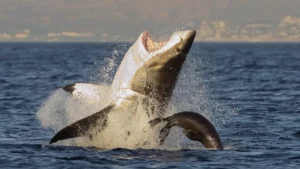 | 4–5.5 m (13–18 ft) | High | Near seal and sea lion colonies from Tillamook Head to Cape Arago, Sep–DecIdentified in 21 of Oregon's 31 records, all involving surfers. Visitors from the California population; no resident adults are known. |
Salmon SharkLamna ditropis | 2–2.6 m (6.5–8.5 ft) | Low | Offshore all year; juveniles strand on beaches Jul–OctA warm-bodied relative of the white shark that keeps its core 10–15 °C above the sea. The shark most often found on an Oregon beach, and usually misreported as a young great white. |
Blue SharkPrionace glauca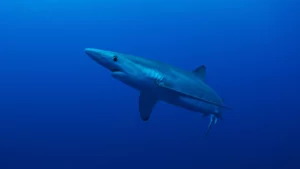 | 2–3 m (7–10 ft) | Low | Albacore grounds 20–40 miles out, Aug–OctThe shark every tuna angler sees beside the boat. Slender, curious and harmless in Oregon's record. |
Broadnose Sevengill SharkNotorynchus cepedianus | 2–3 m (7–10 ft) | Low | Coos Bay, Winchester Bay and Yaquina Bay in summerA seven-gilled hunter of seals, rays and salmon. The old table's 3.5–7.5 ft is a juvenile; adults reach three metres. Bites anglers who unhook it, never swimmers. |
Soupfin (Tope) SharkGaleorhinus galeus | 1.5–1.9 m (5–6 ft) | Low | Estuaries and the inner shelf statewide, most in summerNearly wiped out by the 1940s liver-oil fishery and now common again. Timid and toothless as far as people are concerned. |
Pacific Spiny DogfishSqualus suckleyi | 0.9–1.3 m (3–4 ft) | Low | Every bay, jetty and pier; huge schools on the shelfOregon's most numerous shark by far. A mildly venomous spine in front of each dorsal fin is its only weapon against people. |
Common Thresher SharkAlopias vulpinus | 3–5 m (10–16 ft) including the tail | Low | Warm offshore water in late summer, occasionally close to shoreHalf of its length is a scythe of a tail used to stun anchovies. Taken by albacore trollers some years; no history with swimmers. |
Shortfin Mako SharkIsurus oxyrinchus | 2.5–3.5 m (8–11 ft) | Low | Blue water beyond the shelf in warm yearsReaches Oregon only when the offshore water climbs past 17 °C. The original page rated it highly aggressive; there is no Oregon incident involving one. |
Basking SharkCetorhinus maximus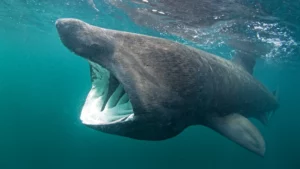 | 6–8 m (20–26 ft) | Low | Rare summer visitor, most often seen on flat calm daysPlankton feeder and the second-largest fish alive. Once common along the West Coast, hunted to scarcity by the 1950s, now a handful of sightings a year at most. |
Bluntnose Sixgill SharkHexanchus griseus | 3–4.8 m (10–16 ft) | Low | Deep water along the shelf edge; occasionally hooked by halibut anglersAn ancient six-gilled giant of the deep slope. Sluggish, night-active, no Oregon bite record. |
Pacific Sleeper SharkSomniosus pacificus | 3–4.4 m (10–14 ft) | Low | Cold deep water off the whole coast; a trawl and longline bycatchA slow deep-sea scavenger related to the Greenland shark. Seen alive only by cameras and crews. |
Leopard SharkTriakis semifasciata | 1.2–1.5 m (4–5 ft) | Low | Coos Bay and the south-coast estuaries; Oregon is its northern limitA harmless California houndshark at the edge of its range. The old table's 6–7 ft is far too large; even record fish barely reach 1.8 m. |
Pacific AngelsharkSquatina californica | 1.2–1.5 m (4–5 ft) | Low | Sandy bottoms off the south coast, rare north of CaliforniaA flat ambush hunter that lies buried in sand. Bites only divers who touch it; labelling it highly aggressive, as the earlier page did, was wrong. |
| Brown SmoothhoundMustelus henlei | 0.6–1 m (2–3 ft) | Low | Coos Bay, the northern edge of its rangeA small houndshark with flat crushing teeth for crabs and shrimp. Cannot harm a person. |
Brown CatsharkApristurus brunneus | 0.5–0.7 m (1.5–2.3 ft) | Low | Deep mud slopes beyond 100 m, brought up by trawlersOregon's real catshark; the European small-spotted catshark on the old list does not occur in the Pacific. Lays eggs in leathery cases. |
The earlier version of this page listed the small-spotted catshark, which is a European species found from Norway to Senegal and has never been recorded in the Pacific; Oregon's catsharks are the brown catshark and the filetail catshark, both of which live in deep water. It also called the Pacific angelshark and the shortfin mako “highly aggressive”. Neither deserves it: the angelshark only bites divers who handle it, and the mako has no record of harming anyone off Oregon. The big absentees are the ones people ask about. There are no bull sharks, tiger sharks, hammerheads or nurse sharks in Oregon; the water is simply too cold, and the nearest regular hammerhead population is off southern California in warm years.
Where to see sharks in Oregon
Oregon has no cage-diving industry and no clear-water reef, so seeing a shark here means either an aquarium tunnel, a fishing boat or a lucky morning on the beach. These are the places that reliably deliver.
- Oregon Coast Aquarium, NewportThe Passages of the Deep tunnel walks you through a tank of broadnose sevengills, soupfin sharks, leopard sharks and spiny dogfish, most of them Oregon-caught. The sevengills come within centimetres of the acrylic. This is the one place in the state where a child is guaranteed a shark.
- Winchester Bay and the Umpqua River mouthThe bar at the Umpqua mouth is sevengill and soupfin country in summer, and the surf just south of the jetties holds the state's highest count of white shark encounters: four records, the worst a shoulder and side bite in 1992. Anglers on the South Jetty regularly catch dogfish.
- Coos Bay and CharlestonOregon's largest estuary is the northern limit of the brown smoothhound and one of the few places in the state where leopard sharks are caught. Sevengills patrol the channel on a flood tide. Cape Arago and Simpson Reef next door hold the seal and sea lion colonies that pull white sharks close to shore in autumn.
- Newport charters and the albacore groundsFrom August to early October the tuna boats out of Newport and Depoe Bay run 20 to 40 miles offshore into 16–18 °C water where blue sharks follow the albacore. A blue shark nosing the chum bag beside the boat is almost routine, and salmon sharks and the occasional thresher or mako take trolled lures.
- Seaside Cove and Indian Beach, Ecola State ParkThe two best-known surf breaks on the north coast, and the scene of Oregon's most recent shark bites (2020 and 2016). Surfers here are inside the autumn range of adult white sharks working the Tillamook Head sea lion haul-outs. Spectacular, cold and not a place to surf alone at dusk.
- Cape Kiwanda, Pacific CityThe dory-boat beach and one of Oregon's busiest surf spots, with three white shark records, the latest a board bitten in March 2019. Haystack Rock offshore holds seals, which is the reason the sharks are here.
- Cape Perpetua Marine ReserveOregon's largest marine reserve, south of Yachats, where no fishing is allowed. Divers and ROV surveys record soupfins, dogfish and sevengills over the reef, and it is a good stretch of coast for spotting a basking shark's fin in a calm summer week.
- Any north-coast beach in late summerFrom July to October juvenile salmon sharks strand along Oregon's beaches almost every year, from Seaside down to Bandon. They are usually one to two metres long and are reported as baby great whites nearly every time; the Seaside Aquarium's beach team is the usual identifier.
For a guaranteed shark, go to Newport in any month. For a wild one, book an albacore trip in late August: the blue sharks are as reliable as the tuna. Surfers do not need to go looking; the sharks will find the sea lion beaches on their own between September and December.
Best time of year to see sharks in Oregon
Oregon's shark calendar is set by upwelling, sea lion pupping and the late-summer warm water offshore.
- August to October: the peak. Upwelling relaxes, offshore water warms into the high teens, and blue sharks, threshers, makos and salmon sharks follow the albacore within reach of day boats. Juvenile salmon sharks strand on the beaches. Sevengills and soupfins are in the estuaries at their highest numbers.
- September to December: white shark season. Adult white sharks from the California population move north along the seal colonies, and Oregon's incident record clusters in these months, with October the busiest single month in the recent records. Water in the surf is 10–13 °C and only surfers are in it.
- May to July: strong upwelling, cold surf, superb fishing but few sharks near shore. Basking sharks, when they appear at all, are most often seen in flat calm weather in early summer.
- January to April: storms, big swell and the quietest shark months. White sharks have gone offshore or south, and only the resident dogfish, sixgills and sleeper sharks are in Oregon water.
Sea surface temperature runs from about 8 °C (46 °F) in a spring upwelling event to 16 °C (61 °F) in a calm September, and offshore beyond the shelf it can reach 18 °C in late summer. A 5 mm wetsuit with hood is standard in every month, which is why the state's beach-goers are almost never in deep water and why surfers dominate the incident record.
Shark attacks in Oregon: what the record actually shows
Oregon has more recorded shark incidents than any US state north of California, but the list is short on injuries. The SharkSider database holds 31 incidents for Oregon, from 1974 to 2020, with one fatality. The full record, updated weekly, is on our shark attacks in Oregon page. The six most recent recorded incidents are listed here:
- 2020 · Seaside Cove, Clatsop CountySurfing — Non-life-threatening to left lower leg & footSpecies not identified
- 2019 · Cape Kiwanda, Tillamook CountySurfing — No injury, board bitten and dentedSpecies not identified
- 2016 · Indian Beach, Ecola State Park, Clatsop CountySurfing — Wounds to upper thigh and lower legSpecies not identified
- 2013 · Gleneden Beach, Lincoln CountySurfing — No injury, board bittenWhite shark, 10 '
- 2012 · Lincoln City, Lincoln CountySurfing — No injury, surfboard damagedWhite shark
- 2011 · Seaside CoveSurfing — Minor injury to calfSpecies not identified
Read down the injury column and the pattern is clear. In roughly half of the records the shark bit or rammed a surfboard and the surfer came away with nothing worse than a shredded fibreglass rail. The other half carry real but survivable wounds, nearly all to legs and feet: a fractured femur at Indian Beach in 1988, a shoulder and side at Winchester Bay in 1992, a thigh at Gleneden Beach in 1998, and in the recent records a foot at Florence in 2006, a thigh and calf at Indian Beach in 2016 and a lower leg and foot at Seaside Cove in December 2020. No surfer has died. Thirty of the 31 records involve a surfer or board rider, and in the 21 cases where the species was identified it was a white shark, often estimated at 10 to 16 feet. The one death, in July 1975, was a sea disaster: a person in the water after a vessel went down, bitten on the arms and legs, which is a different situation from anything that has happened to a beach user.
Geographically the record follows the seals. Clatsop County in the far north (Seaside, Indian Beach) leads with 5 records, Tillamook County (Cape Kiwanda) and Lincoln County (Gleneden Beach, Lincoln City, Newport, the Siletz mouth) have 4 each, and Winchester Bay on the south-central coast is the single busiest spot with 4. The 2010s were the busiest decade with 9 incidents and no deaths; there were 7 in the 1990s and 6 in the 2000s, and 2020 is the only record of the current decade. Sixteen incidents since 2000 without a fatality tells you what the Oregon white shark encounter usually is: a large animal investigating a board-shaped silhouette in murky water, biting once and leaving. Our guide on surviving a shark attack covers what to do in exactly that moment.
Is it safe to swim and surf in Oregon?
For swimmers, Oregon's sharks are close to irrelevant. The water is cold enough that few people spend more than a minute past the break, and there is no case in the database of a swimmer being bitten. The real hazards on an Oregon beach are sneaker waves, rip currents and logs in the surf, all of which kill more people every decade than sharks have in fifty years. If you do swim, stay away from the seal haul-outs at Cape Arago, Sea Lion Caves and Tillamook Head, and get out if a sea lion carcass is on the beach.
Surfers carry nearly all of the risk, and it is manageable. The incidents concentrate from September to December, near sea lion colonies and river mouths, usually in the murky water that follows a storm, and often at dawn or in the last light. Surf with a friend, avoid the mouths of the Umpqua, Siletz and Columbia in autumn when salmon are running and seals are feeding, and treat a shark sighting or a spooked seal as the end of the session. A white shark that has bitten a board almost always leaves; the records show surfers paddling in on damaged boards and walking away.
Divers and anglers meet the smaller sharks. A broadnose sevengill on a line in Coos Bay is a three-metre animal with a serious mouth and will bite a wrist during unhooking; cut the leader instead. Spiny dogfish have a mildly venomous spine in front of each dorsal fin that goes straight through a glove, and the salmon shark that strands on the sand, however dead it looks, can still snap. None of this is a reason to stay off the beach; it is a reason to keep your hands to yourself.
Shark conservation in Oregon
Oregon manages its sharks mostly through federal rules, with two state measures on top. The white shark, basking shark and megamouth shark have been prohibited species under the Pacific highly migratory species plan since 2004, which means no boat may target or keep one in federal waters off the state. Oregon added its own law in 2011 banning the sale, trade and possession of shark fins, effective from January 2012, making it one of the first states in the country to close its market to the fin trade. Between 2012 and 2016 the state also created five marine reserves, at Cape Falcon, Cascade Head, Otter Rock, Cape Perpetua and Redfish Rocks, where all fishing is closed; Cape Perpetua is the largest and is the reef where surveys most often record soupfins and sevengills.
The pressures that remain are the usual ones for a cold coast. Spiny dogfish and soupfins were fished hard for liver oil in the 1930s and 1940s, when the vitamin-A boom emptied the West Coast of both, and the soupfin only rebuilt after synthetic vitamin A killed the market. Blue sharks and threshers still die on longlines outside US waters. Salmon sharks are caught incidentally in the salmon and albacore fisheries and, because they mature at eight to ten years and produce only four or five pups every other year, they recover slowly from any loss. Warming water is the new factor: the 2014–2016 marine heatwave brought makos, threshers and even a few hammerhead reports far north of their usual range, and the strandings of salmon sharks on Oregon beaches have grown more frequent. If you fish, use circle hooks and release sharks in the water; if you find a stranded one, report it to the state marine mammal and shark stranding network rather than dragging it up the beach. Our page on why sharks are endangered explains why slow breeders like these need that care.
Sharks in nearby states
Oregon sits in the middle of the cold-water shark coast. To the south, California holds the white shark population that visits Oregon every autumn, plus a much longer incident list and leopard sharks by the hundred at La Jolla. To the north, Washington shares Oregon's sevengills, dogfish and salmon sharks and adds the bluntnose sixgills of Puget Sound; it has only two recorded white shark encounters, both at Grays Harbor. Beyond it, Alaska is the salmon shark's true home, with feeding aggregations in Prince William Sound. Across the Pacific, Hawaii has a completely different, tropical fauna led by the tiger shark, and inland Idaho gets the question “are there sharks in the Snake River” often enough to have its own page. Every state we cover is on Sharks in the US, and the overview of sharks around the world lists every country.
Frequently asked questions
Are there sharks in Oregon?
Yes. Around 15 species have a solid record along the Oregon coast. The white shark visits the seal colonies each autumn, salmon sharks live offshore and strand on beaches in late summer, blue sharks follow the albacore, and sevengills, soupfins and spiny dogfish live in the bays and estuaries all year.
Are there great white sharks in Oregon?
Yes, but as seasonal visitors rather than residents. Adult white sharks from the California population travel north along the sea lion coast from September to December, and they account for every identified shark in Oregon's incident record: 21 of 31 cases. Sightings cluster around Cape Arago, Sea Lion Caves, Tillamook Head and the river mouths.
How many shark attacks have there been in Oregon?
The SharkSider database lists 31 incidents for Oregon between 1974 and 2020, with one death, a 1975 sea disaster rather than a beach incident. Thirty of the records involve surfers, about half of them bites to the board with no injury, and there have been 16 records and no fatalities since 2000. The latest was a surfer bitten on the leg at Seaside Cove in December 2020.
Is it safe to swim in the ocean in Oregon?
As far as sharks are concerned, yes: no swimmer appears in the state's record. Cold water, rip currents and sneaker waves are the real dangers on Oregon beaches. Surfers face a small, seasonal white shark risk from September to December near seal colonies and river mouths, best managed by surfing with a friend and avoiding dawn, dusk and murky water.
Where do most shark encounters happen in Oregon?
Along the surf beaches nearest the seal and sea lion haul-outs. Clatsop County, home to Seaside Cove and Indian Beach, leads the record with five cases, followed by Tillamook County around Cape Kiwanda and Lincoln County from Gleneden Beach to Newport with four each. Winchester Bay at the Umpqua mouth is the busiest single spot with four.
What kind of shark washes up on Oregon beaches?
Almost always a salmon shark. Juveniles one to two metres long strand between July and October most years, and because they have the same torpedo shape and white belly as a white shark they are reported as baby great whites nearly every time. The giveaway is the salmon shark's blunt snout, dark blotches on the belly and the double keel on its tail.
Are there bull sharks or tiger sharks in Oregon?
No. Both need warm water and neither has ever been confirmed off Oregon. The same goes for hammerheads, nurse sharks and blacktips. The dangerous-looking sharks people see here are salmon sharks, sevengills and, occasionally, white sharks, and only the last has a record of biting anyone in the state.
When is the best time to see sharks in Oregon?
Late August to early October, when the offshore water warms and blue sharks, salmon sharks, threshers and makos come within range of the tuna boats out of Newport and Depoe Bay. Salmon shark strandings peak in the same weeks. White sharks are around from September to December, though seeing one from the shore is rare.
Can you see sharks at the Oregon Coast Aquarium?
Yes. The Passages of the Deep exhibit in Newport walks visitors through a tunnel in a tank holding broadnose sevengills, soupfin sharks, leopard sharks and spiny dogfish, most of them collected from Oregon waters. It is the most reliable shark sighting in the state and open all year.
Is shark fishing legal in Oregon?
With limits. White, basking and megamouth sharks may not be targeted or kept anywhere off the West Coast under federal rules dating from 2004, and Oregon banned the sale and possession of shark fins in 2011. Dogfish, soupfins, blue sharks and threshers can be caught with a state fishing licence, and the five marine reserves are closed to all fishing.
References

A small team focused on researching sharks and making marine biology easy to understand. Every page is reviewed against current species records and the SharkSider attack database, and updated when new incidents or research appear.
Published November 30, 2022 · Last updated September 22, 2026 · Incident data from the SharkSider attack database (31 records for Oregon, 1 fatal).


