
Yes, New Jersey has sharks, and in summer it has a lot of them. Nineteen species are listed here, 18 of them confirmed. The ones that live within reach of the beaches are the sand tiger, sandbar and dusky shark, the smooth and spiny dogfish, and, increasingly, blacktips and Atlantic sharpnose from the south. Blue sharks, makos and threshers work the Mud Hole and the Hudson Canyon offshore, and juvenile great whites use the New York Bight as a nursery.
The record is famous out of all proportion to its size. The SharkSider database holds 57 New Jersey records from 1829 to 2023, 47 of them since 1900, with 6 deaths, 5 since 1900: four in the 1916 attacks and one at Seaside in 1926. Since 2000 there have been only 8 records and no deaths, and two of those eight happened inside an aquarium and a zoo. For a coast that draws tens of millions of bathers each summer, that is about as safe as a shark coast gets.
- Shark species in this list18 confirmed (+1 unconfirmed)
- ProtectionSand tiger, white & dusky prohibited; circle hooks required from shore
- Most seen from the beachSmooth dogfish & sandbar shark
- Signature encounterSand tigers on the Wreck Valley dives
- Incidents in the database57 (1829–2023), 6 fatal, last in 1926
- Water temperature3–6 °C in Feb, 21–25 °C in Aug

On this page
- Why New Jersey has so many sharks
- List of the different types of sharks in New Jersey
- Where to see sharks in New Jersey
- Best time of year to see sharks in New Jersey
- Shark attacks in New Jersey: what the record shows
- Is it safe to swim at the Jersey Shore?
- Shark conservation in New Jersey
- Sharks in nearby states
- Frequently asked questions
- References
Why New Jersey has so many sharks
The Jersey Shore runs 210 km from Sandy Hook to Cape May, and almost none of it is plain coastline. Behind the beach towns lies a chain of barrier islands and back bays, Barnegat Bay, Great Bay, Little Egg Harbor, and behind those roughly 80,000 hectares of salt marsh that flood on every tide. Bunker, mullet, blue crab and young flounder breed in that marsh, and the inlets that drain it, Manasquan, Barnegat, Little Egg, Absecon, Townsends, Cape May, are the doors through which sharks come in to feed and give birth. Rutgers University researchers working out of the Jacques Cousteau reserve on the Mullica River have shown that Great Bay and Little Egg Harbor are the main nursery on the coast for the smooth dogfish, with thousands of pups born there each spring, and that sandbar sharks use the same bays.
At the state's southern tip is Delaware Bay, shared with Delaware, and it holds the largest sandbar shark nursery in the western Atlantic. Pregnant females arrive in May, drop their pups in the lower bay and leave; the young stay through their first summer in water too shallow and murky for most predators. Adult sand tiger sharks gather in the same bay in summer, which is why the Cape May charter fleet catches and releases so many of them. To the north, Raritan Bay and Sandy Hook Bay are where the 1916 “Jersey man-eater”, a 2.6 m white shark, was netted two days after the Matawan Creek deaths, and where juvenile white sharks are still tagged today.
Offshore, New Jersey sits at the head of the Hudson Canyon and beside the Mud Hole, a drowned river channel 25 km out where cold, nutrient-rich water wells up and the blue sharks, makos and threshers gather from June. Between the beach and the canyon lie hundreds of wrecks, the “Wreck Valley” that divers from New York and New Jersey share, and from June to October sand tigers hover over the steel of the Stolt Dagali, the Great Isaac and dozens of smaller hulks in 20–40 m of water. It is the only place in the north-east where you can reliably dive with large sharks without a cage.
The rules are a mix. Federal law requires the release of sand tiger, white, dusky and, since 2022, shortfin mako sharks, and a federal permit for any shark landed from a boat. New Jersey adds its own conditions for shore-based shark fishing: non-offset circle hooks, a ban on chumming from the beach in many towns, and a ban on removing prohibited species from the water. Several municipalities, including Ocean City and the Wildwoods, restrict fishing on lifeguarded beaches in summer.
List of the different types of sharks in New Jersey
The table lists every species with a dependable record in New Jersey waters, from the back bays to the canyon edge. Sizes are typical adult lengths, not tournament records. Risk is about a bather at Long Beach Island or Cape May, and the state's own conditions decide it: cold water, green visibility and a shark fauna that is mostly small or mostly offshore. The original version of this page called the shortfin mako “highly aggressive”; it is a fast, bold fish when hooked, but it lives far beyond the surf and has no place in a beach-safety discussion. Note too that the sand tiger nursery the old page placed on Long Island is in New York, not New Jersey; New Jersey's nurseries are Delaware Bay for sandbar sharks and Great Bay for smooth dogfish.
| Species | Adult size | Risk to swimmers | Where in New Jersey & notes |
|---|---|---|---|
Sand Tiger SharkCarcharias taurus | 2–3.2 m (6.5–10.5 ft) | Low | Wreck Valley wrecks and Delaware Bay, June to OctoberThe shark New Jersey divers come for. Named in one open-water record (a 60 cm juvenile at Ventnor, 2017) and one aquarium bite. Protected since 1997. |
Sandbar SharkCarcharhinus plumbeus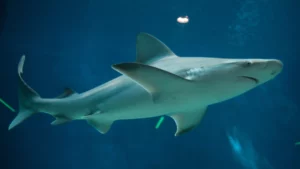 | 1.8–2.4 m (6–8 ft) | Low | Delaware Bay nursery, back bays and the surf in summerThe commonest large shark inshore; a 2.1 m pregnant female was caught at Brigantine the day after a 1966 clamming injury. Must be released. |
| Smooth DogfishMustelus canis | 0.9–1.5 m (3–5 ft) | Low | Great Bay and Little Egg Harbor nursery; every bay and pier, May to OctoberThe most numerous shark in the state and the one most anglers catch. Crushing teeth; cannot cut skin. |
| Spiny DogfishSqualus acanthias | 0.8–1.2 m (2.5–4 ft) | Low | The shelf in the cold months; inshore in spring and autumnSchools of thousands. Two dorsal spines are the only hazard, and only to the angler. |
Dusky SharkCarcharhinus obscurus | 3–3.6 m (10–12 ft) | Low | Along the beaches and off the inlets in summerProhibited since 2000. Juveniles feed on bunker with the sandbar sharks. |
Blacktip SharkCarcharhinus limbatus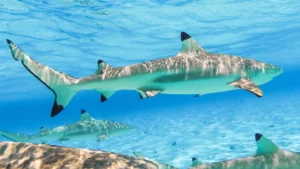 | 1.5–2.5 m (5–8 ft) | Low | Surf zone in the warmest weeks of late summer, mostly south of BarnegatA southern species that now reaches New Jersey most years. Still uncommon. |
Atlantic Sharpnose SharkRhizoprionodon terraenovae | 0.8–1.1 m (2.5–3.5 ft) | Low | Cape May and Delaware Bay in high summerAt the northern limit of its range. Harmless pier catch. |
Blue SharkPrionace glauca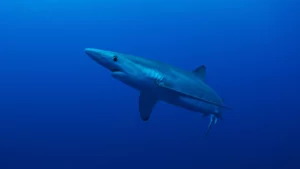 | 2–3 m (7–10 ft) | Low | The Mud Hole and the canyon, June to OctoberThe staple of the offshore charters; one boat-side record in the state list. |
Shortfin Mako SharkIsurus oxyrinchus | 2.5–3.5 m (8–11 ft) | Low | Offshore, 25 km and beyond, summerNot “highly aggressive” in any sense that matters to a bather; it never enters the surf. Release only since 2022. |
Common Thresher SharkAlopias vulpinus | 3–5.5 m (10–18 ft) incl. tail | Low | Outside the inlets and offshore in summer; sometimes within sight of the beachThe “whiptail shark” of a 1926 boat record off Sea Bright. Harmless to people. |
Great White SharkCarcharodon carcharias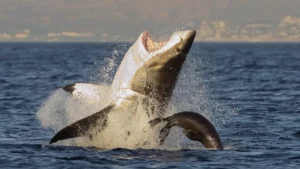 | 4–6 m (13–20 ft); juveniles here 1.5–2.5 m | Moderate | Juveniles in the New York Bight in summer; adults offshore on migrationThe accepted culprit of 1916. Today's animals are mostly young fish-eaters tagged off Sandy Hook and Long Beach Island; no modern bite is attributed to one. |
Porbeagle SharkLamna nasus | 2–2.5 m (7–8 ft) | Low | Cold shelf water, winter and springThe mako's cold-water cousin, taken on the shelf in the off-season. |
Scalloped Hammerhead SharkSphyrna lewini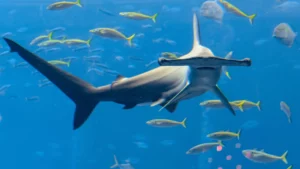 | 2.5–3.5 m (8–12 ft) | Low | Offshore in late summer; occasional juveniles inshoreThreatened; must be released. Shy of people. |
Smooth Hammerhead SharkSphyrna zygaena | 2.5–4 m (8–13 ft) | Low | Offshore from July to SeptemberThe hammerhead that tolerates the north-east's cooler water. |
Tiger SharkGaleocerdo cuvier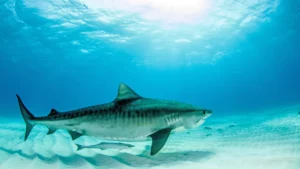 | 3–4.5 m (10–15 ft) | Low | Rare offshore visitor in the warmest weeksNot the regular the old page suggested; hooked off the canyon in some Septembers, never recorded at a beach. |
Basking SharkCetorhinus maximus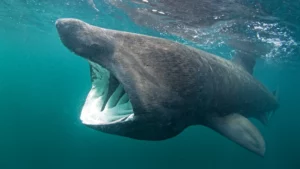 | 6–9 m (20–30 ft) | Low | Shelf edge in spring, occasionally close to shoreA filter feeder that causes a great white scare most Mays. Harmless. |
Whale SharkRhincodon typus | 6–12 m (20–40 ft) | Low | Rare late-summer visitor to the Hudson Canyon edgeSeen by canyon boats once every few years in warm-water summers. Never inshore. |
Chain CatsharkScyliorhinus retifer | 40–50 cm (1.5 ft) | Low | Deep bottom on the outer shelf and canyon wallsA tiny, biofluorescent bottom shark caught by trawlers, never by bathers. |
Bull SharkCarcharhinus leucas | 2.1–3.4 m (7–11 ft) | n/a | Unconfirmed: a handful of possible summer stragglers, no established presenceListed because of the Matawan Creek debate. The 1916 creek attacks are sometimes blamed on a bull shark, but the species has no confirmed modern record in the state. |
What is not here: nurse sharks, lemon sharks, great and bonnethead hammerheads and the reef sharks of Florida do not occur north of the Carolinas except as one-off summer stragglers. Bull sharks are the standing question because of 1916. Some historians argue a bull shark, which can live in fresh water, is the only species that could have been in Matawan Creek, but the white shark caught in Raritan Bay with human remains in its stomach remains the accepted culprit for the ocean attacks. Modern confirmed bull shark records from New Jersey are very few, which is why the species is listed as unconfirmed below. The whale shark and basking shark are both genuine but rare visitors to the canyon edge, never the beach.
Where to see sharks in New Jersey
New Jersey's sharks are easier to meet underwater than in most states, thanks to the wrecks. On land the options are surfcasting at night, a charter from the Manasquan or Cape May inlets, or the aquariums.
- The Wreck Valley sand tiger wrecks (Stolt Dagali, Great Isaac and others)From June to October sand tiger sharks gather on the wrecks 15–40 km off Point Pleasant, Belmar and Shark River in 20–40 m of water. Dive boats from Brielle, Belmar and Point Pleasant run them daily in summer, no cage needed. Visibility is 5–15 m, best in late summer.
- Delaware Bay and Cape MayThe sandbar shark nursery and a summer aggregation ground for adult sand tigers. Charters out of Cape May catch and release both from June to September, and surfcasters on the bay beaches hook sandbar pups after dark.
- The Mud Hole and the Hudson CanyonThe offshore grounds, 25 km and 150 km out from the Manasquan and Shark River inlets. Blue sharks, shortfin makos (release only) and threshers from June to October; basking sharks in spring, the odd whale shark and tiger shark in September.
- Island Beach State Park and Barnegat InletSixteen kilometres of undeveloped beach where night surfcasters catch sandbar and sand tiger sharks in the wash from July to September. Dusky and blacktip sharks feed on the bunker schools off the inlet in late summer.
- Great Bay and the Mullica River (Jacques Cousteau reserve)The smooth dogfish nursery. Kayak the marsh creeks off Tuckerton in June and you will see newborn dogfish and sandbar sharks in a hand's depth of water. Bull sharks are not part of this system; the water is too cold.
- Sandy Hook and Raritan BayWhere the 1916 white shark was caught and where researchers now tag juvenile white sharks in summer. Smooth dogfish, sandbar and the occasional sand tiger are caught from the Sandy Hook surf; the Matawan Creek memorial is a short drive inland.
- Adventure Aquarium, CamdenThe largest shark collection in the state: sand tiger, sandbar, nurse and other sharks in a two-million-litre exhibit with a 12 m tunnel and a rope shark bridge. A diver was bitten on the calf by an 8 ft sand tiger here in 2009, the only sand tiger injury in the state's record.
- Jenkinson's Aquarium, Point Pleasant BeachA small boardwalk aquarium with sandbar and nurse sharks, the easy option for children on a rainy day at the shore. Turtle Back Zoo in West Orange has a touch pool where an epaulette shark nipped a visitor's finger in 2022.
If you are a certified diver, the sand tiger wrecks in August are the best shark experience on the Atlantic coast north of the Carolinas. Cage diving with blue sharks is offered now and then by offshore charters in summer, but it is not an established industry and the old claim on this page that “several charters specialise in it” overstated it. For everyone else, a Cape May shark charter in July or a night on the Island Beach surf will produce a shark in hand.
Best time of year to see sharks in New Jersey
Water temperature decides everything on this coast. The ocean off Long Beach Island drops to 3–6 °C in February and does not pass 15 °C until late May; by August it reaches 21–25 °C, with the back bays and Delaware Bay several degrees warmer.
- December to April: almost nothing inshore. Spiny dogfish and porbeagles remain on the cold shelf, and great whites pass through on migration well offshore. The beaches are empty of sharks and of people.
- May and June: the season opens. Pregnant sandbar sharks enter Delaware Bay to pup, smooth dogfish flood into Great Bay, basking sharks feed along the shelf edge, and the first sand tigers reach the wrecks as the bottom water warms.
- July to September: peak season for everything. Sand tigers on every wreck, sandbar and dusky sharks along the beaches, blacktips and sharpnose in the surf in the warmest years, and the offshore fleet on blue sharks, makos and threshers. Every modern beach incident in the state falls in these months.
- October and November: the water holds 15–18 °C into November and the last sand tigers leave the wrecks. Visibility on the wrecks is often at its best in October.
For divers, August and September on the wrecks. For anglers, July in Delaware Bay. For a beach sighting, a calm August dawn at Island Beach or Sandy Hook with a bunker school close in.
Shark attacks in New Jersey: what the record shows
The New Jersey list is short but contains the most famous shark attacks in American history. The SharkSider database holds 57 records for the state from 1829 to 2023, 47 of them from 1900 onwards. Six were fatal, five since 1900: a swimmer at Beach Haven on 1 July 1916, a swimmer at Spring Lake on 6 July, two people in Matawan Creek on 12 July, and a swimmer at Seaside in August 1926. The full list is on the shark attacks in New Jersey page, updated weekly. These are the six most recent records:
- 2023 · Stone Harbor, Cape May CountySurfing — Lacerations to left foot and calfSpecies not identified
- 2022 · Tutle Back ZooFeeding sharks & stingrays — Finger nipped by captive shark provoked incidentEpaulette shark
- 2019 · Ship Bottom, Ocean CountyBody boarding — No injuryShark involvement unconfirmed but considered probable
- 2017 · Ventnor — Minor injury to handSandtiger shark 2'
- 2013 · Bay Head, Ocean CountyBody boarding — No injury, swim fin bittenSpecies not identified
- 2011 · Egg Harbor, Atlantic CountyWade fishing — No injury, shark bit bootSpecies not identified
The 1916 attacks dominate everything. In twelve days a shark, or sharks, killed a swimmer at Beach Haven, another at Spring Lake, and then, 15 km up the tidal Matawan Creek, a boy and the man who dived in to recover his body, and badly injured a second boy's leg. A 2.6 m white shark caught in Raritan Bay two days later with human remains in its stomach was declared the culprit, and the attacks stopped. The 1910s remain the state's busiest decade with 9 records and 4 deaths. Monmouth County, where Spring Lake and Matawan lie, holds 21 records and 4 of the deaths; Ocean County 10 and 2 deaths; Atlantic County 10 and Cape May County 5, none fatal.
After 1926 the record thins out fast. There were three bites in the summer of 1960, including a boy at Sea Girt whose leg was amputated, and then almost nothing: one record each in the 1970s and 1980s, two in the 2000s, four in the 2010s and two so far in the 2020s. Look closely at the eight cases since 2000 and the picture is even calmer. Two happened in captivity (a diver in the Adventure Aquarium tank in 2009, a zoo visitor nipped by an epaulette shark in 2022). Two involved no injury at all, a boot bitten while wade fishing at Egg Harbor in 2011 and a swim fin at Bay Head in 2013. One, at Ship Bottom in 2019, was never confirmed as a shark. The 2005 Surf City case was announced as a white shark bite and later shown to be no shark at all. That leaves a hand nipped by a 60 cm sand tiger at Ventnor in 2017 and a surfer's foot and calf cut at Stone Harbor in May 2023 as the only open-water injuries in a quarter of a century. Across the whole record swimmers and waders account for 17 cases and fishing and boating for 15, which says a lot about how many of these “attacks” were hooked sharks biting boats. The advice in our guide on how to survive a shark attack is worth knowing anyway.
Is it safe to swim at the Jersey Shore?
Yes, and the numbers back it up more strongly than in any other state on this site with a real shark fauna: two open-water injuries since 2000 against tens of millions of bathers a year. The species that could bite a swimmer here, a sand tiger or sandbar shark feeding on bunker in the surf, is small-mouthed and cautious, and the cold water keeps the sharks' season short. The rules are the same as on Long Island. Avoid the water at dawn and dusk, stay clear of bunker schools and diving birds, do not swim near surfcasters or inlets on a falling tide, and swim on lifeguarded beaches, which will clear the water if a shark is seen inside the bar.
On the wrecks the sand tigers are the attraction, and they are remarkably tolerant. Divers drift beside groups of a dozen or more without incident every summer; the animals move off if crowded and return when left alone. The single sand tiger injury in the state's record happened to a diver inside an aquarium tank, not at sea. Keep your hands to yourself, do not chase, and do not carry speared fish.
The offshore species are for boats. Blue sharks and makos will investigate a hooked fish or a swimmer beside a boat with real curiosity, and the Mud Hole is not a place to go in the water. Delaware Bay's sandbar pups are harmless; the adult sand tigers that share the bay are the same placid animals from the wrecks. The one genuinely dangerous shark in New Jersey's history, the white shark, is today represented mainly by 1.5–2.5 m juveniles feeding on fish in the Bight, and no bite in the modern record is attributed to one.
Shark conservation in New Jersey
New Jersey's coast matters to Atlantic sharks for its nurseries, and those nurseries are now protected in name if not always in practice. The Jacques Cousteau National Estuarine Research Reserve covers Great Bay and the lower Mullica, the Edwin B. Forsythe refuge covers the marsh behind Brigantine and Long Beach Island, and Delaware Bay's sandbar shark grounds are under federal management with a near-total ban on commercial landings. Sand tiger and white sharks have been prohibited since 1997, dusky sharks since 2000 and shortfin makos since 2022, and the Point Pleasant and Brielle tournaments that once hung makos from the scales have largely moved to tag and release.
The threats that remain are the familiar ones. Bycatch in the shelf gillnet and longline fisheries takes threshers, blues and porbeagles; the smooth dogfish is fished commercially under a quota; and coastal development eats the marsh edge that the nurseries depend on. Warming water is the wild card: blacktips and sharpnose sharks, once Carolina fish, now reach the Jersey Shore most summers, while the cold-water porbeagle's window shrinks. For anglers the useful rules are simple: circle hooks, keep prohibited species in the water, cut the leader rather than lift a big shark, and report tags. Our page on why sharks are endangered explains why the slow-breeding species take so long to recover.
Sharks in nearby states
The Jersey Shore's sharks belong to the whole New York Bight. New York shares the sand tiger and sandbar populations and has had a run of small bites on Long Island since 2022; Delaware shares Delaware Bay and its sandbar nursery, and Maryland's Ocean City is the mako-fishing port of the mid-Atlantic. Across the Sound, Connecticut has the same dogfish and sandbar sharks in cooler water, and Virginia's Chesapeake is the other great sandbar nursery. Inland, Pennsylvania has no coast at all, and its only sharks live in aquariums. The full index of countries and states is on our sharks around the world page.
Frequently asked questions
Are there sharks in New Jersey?
Yes. Eighteen species are confirmed in New Jersey waters. Sand tiger, sandbar and dusky sharks live along the beaches and on the wrecks in summer, smooth and spiny dogfish are everywhere, and blue sharks, makos and threshers work the Mud Hole and Hudson Canyon offshore. Juvenile great whites use the New York Bight as a nursery.
Were there shark attacks in New Jersey in 1916?
Yes, the most famous in American history. Between 1 and 12 July 1916 swimmers died at Beach Haven and Spring Lake, and two people were killed and a boy badly injured in Matawan Creek, 15 km from the sea. A 2.6 m white shark caught in Raritan Bay two days later was declared the culprit, though some argue a bull shark was in the creek. The events inspired Jaws.
How many shark attacks have there been in New Jersey?
The SharkSider database lists 57 records for New Jersey from 1829 to 2023, 47 of them since 1900. Six were fatal, five since 1900: the four 1916 deaths and one at Seaside in 1926. Since 2000 there have been just 8 records, none fatal, and two of those happened inside an aquarium and a zoo.
Are there great white sharks in New Jersey?
Yes. The New York Bight off Sandy Hook and Long Beach Island is part of a nursery where juvenile white sharks of 1.5–2.5 m feed on fish in summer, and adults pass offshore on migration between New England and the Carolinas. The 1916 attacks are attributed to a white shark; no modern New Jersey bite is.
Can you cage dive with sharks in New Jersey?
Only occasionally. A few offshore charters run blue shark cage trips in summer, but there is no established cage-diving industry in the state. The reliable way to dive with sharks in New Jersey is a wreck dive with sand tigers off Point Pleasant, Belmar or Brielle from June to October, which needs a certification but no cage.
Is it safe to swim at the Jersey Shore?
Yes. Since 2000 the state has recorded only two shark injuries to people in open water, both minor, against tens of millions of beach visits every summer. Swim on lifeguarded beaches, stay out of the water at dawn and dusk, keep away from bunker schools, inlets and surfcasters, and the risk is as close to zero as the ocean offers.
What is the most common shark in New Jersey?
The smooth dogfish, a metre-long, blunt-toothed shark that breeds in Great Bay and Little Egg Harbor by the thousand and is caught from every bay and pier in summer. Among larger sharks the sandbar shark is the most numerous inshore, thanks to the Delaware Bay nursery, and the sand tiger is the one divers see most.
Are there bull sharks in New Jersey?
Not as an established presence. Bull sharks need warm water and New Jersey's ocean is above 20 °C for only a few months, so records are limited to a handful of possible summer stragglers. The 1916 Matawan Creek attacks are sometimes blamed on a bull shark, but the species has no confirmed modern record in the state.
When is the best time to see sharks in New Jersey?
July to September, when the ocean reaches 21–25 °C and sand tigers gather on the wrecks, sandbar sharks fill Delaware Bay and the offshore charters find blue sharks, makos and threshers. Wreck visibility is often best in late August and September. Basking sharks pass along the shelf in May and June.
Where can you see sharks in New Jersey without diving?
Adventure Aquarium in Camden has the largest collection, with sand tiger, sandbar and nurse sharks in a tunnel and under a rope bridge; Jenkinson's Aquarium at Point Pleasant Beach is a smaller boardwalk option. At sea, a Cape May or Manasquan charter in summer will bring sandbar, sand tiger or blue sharks to the boat for release.
References

A small team focused on researching sharks and making marine biology easy to understand. Every page is reviewed against current species records and the SharkSider attack database, and updated when new incidents or research appear.
Published November 30, 2022 · Last updated September 22, 2026 · Incident data from the SharkSider attack database (47 records for New Jersey, 5 fatal).


