
Yes, Mississippi has sharks, at least 18 species with a confirmed record. The Atlantic sharpnose is the most abundant by far, and the blacktip, finetooth, bull shark and bonnethead round out the five you are most likely to meet inside the Sound. The bull shark is the one that matters for swimmers, because it pups in the bays and river mouths from Bay St. Louis to Pascagoula and stays in murky water all summer.
The bite record is one of the shortest of any coastal state: eight incidents in the SharkSider database between 1879 and 2022, two of them fatal, the last death in 1906. Six are dated 1900 or later, and only one has happened since 2000: an angler with minor injuries from a 1.5-metre shark at Horn Island in October 2022. Three of the eight involved people handling hooked sharks or boats, not swimmers.
- Shark species in this list18 recorded
- Protected speciesSand tiger, white, dusky & others (release only)
- Most seen from the beachAtlantic sharpnose & bonnethead
- Signature encounterBull shark pups in the Mississippi Sound
- Incidents in the database8 (1879–2022), 2 fatal (last 1906)
- Water temperature11–13 °C in Jan, 30–31 °C in Aug

On this page
- Where sharks live in Mississippi: the Sound and the islands
- List of the different types of sharks in Mississippi
- Where to see sharks in Mississippi
- Best time of year to see sharks in Mississippi
- Shark attacks in Mississippi: what the record shows
- Is it safe to swim in Mississippi with sharks around?
- Shark conservation in Mississippi
- Sharks in nearby states
- Frequently asked questions
- References
Where sharks live in Mississippi: the Sound and the islands
Almost everything about sharks in Mississippi comes back to the Sound. Stretching 80 miles from the Pearl River to Mobile Bay and averaging barely 3 metres deep, the Mississippi Sound is a lagoon rather than a sea, fed with fresh water by the Pearl, Wolf, Biloxi and Pascagoula rivers and sealed off from the Gulf by a chain of barrier islands. It warms to bath temperature by June, it is thick with shrimp, menhaden, mullet and blue crabs, and its low, shifting salinity keeps most large predators out. For a female bull shark, blacktip or finetooth that is the ideal place to give birth, and biologists at the University of Southern Mississippi's Gulf Coast Research Laboratory in Ocean Springs, who have surveyed the Sound with gillnets and longlines since the early 2000s, catch newborn and year-old sharks of half a dozen species there every summer.
The bull shark story is the strongest. The bays that open into the Sound, Bay St. Louis in the west, Back Bay of Biloxi in the middle and the Pascagoula River mouth in the east, hold juvenile bull sharks from late spring until the first cold fronts, and the Pascagoula, the largest free-flowing river left in the lower 48 states, lets them travel well inland. The Sound's salinity swings dramatically with the rivers: in 2019 the Bonnet Carré spillway upstream of New Orleans was opened twice for a total of 123 days, and the flood of fresh Mississippi River water that poured east through the Sound killed oysters, stranded dolphins and pushed the sharks out toward the islands until the salt returned.
The barrier islands, Cat, Ship, Horn and Petit Bois, are the other half of the system. Most of them are part of the Gulf Islands National Seashore, and the passes between them are the front door for everything that lives in the Sound: adult blacktips and bulls come and go with the tide, and the islands' Gulf-facing beaches have clearer, saltier water with spinners, blacknose sharks and the occasional hammerhead. Out on the open shelf south of the islands the water deepens slowly toward the oil platforms and the shelf edge 60 miles out, where tiger sharks, silky sharks and scalloped hammerheads take over and, in July and August, whale sharks feed at the surface.
List of the different types of sharks in Mississippi
The table covers every shark with a solid Mississippi record, from the inshore species that fill the Sound to the offshore ones met only by the charter fleet. Lengths are typical adults, and the risk rating is for a swimmer or wader at the beach, not for an angler handling a hooked shark, which is how three of Mississippi's eight recorded bites happened. Some numbers commonly attached to these species are wrong, so they are corrected here: the nurse shark reaches about 3 metres, not 18 to 32 feet; the great hammerhead is normally 3.5 to 4.5 metres, not 15 to 20 feet; and the silky shark and shortfin mako, often called "highly aggressive", are offshore fish that a Mississippi swimmer will never encounter.
| Species | Adult size | Risk to swimmers | Where in Mississippi & notes |
|---|---|---|---|
Atlantic Sharpnose SharkRhizoprionodon terraenovae | 0.8–1.1 m (2.5–3.5 ft) | Low | Throughout the Sound and off every pier, April to NovemberThe most abundant shark in Mississippi and the one children catch from the Biloxi piers. Harmless in the water, sharp-toothed on the hook. |
Blacktip SharkCarcharhinus limbatus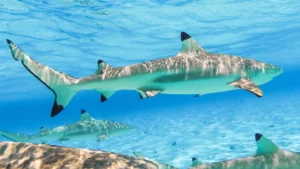 | 1.5–1.8 m (5–6 ft) | Moderate | The passes and island beaches; pups in the SoundThe only species named in a modern Mississippi injury, a hooked fish at Cat Island in 1995. Fast and prone to mistaken-identity bites in murky surf. |
Finetooth SharkCarcharhinus isodon | 1.2–1.6 m (4–5 ft) | Low | Sound and nearshore Gulf in summer, one of the commonest survey catchesA slim menhaden hunter that few beachgoers can name despite its abundance here. No bite record. |
Bull SharkCarcharhinus leucas | 2.2–3.2 m (7–10.5 ft) | High | Bay St. Louis, Back Bay of Biloxi, the Pascagoula and the SoundPups in the bays every summer and travels up the rivers. The species to respect in the Sound, though no Mississippi bite has been attributed to it. |
Bonnethead SharkSphyrna tiburo | 0.9–1.2 m (3–4 ft) | Low | Grass flats around Cat Island, Deer Island and the baysA small crab-eating hammerhead that is a common sight from a kayak in a metre of water. Timid. |
Blacknose SharkCarcharhinus acronotus | 1.1–1.4 m (3.5–4.5 ft) | Low | Gulf side of the islands and the inner shelfRecognised by the dusky smudge on its snout. Common on the shrimp grounds; rarely inside the Sound. |
Spinner SharkCarcharhinus brevipinna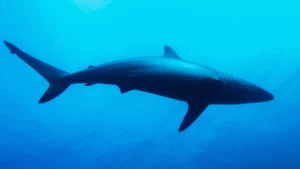 | 1.8–2.2 m (6–7 ft) | Moderate | Island beaches and the nearshore Gulf in late summer and autumnLeaps and spins through bait schools off Ship and Horn islands. Shares the blacktip's small risk of a foot bite. |
Scalloped Hammerhead SharkSphyrna lewini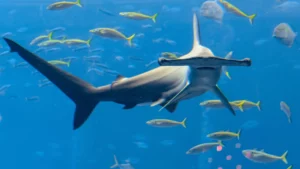 | 2.5–3.5 m (8–12 ft) | Low | Offshore shelf and the platforms; pups on the inner shelfCritically endangered worldwide; the Mississippi shelf is part of a northern Gulf stronghold. Shy of people. |
Great Hammerhead SharkSphyrna mokarran | 3.5–4.5 m (11–15 ft) | Moderate | Passes and Gulf side of the islands in summer, hunting raysThe largest hammerhead, usually well short of its 6 m maximum. Hooked occasionally from the islands; no Mississippi bite on record. |
Sandbar SharkCarcharhinus plumbeus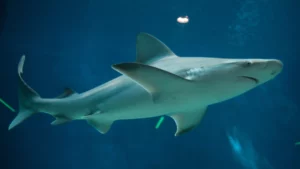 | 1.8–2.4 m (6–8 ft) | Low | Open shelf south of the islands and around the rigsHigh-finned and calm. Recovering slowly from the overfishing of the 1980s and 1990s; landings restricted. |
Tiger SharkGaleocerdo cuvier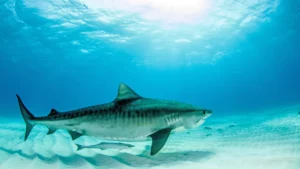 | 3–4.5 m (10–15 ft) | High | Offshore shelf and platforms; rarely the island passesNamed in the 1879 fatality after a boat capsized at a river mouth. An offshore animal here, seen by the charter fleet rather than swimmers. |
Dusky SharkCarcharhinus obscurus | 2.8–3.6 m (9–12 ft) | Low | Outer shelf, offshore onlyProhibited to land and still depleted across the Gulf. Never inshore. |
Silky SharkCarcharhinus falciformis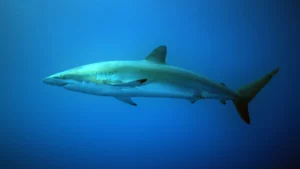 | 2–3 m (7–10 ft) | Low | Deep platforms and the shelf edgeCircles the offshore rigs with the tuna. The "highly aggressive" label sometimes attached to it is undeserved for a shark that never approaches a beach. |
Lemon SharkNegaprion brevirostris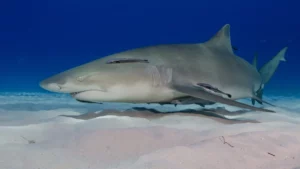 | 2.4–3 m (8–10 ft) | Low | Seagrass flats near the islands in summer, uncommonRegular on the Chandeleur flats just west of the state line and occasionally around Cat Island. Slow and easily seen in shallow water. |
Nurse SharkGinglymostoma cirratum | 2.2–3 m (7–10 ft) | Low | Offshore reefs and platform bases, uncommonRare this far west in the Gulf but recorded on the offshore structures. Reaches about 3 m; the 18 to 32 ft sometimes quoted is fiction. |
Shortfin Mako SharkIsurus oxyrinchus | 2.5–3.5 m (8–11 ft) | Low | Blue water beyond the shelf edge in winter and springCaught by long-range charters 60 miles out. Formidable on a line; irrelevant to swimmers. |
| Gulf SmoothhoundMustelus sinusmexicanus | 0.9–1.2 m (3–4 ft) | Low | Mid- and outer-shelf bottom in 40–200 mA small, flat-toothed shark found only in the Gulf of Mexico. Taken by trawls; never seen from shore. |
Whale SharkRhincodon typus | 6–10 m (20–33 ft) | Low | Offshore shelf south of the islands, June to SeptemberSighted by charter boats most summers and logged by the Gulf Coast Research Laboratory's programme. A filter feeder; harmless. |
The most searched question about Mississippi is whether great white sharks are here, and the honest answer is no: there is no confirmed record of a white shark in Mississippi state waters or near its beaches. Satellite-tagged white sharks from the Atlantic have been tracked in the northern Gulf in winter, but their tracks sit off Louisiana and the Florida panhandle, well offshore, in months when nobody swims. The gulper shark, a deep-water species sometimes listed for the state, lives on the continental slope far beyond Mississippi's waters, and the Caribbean reef shark and blacktip reef shark do not occur in the northern Gulf at all.
Where to see sharks in Mississippi
The Sound is opaque, so sightings here happen from a pier, a boat or an aquarium window rather than through a mask. These are the eight most reliable places.
- Ship Island (Gulf Islands National Seashore)Reached by passenger ferry from Gulfport. The south beach faces the open Gulf with the clearest water in the state; blacktips and sharpnose feed along the bar, and the ferry crossing passes bull shark water in the Sound.
- Horn IslandTwelve miles of wild sand and pine reached only by private boat or charter. Bull sharks and blacktips patrol the Sound side and the passes at each end; two of the state's eight recorded incidents, in 1963 and 2022, involved anglers here.
- Cat IslandThe westernmost island, closest to Bay St. Louis. Its shallow grass flats hold bonnetheads and juvenile bull sharks, and the 1995 record of an angler cut by a hooked blacktip is from its shore.
- Biloxi Bay and Deer IslandThe urban option. Bonnetheads and Atlantic sharpnose are caught from the Biloxi piers and the Ocean Springs bridge all summer, and juvenile bull sharks use the Back Bay. Deer Island, a short kayak paddle from the Biloxi beach, has sharks in its channel on every tide.
- Bay St. Louis and Pass ChristianThe western bay is a known bull shark nursery, and the piers at Bay St. Louis and Pass Christian produce sharpnose and small bulls. The state's 1906 fatality and its 1886 wading injury both happened along this shore.
- Pascagoula River mouth and Round IslandWhere the state's biggest river meets the Sound. Bull sharks move up the Pascagoula in summer, and the flats around Round Island hold blacktips and bonnetheads. Best explored by kayak or skiff on a rising tide.
- Mississippi Aquarium, GulfportOpened in 2020 on the Gulfport waterfront, with a large Gulf of Mexico habitat where sharks and rays swim past floor-to-ceiling windows. The easiest way to see the Sound's species at eye level, and the best rainy-day option on the coast.
- Offshore from Biloxi: the rigs and the shelf edgeCharter boats run 40 to 60 miles south to the platforms and the shelf break, where silky sharks, scalloped hammerheads and tiger sharks hold and whale sharks are sighted at the surface in July and August.
If you want a shark without a boat, the Biloxi piers at dusk in July are the place; if you want to see the islands' sharks in clear water, take the Ship Island ferry on a calm morning and walk to the Gulf side. Whale shark trips are weather-dependent and best booked from Biloxi or Pascagoula in midsummer.
Best time of year to see sharks in Mississippi
The Sound is shallow, so it heats and cools faster than the open Gulf, and the sharks respond within days.
- December to February: water inside the Sound falls to 11–13 °C and the sharks are gone, wintering on the shelf or further south. The islands' Gulf beaches are empty of sharks and people alike.
- March to May: the Sound climbs through 20 °C in April and the sharpnose, blacktip and finetooth sharks return. Pregnant bull sharks push into the bays to pup from late May, and the young of the year appear in survey nets by June.
- June to September: peak abundance, with Sound water of 30–31 °C by August. Every summer bite in the record falls in June, July or August, and the pier fishing for small sharks is at its best. Whale sharks are sighted offshore from June to September, peaking in July and August.
- October to November: the mullet run pulls blacktips and spinners tight to the islands, then the first cold fronts in November send the small species out through the passes and the bull sharks down to the Gulf.
In a spillway year the calendar shifts: fresh water in spring can delay the arrival of the small coastal species by weeks and keep them near the islands until the Sound turns salty again.
Shark attacks in Mississippi: what the record shows
SharkSider's database lists eight incidents for Mississippi, two of them from before 1900. The six dated 1900 or later are summarised below, with the six most recent shown in full; the complete list is on the shark attacks in Mississippi page.
- 2022 · Horn IslandFishing — Minor injuries5'shark
- 1995 · Cat Island, Harrison CountyFishing — Minor laceration to leg from a hooked shark provoked incidentBlacktip shark
- 1963 · Horn IslandFishing, on charter boat silver dollar — Cuts on right hand, provoked incident1.2 m [4'] shark
- 1960 · Mississippi CityPulling raft out to ride to shore — Leg bittenSpecies not identified
- 1917 · Mississippi — Leg bittenSpecies not identified
- 1906 · Bay St. Louis, Hancock CountySwimming — FatalFishermen recovered partial remains from shark a week later · fatal
The two deaths are the oldest entries. In 1879 a pilot launch capsized at a river mouth and a man floating with a life buoy was killed by a tiger shark, the only tiger shark named in the state record. On 5 July 1906 a swimmer died at Bay St. Louis; fishermen recovered partial remains from a shark caught a week later. Nothing since then has come close. The 1886 case at Pass Christian, a wader with a 12-inch cut to the calf, and the 1917 leg bite, location unrecorded, complete the early history.
The modern record is six entries in 106 years and is dominated by fishing. A charter-boat angler cut his hand on a 1.2-metre shark he had landed off Horn Island in 1963, another was cut on the leg by a hooked blacktip at Cat Island in 1995, and the most recent case, in October 2022, was an angler at Horn Island with minor injuries from a 1.5-metre shark. Only one modern record involves a person in the water rather than handling a fish: a swimmer at Mississippi City in July 1960 bitten on the leg while pulling a raft out to ride to shore. Fishing and boats therefore account for three of the eight records, swimming and wading three, and two are unclear. No incident has been recorded on the Gulfport, Biloxi or Bay St. Louis beaches since 1960, despite the casino boom and the millions of visitors it brought, and none of the state's bites has been credibly attributed to a bull shark, the species most people worry about here.
Is it safe to swim in Mississippi with sharks around?
Yes, and the numbers are about as reassuring as they get: one shark injury to a swimmer in the last century, none since 1960, on a coast where the beach at Biloxi and Gulfport runs for 26 uninterrupted miles. Part of the reason is the water itself. The Sound is so shallow and murky that the sharks in it are mostly newborns and juveniles, and even the adult bull sharks that enter the bays in summer are there to give birth, not to hunt large prey. The Gulf-facing beaches of the islands have bigger sharks and clearer water, and still no record of a swimmer hurt.
That is not a reason to be careless. Bull sharks are genuinely present in Bay St. Louis, Back Bay of Biloxi and the Pascagoula from May to October, and the standard rules apply with extra force in water where you cannot see: swim in daylight, stay away from the river mouths and passes on a running tide, keep clear of people fishing or cleaning their catch, and get out if you see bait scattering or birds diving close in. The biggest actual risk in Mississippi is on the end of a fishing line. Three of the eight recorded injuries were caused by sharks that had been hooked and hauled aboard or onto the sand, so if you land one, use pliers or cut the leader and keep hands away from the mouth even of a half-metre sharpnose; its teeth are small but very sharp. Our guide on how to survive a shark attack covers what to do if a shark does make contact, and anyone who joins an offshore whale shark trip should read our whale shark swimming guidelines first.
Shark conservation in Mississippi
The Mississippi Department of Marine Resources manages sharks inside the federal Gulf of Mexico rules. Recreational anglers may keep one shark per person per day, the large coastal species carry a minimum length and the small coastal species a shorter one, and the prohibited list, sand tiger, white, dusky, whale shark, basking shark and a string of rarer species, must be released alive. Commercial shark landings in the state are tiny; most of the sharks caught off Mississippi are taken incidentally by the shrimp fleet and released. The Gulf Islands National Seashore protects the barrier islands and their surrounding waters, and the Grand Bay National Estuarine Research Reserve at the Alabama line safeguards one of the least disturbed marsh systems on the northern Gulf.
The science base is good for a coast this short. The Gulf Coast Research Laboratory's shark surveys have documented the Sound's role as a nursery for bull, blacktip, finetooth, sharpnose and bonnethead sharks, and its researchers helped launch the whale shark sighting programme that now covers the whole northern Gulf. The threats are the ones the whole region shares: the Deepwater Horizon spill of 2010 oiled the islands, the 2019 spillway openings showed how fragile the Sound's salinity balance is, and scalloped and great hammerheads remain endangered worldwide despite doing reasonably well on the Mississippi shelf. The long-term question is habitat: the bays and river mouths where the sharks are born are also where the coast's people, ports and casinos are, and every acre of marsh lost to development is nursery gone. Our explainer on why sharks are endangered puts the state's situation in context.
Sharks in nearby states
Mississippi's sharks are the same animals that fill the rest of the northern Gulf. The Sound continues east into Alabama, where Mobile Bay is a bull shark nursery on a larger scale and the offshore reef zones hold the big species, and west into Louisiana, with the Chandeleur Islands, Lake Pontchartrain's bull sharks and the whale sharks of Ewing Bank. Florida's panhandle is the clear-water end of the same coast, and Texas the far western end; the whole basin is covered on our sharks in the Gulf of Mexico page, and Mexico completes the southern shore. For the Atlantic side of the South, see Georgia, and for every region on the site, our overview of sharks around the world.
Frequently asked questions
Are there sharks in Mississippi?
Yes. At least 18 species are recorded in the Mississippi Sound, around the barrier islands and on the shelf offshore. The Sound is a nursery for bull, blacktip, finetooth, Atlantic sharpnose and bonnethead sharks every summer, and the offshore waters add hammerheads, sandbar, silky, tiger and, in midsummer, whale sharks.
Are there great white sharks in Mississippi?
No confirmed record exists. White sharks satellite-tagged in the Atlantic have been tracked in the northern Gulf in winter, but off Louisiana and the Florida panhandle, far offshore, not in Mississippi waters. The Sound is too shallow, warm and brackish for the species, and there has never been a white shark sighting or bite on a Mississippi beach.
Have there been shark attacks in Mississippi?
Eight incidents are in the SharkSider database from 1879 to 2022, two fatal: a man killed by a tiger shark after a boat capsized in 1879 and a swimmer at Bay St. Louis in 1906. Only one has occurred since 2000, an angler with minor injuries at Horn Island in October 2022, and no swimmer has been bitten since 1960.
Is it safe to swim at Biloxi and Gulfport?
Yes. The 26-mile mainland beach from Biloxi to Pass Christian has no recorded shark injury to a swimmer since 1960. The Sound is shallow and murky and holds mostly small and juvenile sharks. Swim in daylight, avoid the bay mouths and passes on a moving tide, and stay clear of anyone fishing from the piers.
Are there bull sharks in the Mississippi Sound?
Yes. Bull sharks give birth in Bay St. Louis, Back Bay of Biloxi and the Pascagoula River mouth from late May, and juveniles are caught in the Sound by researchers every summer. Adults travel up the Pascagoula River. Despite this, none of the state's eight recorded incidents has been attributed to a bull shark.
What is the most common shark in Mississippi?
The Atlantic sharpnose shark. It dominates the Gulf Coast Research Laboratory's surveys of the Sound and is the small shark anglers catch from the Biloxi, Gulfport and Bay St. Louis piers all summer. Blacktip, finetooth and bonnethead sharks are the next most common, with bull sharks abundant as juveniles in the bays.
When is the best time to see sharks in Mississippi?
June to September, when the Sound is 30 to 31 °C and full of sharks, is the peak; the mullet run in October brings blacktips and spinners close to the islands. Whale sharks are seen offshore from June to September. From December to February the Sound cools to 11 to 13 °C and the sharks leave.
Can you see sharks at Ship Island?
Yes. The passenger ferry from Gulfport crosses bull shark and blacktip water in the Sound, and the island's Gulf-facing south beach has the clearest water in the state, where blacktips and sharpnose feed along the sandbar in summer. Sharks are also caught from the shore by anglers on the Sound side.
Are there whale sharks off Mississippi?
Yes, in summer. Whale sharks move along the northern Gulf shelf from June to September and are sighted by Biloxi and Pascagoula charter boats most years, usually 40 to 60 miles offshore near the platforms and the shelf edge. The Gulf Coast Research Laboratory in Ocean Springs helped start the sighting programme that tracks them.
Is shark fishing legal in Mississippi?
Yes, with limits set by the Department of Marine Resources: one shark per person per day, minimum lengths for large and small coastal sharks, and a prohibited list that includes sand tiger, white, dusky, whale and basking sharks, which must be released. Most sharks caught from the piers are small and are released anyway.
References

A small team focused on researching sharks and making marine biology easy to understand. Every page is reviewed against current species records and the SharkSider attack database, and updated when new incidents or research appear.
Published November 30, 2022 · Last updated September 22, 2026 · Incident data from the SharkSider attack database (6 records for Mississippi, 1 fatal).


