
Yes, Massachusetts has sharks, and it is now the great white capital of the western Atlantic. This list covers 16 species with a solid record in state waters. The ones you are most likely to see are the great white off the Outer Cape from July to October, the basking shark in Cape Cod Bay and the Gulf of Maine in early summer, the blue shark offshore south of Nantucket and Martha's Vineyard, and the porbeagle and spiny dogfish that stay through the cold months. Sand tigers summer in Plymouth Bay; makos and threshers work the offshore banks.
The risk is real but small, and it is concentrated in one place. SharkSider's database holds 20 Massachusetts records from 1751 to 2026 (15 dated 1900 or later), 5 of them fatal, but only 2 since 1900: a swimmer at Mattapoisett in 1936 and a bodyboarder at Newcomb Hollow Beach, Wellfleet, in September 2018, both killed by white sharks. Nine of the records are from 2000 onward and seven from the 2010s alone, the decade the seals and the sharks came back together. Even so, the Cape's beaches host millions of swims a summer, and the 2018 death remains the only fatal bite in the state in nearly ninety years.
- Shark species in this list16 recorded
- Protected speciesWhite shark: federal 1997, state 2005, no attracting since 2015; fin trade banned 2014
- Most seen from the beachGreat white (Outer Cape, July–October)
- Signature encounterWhite sharks hunting seals off Chatham and Monomoy
- Incidents in the database20 (1751–2026), 5 fatal, 2 since 1900
- Water temperature2–4 °C in Feb, 17–20 °C in Aug on the Outer Cape

On this page
- Why Massachusetts has so many sharks now
- List of the different types of sharks in Massachusetts
- Where to see sharks in Massachusetts
- Best time of year to see sharks in Massachusetts
- Shark attacks in Massachusetts: what the record shows
- Is it safe to swim on Cape Cod and in Massachusetts?
- Shark conservation in Massachusetts
- Sharks in nearby states
- Frequently asked questions
- References
Why Massachusetts has so many sharks now
The short answer is seals. Grey seals were hunted for bounty in New England until the 1960s and were close to gone from Massachusetts when the Marine Mammal Protection Act stopped the killing in 1972. They came back slowly from Canada, and by the 2000s the colonies on Monomoy Island and the Chatham bars had grown into the largest grey seal haul-out in the United States, tens of thousands of animals on a single stretch of sand. A great white shark is built to eat seals, and the whites that had always passed Cape Cod in small numbers on their summer migration now had a reason to stop. The first dependable sightings off Chatham came in 2004; by 2009 the Massachusetts Division of Marine Fisheries was tagging them from a spotter plane and a harpoon boat, and by the mid-2010s the seasonal population was large enough that a four-year photo-identification study put the number of individual white sharks using Cape Cod waters at roughly 800. More than 300 have now carried acoustic tags, and the receivers off the Outer Cape beaches log tens of thousands of detections every August. Those detections, not 63,000 separate sharks as the old version of this page suggested, are what the annual counts measure.
Geography does the rest. Cape Cod is a hook of sand thrust 100 kilometres into the Atlantic, and its outer shore drops off quickly into cool, clear water that seals and sharks both like. Cape Cod Bay inside the hook is a shallow, plankton-rich basin that fills with copepods in early summer, which is why basking sharks and threshers appear there in June and July and why the whale-watch boats out of Provincetown see both. South of the islands, the continental shelf runs out 150 kilometres to the canyons, and in summer the water over it is warm enough for blue sharks, makos and the odd tiger shark riding a Gulf Stream eddy. North of the Cape, the Gulf of Maine stays cold all year, which suits porbeagles, spiny dogfish and, in the deep basins, the occasional Greenland shark.
Massachusetts also has an estuary story that most visitors never hear. Plymouth, Kingston and Duxbury bays, the sheltered water inside the Duxbury Beach barrier, turned out in the late 2000s to be a nursery for juvenile sand tiger sharks, one-metre animals that arrive in June and leave in October. State biologists have tagged hundreds there, and the bay is now the northernmost known nursery for the species on the coast.
The state has moved faster than most on protection. White sharks have been on the federal prohibited list since 1997; Massachusetts added its own state-waters protection in 2005 and in 2015, after a proposal for cage-diving off Chatham, made it illegal to attract white sharks with bait, chum or decoys anywhere in state waters. The 2014 shark fin law closed the fin trade in the state. Basking sharks, sand tigers and dusky sharks are federally protected, and shortfin makos have been release-only in the Atlantic since 2022.
List of the different types of sharks in Massachusetts
The table covers every species with a reliable record in Massachusetts waters, from the surf at Nauset to the Gulf of Maine and the shelf south of Nantucket. Sizes are what adults usually measure. The risk column judges the threat to a swimmer or surfer under Massachusetts conditions: the great white earns its rating here because it hunts in the same waist-deep water people swim in on the Outer Cape, while the mako, whatever its reputation, lives 80 kilometres offshore. The old version of this page listed “devil rays” among the sharks; they are rays and have been removed.
| Species | Adult size | Risk to swimmers | Where in Massachusetts & notes |
|---|---|---|---|
Great White SharkCarcharodon carcharias | 4–6 m (13–20 ft) | High | Outer Cape Cod from Chatham to Provincetown, July–October, often in less than 2 m of waterSeveral hundred individuals visit each summer to hunt grey seals. Identified in five state records including the 1936 and 2018 deaths. Federally protected since 1997, state-protected since 2005. |
Basking SharkCetorhinus maximus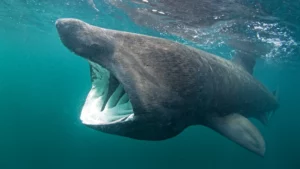 | 6–8 m (20–26 ft), exceptionally 10 m+ | Low | Cape Cod Bay, Stellwagen Bank and off Cape Ann, May–AugustThe second-largest fish in the sea and a plankton feeder. Dozens tagged from the Cape since 2004; the animal behind most 'giant shark' videos in Massachusetts. |
Blue SharkPrionace glauca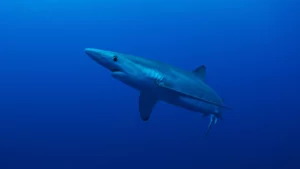 | 2.5–3.5 m (8–11.5 ft) | Low | Shelf waters south of Nantucket and Martha's Vineyard, June–SeptemberAbundant offshore and the species the region's cage-diving trips are built on. Never near beaches. |
Shortfin Mako SharkIsurus oxyrinchus | 2.5–3.5 m (8–11.5 ft) | Low | Offshore south of the islands, June–OctoberA 4.3 m mako bumped a boat off Chatham in 2001. Listed as endangered in 2019; Atlantic anglers have had to release every mako since 2022. |
Porbeagle SharkLamna nasus | 1.8–2.5 m (6–8 ft) | Low | Gulf of Maine and off Cape Ann in every month of the yearWarm-blooded cold-water relative of the white shark. Massachusetts is one of the few states where it is a year-round resident. |
Common Thresher SharkAlopias vulpinus | 3–4.5 m (10–15 ft) incl. tail | Low | Cape Cod Bay and Stellwagen Bank in summer, following mackerel and menhadenHalf of it is tail. Seen from whale-watch boats; the old page's 12–18 ft is an exaggeration for typical adults. |
Sand Tiger SharkCarcharias taurus | 2.2–3 m (7–10 ft); juveniles ~1 m here | Low | Plymouth, Kingston and Duxbury bays, June–OctoberThe northernmost known nursery for the species. Hundreds of juveniles tagged; protected since 1997. |
Sandbar SharkCarcharhinus plumbeus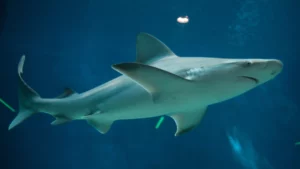 | 1.8–2.4 m (6–8 ft) | Low | Nantucket Sound and Buzzards Bay in the warmest weeks; uncommonAt the northern edge of its range. A few caught and released each summer; release-only since 2008. |
| Smooth DogfishMustelus canis | 0.9–1.3 m (3–4 ft) | Low | Buzzards Bay, Vineyard Sound and the south-facing bays, June–OctoberCrab-crushing teeth, no danger at all. The commonest shark caught from a Massachusetts pier in summer. |
| Spiny DogfishSqualus acanthias | 0.8–1.2 m (2.5–4 ft) | Low | Everywhere, all year; densest in the Gulf of MaineThe most numerous shark in New England and the basis of a large fishery. One provoked record: a hooked dogfish's fin cut an angler off Gloucester in 2016. |
Tiger SharkGaleocerdo cuvier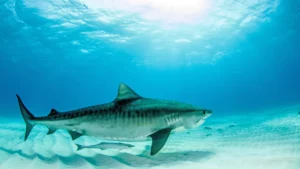 | 3–4.5 m (10–15 ft) | Moderate | Rare visitor to the warm shelf water south of the islands in late summerRides Gulf Stream eddies north in hot years. No Massachusetts incident; rated moderate here only because it is so rare. |
Smooth Hammerhead SharkSphyrna zygaena | 2.5–3.5 m (8–11.5 ft) | Low | Offshore south of the Cape in late summer, increasingly oftenThe cool-water hammerhead, seen finning at the surface on offshore trips. |
Dusky SharkCarcharhinus obscurus | 3–3.6 m (10–12 ft) | Low | Rare on the shelf south of the islands in summerEndangered and prohibited since 2000; Massachusetts is the top of its range. |
Whale SharkRhincodon typus | 6–12 m (20–40 ft) | Low | Very rare straggler in warm water far south of NantucketA handful of records in hot summers. Harmless plankton feeder; not a Massachusetts attraction. |
Greenland SharkSomniosus microcephalus | 3–5 m (10–16 ft) | Low | Deep, cold basins of the Gulf of MaineThe slowest and possibly longest-lived shark on Earth. Occasionally hauled up by trawlers off Cape Ann; never near shore. |
Chain CatsharkScyliorhinus retifer | 0.4–0.5 m (1.5 ft) | Low | Continental slope south of the islands, below 100 mA tiny patterned deep-water shark that fluoresces under blue light. Common in trawl catches, unknown to swimmers. |
Bull SharkCarcharhinus leucas | 2.1–3.4 m (7–11 ft) | n/a | Not confirmed in MassachusettsListed on the old page as a 'negligible population'; there is no confirmed record. The water is too cold and the species' range ends around New York. |
What is missing matters as much as what is here. There is no evidence of a bull shark population in Massachusetts: the old page's claim of a “negligible population” visiting the north shore in summer has no confirmed record behind it, and the species' northern limit on this coast is effectively New York. Reef sharks do not live in the Atlantic. Whale sharks are genuine but very rare summer stragglers in the warm water south of the islands, not something to plan a trip around. And the basking shark that went viral as a “megalodon” when it was filmed from the Woods Hole sail-training ship Corwith Cramer was a plankton-feeder; the species can reach 10–12 m in exceptional cases, though the ones in Cape Cod Bay are mostly 6–8 m.
Where to see sharks in Massachusetts
Massachusetts is the easiest place on the East Coast to see a great white from land, and one of the few places anywhere to watch one hunt from a public beach. Beyond the Cape, the state offers offshore blue shark trips, basking sharks from whale-watch boats and a large aquarium in Boston. These are the sites that deliver.
- Chatham: Lighthouse Beach, South Beach and MonomoyThe centre of the white shark world. The seal colonies on the Chatham bars and Monomoy National Wildlife Refuge draw the sharks within metres of the sand from July to October, and the bluff at Chatham Light is the classic spot to watch the spotter plane circle and the tagging boat move in. Seal-watching boat tours from Chatham Harbor and Stage Harbor see sharks on many summer days; swimming off the outer bars is restricted for good reason.
- Cape Cod National Seashore beaches (Nauset, Marconi, Newcomb Hollow, Longnook, Head of the Meadow, Race Point)Forty miles of Outer Cape surf beach with purple shark flags, warning signs and lifeguards who clear the water for an hour after a sighting. Every white shark bite on a swimmer or boarder since 2012 happened on this coast: Ballston and Longnook in Truro, Marconi and Newcomb Hollow in Wellfleet. Sharks are seen from the dunes most weeks in August and September; check the Sharktivity app before you go.
- Atlantic White Shark Conservancy Shark Center, ChathamThe small museum run by the research charity that works alongside the state's tagging programme. It explains the seal-and-shark story, shows the tagging footage, and is the place to learn how to read the Sharktivity map. There is also a seasonal outpost in Provincetown.
- Cape Cod Bay and Stellwagen BankWhale-watch boats out of Provincetown, Plymouth and Gloucester cross water where basking sharks feed at the surface in June and July and where threshers, blue sharks and the odd porbeagle show up around the bait. A basking shark's dorsal fin and tail tip breaking the surface together is a sight that fools people into calling the coastguard every summer.
- Plymouth, Kingston and Duxbury baysThe sand tiger nursery. Juvenile sand tigers of about a metre live in the bays from June to October and are caught, tagged and released by state biologists and by anglers fishing bait from the Duxbury and Plymouth shore. Manomet Point, where a white shark bit a kayak in 2014, is just outside the bay mouth.
- South of Martha's Vineyard and NantucketThe blue shark grounds. From June to September the water over the shelf holds blue sharks in extraordinary numbers, with makos, threshers and occasional hammerheads, and cage-diving and shark-fishing charters from southern New England ports work this area. Nantucket's Hoicks Hollow beach is where the most recent record in the file, an angler with a leg injury, was logged in July 2025.
- Cape Ann: Gloucester and RockportThe north shore's shark port. Porbeagles are caught off Cape Ann in every month of the year, blue sharks arrive in summer, and Granite Pier in Rockport is where a scuba diver was punctured on the thigh by a 1.2 m shark in 1965. A hooked dogfish that cut a fisherman's forearm off Gloucester in 2016 is also in the state's record.
- New England Aquarium, BostonThe four-storey Giant Ocean Tank holds sand tiger sharks alongside Myrtle the green turtle, and the shark and ray touch tank lets children handle small bamboo and epaulette sharks. It is the only place to see a live shark in Massachusetts between November and May, and there is no cage-diving with white sharks anywhere in the state.
If you want a white shark, go to Chatham in August or September, stand on the bluff at the lighthouse at low tide and give it an hour. If you want a shark in the water with you, the offshore blue shark trips are the only legal option in Massachusetts, and they are excellent.
Best time of year to see sharks in Massachusetts
Massachusetts has cold water and a short season. The Outer Cape surf is 2–4 °C in February and only 17–20 °C in August; Nantucket Sound and Cape Cod Bay warm to 22–24 °C in the shallows, and the Gulf of Maine north of the Cape rarely passes 18 °C at the surface.
- December to April: the white sharks are gone to the Carolinas and Florida, or sitting in deep water far offshore. Porbeagles and spiny dogfish are the sharks of the Gulf of Maine winter, and Greenland sharks are occasionally caught in the deep basins.
- May and June: the first white sharks arrive as the water passes 12 °C, usually big females first. Basking sharks appear in Cape Cod Bay and off Cape Ann to feed on the spring plankton bloom, threshers follow the mackerel into the Bay, and juvenile sand tigers move into Plymouth Bay.
- July to October: the peak. White shark detections on the Outer Cape receivers climb from July, peak in August and September and stay high into October, which is when the seals have pups and the water is warmest. Blue sharks and makos are on the shelf south of the islands, smooth dogfish are in Buzzards Bay and Vineyard Sound, and every one of the state's beach incidents since 1996 falls between July and September.
- November: the whites leave as the water drops below about 10 °C, though a few late animals are detected off Chatham into December.
For beach sightings, late August to early October is the sweet spot: the sharks are at their most numerous, the summer crowds have thinned and the light off Chatham in the early morning is ideal for spotting a fin.
Shark attacks in Massachusetts: what the record shows
Massachusetts has the longest history and the newest incidents of any New England state. The SharkSider database holds 20 records, the oldest a swimmer killed in 1751 and the most recent a swimmer with leg lacerations at Norton Point, South Beach, Edgartown, on Martha's Vineyard in August 2026. Fifteen are dated 1900 or later, and five in total were fatal, two of them since 1900. There is no separate attacks page for the state yet; every case is listed with the rest of the country on the shark attacks in the USA hub, updated weekly. The six most recent records are shown here:
- 2026 · Norton Point South Beach Edgartown Marthas VineyardSwimming — Lacerations to lower leg consistent with a shark biteNot stated sandbar or sand tiger shark suspected
- 2025 · Hoicks Hollow Nantucket BeachFishing — Injury to legSpecies not identified
- 2018 · Newcomb Hollow Beach, Wellfleet, Barnstable CountyBoogie boarding — FatalWhite shark · fatal
- 2018 · Longnook Beach, Truro, Barnstable CountySwimming — Lacerations to leg, hip and handWhite shark
- 2017 · Marconi Beach, Wellfleet, Barnstable CountySup — Not injured by shark but board bittenWhite shark, 5' to 7'
- 2017 · Menauhant Beach, Falmouth,Species not identified
The record splits neatly at 2012. Before that year the file is thin and mostly maritime: a fisherman killed 30 miles south of Lynn in 1897, a dory upset by a shark off Swampscott in 1830, human remains found inside a 4.9 m shark off Cape Cod in 1848, a netted shark biting a crewman 40 miles south of Nantucket in 1969. The one modern beach death before the seals returned was Joseph Troy, a 16-year-old swimming crawl stroke off Hollywood Beach in Mattapoisett, on Buzzards Bay, in July 1936; the shark was identified as a white by Dr Hugh Smith, and the boy died during surgery. Between 1936 and 2012 the file holds a 1965 scuba diver at Rockport, a 1996 swimmer at Truro with lacerations to the leg and foot, and a 2001 mako that bumped a boat off Chatham.
From 2012 the white sharks appear by name. A bodysurfer at Ballston Beach in Truro had both legs lacerated in July 2012; a white shark bit a kayak at Manomet Point off Plymouth in 2014; a stand-up paddleboard was bitten at Marconi Beach in 2017; a 61-year-old swimmer at Longnook Beach in Truro was badly injured on his leg, hip and hand in August 2018; and a month later, on 15 September 2018, Arthur Medici, 26, was killed while bodyboarding at Newcomb Hollow Beach in Wellfleet, the state's first fatal shark bite in 82 years. Where a species is named in the file, the white shark accounts for five records, the dogfish and the mako for one each. Barnstable County, which is Cape Cod, holds four of the modern records and the only modern death.
What the pattern shows is not a coast becoming dangerous but a specific habitat that has changed. All of the white shark incidents happened within a few hundred metres of a seal haul-out or in the surf zone of the Outer Cape, in water where the sharks hunt in less than two metres of depth. Away from the Outer Cape and the seal colonies, Buzzards Bay, the south-facing beaches of the islands and the North Shore have had no white shark incident since 1936. Anglers make up 7 of the 20 records, swimmers and waders 6, surfers and boarders 4, which is the usual mix anywhere. Our guide on how to survive a shark attack covers what to do, and the Cape's own advice, stay close to shore, avoid seals, and get out when the purple flag goes up, is the version that matters here.
Is it safe to swim on Cape Cod and in Massachusetts?
On most of the Massachusetts coast the answer is an unqualified yes. The water in Buzzards Bay, Nantucket Sound, Cape Cod Bay and along the North Shore holds smooth and spiny dogfish, occasional sand tigers and, offshore, blue sharks, none of which has hurt a swimmer in the state in living memory. The white sharks are an Outer Cape phenomenon, and even there the maths are on the swimmer's side: the National Seashore beaches see millions of visits a summer against one death and one serious injury in a decade and a half.
The Outer Cape does demand a different kind of attention, and the state and the National Park Service have built a system around it. Lifeguarded beaches fly a purple flag when sharks are active and close the water for an hour after every confirmed sighting; the Sharktivity app, run by the Atlantic White Shark Conservancy with the state's biologists, posts sightings and detections in near real time; and the receivers off the beaches feed a live network. The behavioural rules follow from how the sharks hunt. Stay in water you can stand in, close to shore, because the whites here attack seals from below in shallow water and the 2018 cases were both in chest-deep surf. Do not swim near seals, ever, and leave the water if seals bolt for the beach. Avoid the sandbars and the deep troughs just behind them, avoid dawn and dusk, do not swim alone, and keep bodyboards and paddleboards, which look like seals from below, out of murky water at the seal beaches. Kayakers off Plymouth and Chatham should remember the 2014 Manomet case and stay in groups.
None of this applies to the basking shark, which is harmless and often mistaken for a white from a distance, or to the blue sharks on the offshore cage-diving trips, which are curious rather than dangerous when the boat is following the rules. What eats sharks explains why the whites themselves have nothing to fear here except a ship's propeller.
Shark conservation in Massachusetts
The return of the white shark is one of the clearest conservation results on the American coast, and it is the product of two laws that had nothing to do with each other. The Marine Mammal Protection Act of 1972 rebuilt the seal herds, and the 1997 federal prohibition on landing white sharks, followed by state protection in 2005, meant that when the sharks came back to eat those seals nobody was allowed to kill them. Massachusetts added the 2015 ban on attracting white sharks, which keeps chumming boats and cage-diving operators away from the beaches, and the 2014 fin law. Basking sharks, protected since 1997, have recovered enough that dozens have been satellite-tagged from Cape Cod Bay since 2004, revealing winter migrations as far as the Caribbean and Brazil that nobody had suspected.
The pressures now are more subtle. Porbeagles and shortfin makos, both long-lived and slow to breed, were fished hard by the tournament and longline fleets through the 1990s and 2000s; the mako is now endangered and release-only, and the famous Oak Bluffs Monster Shark Tournament on Martha's Vineyard, once a kill tournament for makos and threshers, has become a catch-and-release event. Blue sharks are still killed in large numbers as bycatch on the offshore longlines. Grey seals are healthy enough that fishermen now lobby for culls, which would in time undo the white shark recovery too. And the Gulf of Maine is warming faster than almost any other ocean region on Earth, pushing the cold-water species north and bringing smooth hammerheads and warm-water stragglers to Massachusetts in summers that would once have been too cool for them. If you fish, use non-offset circle hooks and release makos, porbeagles and threshers in the water; if you boat, slow down near seal haul-outs, because propeller wounds are the commonest injury on the tagged sharks. Our page on why sharks are endangered explains the wider picture.
Sharks in nearby states
Massachusetts sits in the middle of the white shark migration, and its neighbours see the same animals at either end of the season. Rhode Island shares the blue shark grounds south of the islands and is where most of the cage-diving charters are based; Connecticut, at the head of Long Island Sound, sees far fewer sharks but the same summer dogfish and the occasional sand tiger. To the north, New Hampshire and Maine get the porbeagles, basking sharks and, since 2020, the first white sharks tagged off Cape Cod pushing into the Gulf of Maine, where Maine recorded its first fatal bite that year. To the south, New York's Long Island beaches have had a run of juvenile sand tiger and sandbar bites since 2022, and New Jersey is where the 1916 attacks that inspired Jaws happened, a film that was famously shot on Martha's Vineyard. Many of the Cape's tagged white sharks summer in Canada's Nova Scotia in some years instead. Every other country and state on the site is indexed on our sharks around the world page.
Frequently asked questions
Are there sharks in Massachusetts?
Yes, 16 species with a solid record. Great white sharks gather off the Outer Cape from July to October to hunt grey seals, basking sharks feed in Cape Cod Bay in early summer, blue sharks and makos are abundant offshore south of the islands, porbeagles and spiny dogfish stay through the winter, and juvenile sand tigers use Plymouth Bay as a nursery.
Are there great white sharks on Cape Cod?
Yes, in larger numbers than anywhere else on the US East Coast. A four-year photo-identification study estimated roughly 800 individual white sharks used Cape Cod waters between 2015 and 2018, more than 300 have been tagged since 2009, and the receivers off the Outer Cape beaches log tens of thousands of detections every August and September.
How many shark attacks have there been in Massachusetts?
The SharkSider database lists 20 Massachusetts records from 1751 to 2026, 15 of them since 1900. Five were fatal, but only two since 1900: a swimmer at Mattapoisett in 1936 and a bodyboarder at Newcomb Hollow Beach in Wellfleet in September 2018, both by white sharks. Seven of the records are from the 2010s, the busiest decade on file.
Is it safe to swim on Cape Cod?
Yes, with care on the Outer Cape. Beaches from Chatham to Provincetown fly purple flags and close the water for an hour after a sighting, and the Sharktivity app posts live detections. Stay in water you can stand in, never swim near seals, avoid dawn and dusk, and keep boards out of murky water. Buzzards Bay, Nantucket Sound and the North Shore have had no white shark incident since 1936.
When is the best time to see great white sharks in Massachusetts?
Late August to early October. Detections off the Outer Cape start in June, climb through July, peak in August and September and stay high into October before the sharks head south as the water cools below about 10 degrees Celsius. Chatham Light at low tide, the seal-watching boats from Chatham Harbor and the Cape Cod National Seashore dunes are the best vantage points.
Are there bull sharks in Massachusetts?
No confirmed records. Bull sharks need warm water, and their northern limit on the Atlantic coast is effectively New York and Long Island. The old version of this page claimed a small summer population on the north shore, but there is no verified sighting or catch behind that claim, and none of the state's recorded incidents involved a bull shark.
Can you cage dive with sharks in Massachusetts?
Not with great whites. Massachusetts made it illegal in 2015 to attract white sharks with bait, chum or decoys in state waters, so there is no white shark cage-diving off Cape Cod. Cage-diving trips for blue and mako sharks run in summer to the offshore waters south of Martha's Vineyard and Nantucket, mostly from Rhode Island ports, and do not require a diving certification.
Are basking sharks in Massachusetts dangerous?
No. Basking sharks are plankton feeders with tiny teeth that swim slowly at the surface with their mouths open, and they are the animal behind most 'giant shark' videos filmed off Massachusetts. Adults in Cape Cod Bay are usually 6 to 8 metres long. The only sensible precaution is to give them room and never approach with a boat at speed.
What was the shark trapped near Woods Hole in 2004?
A female great white of about 4.3 metres and 770 kilograms that spent two weeks in September 2004 in a shallow salt pond on Naushon Island in the Elizabeth Islands, near Woods Hole. State biologists eventually guided her out to open water, and the episode was the first sign that white sharks were returning to Massachusetts in numbers.
Is shark fishing legal in Massachusetts?
Yes, with limits. White, basking, sand tiger and dusky sharks must be released, shortfin makos have been release-only in the Atlantic since 2022, and since 2014 it has been illegal to possess or sell shark fins in the state. Porbeagles, threshers and blue sharks may be landed under federal permit rules, and the old Martha's Vineyard kill tournament is now catch-and-release.
References

A small team focused on researching sharks and making marine biology easy to understand. Every page is reviewed against current species records and the SharkSider attack database, and updated when new incidents or research appear.
Published November 30, 2022 · Last updated September 28, 2026 · Incident data from the SharkSider attack database (15 records for Massachusetts, 2 fatal).


