Yes, Florida has sharks on every one of its beaches, all year round. The state's official checklist runs past 40 species; the 21 in this guide are the ones a swimmer, angler or diver can realistically meet. Blacktip, bonnethead, Atlantic sharpnose and spinner sharks are the everyday sharks of the surf zone, bull sharks hold the bays and river mouths, and lemon, nurse, tiger and hammerhead sharks dominate the reefs and passes of the south.
The safety picture is precise because the record is so long. The SharkSider database holds 1,202 incidents for Florida (1780–2026), 1,174 of them since 1900, and 53 that were fatal. Since 2000 there have been 703 records and 5 deaths, the last in 2010; the 119 incidents of the 2020s have not killed anyone. Most bites happen to surfers and swimmers in the murky inlet water of Volusia County, and most are over in a second.
- Shark species in this guide21 (state list 40+)
- Protected in state waters27 species (FWC prohibited list)
- Most seen from the beachBlacktip shark
- Signature encounterJupiter lemon sharks, Dec–Mar
- Incidents in the database1,202 (1780–2026), 53 fatal
- Water temperature18–30 °C (64–86 °F)

On this page
- Why Florida has so many sharks
- List of the different types of sharks in Florida
- Where to see sharks in Florida
- Best time of year to see sharks in Florida
- Shark attacks in Florida: what the record actually shows
- Is it safe to swim and snorkel in Florida?
- Shark conservation in Florida
- Sharks in nearby states and waters
- Frequently asked questions
- References
Why Florida has so many sharks
Florida is a peninsula hanging between two very different seas. On the east, the Gulf Stream runs north within a few miles of the beach from the Keys to Cape Canaveral, carrying warm Caribbean water and the pelagic sharks that follow it: silky, dusky, tiger and, in winter, the occasional white shark riding the temperature edge. On the west, the Gulf of Mexico is a shallow, muddy, enormously productive shelf that stretches a hundred miles offshore in places; it is the nursery for blacktips, bonnetheads, sharpnose sharks and bull sharks by the million. In between sit the Keys, a 120-mile arc of coral reef and seagrass flats where Caribbean reef species meet the Atlantic ones.
The coastline itself is built for sharks. Florida's east coast is a string of barrier islands broken by inlets, and every inlet is a funnel: baitfish pour out on the falling tide, sharks wait in the turbid water where the ebb meets the surf, and, unfortunately, so do surfers. Ponce Inlet at New Smyrna Beach is the textbook case. Behind the barrier islands lie the Indian River Lagoon, Tampa Bay, Charlotte Harbor and Florida Bay, brackish nurseries where bull sharks give birth and juveniles spend their first years miles from the open sea. Add water that rarely drops below 18 °C (64 °F) in the south, a seasonal migration that brings tens of thousands of blacktip and spinner sharks past Palm Beach every winter, and a human population of 22 million plus 140 million visitors a year, and the numbers on the rest of this page make sense.
List of the different types of sharks in Florida
The rows below are the species with a firm record in Florida waters that you could actually encounter; deep-water dogfish and catsharks trawled up off the shelf are left out. Sizes are typical adults, not record fish. The risk column rates the danger to a swimmer or surfer, which is not the same as how a shark behaves toward a diver who approaches it. One naming note: the “blacktip” of Florida is Carcharhinus limbatus, a fast coastal shark, and not the small blacktip reef shark of the Indo-Pacific, and the nurse shark here is the Atlantic Ginglymostoma cirratum.
| Species | Adult size | Risk to swimmers | Where in Florida & notes |
|---|---|---|---|
Blacktip SharkCarcharhinus limbatus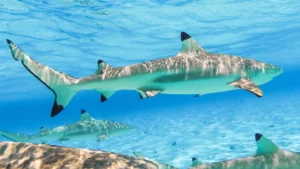 | 1.5–2 m (5–6.5 ft) | Moderate | Every surf zone and inlet; winter migration off Palm BeachThe most abundant large shark on Florida beaches and the likeliest source of a quick bite to a surfer's foot. Leaps clear of the water when feeding. |
Bull SharkCarcharhinus leucas | 2.2–3.4 m (7–11 ft) | High | Bays, lagoons and river mouths on both coasts; Indian River Lagoon nurseryTop of Florida's identified-species list with 51 records and behind most of the serious injuries. Tolerates fresh water and swims far up rivers. |
Spinner SharkCarcharhinus brevipinna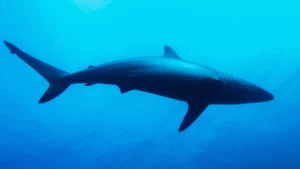 | 1.8–2.2 m (6–7 ft) | Moderate | With the blacktips in the surf; spectacular spinning leaps in the mullet runConstantly confused with the blacktip. 18 Florida records, nearly all minor bites in cloudy water. |
Lemon SharkNegaprion brevirostris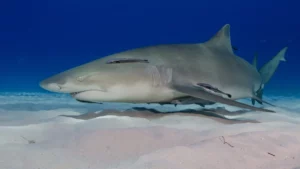 | 2.4–3 m (8–10 ft) | Low | Jupiter ledges in winter; Keys and Biscayne Bay flats all yearProtected in state waters since 2010. The Jupiter aggregation is the state's signature dive; the 18 records are mostly fishing and spearfishing cases. |
Nurse SharkGinglymostoma cirratum | 2.2–2.7 m (7–9 ft) | Low | Keys reefs, Dry Tortugas, pilings and ledges on the southwest coastSluggish bottom shark with a vice-like grip. Second on the identified list with 39 records because people grab, spear or step on it. |
Tiger SharkGaleocerdo cuvier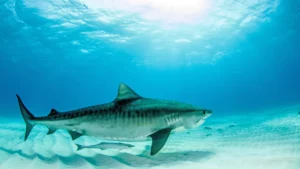 | 3–4.5 m (10–15 ft) | High | Offshore reefs and wrecks, the Keys, Jupiter; enters shallow water at nightProhibited species in Florida. Responsible for the 1998 Vero Beach fatality; sightings from beaches are rare but real. |
Great Hammerhead SharkSphyrna mokarran | 3–4.5 m (10–15 ft), rarely 5.5 m | Moderate | Boca Grande Pass and the Keys in tarpon season; Palm Beach in winterEnormous but has almost no history of biting swimmers. Prohibited from harvest; dies easily on the line, so anglers must release it in the water. |
Scalloped Hammerhead SharkSphyrna lewini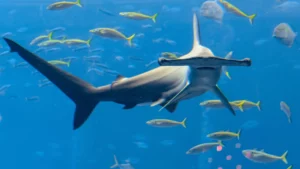 | 2.5–3.5 m (8–12 ft) | Low | Offshore schools; juveniles in the bays and Panhandle estuaries in summerCritically endangered worldwide and prohibited in Florida. The small hammerheads seen from Gulf piers are usually this species or the bonnethead. |
Bonnethead SharkSphyrna tiburo | 0.8–1.2 m (3–4 ft) | Low | Seagrass flats and bays on both coasts, often in ankle-deep waterThe little shovel-headed hammerhead of Florida's estuaries, and probably the state's most numerous shark. Eats crabs and even seagrass. Harmless. |
Atlantic Sharpnose SharkRhizoprionodon terraenovae | 0.8–1.1 m (2.5–3.5 ft) | Low | Surf zone and piers statewide, especially the Gulf coastThe shark most Florida anglers catch first. Small, white-spotted, and responsible for nips to fishermen unhooking it, not to swimmers. |
Blacknose SharkCarcharhinus acronotus | 1–1.3 m (3.5–4.5 ft) | Low | Sandy shallows and seagrass beds on both coastsRecognised by a dark smudge on the snout tip. A small, quick schooling shark with no bite record of note in Florida. |
Finetooth SharkCarcharhinus isodon | 1.3–1.6 m (4–5 ft) | Low | Panhandle and Big Bend surf and bays in summerA Gulf specialist missing from most Florida lists. Runs in schools after menhaden close to the beach; harmless. |
Sandbar SharkCarcharhinus plumbeus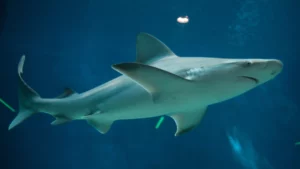 | 1.8–2.4 m (6–8 ft) | Low | East coast shelf in winter; Jupiter and the Keys drop-offsTall-finned, heavy-bodied and prohibited from harvest. Common on winter dives but almost never involved with swimmers. |
Dusky SharkCarcharhinus obscurus | 3–3.6 m (10–12 ft) | Low | Offshore migrant along the Atlantic shelf, mostly in winter and springOverfished and prohibited in both state and federal waters. Stays offshore; not a beach shark. |
Silky SharkCarcharhinus falciformis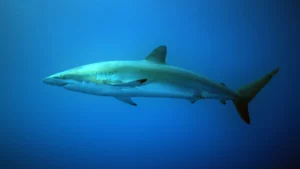 | 2–3 m (7–10 ft) | Low | Gulf Stream and offshore Gulf of Mexico around oil platforms and weed linesOpen-ocean shark that follows tuna. The old table called it highly aggressive; in reality it is a bycatch victim with no Florida beach record. |
Caribbean Reef SharkCarcharhinus perezi | 2–2.5 m (6.5–8 ft) | Low | Keys outer reefs, Dry Tortugas, Biscayne National ParkThe reef shark of Florida's coral, and the northern limit of its range. Prohibited species; calm around divers. |
Shortfin Mako SharkIsurus oxyrinchus | 2.5–3.5 m (8–11 ft) | Low | Gulf Stream blue water off the east coast, winter and springThe fastest shark, hooked by offshore anglers and now release-only under federal rules. Never a beach species. |
Sand Tiger SharkCarcharias taurus | 2.2–3 m (7–10 ft) | Low | Wrecks off northeast Florida in winter; aquaria statewideRagged-toothed but docile; its fierce look is why aquariums love it. Prohibited from harvest. |
Whale SharkRhincodon typus | 6–10 m (20–33 ft), rarely 12 m+ | Low | Offshore Gulf of Mexico and the Keys, June–SeptemberSeen a few times each summer by boaters off the Panhandle and the Keys. Filter feeder, fully protected. |
Smooth Hammerhead SharkSphyrna zygaena | 2.5–3.5 m (8–12 ft) | Low | Rare winter visitor to northeast Florida; prefers cooler waterThe temperate hammerhead. Prohibited species; occasional catches off Jacksonville in the cold months. |
Great White SharkCarcharodon carcharias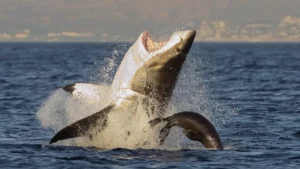 | 4–5.5 m (13–18 ft) | Low | Winter visitor to the outer Atlantic shelf, December–March; rarely near beachesNot resident, but satellite tags show Cape Cod white sharks wintering off Florida every year. Fully protected; no confirmed Florida swimmer fatality. |
Two things people search for do not belong on the list. The smalltooth sawfish, which the old version of this page counted as a shark, is a ray: a flattened relative of sharks that lives in the Everglades and Charlotte Harbor and was the first marine fish in the United States to be listed as endangered, back in 2003. And the great white shark, which the original page called “not native”, is in fact a regular seasonal visitor. Satellite-tagged white sharks from Cape Cod and Nova Scotia spend December to March along Florida's Atlantic shelf, and a few round the Keys into the Gulf. They are offshore, deep and cold-water animals here; a white shark in the surf at a Florida beach is a once-a-decade headline, not a pattern.
Where to see sharks in Florida
Florida is the easiest place in the United States to see a wild shark, and much of it needs no boat. These are the places that produce sightings reliably, from the beach, a pier or a dive charter.
- Jupiter and Palm BeachThe best shark diving on the US east coast. Drift dives off Jupiter Inlet find lemon sharks in the dozens from December to March, with bull sharks, great hammerheads and tiger sharks on the deeper ledges. From the beach, the winter blacktip migration passes so close that lifeguards clear the water when the schools arrive.
- New Smyrna Beach and Ponce Inlet, Volusia CountyThe surf here is thick with blacktip, spinner and sharpnose sharks chasing mullet and menhaden through the inlet. Stand on the jetty on an outgoing tide and you will see fins. It is also the single most-recorded shark-bite location in the world, for exactly that reason.
- Boca Grande Pass, Charlotte HarborDuring the tarpon run in May and June, great hammerheads of four metres and more follow the tarpon schools into the pass and take hooked fish beside the boats. Bull sharks and lemon sharks feed in the same current.
- Florida Keys: Looe Key, Sombrero Reef and Bahia HondaShallow coral reefs where nurse sharks rest under ledges and Caribbean reef sharks patrol the drop-off. The Bahia Honda channel and the flats around Marathon are good for bonnetheads and lemon sharks in knee-deep water.
- Dry Tortugas National ParkSeventy miles west of Key West, the least-fished reef in Florida. Nurse sharks, Caribbean reef sharks, lemon sharks and the occasional great hammerhead around the fort's moat wall and the outer reef.
- Panhandle beaches: Destin, Panama City, PensacolaEmerald-clear Gulf water where blacktip and bull sharks are often visible from the pier or a paddleboard. Whale sharks feed offshore from June to September, and the Navarre and Okaloosa Island piers are among the busiest shark-fishing spots in the state.
- Indian River Lagoon and Tampa BayTwo of the largest bull shark nurseries in the world. Juveniles of a metre or so are common in the brackish creeks and canals from Sebastian to Stuart, and around the causeways of Tampa Bay, especially in summer.
- The Florida Aquarium, TampaFor a guaranteed look without the sun and salt: sand tiger sharks, nurse sharks and reef sharks in a 500,000-gallon coral reef gallery, with a walk-through tunnel and a shark-swim programme for certified divers.
If you want one trip that shows the range, book a winter drift dive out of Jupiter: lemon sharks are close to certain, and the same ledges regularly turn up bull, tiger, hammerhead and sandbar sharks within a single dive. For a family that will not dive, the Ponce Inlet jetty at low tide or the flats of Bahia Honda at high tide are the best free shark-watching in the state.
Best time of year to see sharks in Florida
Sharks are in Florida water in every month; what changes with the seasons is which species is nearest the beach.
- December to March: the winter aggregation. Lemon sharks gather off Jupiter, sandbar and dusky sharks winter along the east coast shelf, white sharks track the cold edge of the Gulf Stream offshore, and the blacktip and spinner migration parks tens of thousands of sharks in the clear water off Palm Beach and Broward. The best months for divers.
- April to June: the migration moves north along the coast toward the Carolinas. Great hammerheads follow the tarpon into Boca Grande and the Keys; bull sharks push into the lagoons to give birth.
- June to September: peak beach season and peak bite season, simply because the most people are in the water. Nearshore water hits 28–30 °C (82–86 °F), juvenile blacktips, sharpnose and bonnetheads fill the surf zone, and whale sharks surface over the Gulf shelf and off the Keys.
- October and November: the mullet run. Huge schools of mullet move south along the east coast and every predatory shark on the coast follows them through the inlets. Spectacular from a pier, and the second small peak in the incident record.
Water temperature ranges from about 18 °C (64 °F) off the Panhandle in January to 30 °C (86 °F) in the Keys in August; south of Palm Beach it seldom falls below 22 °C (72 °F), which is why the tropical reef species stay all year.
Shark attacks in Florida: what the record actually shows
Florida is the shark-bite capital of the world, and the numbers deserve to be read carefully rather than feared. The SharkSider database holds 1,202 incidents for the state, the oldest from Pensacola Harbor in 1780; 1,174 of them date from 1900 onward, and 53 in total were fatal, 40 of those since 1900. The full list, updated weekly, is on our shark attacks in Florida page. These are the six most recent recorded incidents:
- 2026 · New Smyrna Beach Volusia CountySurfing — Bite to right foot declined further treatmentSpecies not identified
- 2026 · 30 nautical miles offshore of Pensacola Escambia CountySpearfishing — Bites to both forearms artery damaged in one armBull shark
- 2026 · Boca Grande Key sandbar off Key West Monroe CountyFishing — Bite to right foot and lower leg arterial bleed two surgeriesNurse shark 1.8-2.1m
- 2026 · Daytona Beach Shores Volusia CountySwimming — Bite to left ankle and foot4ft shark unknown species
- 2026 · Reservation Way near Indian PassSwimming — Bite to back of ankleUnknown small shark
- 2026 · Panama CitySwimming — Bites to both arms2.4m (8ft) Bull shark
The pattern is unmistakable. Volusia County alone accounts for 353 records, 208 of them at New Smyrna Beach, followed by Brevard (122) and Palm Beach (110): the surf-and-inlet counties of the central east coast. Surfers and board riders make up 523 of the records and swimmers or waders 328, while divers and spearfishers account for 93 and people fishing or on boats for 83. Where the species was identified, the bull shark leads with 51 cases, then the nurse shark with 39 (almost all of them grabbed, speared or stepped on first), the blacktip with 30, and the lemon and spinner with 18 each. The typical Florida bite is a one-to-two-metre blacktip or spinner in murky inlet water mistaking a kicking foot for a mullet, biting once and releasing.
Deaths are a different story. Of the 703 incidents recorded since 2000, five were fatal, and the most recent was a kiteboarder off Stuart in February 2010. Every one of the 119 records from the 2020s ended with the victim surviving. The serious cases cluster around three situations: bull sharks in the Gulf and the bays, as at Destin in 2005 and Boca Ciega Bay in 2000; people in the water at night or far from shore; and fishing, where a hooked or netted shark bites the person handling it. The 2026 Pensacola record, a bull shark biting an angler's leg at Fort Pickens, fits that last category exactly. Our guide to surviving a shark attack covers what to do if the rare bad case happens.
Is it safe to swim and snorkel in Florida?
Yes, with a few local habits. The blacktips and spinners that cause most Florida bites hunt by sight in cloudy water, so the risk concentrates in the surf near inlets, at dawn and dusk, and during the mullet run when bait is thick. Avoid swimming beside a pier where people are fishing, take off shiny jewellery, and stay out of the water when you can see baitfish jumping or birds diving: that is a feeding shark's dinner table, and a foot in the middle of it looks like food. Lifeguarded beaches on the Atlantic side fly a purple flag when dangerous marine life, sharks included, has been sighted.
Bull sharks need their own paragraph because they are the species behind most of the state's serious injuries. They live in the same brackish water people fish, wakeboard and paddle in, from the Indian River Lagoon to the canals of Cape Coral, and they are bold. Do not swim in the bays and river mouths at night, never clean fish or dump bait where people swim, and treat any shark over two metres in cloudy water as one to leave alone. On the reefs of the Keys the calculation flips: nurse sharks and Caribbean reef sharks are placid, and the injuries on record come almost entirely from people who grabbed a nurse shark's tail or speared a fish beside one. Whale sharks, which appear off the Panhandle and the Keys in summer, are harmless filter feeders; if you are lucky enough to find one, swim alongside it slowly and do not touch it.
Shark conservation in Florida
Florida's rules are among the strictest of any US state. The Fish and Wildlife Conservation Commission prohibits the harvest of 27 shark species in state waters (out to three miles on the Atlantic side and nine in the Gulf), including the tiger, the great, scalloped and smooth hammerheads, the lemon shark since 2010, the sand tiger, the silky and dusky sharks, the Caribbean reef shark, the white shark and the whale shark. For the species that may be kept, the bag limit is one shark per person or two per boat, and hammerheads over the size limit must stay in the water. Since July 2019 anyone fishing for sharks from the shore needs a free FWC shore-based shark permit and an online course, must use non-stainless circle hooks, may not chum from the beach, and must release prohibited species without dragging them onto the sand. That last rule matters: the big hammerheads pulled onto Florida beaches for photographs often died afterwards. Federal rules add protection offshore, and since 2022 shortfin makos caught in the Atlantic must be released.
The results are visible. The lemon shark aggregation off Jupiter, blacktip numbers in the winter migration and the return of large hammerheads to Boca Grande all point to coastal populations that are stable or recovering. The worries are elsewhere: the smalltooth sawfish and the dusky and scalloped hammerhead sharks remain endangered, the Indian River Lagoon nursery has been hit by repeated algal blooms, and the oceanic species that pass through the Gulf Stream are still caught by longliners far outside any state's reach. Our page on why sharks are endangered explains why slow-growing species like these take decades to rebuild.
Sharks in nearby states and waters
The same sharks that pass Florida keep going. To the north, Georgia and South Carolina share the blacktip and spinner migration and the sandbar and dusky sharks of the shelf, and North Carolina is where the sand tigers and the summer bull sharks head next. Around the Gulf, Alabama, Mississippi and Louisiana have the Panhandle's mix of bull, blacktip and finetooth sharks in muddier water; our overview of sharks in the Gulf of Mexico covers the whole basin. Across the Straits, the Bahamas is where Florida's tiger sharks, great hammerheads and lemon sharks spend part of the year, and Cuba shares the Caribbean reef fauna of the Keys. Every state we cover is listed on Sharks in the US.
Frequently asked questions
Are there sharks in Florida?
Yes, on every beach and in every bay, all year. The state list exceeds 40 species; the ones swimmers actually meet are blacktip, spinner, bonnethead and Atlantic sharpnose sharks in the surf, bull sharks in the lagoons and river mouths, and lemon, nurse, tiger and hammerhead sharks on the reefs and ledges of the south.
Are there great white sharks in Florida?
Yes, seasonally. White sharks tagged off Cape Cod and Nova Scotia migrate south each winter and spend December to March along Florida's Atlantic shelf, occasionally rounding the Keys into the Gulf. They stay offshore in deeper, cooler water, so a great white near a Florida beach is a rare event rather than a summer concern.
How many shark attacks have there been in Florida?
The SharkSider database records 1,202 incidents for Florida from 1780 to 2026, with 53 fatal. Since 2000 there have been 703 records and 5 deaths, the last in 2010. Volusia County, and New Smyrna Beach in particular, produces more records than anywhere else on Earth, almost all of them minor bites to surfers.
Is it safe to swim in Florida with all these sharks?
Statistically, yes. Tens of millions of people swim in Florida every year and the state averages a few dozen mostly minor bites and, in the 2020s, no deaths. Stay out of murky inlet water at dawn and dusk, keep away from piers and baitfish schools, and avoid the bays at night, where bull sharks feed.
What is the most common shark in Florida?
Along the beaches it is the blacktip shark, which is also the species behind most of the state's bites. In the bays and seagrass flats the little bonnethead is probably even more numerous, and the Atlantic sharpnose is the shark Florida anglers catch most often from piers and the surf.
When is shark season in Florida?
There is no off-season. Bites peak from June to September because that is when the most people are in the water, and again briefly during the October mullet run. For seeing sharks, December to March is best: lemon sharks gather off Jupiter and the blacktip migration fills the water off Palm Beach.
When do sharks migrate along Florida?
Blacktip and spinner sharks move south into the clear water off Palm Beach and Broward from January to March, then travel north toward the Carolinas from April as the water warms. White sharks and sandbar sharks winter offshore from December to March and head north in spring; bull sharks stay all year in the south.
Can you swim or dive with sharks in Florida?
Yes. Jupiter and Palm Beach run drift dives where lemon, bull, tiger, hammerhead and sandbar sharks are seen without cages, and the Keys reefs offer easy snorkelling with nurse and Caribbean reef sharks. Choose an operator that follows no-touch rules, and remember that chumming from the beach is illegal in Florida.
Do you need a permit to fish for sharks in Florida?
Yes. Since July 2019 anyone aged 16 or older who fishes for sharks from shore needs a free FWC shore-based shark fishing permit and an online course, including anglers over 65 who are exempt from the general licence. Circle hooks are required, chumming from the beach is banned, and 27 prohibited species must be released in the water.
Are there bull sharks in Florida rivers and lakes?
Yes. Bull sharks are the one large shark that thrives in fresh water, and Florida's lagoons, rivers and canals are among their most important nurseries. Juveniles are common in the Indian River Lagoon, the St. Johns River and the Caloosahatchee, and adults have been caught well inland. They are the reason not to swim in brackish water at night.
References

A small team focused on researching sharks and making marine biology easy to understand. Every page is reviewed against current species records and the SharkSider attack database, and updated when new incidents or research appear.
Published November 30, 2022 · Last updated September 28, 2026 · Incident data from the SharkSider attack database (1177 records for Florida, 40 fatal).


