
Yes, California has sharks along its entire 840-mile coast, and more than 30 species have been recorded. The 18 in this guide are the ones divers, surfers and anglers actually meet: the great white, the leopard shark, the shortfin mako, the blue shark, the common thresher, the broadnose sevengill, the soupfin, and a kelp-forest cast of horn sharks, swell sharks and angelsharks.
The risk is real but narrow. The SharkSider database lists 331 incidents for California (1851–2026), 327 of them since 1900, and 22 that were fatal; since 2000 there have been 152 records and 7 deaths. Almost every serious case involved one species, the white shark, and one type of person: a surfer, diver or swimmer in cold water near a seal colony. Away from those places, California's sharks are among the least dangerous on any coast.
- Shark species in this guide18 (30+ recorded)
- White shark protected since1 January 1994 (state law)
- Most seen from the beachLeopard shark (La Jolla Shores)
- Signature encounterWhite sharks at the Farallons, Sep–Nov
- Incidents in the database331 (1851–2026), 22 fatal
- Water temperature10–22 °C (50–72 °F)

On this page
- Where California's sharks live and why
- List of the different types of sharks in California
- Where to see sharks in California
- Best time of year to see sharks in California
- Shark attacks in California: what the record actually shows
- Is it safe to swim, surf and dive in California?
- Shark conservation in California
- Sharks in nearby states and waters
- Frequently asked questions
- References
Where California's sharks live and why
The California Current is the engine. It pulls cold, nutrient-rich water down the coast from the Gulf of Alaska, and every spring the northwest winds push the surface layer offshore so that even colder water wells up from the deep. The result is one of the most productive stretches of ocean on the planet: anchovies and sardines in vast shoals, and on top of them the salmon, tuna, sea lions and elephant seals that big sharks eat. Point Conception, west of Santa Barbara, divides the coast in two. North of it the water rarely climbs above 15 °C (59 °F) and the shark community is a cold-water one: white sharks, sevengills, soupfins, salmon sharks and spiny dogfish. South of it the coastline bends east into the sheltered Southern California Bight, the water warms into the low twenties in late summer, and subtropical visitors such as smooth hammerheads and makos join the residents.
Three features explain where people actually see sharks. The seal and sea lion rookeries at the Farallon Islands, Año Nuevo, Point Reyes and the Channel Islands draw adult white sharks every autumn. The long sandy beaches of the Bight, from Ventura to San Diego, are a nursery: white sharks are born offshore in spring and the pups spend their first years in warm water a few hundred metres from surfers, eating stingrays and fish, not mammals. And the state's bays and sloughs, San Francisco Bay, Elkhorn Slough, Humboldt Bay, Mission Bay and San Diego Bay, are nurseries for leopard sharks, smoothhounds and sevengills, which is why a kayaker in six feet of water sees more sharks in a summer than most divers do.
List of the different types of sharks in California
California's official records include more than 30 sharks, but half of them are small deep-water dogfish, catsharks and lanternsharks that only trawlers and submersibles ever see. The table sticks to the species with a solid record in water people use. The risk column is about swimmers and surfers; several of these sharks will nip a diver who grabs them, which is a different matter. Note that the “leopard shark” of California is Triakis semifasciata, a harmless houndshark, and has nothing to do with the leopard shark of Indo-Pacific dive guides, which is the zebra shark.
| Species | Adult size | Risk to swimmers | Where in California & notes |
|---|---|---|---|
Great White SharkCarcharodon carcharias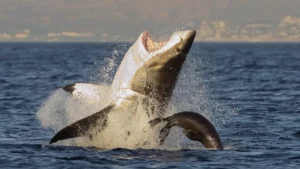 | 4–5.5 m (13–18 ft), rarely 6 m | High | Adults at the Farallons, Año Nuevo, Point Reyes and the Channel Islands, Sep–Dec; juveniles off Southern California beaches in summerBehind more than 160 identified California records and every modern fatality. Protected in state waters since 1994; the population is slowly growing. |
Leopard SharkTriakis semifasciata | 1.2–1.5 m (4–5 ft) | Low | La Jolla Shores in summer; every bay and slough from Humboldt to San DiegoThe state's most-seen shark and completely harmless. Eats clams, worms and crabs from the sand. |
Shortfin Mako SharkIsurus oxyrinchus | 2.5–3.5 m (8–11 ft) | Low | Blue water off Southern California, May–October; juveniles use the Bight as a nurseryFast, warm-blooded and curious around chum boats. Four California records, all offshore encounters with anglers or divers. |
Blue SharkPrionace glauca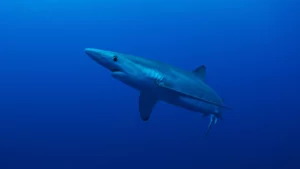 | 2–3 m (7–10 ft) | Low | Offshore everywhere, most often 10 miles or more outThe second most-identified species in the record with 6 cases, nearly all divers on baited trips. Slender, deep blue, unhurried. |
Common Thresher SharkAlopias vulpinus | 3–5 m (10–16 ft) including the tail | Low | Southern California Bight; pups in shallow water off Ventura and Los Angeles in springHalf its length is tail, used to whip schooling anchovies. A major sport fish here; no history of biting swimmers. |
Bigeye Thresher SharkAlopias superciliosus | 3–4 m (10–13 ft) | Low | Deep offshore water, occasionally caught by longliners and swordfish boatsHuge upward-facing eyes for hunting in the dark. Almost never seen alive by divers. |
Broadnose Sevengill SharkNotorynchus cepedianus | 2–3 m (7–10 ft) | Low | San Francisco Bay, Humboldt Bay and the kelp at La Jolla CoveA primitive, seven-gilled predator of seals and rays that has recovered strongly in the Bay. Has bitten divers and anglers who handled it; no swimmer record. |
Soupfin (Tope) SharkGaleorhinus galeus | 1.5–1.9 m (5–6 ft) | Low | Bays and coastal shelf statewide; La Jolla in summerNearly fished out for vitamin-A liver oil in the 1940s and now common again. Slim, shy and harmless. |
Smooth Hammerhead SharkSphyrna zygaena | 2.5–3.5 m (8–12 ft) | Low | Southern California in warm years; reaches Monterey during El NiñoThe only hammerhead regularly off California, and behind 5 records, mostly anglers and kayakers in the 2014–2016 warm-water years. |
Horn SharkHeterodontus francisci | 0.8–1.2 m (3–4 ft) | Low | Kelp forests and rocky ledges from Monterey south; Catalina and the Channel IslandsPig-snouted, spotted and sluggish, with a sharp spine on each dorsal fin. Lays spiral eggs. The original page called it moderately aggressive; it is not. |
Swell SharkCephaloscyllium ventriosum | 0.8–1 m (2.5–3.5 ft) | Low | Kelp beds and crevices, Santa Barbara to San DiegoGulps water to wedge itself into rock cracks when threatened. Fluoresces green under blue light. Harmless. |
Pacific AngelsharkSquatina californica | 1.2–1.5 m (4–5 ft) | Low | Sand flats beside reefs at Catalina and the Channel IslandsFlat, ray-like ambush hunter buried in sand. Bites divers who grab it; a gill-net fishery nearly emptied the Bight of them in the 1980s. |
Pacific Spiny DogfishSqualus suckleyi | 1–1.3 m (3–4 ft) | Low | Cold water north of Point Conception; Monterey Bay and Humboldt in schoolsSmall, abundant and armed with a mildly venomous spine in front of each dorsal fin. A nuisance to anglers, nothing to swimmers. |
| Brown SmoothhoundMustelus henlei | 0.6–1 m (2–3 ft) | Low | San Francisco Bay, Tomales Bay and every estuary in betweenThe little shark every Bay Area pier angler catches. Flat crushing teeth for crabs and shrimp; cannot hurt a person. |
Bluntnose Sixgill SharkHexanchus griseus | 3–4.8 m (10–16 ft) | Low | Deep water of the Monterey submarine canyon; juveniles occasionally in shallow bays at nightAn ancient deep-water giant filmed by ROVs off Monterey. No California bite record. |
Salmon SharkLamna ditropis | 2–2.6 m (6.5–8.5 ft) | Low | Cold offshore water of northern California; young ones strand on beaches in winterA warm-blooded relative of the white shark, often mistaken for a small one when found dead on the sand. Harmless. |
Pacific Sleeper SharkSomniosus pacificus | 3–4.4 m (10–14 ft) | Low | Deep, cold water off the north coast and in the Monterey canyonSluggish deep-sea scavenger related to the Greenland shark. Seen only by cameras and trawlers. |
Basking SharkCetorhinus maximus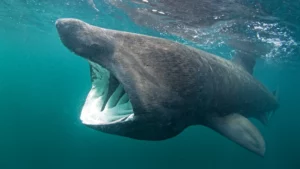 | 6–8 m (20–26 ft) | Low | Formerly common in Monterey Bay and the Bight; now a rare sightingPlankton feeder; the second-largest fish. The only pre-1900 deaths in the California record were fishermen killed when harpooned basking sharks wrecked their boats. |
Several species from the original version of this page do not belong in Californian water. The nurse shark is an Atlantic and Caribbean animal with no California record (and the old table gave it a whale shark's size). The bull shark has never been confirmed in the state; the nearest population is in the Gulf of California, hundreds of miles down the Mexican coast, and every “bull shark” reported off San Diego has turned out to be a sevengill, a soupfin or a juvenile white. Oceanic whitetips and whale sharks are tropical strays that reach Southern California only in warm El Niño years, and the “common smooth-hound” is a European species; the local smoothhounds are the brown, grey and sicklefin smoothhounds.
Where to see sharks in California
California offers everything from a snorkel among hundreds of leopard sharks to a cage in front of a five-metre white shark. These are the places that deliver.
- Farallon Islands, off San FranciscoThe most famous white shark site in the United States. Adult sharks arrive in September to hunt elephant seals and stay until November or December; cage-diving and surface-viewing trips run from San Francisco and Sausalito. Expect cold water, big swells and a real chance of a 4–5 m animal.
- Año Nuevo, Tomales Point and Point Reyes (the Red Triangle)Shore-based white shark country. From the cliffs at Año Nuevo State Park and the Point Reyes headlands, autumn visitors sometimes watch a predation on a seal from dry land. Divers and surfers here are inside the Red Triangle, the stretch from Bodega Bay to Big Sur that accounts for a large share of the state's incidents.
- La Jolla Shores, San DiegoFrom June to October hundreds of pregnant leopard sharks gather in waist-deep water off the Marine Room, warming themselves in the shallows. Snorkellers and kayakers float above them with no risk at all. Sevengills and soupfins patrol the kelp at La Jolla Cove next door.
- Santa Monica Bay and the South Bay beachesManhattan Beach, El Segundo and the water off Sunset Beach in Orange County are juvenile white shark nurseries. Drone footage of one-to-two-metre pups cruising beside surfers is now a summer routine. They are eating stingrays, not people, and have caused no serious injury here.
- Catalina and the Channel IslandsKelp-forest diving with horn sharks under ledges, swell sharks in crevices, Pacific angelsharks buried in the sand and leopard sharks over the bottom. Giant sea bass and sea lions share the reef. Santa Barbara and San Miguel islands also draw adult white sharks to their seal colonies.
- Offshore San Diego and the Nine Mile BankFree-diving and cage trips from May to October put snorkellers in blue water with shortfin makos and blue sharks drawn to a chum slick. The makos are fast and curious; the blues are elegant and endless.
- San Francisco Bay and Elkhorn SloughKayak and pier country for leopard sharks, brown smoothhounds, soupfins and broadnose sevengills, which have recovered strongly in the Bay since gill nets were banned. The Berkeley and Pacifica piers are reliable spots for anglers, and Elkhorn Slough near Moss Landing is a leopard shark nursery.
- Monterey Bay Aquarium and the Aquarium of the Pacific, Long BeachMonterey shows sevengills, leopard sharks and the deep-water species of its own submarine canyon; Long Beach has a shark lagoon with touch pools and a walk-through tunnel. Both are the sensible first stop for children.
For the biggest animal with the least effort, book a Farallon trip in October. For the most sharks with the least fuss, walk into the water at La Jolla Shores on an August morning at high tide: the leopard sharks will be within a few metres of the sand.
Best time of year to see sharks in California
California's shark calendar follows the seals, the plankton and the water temperature.
- September to December: adult white sharks at the Farallons, Año Nuevo, Point Reyes and the northern Channel Islands, timed to the arrival of young elephant seals and sea lion pups. October is the peak. This is also the season in which the majority of the state's serious incidents have happened.
- May to October: the warm season in the south. Juvenile white sharks spread along the beaches of the Bight, leopard sharks pack into La Jolla Shores (best in August and September), and makos, blue sharks and threshers follow the bait offshore. Sevengills are at their most visible in La Jolla's kelp in spring.
- January to April: the quiet months. Adult white sharks have left for the open Pacific and the “White Shark Café” halfway to Hawaii, water in the north drops to 10–12 °C (50–54 °F), and the bays hold only resident smoothhounds and the odd sevengill. Salmon sharks sometimes wash up on northern beaches in these months.
- El Niño years: warm water pushes smooth hammerheads, and occasionally whale sharks and other tropical visitors, as far north as Monterey. 2014–2016 brought hammerheads to San Diego piers and a rash of nervous headlines.
Sea temperature runs from around 10 °C (50 °F) off Mendocino in spring to 20–22 °C (68–72 °F) off San Diego in late summer. Wetsuits are the rule everywhere north of Santa Barbara in every month, which is one reason surfers, who are in the water in autumn when swimmers are not, dominate the incident record.
Shark attacks in California: what the record actually shows
California has the second-longest incident list of any US state, but it is a list with a single main character. The SharkSider database holds 331 incidents for the state, the earliest a hard-hat diver in San Francisco Bay in 1851; 327 date from 1900 onward, and 22 were fatal, 21 of them since 1900. The complete record, updated weekly, is on our shark attacks in California page. The six most recent recorded incidents are listed here:
- 2026 · Paradise Cove, Malibu, Los Angeles CountyKayak fishing - releasing a hooked shark (provoked) — Bites to lower leg and above the kneeShortfin mako shark
- 2026 · Big River Beach Mendocino CountySurfing — Injuries to both legs and feetGreat White Shark
- 2026 · Mendocino CountySurfing — Minor puncture wounds to upper left thighSuspected GWS
- 2025 · Lovers Point Pacific GroveSwimming — Taken by shark body recovered with multiple injuriesGreat White Shark
- 2025 · Salmon CreekSurfing — Hand injurySuspected Great White Shark
- 2025 · Catalina IslandSwimming — Leg and foot injuryunknown 1.2m shark
Look at the species column and the pattern jumps out: where a shark was identified, it was a white shark in more than 160 of the records, and the next species on the list, the blue shark with six cases, is mostly divers on chum trips. Surfers and board riders account for 168 records, divers and spearfishers 57, swimmers 41 and people fishing or in boats 34. Geographically the record splits between the Red Triangle counties of the north (San Mateo, Marin, Sonoma, Santa Cruz, Monterey and Humboldt) and the crowded beaches of the south: San Diego County leads with 42 records, Los Angeles has 40, and Santa Barbara County, whose figure is inflated by the seal islands off its coast, has the most deaths with 4.
The fatal cases follow one script. All seven deaths since 2000 were white shark bites on a surfer, boogie boarder, swimmer or diver in cold water within a few miles of a pinniped colony: Avila Beach in 2003, a diver at Kibesillah in Mendocino County in 2004, Solana Beach in 2008, Surf Beach at Vandenberg in 2010 and 2012, Sand Dollar Beach in 2020 and San Miguel Island in 2022. The 2010s were the busiest decade with 74 records but only 2 deaths, and the 26 records so far in the 2020s include 2 fatalities; the 2026 cases at Big River Beach and elsewhere in Mendocino County were surfers bitten by white sharks who survived. The typical Californian bite is a single investigative strike from a large shark that lets go, which is why quick help from other surfers so often makes the difference. Our guide on surviving a shark attack is written with exactly that scenario in mind.
Is it safe to swim, surf and dive in California?
For swimmers, almost entirely yes. Californian beaches see tens of millions of visits a year, and the sharks in the surf zone of the south are juvenile whites that eat rays, leopard sharks that eat clams, and smoothhounds that eat crabs. None of them is interested in you. The risk concentrates on surfers and divers in the north between September and December, near seal haul-outs, at dawn and dusk, and in murky water after a storm. If you surf the Red Triangle in autumn, stay in a group, keep away from the seal colonies and river mouths, and get out if seals are behaving nervously or a carcass is in the water. Divers and spearfishers at the Channel Islands and along the Sonoma coast should treat any sighting of an adult white shark as the end of the dive.
The gentler sharks reward respect too. A broadnose sevengill in San Francisco Bay is a three-metre predator with a serious bite and has injured a handful of anglers and divers who handled it; leave it alone and it ignores you. Pacific angelsharks bite the hands of divers who touch them, and horn sharks have spines on their dorsal fins that will go through a glove. Leopard sharks at La Jolla are the one Californian shark you can snorkel among with children; keep your fins still so you do not stir up the sand and scatter them, and never try to touch one. Lifeguards on Southern California beaches now post shark advisories and, occasionally, closures when an adult white shark is seen close in; take them seriously, they are rare.
Shark conservation in California
California has done more for its sharks than almost any other US state, and the results are visible. The white shark has been fully protected in state waters since 1 January 1994, which made California the first place in North America to safeguard the species; federal protection for the Pacific population followed, and satellite tagging since the early 2000s has shown a slowly growing population that returns to the same rookeries every year. In 2011 the state banned the sale and possession of shark fins, closing the largest fin market in the country outside Asia, and the drift-gillnet swordfish fishery that killed thousands of thresher, mako and blue sharks a year is being phased out under a 2018 state law and a 2022 federal one. Recreational rules cap the take of leopard sharks at three fish of at least 36 inches, and basking sharks, whose Monterey Bay population collapsed under a harpoon fishery in the 1940s and 1950s, are protected federally as a species of concern.
The recoveries are real: sevengills have returned to San Francisco Bay since the 1994 gill-net ban, soupfin sharks have rebuilt from the 1940s liver-oil boom that nearly wiped them out, and juvenile white sharks are now a routine summer sight off Los Angeles. The problems that remain are the slow ones. Basking sharks are still barely seen, threshers and makos are shared with high-seas fleets that California cannot regulate, and warming water is pushing subtropical species north while the cold-water residents lose range. The state's network of 124 marine protected areas, completed in 2012, gives the kelp-forest sharks a refuge; our page on why sharks are endangered explains why species that mature at 15 years old need that kind of patience.
Sharks in nearby states and waters
The cold-water community continues up the coast. Oregon and Washington share California's white sharks, sevengills, soupfins and spiny dogfish, with a handful of surfer incidents each decade; Alaska is salmon shark and sleeper shark country. Across the Pacific, the adult white sharks that leave the Farallons in winter head toward Hawaii, whose sharks are otherwise a tropical set led by the tiger shark. To the south, Mexico's Baja peninsula holds the same Pacific fauna plus the Guadalupe Island white sharks and the hammerhead schools of the Gulf of California. For the big warm-water states on the other coast, see Texas and Florida, and for a city-level view of the Bight, our page on sharks in Los Angeles. Every state we cover is on Sharks in the US.
Frequently asked questions
Are there sharks in California?
Yes, more than 30 species along the whole coast. The great white is the famous one, hunting seals off the Farallon Islands and Año Nuevo each autumn and nursing its young off Southern California beaches in summer. Leopard sharks, sevengills, soupfins, makos, blues and threshers are the others people regularly see.
Are there great white sharks in California?
Yes, California has one of the world's best-studied white shark populations. Adults gather at the Farallon Islands, Año Nuevo, Point Reyes and the Channel Islands from September to December to hunt seals, then head into the open Pacific. Juveniles live along the beaches of the Southern California Bight, where they eat rays and fish.
How many shark attacks have there been in California?
The SharkSider database records 331 incidents for California from 1851 to 2026, 22 of them fatal. Since 2000 there have been 152 records and 7 deaths, the latest in 2022. White sharks were identified in more than 160 cases; surfers make up about half the victims, followed by divers and swimmers.
Is it safe to swim in California?
For swimmers, yes. The sharks in the surf zone of Southern California are juvenile white sharks, leopard sharks and smoothhounds that eat rays, clams and crabs. The real risk is to surfers and divers in the cold water of Northern and Central California in autumn, near seal colonies. Stay in groups there and avoid dawn, dusk and murky water.
Which sharks are found in Southern California?
Leopard sharks, juvenile white sharks, shortfin makos, blue sharks, common threshers, broadnose sevengills, soupfin sharks, smooth hammerheads in warm years, and the kelp-forest trio of horn sharks, swell sharks and Pacific angelsharks. La Jolla, Catalina and the Channel Islands are the places to see most of them.
Are there bull sharks in California?
No. Despite what the earlier version of this page said, there is no confirmed bull shark record from California. The species needs warm water and the nearest population is in the Gulf of California in Mexico. Reported bull sharks off San Diego have turned out to be sevengills, soupfins or young white sharks.
Can you swim with sharks in California?
Yes, in several ways. Snorkel with leopard sharks at La Jolla Shores from June to October, join a blue shark and mako free-diving trip out of San Diego in summer, or take a cage-diving boat to the Farallon Islands between September and November to see adult white sharks. All are run by licensed operators; feeding or chumming for white sharks is illegal.
When is the best time to see sharks in California?
September to November for adult white sharks at the Farallons and Año Nuevo, when elephant seal pups are in the water. June to October for leopard sharks at La Jolla, juvenile white sharks off Los Angeles and makos and blues offshore. Winter is the quietest season, with the big animals far out in the Pacific.
Is shark fishing legal in California?
Mostly, with limits. White sharks have been fully protected since 1994 and may not be targeted or kept; basking sharks are protected federally. Leopard sharks have a 36-inch minimum size and a bag limit of three, and the sale of shark fins has been illegal in the state since 2011. Makos, threshers, blues and soupfins remain legal sport fish with a fishing licence.
What is the Red Triangle in California?
The Red Triangle is the stretch of coast from Bodega Bay north of San Francisco out to the Farallon Islands and south to Big Sur, where elephant seals, sea lions and adult white sharks all concentrate. A large share of California's shark incidents, including many of the fatal ones, has happened inside it, mostly to surfers and divers in autumn.
References

A small team focused on researching sharks and making marine biology easy to understand. Every page is reviewed against current species records and the SharkSider attack database, and updated when new incidents or research appear.
Published November 30, 2022 · Last updated October 5, 2026 · Incident data from the SharkSider attack database (328 records for California, 21 fatal).


