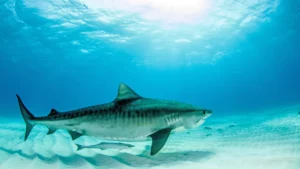
The salamander shark (Parmaturus pilosus) is a small deepwater catshark of the family Pentanchidae, reaching about 64 cm (2.1 ft), that lives on the upper continental slope off south-eastern Japan, in the East China Sea and off Taiwan at 358 to 895 m. A long blunt snout, a flabby body, pinkish-brown skin as soft as felt and a crest of enlarged denticles along the top of the tail identify it.
It almost certainly eats small slope fish, squid and shrimps, though no stomach study exists. It lays eggs in pairs; growth and lifespan are unknown. The IUCN assesses it as Least Concern, it is taken only as trawl bycatch, and it has never been involved in any incident with people.
- Maximum lengthAbout 64 cm (2.1 ft); most specimens 55–64 cm
- WeightNo published maximum; well under 1 kg
- LifespanUnknown; no ageing study exists
- Depth range358–895 m (1,175–2,935 ft) on the upper continental slope
- DietSmall slope fish, squid and crustaceans (inferred from relatives)
- IUCN statusLeast Concern (assessed 2020)
- Kingdom
- Animalia
- Phylum
- Chordata
- Class
- Chondrichthyes
- Order
- Carcharhiniformes
- Family
- Pentanchidae
- Genus
- Parmaturus
- Species
- Parmaturus pilosus
- Family (common)
- Deepwater catsharks
- Also known as
- Salamander catshark
On this page
How to recognise a salamander shark
Pick one up and the first thing you notice is the skin. It is covered in dermal denticles so fine and so dense that the whole animal feels like velvet or wet felt, which is where the species name pilosus, Latin for hairy, comes from. The colour is a warm reddish or pinkish brown above, paling to a dirty white on the belly, and the flesh beneath is soft and loose, as it is in most sharks that live in cold, food-poor water and never need to sprint.
The head is the second clue. The snout is long, broad and rounded at the tip, with each nostril partly covered by a triangular flap of skin, and the eyes are large, oval and set high, with a nictitating lower eyelid as in all catsharks. The mouth is long and strongly arched, reaching back well past the front of the eyes, and holds many rows of tiny teeth with a tall central point flanked by one or two small side cusps. The five gill slits are short.
The fins settle the genus. The first dorsal fin begins above the pelvic fins, far back on the body, and the second dorsal is about the same size and sits above the anal fin, which is long and low. Along the upper edge of the caudal fin runs a crest of enlarged, saw-like denticles, the mark of Parmaturus that gives the American members of the genus their name of filetail catsharks. No Japanese catshark of the genus Apristurus, the group most easily confused with it in a trawl, carries that crest.
How big is a salamander shark?
This is a small shark. The largest specimens described in the literature measure about 64 cm (2.1 ft) in total length, and the handful of adults in museum collections fall between roughly 55 and 64 cm. Nothing longer has been reliably reported. The size bar below puts that against a 1.8 m diver.
Weight has never been published. A catshark of this length and build, with a soft body and a large oily liver, weighs well under a kilogram; a comparison with the similarly sized filetail catshark of California suggests 400 to 700 g for a large adult.
Newborn size is unknown, because no egg case of the species has been hatched and no free-living juvenile has been described in detail. Catsharks in this family typically emerge at 8 to 12 cm, and there is no reason to expect the salamander shark to be different. Sexual dimorphism has not been studied; in related deepwater catsharks the sexes are close in size, with mature males slightly shorter than mature females, and mature males of this species have been recorded at around 59 cm.
Where salamander sharks live
The salamander shark is a north-western Pacific animal, not an eastern Pacific one as older accounts claimed. It was described in 1906 from a specimen taken off Japan, and every record since has come from the same corner of the ocean: the Pacific side of south-eastern Honshu in Japan, the outer shelf and slope of the East China Sea off China, and the deep water off north-eastern Taiwan. Reports from the Ryukyu Islands fill in the gap between Japan and Taiwan, and the map above shows that arc.
Within it the species keeps to the upper continental slope. Confirmed captures come from 358 to 895 m (1,175–2,935 ft), a band where sunlight has long gone, water temperature sits at roughly 4 to 8 °C, and the bottom is soft mud and fine sand. It is bathydemersal, meaning it lives on or just above that bottom rather than in open water, and is almost certainly absent from the shallow shelf that most Japanese fisheries work. That depth and mud is exactly where the East China Sea trawl fleets drag, which is how nearly every known specimen was obtained.
No one has tracked a salamander shark, so nothing is known about whether individuals move along the slope with the seasons or stay put. The unrelated frilled shark and goblin shark, which share these Japanese slopes, are met by the same nets and have the same gaps in their story.

What salamander sharks eat
No published study has opened the stomach of a salamander shark, so the honest answer is that the diet is inferred. The inference is a strong one. Every deepwater catshark examined so far, including the two American Parmaturus species, eats a mixture of small fish, squid and crustaceans found on and just above the slope floor: lanternfish and other small midwater fish that sink at dawn, shrimps, mysids, amphipods, small squid and the occasional polychaete worm. A soft-bodied 60 cm shark with small multi-cusped teeth and a wide mouth is built for exactly that kind of prey, gripping it rather than cutting it and swallowing it whole.
The hunting method is presumably the slow patrol that has been filmed in related species: a leisurely cruise a few centimetres above the mud, snout down, using the ampullae of Lorenzini on the underside of the head to feel for the electric fields of buried animals, and the large eyes to catch the faint bioluminescence of prey in a sea with no other light. There is no evidence of the species scavenging, but no deepwater catshark passes up a dead fish, and baited cameras on other slopes attract relatives within minutes.
Behaviour, buoyancy and senses
The most interesting thing known about the salamander shark's biology concerns its liver. Like most sharks it has no swim bladder (see why shark skeletons differ from bony fish), and like other deepwater catsharks it compensates with an enormous liver full of oil that is unusually rich in squalene, a hydrocarbon lighter than water. The result is a shark close to neutral buoyancy: it can hover just above the bottom or rest on it without sinking into the mud and without swimming constantly to stay up, which in a cold, food-poor habitat saves a great deal of energy. The soft muscle and lightly calcified skeleton point the same way: an animal built to spend as little energy as possible.
Its senses are those of a night-dweller. The eyes are large for the head and backed by a reflective layer, so they gather whatever bioluminescence the slope provides. Smell and electroreception do the rest of the work, while the lateral line senses the wake of anything approaching. The gill slits are small, consistent with a slow metabolism and the low oxygen of deep water.
Social behaviour is a blank. No aggregation has been reported, no mating has been seen and no diver or submersible film of a living salamander shark has been published. Deepwater catsharks watched from submersibles elsewhere are solitary, slow and indifferent to lights, and that is the reasonable expectation here.
Reproduction and lifespan
The salamander shark is oviparous. Females carry two functional oviducts and lay eggs in pairs, one from each side, enclosed in a tough case with tendrils at the corners that anchor it to the bottom. The egg case of this species has been described only from females that were caught carrying them, so its size is uncertain; those of related deepwater catsharks are 5 to 8 cm long, and their embryos take a year or more to develop in water of 5 °C. There is no parental care, and a female presumably lays repeated pairs through a long season, as the small-spotted catshark of Europe does.
Maturity is known only roughly: mature males of about 59 cm have been examined, which places adult size within a few centimetres of the maximum, a pattern typical of catsharks, which do most of their growing before breeding. Age at maturity, growth rate and lifespan have never been measured, because no one has sectioned the vertebrae of this species and the growth bands of deepwater catsharks are in any case hard to read.
The general rule for deep, cold-water sharks is slow growth and a long life for their size, and it would be surprising if a salamander shark did not live well past ten years (see how long sharks live). Until someone ages one, that is an expectation, not a fact.
Are salamander sharks dangerous?
No. The SharkSider database contains no incident attributed to a salamander shark, and it is difficult to imagine how one could arise. The species lives at 358 to 895 m, deeper than any swimmer, surfer or diver goes, and is a soft-bodied animal of about 60 cm with teeth built for gripping shrimps. Its only contact with people is on the deck of a trawler, where it is usually dead or dying from the pressure change by the time it is sorted.
The bites recorded in Japan involve white sharks, tiger sharks and, in one or two cases, wobbegongs and reef sharks in shallow water. Nothing in this family, anywhere in the world, has ever done more than nip a hand that was holding it. Advice on avoiding shark encounters is not something a salamander shark will ever require.
The SharkSider database has no incident attributed to this species. The database draws on the International Shark Attack File, the Global Shark Attack File and verified local reports, and is updated weekly.
Conservation status
The IUCN Red List assesses the salamander shark as Least Concern, in an assessment completed in 2020. That may seem generous for a species known from a few dozen specimens, but the logic holds: the shark's range covers a long stretch of slope, much of it deeper than the bottom-trawl fleets routinely reach, and there is no evidence of decline. It appears on neither the CITES appendices nor the CMS lists, and no range state protects it by name.
The pressure that does exist is bycatch. Deep bottom trawls in the East China Sea and off Japan catch salamander sharks along with the shrimp and lanternfish they eat, and the sharks have no commercial value, so they are discarded. Survival after a haul from 500 m is poor. As inshore stocks of the East China Sea decline, trawlers have pushed deeper into the band the species occupies, so the shallower part of the range, around 350 to 500 m, is the part most at risk.
What the species needs above all is data. A stomach-content study, a set of aged vertebrae and a few years of catch records would move it from an inferred biology to a measured one and would show whether the Least Concern verdict still holds a decade from now. Until then it sits in the large group of deep-sea sharks that are not on our endangered list only because nobody has looked closely enough.
Similar species and close relatives
The genus Parmaturus holds about ten species of soft, velvety catsharks scattered across the deep slopes of the Pacific, the Gulf of Mexico and the western Indian Ocean, all with the same tail crest. The two best known are American: the filetail catshark (Parmaturus xaniurus) of California and Mexico, which is the same size and colour and stands in for the salamander shark in most of what is assumed about its biology, and the Campeche catshark (Parmaturus campechiensis) of the Gulf of Mexico, known from a single small specimen.
In a trawl from the East China Sea, the animals most easily confused with it are the deepwater catsharks of the genus Apristurus, such as the Japanese catshark, the brown catshark and the longnose catshark: similar soft bodies, similar depths, but no crest of enlarged denticles on the tail and generally a darker, more uniform colour. The cloudy catshark, the common catshark of Japanese coasts, is a shallow-water species with a firm body and dark saddles, and is included below as the catshark a visitor to Japan is far more likely to see.
- Filetail Catsharkspecies profile
- Campeche Catsharkspecies profile
- Japanese Catsharkspecies profile
- Brown Catsharkspecies profile
- Longnose Catsharkspecies profile
- Cloudy Catsharkspecies profile
Frequently asked questions
How big is a salamander shark?
Small. The largest specimens measure about 64 cm (2.1 ft), and most adults in collections are 55 to 64 cm long. Mature males have been recorded at around 59 cm. No weight has been published, but a soft-bodied catshark of this length weighs well under a kilogram, probably 400 to 700 g.
Why is it called the salamander shark?
Nobody recorded the reason, but the name almost certainly refers to the animal's appearance: a soft, reddish, smooth-looking body with a long blunt head, which brings a salamander to mind more than a shark. The scientific name pilosus means hairy and describes the dense velvet-like denticles covering the skin.
Where do salamander sharks live?
In the north-western Pacific only: off south-eastern Honshu in Japan, in the East China Sea off China, around the Ryukyu Islands and off Taiwan. They live on the upper continental slope at 358 to 895 m, on soft mud and sand in water of about 4 to 8 °C, and never come into shallow water.
What do salamander sharks eat?
No stomach study has been published, so the diet is inferred from related deepwater catsharks: small slope fish such as lanternfish, shrimps and other crustaceans, and small squid, gripped with tiny multi-cusped teeth and swallowed whole. They probably also scavenge on dead animals that reach the bottom.
Are salamander sharks dangerous to humans?
No. The species lives far below diving depth, grows to about 64 cm and has teeth suited to shrimps and small fish. The SharkSider database holds no incident attributed to it, and no deepwater catshark anywhere has ever injured a person beyond a nip to a hand on a trawler deck.
How do salamander sharks reproduce?
They are oviparous, laying eggs in pairs, one from each oviduct, inside tough cases anchored to the seabed by tendrils. Egg size and incubation time have not been measured for this species; relatives lay cases 5 to 8 cm long that take a year or more to hatch in cold water. There is no parental care.
How long do salamander sharks live?
Unknown. No one has aged a salamander shark, and its growth rate and age at maturity have never been measured. Deepwater catsharks in general grow slowly and live long for their size, so a lifespan well beyond ten years is likely, but that remains an expectation rather than a measured fact.
Are salamander sharks endangered?
No. The IUCN assessed the species as Least Concern in 2020 because its range spans a long stretch of slope, much of it below routine trawling depth, and there is no evidence of decline. The only known pressure is discarded bycatch from deep bottom trawls in the East China Sea and off Japan.
What is the difference between a salamander shark and a filetail catshark?
They are close relatives in the same genus and look much alike: soft, reddish-brown bodies and a crest of enlarged denticles along the top of the tail. The difference is geography. The filetail catshark lives off California and Mexico in the eastern Pacific; the salamander shark lives off Japan, China and Taiwan in the north-west.
References

A small team focused on researching sharks and making marine biology easy to understand. Every page is reviewed against current species records and the SharkSider attack database, and updated when new incidents or research appear.
Published October 25, 2022 · Last updated September 22, 2026 · No incident attributed to this species in the SharkSider attack database, which is updated weekly.