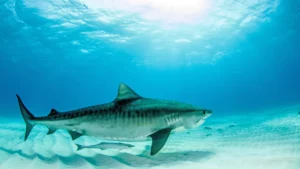
The Pacific sharpnose shark (Rhizoprionodon longurio) is a small requiem shark of the eastern Pacific shelf, reaching about 1.54 m (5 ft) with females larger than males and most adults between 90 cm and 1.1 m. It has a very long, pointed snout, long grooves at the corners of the mouth, a second dorsal fin set far back over the anal fin, and a bronze-grey back over a white belly.
It hunts small bony fish, shrimp, crabs and squid over sand and mud, usually shallower than 30 m. Females carry 1 to 12 placental pups for ten to twelve months and give birth in coastal bays between April and July. The IUCN lists the species as Vulnerable because artisanal fleets catch it everywhere, and it has never been implicated in a bite on a person.
- Maximum length1.54 m (5 ft); females larger, males to about 1.1 m
- WeightNo reliable published maximum; adults are small, roughly 5–15 kg
- LifespanNot firmly established; close relatives live about 8–12 years
- Depth rangeSurface to 100 m (330 ft), usually under 30 m
- DietSmall bony fish, shrimp, crabs, squid
- IUCN statusVulnerable (assessed 2019)
- Kingdom
- Animalia
- Phylum
- Chordata
- Class
- Chondrichthyes
- Order
- Carcharhiniformes
- Family
- Carcharhinidae
- Genus
- Rhizoprionodon
- Species
- Rhizoprionodon longurio
- Family (common)
- Requiem sharks
- Also known as
- Cazón bironche, Bironche, Pacific sharp-nosed shark
On this page
- How to recognise a Pacific sharpnose shark
- How big do Pacific sharpnose sharks get?
- Where Pacific sharpnose sharks live
- What Pacific sharpnose sharks eat
- Behaviour, senses and daily life
- Reproduction and lifespan
- Are Pacific sharpnose sharks dangerous to people?
- Conservation status
- Similar species and close relatives
- Frequently asked questions
- References
How to recognise a Pacific sharpnose shark
Begin at the nose. The snout of a sharpnose shark is long, flattened and drawn out to a point, and its length in front of the mouth is greater than the width of the mouth itself. Run a finger back to the corner of the jaw and you will find the second genus mark: deep labial furrows, long enough to see without opening the mouth. Very few requiem sharks show those grooves so clearly.
The fins settle the identification. The second dorsal fin is tiny and its origin sits well back, over the middle or rear half of the anal fin base, instead of above the anal origin as in a young Carcharhinus. There is no ridge of skin along the back between the two dorsal fins. The pectorals are short and narrowly angled, and the last two of the five gill slits stand above the pectoral base.
Colour is plain and useful: bronze to grey-brown above, abruptly white below, with a pale edge on the rear margin of each pectoral fin and a dusky or black smudge along the upper lobe of the tail. The teeth are small and oblique with a single narrow cusp and only weak serrations, and the upper and lower sets look much alike, which is the opposite of the cutting-and-holding contrast seen in larger requiem sharks.
How big do Pacific sharpnose sharks get?
This is a small shark, and the older figure of about 1.3 m (4 ft 3 in) that circulates online undersells it. The largest reliably measured individuals are females of roughly 1.54 m (5 ft) total length, and a 2023 review of the species reports specimens approaching 1.7 m from the southern end of the range. Males are notably shorter, topping out near 1.1 m. In an ordinary market landing the animals are smaller still: most adults fall between 90 cm and 1.1 m.
Weight is rarely recorded, because the species is sold by the piece rather than weighed individually. A shark of this build is slender and light for its length, and a large female is on the order of ten to fifteen kilograms rather than the tens of kilograms a blacknose or spinner shark of similar length would carry.
Pups are born at 31 to 34 cm, about a fifth of the maximum length, which is a large newborn relative to the adult and typical of a shark that produces few, well-developed young. Females mature at roughly 93 cm and males at about 1 m, so a sexually mature Pacific sharpnose is already two thirds of the length it will ever reach. The scale bar underneath puts that maximum length beside a 1.8 m diver.
Where Pacific sharpnose sharks live
The species belongs to the eastern tropical Pacific and nowhere else. Its northern limit is southern California, where it is an uncommon warm-season stray, and the population thickens quickly south of the border. The Gulf of California is the centre of abundance: Mexican artisanal camps in Sinaloa, Sonora and Baja California Sur land it in thousands. From there the range runs unbroken along the Pacific coast of Central America through El Salvador and Costa Rica to Ecuador and northern Peru.
It is a shelf animal. Most captures come from water shallower than 30 m over sand and soft mud, and the deepest reliable records reach about 100 m, which corrects the frequently repeated claim that the species stops at 27 m. It tolerates the turbid, slightly brackish water of estuaries and mangrove lagoons and is often taken within sight of the beach, but it does not run far up rivers the way a bull shark does.
Within that range the sharks move with the seasons. In the Gulf of California tagging and fishery data point to a northward shift in spring as the water warms, with pregnant females arriving in shallow bays to pup and the schools drifting south again in autumn. Water temperature rather than depth appears to set the timetable.

- Colombialisted
- Costa Ricalisted
- Ecuadorlisted
- El Salvadorlisted
- Guatemalalisted
- Honduraslisted
- Mexicolisted
- Nicaragualisted
- Panamalisted
- Perulisted
10 countries list the pacific sharpnose shark in their species guide; the count is the number of incidents attributed to it there in the SharkSider database. Browse every guide on sharks around the world and sharks in the US.
What Pacific sharpnose sharks eat
Stomach studies from the Gulf of California and the Mexican mainland shelf show a predator of small, soft prey. Bony fish dominate: anchovies, sardines, herrings, croakers, grunts, sea catfish and small flatfish, most of them schooling species that shoal over the same sandy bottoms the shark patrols. Shrimp and small swimming crabs come next, and squid and octopus appear regularly but in smaller quantities.
The dentition explains the menu. Those narrow, weakly serrated teeth are gripping tools, not saws, so prey is seized and swallowed whole rather than cut into pieces. A shark of this size cannot subdue anything large, and it does not try; the strategy is to take a great many small meals rather than a few big ones. Analyses that place the species in the food web put it at a middling trophic level, above the plankton feeders and well below the scalloped hammerhead that shares its nursery bays.
Feeding is heaviest around dusk and through the night, when the fish shoals the shark follows leave open water and settle near the bottom. Juveniles in shallow lagoons lean more heavily on shrimp and other crustaceans, and the switch towards fish comes with size. Because the same shrimp grounds attract both the sharks and the trawlers, the diet and the fishery overlap almost exactly.
Behaviour, senses and daily life
Pacific sharpnose sharks live in loose groups sorted roughly by size and sex, a pattern common to the genus and one that shows up plainly in fishery landings: a single set of nets will often bring in a run of similar-sized animals. Adult males and pregnant females are frequently taken in different places in the same month, which suggests the sexes separate for much of the year and meet only around the mating season.
Like other fast-swimming requiem sharks it appears to be an obligate ram ventilator, driving water over the gills by swimming rather than pumping it, so the animal is almost never still. Continuous swimming in warm, shallow, oxygen-poor lagoon water is expensive, which is one reason the species grows fast and dies young compared with the deep-water sharks on this site.
Its senses are the standard requiem toolkit rather than anything exotic. Eyes are large for the head, with a reflective tapetum that helps in turbid green water; the nostrils sit well forward on that long snout, giving a wide gap between them and good directional information about odour trails; and the jelly-filled pores of the ampullae of Lorenzini pick up the weak electric fields of buried shrimp and flatfish at close range. The snout itself acts as a probe, sweeping a few centimetres above the sand while the shark quarters the bottom.
Reproduction and lifespan
The Pacific sharpnose is viviparous in the fullest sense: after the embryo exhausts its yolk, the spent yolk sac attaches to the uterine wall and becomes a true placenta through which the mother supplies oxygen and food for the rest of the pregnancy. This is the requiem shark pattern, and it produces small numbers of large, well-formed young.
Litters run from 1 to 12 pups and average between seven and eight, which is generous by shark standards and is the main reason the species has survived heavy fishing as long as it has. Gestation lasts about ten to twelve months, and births are concentrated from April to July in shallow, sheltered coastal water. Bays and mangrove lagoons along the Mexican coast serve as nurseries, and newborns of 31 to 34 cm stay in that shallow, warm, predator-poor water through their first year.
Age and growth are the weakest part of the picture. Vertebral counts from the Gulf of California suggest fast early growth and maturity within a few years, but no study has yet produced a validated maximum age for the species, and the honest answer is that its lifespan is unknown. Congeners such as the Atlantic sharpnose are aged at eight to twelve years or so, and it would be surprising if this one lived very much longer (see how long sharks live).
Are Pacific sharpnose sharks dangerous to people?
No. A shark that rarely exceeds a metre and a half, that hunts anchovies and shrimp, and whose teeth are small pegs built for gripping is not equipped to injure a swimmer, and the record bears that out: the SharkSider database holds no incident attributed to this species anywhere in its range. Neither the International Shark Attack File nor the fishery literature records a bite. It is one of the commonest sharks in the warm shallows of the eastern Pacific, sharing the water with bathers on hundreds of beaches every day of the year, and nothing comes of it.
The one situation that deserves care is handling. Fishermen working gillnets and longlines off Sinaloa and Nayarit take these sharks by the thousand, and a live animal on deck will twist and snap; the teeth are small but sharp enough to open a hand. That is a handling injury, not an attack, and it is the same hazard any small shark presents. In the water, a Pacific sharpnose will turn and leave long before a swimmer or diver notices it was there.
The SharkSider database has no incident attributed to this species. The database draws on the International Shark Attack File, the Global Shark Attack File and verified local reports, and is updated weekly.
Conservation status
The IUCN Red List assessed Rhizoprionodon longurio as Vulnerable in 2019, with a declining population. Nothing exotic is driving that decline: this is simply the shark that the artisanal fleets of the eastern Pacific catch most often. Sold fresh, salted or dried as cazón, it is a staple protein from Sonora to Ecuador, and it is taken in gillnets, on bottom longlines and as bycatch in the shrimp trawl fisheries that work the same muddy shelf. Because the nurseries sit in shallow bays close to the fishing camps, the youngest age classes are hit hardest.
Some protection exists. Mexico closes its Pacific shark fisheries each year from 1 May to 31 July, a window that covers the peak of pupping, and reporting requirements have improved since the species was written into national fishery standards. In November 2023 the whole family Carcharhinidae, this shark included, came under CITES Appendix II, so international trade in its fins and meat now requires a permit and a finding that the trade is sustainable.
What is missing is the basic science. Without a validated age and growth curve, managers cannot say how much fishing the stock can take, and catch statistics across most of Central and South America lump every small shark together as cazón. Better species-level reporting would do more for this animal than any new rule, a problem it shares with most of the sharks on our list of species at risk.
Similar species and close relatives
Within the genus, the Pacific sharpnose has six or seven cousins, all built to the same slim, long-nosed plan and none of them sharing its ocean. In the western Atlantic the equivalent animals are the Atlantic sharpnose of the United States coast, the Caribbean sharpnose and the Brazilian sharpnose; in the Indian Ocean and western Pacific there are the milk shark and the smaller grey sharpnose. Because the ranges do not overlap, geography identifies the genus member for you.
The confusions that actually happen are with other small eastern Pacific sharks. The whitenose shark is the closest trap: similar size, similar shape, similar habitat, but its snout carries a conspicuous pale tip and its nostrils are unusually large, and the second dorsal fin sits further forward. The Pacific smalltail shark, the eastern Pacific twin of the smalltail shark, is stockier, has a shorter snout and lacks the long labial furrows. Juvenile Carcharhinus of several species turn up in the same nets, and for all of them the test is the same: look at the position of the second dorsal fin and at the grooves beside the mouth.
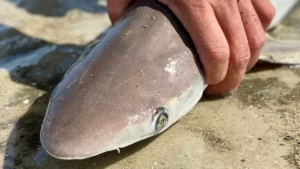 Atlantic Sharpnose Sharkspecies profile
- Caribbean Sharpnose Sharkspecies profile
- Brazilian Sharpnose Sharkspecies profile
- Grey Sharpnose Sharkspecies profile
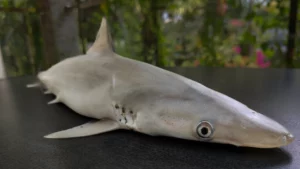 Milk Sharkspecies profile
- Whitenose Sharkspecies profile
Frequently asked questions
How big does a Pacific sharpnose shark get?
The largest reliably measured individuals are females of about 1.54 m (5 ft), with a few reports approaching 1.7 m from the south of the range. Males are smaller and rarely exceed 1.1 m. Most adults landed by fishermen are between 90 cm and 1.1 m, and newborn pups measure 31 to 34 cm.
Where do Pacific sharpnose sharks live?
Only in the eastern Pacific, from southern California as a warm-season stray, through the Gulf of California and the Pacific coast of Mexico and Central America, to Ecuador and northern Peru. They keep to the shelf over sand and mud, usually shallower than 30 m, and enter turbid bays, estuaries and mangrove lagoons.
What do Pacific sharpnose sharks eat?
Small bony fish make up most of the diet: anchovies, sardines, herrings, croakers, grunts, sea catfish and small flatfish. Shrimp and swimming crabs come next, with squid and octopus taken regularly. Their narrow teeth grip rather than cut, so prey is swallowed whole. Feeding peaks around dusk and through the night.
Are Pacific sharpnose sharks dangerous?
No. There is no record anywhere of this species biting a swimmer or diver, and the SharkSider database holds no incident attributed to it. It is too small, too shy and too weakly toothed to be a threat. The only real risk is to fishermen handling a live shark on deck, which is a handling injury rather than an attack.
How many pups does a Pacific sharpnose shark have?
Litters range from 1 to 12 pups and average between seven and eight. Pregnancy lasts about ten to twelve months and the embryos are fed through a true placenta after the yolk runs out. Births are concentrated between April and July in shallow coastal bays and mangrove lagoons that serve as nurseries.
How long do Pacific sharpnose sharks live?
No validated maximum age has been published for this species, so the honest answer is that nobody knows. Vertebral studies point to fast growth and maturity within a few years, at about 93 cm in females and 1 m in males. Closely related sharpnose sharks are aged at roughly eight to twelve years.
Is the Pacific sharpnose shark endangered?
The IUCN listed it as Vulnerable in 2019 with a declining population. It is the shark most often caught by artisanal fleets from Mexico to Ecuador, sold as cazón, and it is also taken as bycatch in shrimp trawls. Since November 2023 all requiem sharks, this one included, are on CITES Appendix II.
How do you tell a Pacific sharpnose shark from other small sharks?
Check two features. The snout is long, flat and pointed, longer in front of the mouth than the mouth is wide, and there are long grooves at the corners of the jaw. Then look at the small second dorsal fin: its origin sits over the middle or rear of the anal fin, not above the anal fin's front edge.
Can you eat Pacific sharpnose shark?
Yes, and millions of people do. Sold fresh, salted or dried as cazón, it is a cheap everyday protein in Mexico and Central America and appears in tacos, empanadas and stews. Being small and short-lived, it accumulates less mercury than large predatory sharks, though the usual advice on limiting shark meat still applies.
Why is it called a sharpnose shark?
Because of the snout, which is unusually long and tapers to a distinct point. The genus name Rhizoprionodon comes from Greek roots meaning root, saw and tooth, a reference to the small serrated teeth. The species name longurio means a long, lanky person, another nod to the shark's slender, drawn-out build.
References

A small team focused on researching sharks and making marine biology easy to understand. Every page is reviewed against current species records and the SharkSider attack database, and updated when new incidents or research appear.
Published October 31, 2022 · Last updated September 22, 2026 · No incident attributed to this species in the SharkSider attack database, which is updated weekly.