The Pacific nurse shark (Ginglymostoma unami) is a shallow-water nurse shark of the family Ginglymostomatidae, measured to about 207 cm (6 ft 9 in), that lives on rocky reefs, in caves and over mangrove and sand flats from the Gulf of California south to Peru. It is brown above and cream below, with a blunt broad head, a small mouth set well back under the snout and a pair of fleshy barbels between the nostrils.
It feeds at night on crustaceans, molluscs, octopus and small bottom fish, drawing them out of crevices with powerful suction. Like other nurse sharks it bears live young nourished by their own yolk, though no litter has yet been described. The IUCN assessed the species as Endangered in 2019. It is not aggressive, but it will bite hard and hold on if a diver grabs it.
- Maximum lengthAbout 207 cm (6 ft 9 in) measured
- WeightNot reliably recorded
- LifespanNot measured
- Depth rangeSurface to about 30 m (100 ft)
- DietCrustaceans, molluscs, octopus and small reef fish
- IUCN statusEndangered (assessed 2019)
- Kingdom
- Animalia
- Phylum
- Chordata
- Class
- Chondrichthyes
- Order
- Orectolobiformes
- Family
- Ginglymostomatidae
- Genus
- Ginglymostoma
- Species
- Ginglymostoma unami
- Family (common)
- Nurse sharks
- Also known as
- Tiburón gata, Gata nodriza del Pacífico
On this page
- How to recognise a Pacific nurse shark
- How big do Pacific nurse sharks get?
- Where Pacific nurse sharks live
- What Pacific nurse sharks eat
- Behaviour, resting and breathing
- Reproduction and lifespan
- Are Pacific nurse sharks dangerous?
- Conservation status
- Relatives and look-alikes
- Frequently asked questions
- References
How to recognise a Pacific nurse shark
Nurse sharks are among the easiest sharks in the world to name, and this one follows the family pattern exactly. The head is broad, blunt and flattened, the small oval eyes sit high on the sides, and the mouth is a narrow slit placed well back beneath the snout rather than at the front of it. Hanging between the nostrils is a pair of short fleshy barbels, and a groove runs from each nostril to the corner of the mouth. Nothing else on an eastern Pacific reef has that combination.
The body is heavy and cylindrical, tapering into a long tail that makes up roughly a third of the total length and has almost no lower lobe, so it trails behind the shark like a broad ribbon. The two dorsal fins are of similar size and set well back, the first over or just behind the pelvic fins, and the pectoral fins are broad and rounded.
Colour is yellow-brown to grey-brown above and cream to pale yellow below, without pattern in adults. Young sharks carry small dark spots and faint saddle markings that fade as they grow. The teeth are small, broad and many-pointed, arranged in dense rows and designed for crushing rather than cutting, which fits an animal that eats crabs and molluscs.
How big do Pacific nurse sharks get?
The largest properly measured Pacific nurse shark is about 207 cm (6 ft 9 in) in total length. A maximum of around 280 cm appears in several accounts, including the earlier version of this page, which gave 110 inches, but no measured specimen backs it, and the honest position is to quote the measured figure and flag the larger one as an estimate.
That makes this species slightly smaller than its Atlantic counterpart, the nurse shark, which reaches about 3 m, and considerably smaller than the tawny nurse shark of the Indo-Pacific. Weight has not been published for G. unami; a nurse shark of two metres is a thickset animal, and comparison with its relatives suggests something in the region of 70 to 90 kg, but no measurement supports a precise figure.
Size at birth, size at maturity and any difference between the sexes are all unrecorded. The species has only been recognised since 2015, and the basic life-history work that would fill those gaps has not been done. In the Atlantic nurse shark pups are born at about 30 cm and mature at roughly 2 m, which gives a rough expectation for this one and nothing more. The scale bar below sets the measured maximum against a 1.8 m diver.
Where Pacific nurse sharks live
This is a species of the tropical eastern Pacific and nowhere else. It is recorded from the southern Gulf of California and the Baja peninsula in Mexico, south along the mainland coast through Costa Rica, Panama, Colombia and Ecuador to northern Peru, and it also occurs at the oceanic islands of Cocos and Malpelo. It does not cross into the Atlantic; the Caribbean coasts of the same countries hold the Atlantic nurse shark instead, and confusing the two is the commonest error made about this species.
Habitat is shallow and structured. Pacific nurse sharks are found on rocky reefs and around caves, ledges and boulder fields, over seagrass and sand flats, and in mangrove channels, generally in less than 30 m of water and often in a metre or two. Daylight hours are typically spent resting under an overhang, frequently several animals together, sometimes lying across one another.
Temperature shapes their movements. Work in the upwelling bays of Pacific Costa Rica has shown that numbers at a site change with the seasonal arrival and retreat of cold upwelled water, with sharks gathering in warmer pockets when the cold water floods the bay. That matches the old observation, repeated on the previous version of this page, that the species shelters in warm spots during cooler months.

- Colombialisted
- Costa Ricalisted
- Ecuadorlisted
- El Salvadorlisted
- Guatemalalisted
- Mexicolisted
- Nicaragualisted
- Panamalisted
- Perulisted
9 countries list the pacific nurse shark in their species guide; the count is the number of incidents attributed to it there in the SharkSider database. Browse every guide on sharks around the world and sharks in the US.
What Pacific nurse sharks eat
No detailed diet study has been published for G. unami, which is unsurprising for a species described in 2015, so the picture here rests on its anatomy and on the well-studied habits of its close relatives. Both point clearly to crustaceans, molluscs, octopus, sea urchins and small bottom-living fish taken at night on and around the reef.
The feeding mechanism is the interesting part, and nurse sharks are among the most powerful suction feeders of any fish. The small mouth, the enormous throat muscles and the ability to expand the mouth cavity very rapidly let the shark generate a sharp drop in pressure and pull prey straight out of a crevice, an effect strong enough to draw a conch out of its shell or an octopus from a hole. The many-cusped crushing teeth then deal with the shell.
The barbels and the nasoral grooves work together as the search system. Water is drawn continuously across the nostrils, and the barbels are touch and taste organs swept over the bottom as the shark noses along at a walking pace. Vision plays little part; a nurse shark hunting at two in the morning under a ledge is working almost entirely by smell and touch, with electroreception closing the final centimetres. Daytime hunting is rare, which is why divers usually see these sharks asleep.
Behaviour, resting and breathing
The behaviour that defines nurse sharks is the one most sharks cannot manage: lying completely still on the bottom for hours. Most large sharks must swim to force water over their gills, but a nurse shark pumps water in through its mouth and out through the gill slits using the muscles of the throat, so it can rest under a ledge all day without moving. Our page on how sharks breathe sets the two systems side by side.
That ability underpins everything else about the species. Pacific nurse sharks are nocturnal, spending daylight in caves and beneath overhangs and becoming active after dark. They are also social in a loose way, and groups resting in physical contact, stacked or draped over one another, are a normal sight at a good site.
The senses suit a slow bottom forager rather than a hunter of fast prey. Smell, touch through the barbels, and the electrical sense of the pores on the snout do most of the work; our page on shark anatomy covers those structures. The one thing a Pacific nurse shark does quickly is bite, and the strike is a suction snap rather than a lunge, which is worth remembering before touching one.
Reproduction and lifespan
Reproduction in this species is inferred rather than documented. Nurse sharks are aplacental viviparous: eggs are fertilised internally, each embryo develops inside the mother on the yolk of its own large egg with no placental connection, and the pups are born fully formed. That is the mode our page on how sharks reproduce describes as yolk-sac viviparity, and there is no reason to expect anything different here.
What has not been established for G. unami is every detail that matters for management: litter size, gestation length, the interval between litters, the location of any nursery area and the size of a newborn. For comparison, the Atlantic nurse shark carries litters of 20 to 30 pups for roughly five to six months, gives birth in shallow mangrove and seagrass habitat and breeds only every other year. Whether the Pacific species does any of this remains an open question.
Age has never been measured either. No vertebral ageing study exists, and the species is too recently recognised for one to have been attempted. Atlantic nurse sharks are thought to live around 25 years in the wild and longer in aquaria, which gives a working expectation for this one. Our guide to how long sharks live explains how such figures are established and why they are so often missing.
Are Pacific nurse sharks dangerous?
Not to a diver who behaves sensibly. The SharkSider database holds no incident attributed to this species, which reflects both its temperament and the fact that it has only been recognised as separate since 2015; records of bites from tropical American waters are attributed to the Atlantic nurse shark, a different animal on the other side of the continent. A Pacific nurse shark resting under a ledge will normally ignore a diver completely, or move deeper into the cave.
The thing to understand is what happens if you touch one. Nurse sharks have small mouths and crushing teeth, but the bite is powered by the same suction musculature used to pull a conch out of its shell, and a shark that takes hold of a hand or a leg tends not to let go. Essentially every nurse shark bite on record worldwide followed someone grabbing the tail, riding the shark, cornering it or trying to move it for a photograph.
The practical rules are short. Do not touch, do not block the exit from a cave, and do not spearfish next to a resting shark. Handled that way, this is one of the safest large sharks a diver can share a reef with, and it belongs alongside the other species on our list of the least dangerous sharks; the general principles are on our page on what to do around sharks.
The SharkSider database has no incident attributed to this species. The database draws on the International Shark Attack File, the Global Shark Attack File and verified local reports, and is updated weekly.
Conservation status
The IUCN Red List assessed the Pacific nurse shark as Endangered in 2019, and the reasoning is a textbook case of how a newly recognised species can turn out to be in trouble. For decades the population was treated as part of the wide-ranging Atlantic nurse shark and therefore as no particular concern. Once it was separated in 2015, the animal that remained was a shallow-water, slow-moving, slow-breeding shark confined to a narrow strip of coast from Baja California to Peru, which is one of the most heavily fished tropical coastlines in the world.
The pressures are direct. Artisanal gillnet and longline fisheries operate the length of that coast, and a shark that lives in the top thirty metres, rests in predictable caves and does not flee is easy to catch and easy to catch again at the same place. Meat is sold locally and fins enter the trade. Habitat loss compounds it: mangrove clearance for shrimp ponds and coastal development has removed nursery habitat through much of Central America.
There is one real advantage. A species that aggregates at known reef sites and tolerates divers is exactly the sort of animal that benefits from marine protected areas and from dive tourism, and populations at protected sites such as Cocos Island and Coiba have a far better outlook than those on the open coast. The background to this pattern is set out on our page on why sharks are endangered.
Relatives and look-alikes
The genus Ginglymostoma now holds two species, and the other one is the closest relative by a wide margin. The Atlantic nurse shark is the same animal in outline, grows larger at about 3 m, and lives on the opposite side of the Americas, so an ocean basin is the simplest way to separate them. The technical differences, set out when the Pacific species was described in 2015, are proportions of the head and interdorsal space, the position of the first dorsal fin relative to the pelvic fins, and the keels on the skin denticles, none of which helps a diver in the water.
Within the family, the tawny nurse shark of the Indo-Pacific fills the same role from East Africa to Australia and can be told apart by its narrower, more pointed fins. The wider order Orectolobiformes contains the carpet sharks and their relatives, including the zebra shark, the small whitespotted bamboo shark and, at the far end of the scale, the whale shark, which shares the barbels and the terminal mouth on a body forty times the size; our guide to the types of sharks maps the group.
On an eastern Pacific reef the only shark likely to be mistaken for it is the whitetip reef shark, which also rests motionless in caves by day. It is slimmer and grey with white fin tips, its mouth is at the front of the head and it has no barbels, so a second look settles it.
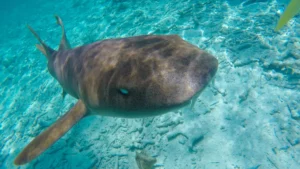 Nurse Sharkspecies profile
 Tawny Nurse Sharkspecies profile
 Zebra Sharkspecies profile
 Whitespotted Bamboo Sharkspecies profile
 Whale Sharkspecies profile
 Whitetip Reef Sharkspecies profile
Frequently asked questions
What is a Pacific nurse shark?
A heavy-bodied, bottom-living shark of the tropical eastern Pacific, Ginglymostoma unami, in the family Ginglymostomatidae. It reaches about 207 cm, rests in reef caves by day and feeds at night on crustaceans and molluscs. It was recognised as a species separate from the Atlantic nurse shark only in 2015.
How big do Pacific nurse sharks get?
The largest properly measured specimen is about 207 cm, roughly 6 feet 9 inches. Some accounts quote a maximum near 280 cm, but no measured shark supports that figure. Weight has never been published for the species. It is smaller than the Atlantic nurse shark, which reaches about three metres.
Where do Pacific nurse sharks live?
Along the tropical eastern Pacific coast only, from the southern Gulf of California and Baja California through Mexico, Costa Rica, Panama, Colombia and Ecuador to northern Peru, plus the oceanic islands of Cocos and Malpelo. They stay on shallow rocky reefs, in caves, over seagrass and sand and in mangroves, usually under 30 metres.
What do Pacific nurse sharks eat?
Crustaceans, molluscs, octopus, sea urchins and small bottom-living fish, taken at night. No detailed diet study has been published for this species, but the anatomy is unambiguous: powerful throat muscles generate suction strong enough to pull prey out of a crevice, and dense many-cusped teeth crush shells.
Are Pacific nurse sharks dangerous to people?
Not if you leave them alone, and the SharkSider database holds no incident attributed to the species. Nurse sharks bite when grabbed, ridden or cornered, and because the bite uses the same suction muscles the shark can be very hard to remove. Do not touch one and do not block its exit from a cave.
Why is it called a nurse shark?
The origin is uncertain. The most common explanation is that the sucking noise the shark makes when feeding sounds like a nursing infant. Another traces the word to nusse, an old name for catsharks, or to the Middle English hurse, meaning a bottom-dwelling shark. The Spanish name along its range is tiburon gata, cat shark.
How do Pacific nurse sharks reproduce?
They bear live young. Eggs are fertilised internally and each embryo develops inside the mother on the yolk of its own egg with no placental connection, then is born fully formed. Litter size, gestation length and size at birth have never been recorded for this species, which has only been recognised since 2015.
Why are Pacific nurse sharks endangered?
The IUCN listed the species as Endangered in 2019. It lives in the top thirty metres of a heavily fished coastline, rests in predictable caves, does not flee from boats or divers, and breeds slowly. Artisanal gillnets and longlines take it throughout its range, and mangrove clearance has removed nursery habitat.
How long do Pacific nurse sharks live?
Nobody has measured it. No ageing study has been carried out on this species, which was described only in 2015. The Atlantic nurse shark is thought to live about 25 years in the wild and longer in aquaria, so a comparable lifespan is a reasonable expectation here, but it should not be quoted as a fact.
What is the difference between the Pacific and Atlantic nurse shark?
They are separate species that look almost identical. Geography settles it: the Pacific nurse shark lives from Baja California to Peru, the Atlantic nurse shark from the eastern United States through the Caribbean to Brazil and West Africa. The Atlantic species also grows larger, to about three metres against roughly two.
References

A small team focused on researching sharks and making marine biology easy to understand. Every page is reviewed against current species records and the SharkSider attack database, and updated when new incidents or research appear.
Published October 29, 2022 · Last updated September 22, 2026 · No incident attributed to this species in the SharkSider attack database, which is updated weekly.