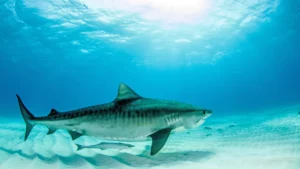
The ornate dogfish (Centroscyllium ornatum) is a tiny deep-water shark of the lanternshark family Etmopteridae, reaching only about 30 cm (12 in), which lives on the upper continental slope of the Arabian Sea and the Bay of Bengal at depths of roughly 520 to 1,260 m. It is a uniform dark brown to black, with a stout compressed body, a grooved spine in front of each of its two dorsal fins and no anal fin.
Almost nothing has been published on its diet; small deep-sea fish, squid and crustaceans are what a shark of this size and build takes on that slope. It is a live-bearer whose young develop on their own yolk, and litter size has never been recorded. The IUCN listed it as Least Concern in 2019 on the grounds that little fishing reaches it. It has no contact with people whatever.
- Maximum lengthAbout 30 cm (12 in)
- WeightNot recorded; a few hundred grams
- LifespanNot measured
- Depth rangeAbout 520–1,260 m (1,700–4,140 ft)
- DietSmall deep-sea fish, squid and crustaceans
- IUCN statusLeast Concern (assessed 2019)
- Kingdom
- Animalia
- Phylum
- Chordata
- Class
- Chondrichthyes
- Order
- Squaliformes
- Family
- Etmopteridae
- Genus
- Centroscyllium
- Species
- Centroscyllium ornatum
- Family (common)
- Lanternsharks
On this page
How to recognise an ornate dogfish
Begin with the fin spines, because they place the animal in the right order immediately. Two dorsal fins, each preceded by a stiff grooved spine, and no anal fin at all: that combination belongs to the squaliform sharks and rules out every catshark, houndshark and requiem shark in the Indian Ocean. In this species the second dorsal fin is clearly the larger of the two, with a correspondingly longer spine, which is the normal arrangement in the genus Centroscyllium.
The body is short, stout and slightly compressed from side to side, with a moderately long snout in front of a narrowly arched mouth, and a tail set on a short, thick stalk. The colour is a plain dark brown to black over the whole animal, without the flank markings that make many lanternsharks of the genus Etmopterus so easy to name. The species epithet ornatum, ornate, refers to fine detail in the skin denticles noted by its describer rather than to any bold pattern a person would see on deck.
The teeth are the genus signature and are worth a hand lens. Unlike the blade-like cutting teeth of a spurdog, every tooth in both jaws is small and carries three to five slender cusps, giving each jaw the look of a fine comb. It is a grasping set, built for holding small soft prey, and it is the quickest way to separate a Centroscyllium from any other small dark dogfish brought up in the same net.
How big does an ornate dogfish get?
This is a very small shark. The largest reliably measured specimens are about 30 cm (12 in) in total length, which puts the whole animal comfortably inside the span of two hands. The earlier version of this page gave an average of around 30 cm and then claimed that some reach roughly 50 cm; no verified specimen supports the larger figure, and it should be treated as an error rather than as a record.
Sizes at maturity have never been established, nor has any consistent difference between males and females. In other members of the genus females grow somewhat larger, and the same is likely here, but likely is not the same as measured and the distinction matters on a species known from so few animals.
Weight has not been published and an estimate would be close to meaningless. Deep-water lanternsharks carry lightly built skeletons and a large liver loaded with low-density oil that keeps them close to neutral buoyancy, so a 30 cm ornate dogfish is a light animal of a few hundred grams. Size at birth is unrecorded. Set against the 1.8 m diver on the scale bar below, the species is one of the smallest sharks on this site.
Where ornate dogfish live
Every confirmed record comes from the northern Indian Ocean, on both sides of the Indian subcontinent. The species is known from the Arabian Sea, off the west coast of India and towards Pakistan, and from the Bay of Bengal on the east, with the known latitude band running roughly from 25°N down to 17°N. The waters around Sri Lanka sit just south of that band and are a reasonable place to expect it, but no confirmed specimen has come from there.
Depth is the defining fact of its life. Catches fall between about 520 and 1,260 m, on or just above the bottom of the upper continental slope. That band is far below any diver and below most of the trawling done in the region, and it is also the depth at which the northern Indian Ocean develops one of the strongest oxygen minimum zones in the world, a layer of water so poorly oxygenated that few large fish can tolerate it.
The physical conditions are constant. There is no daylight, the water sits at roughly 5 to 12 °C depending on depth, and the bottom is soft mud on a steady slope. Food arrives chiefly as material sinking from the very productive surface waters of the Arabian Sea and the Bay of Bengal. Our overview of where sharks live sets this kind of habitat against the shelves and reefs where most shark species are found.

What ornate dogfish eat
No stomach-content study has been published for this species, and it is better to say so than to fill the gap with invention. What can be said rests on the mouth, the size of the animal and the diet of its close relatives, all of which point the same way: small deep-sea fish, squid and crustaceans, taken on or close to the sea floor.
The dentition supports it precisely. Comb-like teeth with three to five fine cusps in both jaws are a gripping tool, not a cutting one. A shark equipped this way seizes small soft-bodied prey and swallows it whole, which is exactly what a 30 cm predator on a muddy slope can manage. Related lanternsharks of similar size are known to eat lanternfish, small squid and shrimps.
Finding them in permanent darkness is a matter of the other senses. The pores of the ampullae of Lorenzini across the snout register the weak electrical fields produced by the muscles and gills of living animals, the lateral line picks up movement, and smell carries a shark along a scent trail to carrion. Lanternsharks also possess photophores, light-producing organs set in the skin; in Etmopterus these form distinct flank markings used in signalling and camouflage, while in Centroscyllium they are smaller and scattered, and no one has measured the light of this species.
How the ornate dogfish lives
Nothing about the behaviour of this shark has ever been observed. It has not been filmed, tagged or kept alive, and every specimen in the world's museums arrived dead in a research trawl. The previous version of this page said that a lot remains unknown about the species, and that was the most accurate sentence on it.
The body still says something. The stout, compressed shape and short thick tail stalk suit manoeuvring rather than sustained speed, and the low-aspect fins are those of a slow cruiser working close to the bottom. Like other deep-water squaliforms it carries a very large liver rich in light hydrocarbon oils, which is what lets a shark without a swim bladder hold its depth without constantly swimming.
Two further points follow from the anatomy. The grooved dorsal spines are defensive structures: a small dogfish threatened by a larger fish arches its back to present them, and in several dogfish sharks the grooves carry mildly venomous tissue. And breathing does not require movement, since a bottom-living shark of this kind can pump water over its gills through the mouth and spiracles while lying still, which our page on how sharks breathe contrasts with the ram ventilation of open-water species. Whether ornate dogfish school, migrate up and down the slope or separate by sex is entirely unknown.
Reproduction and lifespan
The ornate dogfish gives birth to live young. Eggs are fertilised internally and each embryo develops inside the mother on the yolk of its own egg, with no placental connection of any kind, a mode usually called yolk-sac viviparity and still often written as ovoviviparity. It is the arrangement used across the lanternshark family and by most of the deep-water sharks in the order; our page on how sharks reproduce sets it beside the egg-laying and placental alternatives.
Beyond that, the record is empty. Litter size has never been counted for this species, gestation length has never been measured, no pregnant female has been described in the literature and the size of a newborn is unknown. What can reasonably be said is that lanternsharks as a group produce small litters, often fewer than ten pups, carry them for a long time in cold water and mature late relative to their maximum size.
Lifespan is equally unrecorded. No vertebral ageing study exists, and the small, weakly calcified vertebrae of a 30 cm deep-sea shark are difficult material to work with even when someone attempts it. Deep-water dogfishes that have been aged commonly live for several decades, far longer than coastal sharks of similar size, which is one of the reasons they recover so slowly from fishing; our guide to how long sharks live explains where those numbers come from.
Is the ornate dogfish dangerous?
No, and not marginally so. A fully grown ornate dogfish is about the length of a school ruler and a half, its teeth are a millimetre or two long with three to five fine cusps each, and the shallowest water it has ever been taken from is some 520 m down, more than ten times the limit of recreational scuba diving. The SharkSider database holds no incident attributed to the species, and no mechanism exists by which one could occur.
The only people who ever handle one are the crews of deep-water research and commercial trawlers in the Arabian Sea and the Bay of Bengal, and the scientists who sort the catch. For them the only thing worth watching is the two dorsal spines, which are sharp enough to prick a hand as the shark flexes. The species sits with the other harmless deep-sea sharks on our list of the least dangerous sharks.
The SharkSider database has no incident attributed to this species. The database draws on the International Shark Attack File, the Global Shark Attack File and verified local reports, and is updated weekly.
Conservation status
The IUCN Red List assessed the ornate dogfish as Least Concern in 2019. The reasoning is worth spelling out, because a listing of Least Concern for a species nobody has studied can be misread. It means the shark occupies a depth band on the Indian Ocean slope that current fisheries barely reach, that its known range spans both the Arabian Sea and the Bay of Bengal rather than a single small area, and that no fishery targets it anywhere.
What fishing pressure exists is incidental. Deep-water trawling in the northern Indian Ocean is limited compared with the intensive shelf fisheries above it, and a 30 cm shark with no market value that comes up in a deep haul is discarded, generally dead. India, Pakistan, Sri Lanka and Bangladesh all operate large fleets, and the long-term direction of travel in the region is towards deeper water as shelf stocks decline, which is the single change most likely to alter this assessment.
The other pressure is environmental. The oxygen minimum zone of the northern Indian Ocean is among the most intense in the world, and it has been expanding, which compresses the habitable band for slope animals from above and below at once. A small shark that produces few young and probably lives for decades has no capacity to absorb a rapid change of that sort. The broader pattern is on our page on why sharks are endangered, and the honest qualification here is that nobody is monitoring this species at all.
Relatives and look-alikes
The genus Centroscyllium contains around seven species of small, dark, comb-toothed dogfishes spread across the deep oceans. The best known is the black dogfish of the cold north Atlantic, which reaches about a metre and is far the largest member of the group; the combtooth dogfish of the Pacific and the granular dogfish of southern South America are closer to the ornate dogfish in size and general appearance. All share the multicusped teeth and the two spined dorsal fins, and telling small dark specimens apart usually needs denticle and tooth detail rather than a photograph.
Within the wider lanternshark family the animals most easily confused with it are the true lanternsharks of the genus Etmopterus. The blackbelly lanternshark occurs widely in the Indo-Pacific and is a similar size, but it carries the dark flank and belly markings that give the genus its character, and its teeth differ sharply between the upper and lower jaws. The smooth lanternshark and the larger great lanternshark fill comparable roles on Atlantic slopes.
Two other sharks share the deep Indian Ocean slope and could be confused with it by size alone: the broadnose catshark, a small soft-bodied catshark of the Bay of Bengal with no fin spines at all, and the far larger gulper shark, which has huge green eyes and a very different profile.
- Combtooth Dogfish Sharkspecies profile
- Black Dogfishspecies profile
- Granular Dogfish Sharkspecies profile
- Blackbelly Lanternsharkspecies profile
- Smooth Lanternsharkspecies profile
- Great Lanternsharkspecies profile
Frequently asked questions
What is an ornate dogfish?
A very small deep-water shark, Centroscyllium ornatum, in the lanternshark family Etmopteridae. It reaches only about 30 cm, lives on the upper continental slope of the Arabian Sea and the Bay of Bengal between roughly 520 and 1,260 metres, and is a plain dark brown to black with a spine in front of each dorsal fin.
How big do ornate dogfish get?
About 30 cm, or 12 inches, in total length, which makes it one of the smallest sharks in the Indian Ocean. Claims that some reach roughly 50 cm are not supported by any verified specimen. Weight has never been published; a full-grown animal is a light, oily-livered shark of a few hundred grams.
Where do ornate dogfish live?
Only in the northern Indian Ocean, on both sides of the Indian subcontinent: the Arabian Sea off western India and towards Pakistan, and the Bay of Bengal to the east, roughly between 25 and 17 degrees north. They live on or just above the bottom of the continental slope, between about 520 and 1,260 metres.
What do ornate dogfish eat?
No stomach study has been published for this species. Its comb-like teeth, with three to five fine cusps on every tooth in both jaws, are built for gripping small soft prey whole, and close relatives of the same size eat lanternfish, small squid and shrimps. Those are almost certainly its prey too.
Why is it called the ornate dogfish?
The name comes from the scientific epithet ornatum, ornate, given by Alfred Alcock when he described the species from Indian Marine Survey collections in 1889. It refers to fine detail in the skin denticles rather than to any bold pattern; on deck the shark looks plain dark brown or black all over.
How do ornate dogfish reproduce?
They bear live young. Eggs are fertilised internally and each embryo develops inside the mother on the yolk of its own egg, with no placental connection. Litter size, gestation length and size at birth have never been recorded for this species. Lanternsharks generally produce small litters and carry them for a long time in cold water.
Are ornate dogfish dangerous to people?
No. A full-grown one is about 30 cm long with teeth a millimetre or two in length, and the shallowest record is around 520 metres, more than ten times the depth limit of recreational diving. No incident has ever been attributed to the species. The only hazard is the two dorsal spines, and only to a handler.
Are ornate dogfish endangered?
No. The IUCN assessed the species as Least Concern in 2019. That is a judgement about exposure rather than a population count: no fishery targets it, deep trawling in the northern Indian Ocean is limited, and its range spans both the Arabian Sea and the Bay of Bengal. Nobody is currently monitoring its numbers.
How long do ornate dogfish live?
It has never been measured. No ageing study exists, and the small, weakly calcified vertebrae of a 30 cm deep-sea shark are hard material to read growth bands from. Deep-water dogfishes that have been aged usually live for several decades, so a long life is likely, but no figure can be quoted for this species.
Do ornate dogfish glow in the dark?
Probably, at least faintly. They belong to the lanternshark family, whose members carry photophores, light-producing organs set in the skin. In the genus Etmopterus these form clear flank markings used for camouflage and signalling. In Centroscyllium they are smaller and scattered, and the light of this particular species has never been measured.
References

A small team focused on researching sharks and making marine biology easy to understand. Every page is reviewed against current species records and the SharkSider attack database, and updated when new incidents or research appear.
Published November 10, 2022 · Last updated September 22, 2026 · No incident attributed to this species in the SharkSider attack database, which is updated weekly.