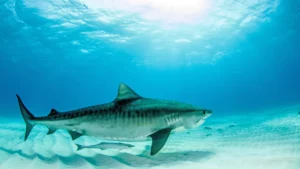
The hooktooth shark (Chaenogaleus macrostoma) is a small weasel shark of the Indo-West Pacific, reaching about 1 m (3.3 ft) and living on shallow shelves from the Persian Gulf to India, Southeast Asia and southern China. It is a slender grey to bronze shark with a long snout, very long gill slits, and lower teeth so long and hooked that their tips show when the mouth is shut.
It feeds on small bony fishes, squid and shrimps and bears litters of about four pups nourished by a yolk-sac placenta. The IUCN lists it as Vulnerable because inshore gillnets, trawls and longlines catch it throughout its range. Not one bite on a person has ever been laid at its door.
- Maximum lengthAbout 100 cm (39 in); most adults 70–90 cm
- WeightNot recorded; an adult is roughly 3–5 kg (7–11 lb)
- LifespanUnknown; no ageing study exists
- Depth rangeInshore to at least 59 m (195 ft)
- DietSmall bony fishes, squid and cuttlefish, crustaceans
- IUCN statusVulnerable (assessed 2020, population decreasing)
- Kingdom
- Animalia
- Phylum
- Chordata
- Class
- Chondrichthyes
- Order
- Carcharhiniformes
- Family
- Hemigaleidae
- Genus
- Chaenogaleus
- Species
- Chaenogaleus macrostoma
- Family (common)
- Weasel sharks
- Also known as
- Balfour's shark, Gaping weasel shark
On this page
How to recognise a hooktooth shark
The name does most of the work. Look at a hooktooth shark with its mouth closed and you will still see teeth: the lower jaw carries a row of long, narrow, strongly hooked cusps that project beyond the lips, a snaggle-toothed look no other small shark in its range shares. The upper teeth are different, with an oblique main cusp and one or two small cusplets on the outer edge, and neither jaw is serrated. The mouth is long and wide, which is what the species name macrostoma, "big mouth", refers to.
The body is slender and the snout long and pointed, with large oval eyes protected by a nictitating lower eyelid. The gill slits are the second give-away: unusually long for a shark this size, two to three times the diameter of the eye. The first dorsal fin sits over the rear of the pectoral fins; the second dorsal is about two-thirds as high as the first, larger than in most requiem sharks, and the anal fin below it is smaller still. A precaudal pit marks the base of the tail and the caudal fin has a strong lower lobe.
Colour is plain light grey to bronze above and paler below, with no spots or bars, though some individuals have dusky edges on the second dorsal fin and the tail tip. Protruding lower teeth, long gill slits and a big second dorsal separate it from the milk shark and spadenose shark that share its fish markets.
How big do hooktooth sharks get?
This is a small shark. The largest specimens on record are about 100 cm (39 in) in total length, and the fisheries catch across its range consists mostly of animals between 70 and 90 cm. Males are mature at roughly 68–80 cm; the size at which females mature has never been properly established, but it is presumably similar or slightly larger, as in other weasel sharks. There is no evidence of the strong size difference between the sexes seen in some larger sharks.
Very few newborns have been measured. Free-swimming pups of around 20 cm have been reported, and full-term embryos are of that order, so the size at birth is probably close to 20 cm (8 in). Treat that as an estimate rather than a measured value.
Nobody has published weights for the species. A slim shark of 90 cm with a body depth of a hand's width weighs in the region of 3–5 kg (7–11 lb); a large snaggletooth shark, its closest well-known relative, is ten times heavier. The size bar below sets the 1 m maximum against a 1.8 m diver.
Where hooktooth sharks live
The hooktooth shark belongs to the warm, shallow shelves that ring the northern Indian Ocean and the western edge of the Pacific. Its range begins in the Persian Gulf, where it is a regular part of the catch landed in Bahrain and Qatar, continues along Pakistan and both coasts of India to Sri Lanka, then wraps around the Gulf of Thailand and the Malay Peninsula to Singapore, Java and Sulawesi in Indonesia, Vietnam, southern China and Taiwan. Records from the Philippines are sparse but plausible.
Everywhere it is a shark of the inshore zone: continental and island shelves from the surf line down to at least 59 m, over sand and mud rather than reef. It tolerates the turbid water of river-influenced coasts, and the specimens that reach scientists almost always come from small-mesh gillnets and shrimp trawls working within a few kilometres of shore. Water temperature across this range is a steady 24–30 °C, and there is no record of the species in cool or deep water.
Nothing is known about its movements. There has been no tagging, and the seasonal changes in landings that fishermen report in the Gulf and the Andaman Sea have not been studied. Given its size and inshore habit, long migrations are unlikely; local shifts with the monsoon and with spawning fish are far more probable.

4 countries list the hooktooth shark in their species guide; the count is the number of incidents attributed to it there in the SharkSider database. Browse every guide on sharks around the world and sharks in the US.
What hooktooth sharks eat
Those hooked lower teeth are a fish-catching tool. A jaw of long, curved, needle-tipped cusps is built to impale and hold slippery prey rather than to slice it, and stomach contents from market specimens fit the design: small schooling bony fishes such as anchovies, sardines, ponyfishes and juvenile croakers, together with squid and cuttlefish and a share of shrimps and small crabs. Everything is swallowed whole or in a few pieces. The oblique upper teeth pin a struggling fish while the lower row hooks it.
The long gill slits point to the hunting style. A shark that pushes a large volume of water over its gills is one that swims actively, and the hooktooth shark appears to be a cruising hunter of the mid-water and near-bottom layers, working the dense schools of small fish that the monsoon-fed coasts of South and Southeast Asia produce. It is probably most active at dusk and at night, when its prey rises and scatters, but no one has yet followed a free-swimming individual to confirm that.
The large mouth lets it take prey that is wide for its body, and the nictitating eyelid protects the eye during the final lunge. For a small shark on a crowded shelf, that is the whole strategy: find the school, take a few fish, move on. It is not a scavenger of any note and has never been reported feeding on anything larger than a fish of a hand's length.
Behaviour and senses
Almost everything we know about the hooktooth shark comes from dead animals on a fish-market slab, so its behaviour has to be read from anatomy and from the habits of its relatives. The slender body, big second dorsal fin and deeply forked tail belong to a shark that swims steadily rather than one that rests on the bottom, and weasel sharks in general are active, restless fish in the few aquaria that have kept them.
Its senses follow the standard shark kit. The pores of the ampullae of Lorenzini around the long snout detect the electric fields of hidden prey at close range; the lateral line reads the pressure wave of a school moving ahead; and the large eyes, with a reflective layer behind the retina, cope with the dim, silt-laden water of the coasts it lives on. Smell works over tens to hundreds of metres, not the miles of popular myth.
Fishermen in the Gulf and in Thailand describe catching hooktooth sharks several at a time in the same net, which suggests loose aggregations, perhaps of one sex or size, of the kind documented in other small carcharhiniform sharks. Whether these are feeding groups, breeding groups or simply many sharks converging on one school of fish is unknown. Nothing has been published on its social behaviour, its response to divers or its daily rhythm.
Reproduction and lifespan
The hooktooth shark is viviparous with a yolk-sac placenta: once the embryo has used up its yolk, the empty yolk sac attaches to the wall of the uterus and passes nutrients from the mother's blood for the rest of the pregnancy, the same arrangement found in the requiem sharks and hammerheads. Litters are small. The few pregnant females that have been examined carried about four pups, and no litter larger than that has been reported.
Gestation has not been measured. In weasel sharks of similar size it is thought to be under a year, and the appearance of small juveniles in inshore catches after the monsoon in parts of India and Thailand suggests a seasonal birth, but this remains unverified. Newborns are probably about 20 cm long. Nursery grounds, if the species uses them, have not been identified; the shallow, turbid, prey-rich estuarine shelves that the adults frequent would serve the purpose.
Age and growth are equally blank. No vertebral ageing study has been done, so lifespan, growth rate and age at maturity are all unknown; small sharks of this build typically live 10–15 years and mature within their first few, but that is inference from relatives, not data (see how long sharks live). What matters for management is that four pups a year, at best, is a slow rate of replacement for an animal caught in the thousands by inshore fleets.
Is the hooktooth shark dangerous to people?
No. The SharkSider database contains no incident attributed to this species, and none appears in the international attack files either. A metre-long shark that eats anchovies, with a mouth sized for fish of a hand's length, has neither the motive nor the equipment to injure a swimmer, and it lives in murky inshore water where people rarely see it alive.
The only people who handle it are fishermen sorting gillnet and trawl catches from the Gulf to the Java Sea, and the risk there is the one that comes with any shark on a deck: the hooked lower teeth, which stand proud of the closed mouth, can catch a hand during unhooking. Bathers on the same coasts have real sharks to consider, listed on the India and Thailand attack pages, but this is not one of them; it sits comfortably among the least dangerous sharks in the sea.
The SharkSider database has no incident attributed to this species. The database draws on the International Shark Attack File, the Global Shark Attack File and verified local reports, and is updated weekly.
Conservation status
The IUCN Red List lists the hooktooth shark as Vulnerable with a decreasing population trend, on the basis of a suspected decline of at least 30 percent over three generations driven by fishing. It is not on any CITES appendix (the 2023 listings covered requiem and hammerhead sharks, not the weasel shark family) and has no listing under the Convention on Migratory Species. No country protects it specifically.
The threat is simple and hard to fix: the species lives in the most intensively fished shallow water on Earth. Inshore gillnets, shrimp and fish trawls and small-scale longlines from the Persian Gulf to the South China Sea take it continuously, and it is sold fresh or dried, with the fins entering the low-grade end of the fin trade. In the Persian Gulf it remains a regular part of the mixed shark catch; in the Gulf of Thailand and the Java Sea, where trawl effort exploded from the 1960s onward, market surveys now find it far less often than the older literature describes. Landings data in most of these countries do not separate it from other small sharks, so the true rate of loss is unknown.
What would help is what would help every small coastal shark of the region: enforced mesh-size and seasonal closures, protection of the estuarine shelves where the young grow up, and species-level recording at landing sites. Until then its fate is tied to the pressures described on our pages on bycatch and why sharks are endangered.
Similar species and close relatives
The weasel shark family, Hemigaleidae, holds only eight species in four genera, and the hooktooth shark is the sole member of Chaenogaleus. Its nearest relatives are the other Indo-West Pacific weasel sharks. The sicklefin weasel shark is similar in size but has short gill slits, a small mouth, sickle-shaped fins and a diet built almost entirely on squid and octopus. The snaggletooth shark also shows its lower teeth when the mouth is shut, but it grows to 2.4 m and has large, coarsely serrated upper teeth; a hooktooth shark is a smooth-toothed miniature by comparison. The whitetip weasel shark of the western Indian Ocean and the Atlantic weasel shark of West Africa are the family's outliers in range, and the Australian weasel shark replaces them off northern Australia.
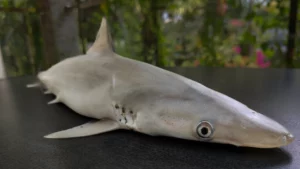
The sharks most likely to be confused with a hooktooth shark in a market are not weasel sharks at all but small requiem sharks of the same size and colour: the milk shark, the spadenose shark and other sharpnose sharks. Check the lower teeth, the length of the gill slits and the height of the second dorsal fin; all three point the other way in those species.
- Sicklefin Weasel Sharkspecies profile
- Snaggletooth Sharkspecies profile
- Whitetip Weasel Sharkspecies profile
- Atlantic Weasel Sharkspecies profile
- Australian Weasel Sharkspecies profile
 Milk Sharkspecies profile
Frequently asked questions
How big is a hooktooth shark?
Small. The largest recorded hooktooth sharks are about 100 cm (39 in) long, and most adults in fishery catches measure 70 to 90 cm. Males mature at roughly 68 to 80 cm. Newborns are probably around 20 cm, though very few have been measured, and no weights have been published for the species.
Where do hooktooth sharks live?
On shallow tropical continental shelves from the Persian Gulf and Pakistan through India and Sri Lanka to Thailand, Malaysia, Singapore, Indonesia, Vietnam, southern China and Taiwan. They stay inshore over sand and mud, from the surf zone down to at least 59 m, in warm water of about 24 to 30 °C.
What do hooktooth sharks eat?
Small schooling bony fishes such as anchovies, sardines and ponyfishes, plus squid, cuttlefish, shrimps and small crabs. The long, hooked lower teeth impale and hold slippery prey, which is swallowed whole. They appear to be active mid-water hunters and are probably busiest around dusk and at night.
Why is it called the hooktooth shark?
Because the teeth in its lower jaw are long, narrow and strongly hooked, and they are so long that their tips stick out beyond the lips even when the mouth is closed. The scientific name Chaenogaleus macrostoma means roughly gaping weasel shark with a big mouth, describing the same feature.
Are hooktooth sharks dangerous to humans?
No. There is no recorded bite by a hooktooth shark on a person anywhere in its range, and the SharkSider database holds no incident attributed to it. It is a metre-long fish-eater with a mouth built for anchovies. The only risk is a nicked hand while unhooking one on a fishing boat.
How do hooktooth sharks reproduce?
They are viviparous with a yolk-sac placenta, so the pups are nourished by the mother after the yolk runs out and are born alive. Litters are small, about four pups. Gestation and birth season have not been measured, and no nursery area is known. Newborns are thought to be around 20 cm long.
How long do hooktooth sharks live?
Nobody knows. No ageing study has ever been carried out on the species, so lifespan, growth rate and age at maturity are all unrecorded. Small sharks of similar build typically live 10 to 15 years and mature within their first few years, but for the hooktooth shark that is inference from relatives, not data.
Is the hooktooth shark endangered?
It is listed as Vulnerable by the IUCN, with a decreasing population, because inshore gillnets, trawls and longlines catch it throughout its range and it is kept for meat and fins. It appears to have become scarce in the Gulf of Thailand and Java Sea. It has no CITES or CMS listing and no national protection.
What is the difference between a hooktooth shark and a snaggletooth shark?
Both are weasel sharks whose lower teeth show when the mouth is shut, but the snaggletooth shark grows to about 2.4 m and has large, coarsely serrated upper teeth, while the hooktooth shark stays around 1 m and has smooth upper teeth with small side cusplets. The hooktooth also has a proportionally larger second dorsal fin.
References

A small team focused on researching sharks and making marine biology easy to understand. Every page is reviewed against current species records and the SharkSider attack database, and updated when new incidents or research appear.
Published October 18, 2022 · Last updated September 22, 2026 · No incident attributed to this species in the SharkSider attack database, which is updated weekly.