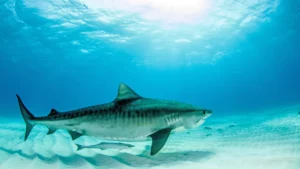
The cobbler wobbegong (Sutorectus tentaculatus) is a small, flattened carpet shark found only in southern Australia, reaching about 92 cm (3 ft) and living on shallow rocky and coral reefs, in seagrass and among seaweed from the intertidal down to roughly 30 m. It is the sole species in the genus Sutorectus, and it is recognised instantly by the rows of large warty tubercles along its back and dorsal fins, which no other wobbegong has.
It is a night-time ambush hunter of small reef fish, octopus and crustaceans, lying motionless by day with its patterned skin breaking up its outline. Like other wobbegongs it bears live young, with pups born at about 22 cm and both sexes maturing near 60 to 64 cm. The IUCN lists it as Least Concern. It is harmless unless trodden on or handled.
- Maximum length92 cm (3 ft)
- WeightNo reliable published figure
- LifespanUnknown; never aged
- Depth rangeIntertidal to about 30 m (100 ft)
- DietSmall reef fish, octopus, crabs and prawns
- IUCN statusLeast Concern
- Kingdom
- Animalia
- Phylum
- Chordata
- Class
- Chondrichthyes
- Order
- Orectolobiformes
- Family
- Orectolobidae
- Genus
- Sutorectus
- Species
- Sutorectus tentaculatus
- Family (common)
- Wobbegongs
- Also known as
- Cobbler carpetshark, Warty wobbegong
On this page
- The wobbegong with warts
- How big do cobbler wobbegongs get?
- Where cobbler wobbegongs live
- What cobbler wobbegongs eat
- Behaviour, camouflage and defence
- Pups, maturity and lifespan
- Is the cobbler wobbegong dangerous?
- Conservation status
- Other wobbegongs and how to separate them
- Frequently asked questions
- References
The wobbegong with warts
Wobbegongs all look roughly alike from a distance: flat, wide-headed sharks pressed against the reef under a carpet of blotches. The cobbler is the one you can name without a book. Running down the midline of its back and across the bases of both dorsal fins are rows of large, hard, warty tubercles, raised enough to catch the light and to feel like gravel under a glove. No other wobbegong carries them, and they are the reason for both names the animal has: cobbler, the Australian word for a prickly fish, and Sutorectus, built on the Latin sutor, a shoemaker.
The head is the second clue. It is narrow for a wobbegong, the eyes are small, and the fringe of skin lobes along its edges is sparse and simple — short, unbranched tags rather than the dense branching beard of the tasselled wobbegong. The chin is smooth, without the extra lobes that decorate the ornate and spotted species, and the nasal barbels are unbranched.
The pattern is broad dark saddles with jagged, torn-looking edges, separated by paler bands scattered with irregular dark spots and rings. Inside the short mouth are long, slim, fang-like teeth set in a wide pharynx — the standard wobbegong arrangement for gripping a fish and swallowing it whole. Both dorsal fins sit far back, the first beginning over the pelvic fins, and the tail is short with almost no lower lobe.
How big do cobbler wobbegongs get?
Small, by the standards of the family. The maximum reliably recorded length is 92 cm (3 ft), which makes the cobbler the smallest wobbegong in Australian waters and less than half the length of the spotted wobbegong that shares parts of its range. Occasional claims of a metre exist but have not been confirmed with a measured specimen.
No maximum weight has been published. A flattened shark of 90 cm is a broad, heavy-looking animal but a light one, and because the cobbler is uncommon and of no commercial interest, nobody has bothered to weigh a series of them.
Pups are born at about 22 cm, already carrying the adult pattern and the first of the tubercles along the back. Both sexes reach sexual maturity somewhere between 60 and 64 cm, which is late relative to the maximum length: an adult cobbler spends most of its life within a 30 cm band of size. Whether females grow larger than males, as they do in most wobbegongs, has not been established from the small number of specimens available. The bar below sets the species against a 1.8 m diver, and the comparison is a fair reflection of how unthreatening this animal is in the water.
Where cobbler wobbegongs live
This shark is endemic to southern Australia and found nowhere else on earth. Its range runs along the coast of Western Australia from around the tropic, near the Houtman Abrolhos and Shark Bay, south past Perth and Cape Leeuwin, then eastward through the Great Australian Bight into South Australia, taking in the Spencer Gulf and the coast to about the Victorian border — roughly 26°S to 35°S. It does not occur in New South Wales or Queensland, which is worth remembering because most wobbegong photographs published in Australia come from the east coast and show other species.
It is a shallow-water animal throughout. Divers find it on coral reefs at the Abrolhos, on limestone and granite reefs further south, in kelp and Ecklonia beds, and among seagrass, from the intertidal zone down to about 30 m. Structure matters more than depth: the cobbler wants a ledge, a crevice or a thick stand of weed to press itself into during daylight.
No country or state guide on SharkSider currently lists the cobbler wobbegong, a reflection of how seldom it is seen rather than of any doubt about where it lives. If you want to look for one yourself, the reefs and weed beds of the lower west coast of Australia are the place, and a slow search of ledges after dusk is far more productive than swimming over open reef by day.

What cobbler wobbegongs eat
No detailed stomach-content study of this species has been published, so the honest starting point is that its diet is inferred from close relatives that use the same reefs in the same way. Those relatives take small bottom fish — wrasse, leatherjackets, gobies, juvenile reef species — along with octopus, cuttlefish, crabs, prawns and the occasional small shark or ray.
The hunting method is not in doubt, because every wobbegong uses it. The shark lies motionless on the bottom with its head close to a ledge or a gap in the weed, its pattern and the skin lobes around its face dissolving the outline of the head against the reef. When a fish swims within range the strike is upward and almost instantaneous: the jaws open wide, the throat expands, and suction pulls the prey inward onto those long backward-pointing teeth. There is no chase, and a miss costs almost nothing.
Because the cobbler is small, its prey is small. It is not equipped to take the large fish that a 3 m spotted wobbegong can handle, and its narrow head limits gape. Hunting happens mainly at night and around dawn, when small reef fish are moving and visibility works in the ambusher's favour; through the day the shark digests and does not move. It is one of the least energetic ways of making a living available to a shark.
Behaviour, camouflage and defence
The behavioural repertoire is short. A cobbler wobbegong spends the great majority of its life lying still, usually under an overhang, in a crevice or beneath a canopy of kelp, and it will use the same shelter repeatedly. Tagging work on other wobbegongs shows individuals returning to favourite ledges over months while ranging a few hundred metres to feed, and there is no reason to expect this species to behave differently.
Camouflage is the whole defensive strategy and most of the hunting strategy. The torn-edged saddles break up the body outline, the fringe of lobes around the head hides the shape of the jaw, and the flattened profile casts almost no shadow. Add the warty tubercles and the effect from above is a patch of encrusted rock rather than a fish. The tubercles themselves may also make the shark harder to swallow — a large predator that tries gets a mouthful of hard knobs — although this has not been tested.
What the cobbler does not do is swim well. The body is stiff and broad, the tail small, and sustained swimming is expensive, so movement between shelters is short and close to the bottom. Like other carpet sharks it pumps water across its gills using the throat muscles and the spiracles behind the eyes, which means it can breathe while lying flat and motionless for hours — the physiological trick that makes the entire ambush lifestyle possible.
Pups, maturity and lifespan
The cobbler wobbegong is ovoviviparous, or aplacental viviparous: the eggs are retained and hatch inside the female, the embryos live on their yolk sacs without any placental connection, and the pups are born free-swimming at about 22 cm. That is the mode used by every wobbegong examined, and the few pregnant cobblers recorded confirm it for this species.
The numbers around it are thin. No litter size has been published, and the gestation period is unrecorded. Better-studied wobbegongs carry litters ranging from a handful to more than twenty pups after a gestation of close to a year, with females resting between pregnancies, and a shark as small as the cobbler is likely to sit at the low end of that spread. Both sexes mature at 60 to 64 cm.
Nobody has aged a cobbler wobbegong. There is no vertebral study, no growth curve and therefore no maximum recorded age; the figure simply does not exist in the literature, and any lifespan quoted for the species elsewhere has been borrowed from a relative. What can be said is that wobbegongs in general grow slowly, mature late relative to their maximum size and produce small litters, a life history that copes badly with sustained fishing pressure even when the animal itself is not the target. The background is on our page about how long sharks live.
Is the cobbler wobbegong dangerous?
The SharkSider database has no incident attributed to this species, and none should be expected. A 92 cm shark with a narrow head cannot do serious damage, it has no interest in anything the size of a person, and it will stay flat and hope to be missed rather than react to a swimmer. In the shallow reefs of southern Western Australia and South Australia it is simply part of the scenery.
The family, however, does have a record. The database holds several dozen bites logged only as "wobbegong", in New South Wales and Western Australia, and the pattern in them is consistent: someone stood on a resting shark, put a hand into a crevice, or speared or grabbed one. None of those records identifies the species, and the larger, far commoner spotted and ornate wobbegongs are the likely animals in nearly all of them. The lesson transfers anyway: never put a hand or a foot into a wobbegong's ledge, because these sharks hold on once they bite. Australia's full bite record is on the shark attacks in Australia page, and general advice is on what to do in a shark encounter.
The SharkSider database has no incident attributed to this species. The database draws on the International Shark Attack File, the Global Shark Attack File and verified local reports, and is updated weekly.
Conservation status
The IUCN Red List assesses the cobbler wobbegong as Least Concern. The assessment rests on three things: the species has no commercial value in Australia, the shallow reefs it lives on are not trawled, and a substantial part of its range lies inside marine parks and reserves on the Western Australian and South Australian coasts.
It is caught occasionally as bycatch in rock lobster pots, in inshore gill nets and on lines, and it is sometimes speared or taken by divers who do not recognise it. Because it is a shallow, site-attached species, the local risks are the familiar coastal ones: loss of seagrass and kelp, sedimentation and coastal development. Southern Australia is also warming faster than most temperate coasts, and the marine heatwave of 2011 stripped kelp from hundreds of kilometres of the Western Australian shelf, which is precisely the habitat this shark uses.
Nothing about the species is being monitored closely enough to detect a decline if one began. That is a common problem with small, uncommercial sharks: they are assessed as Least Concern partly because nobody is catching them and partly because nobody is counting them. Our page on why sharks are endangered explains why an unlisted species is not automatically a safe one.
Other wobbegongs and how to separate them
Wobbegongs are one family, Orectolobidae, within the carpet shark order Orectolobiformes — one of the eight orders of sharks, and the one that also contains the whale shark and the bamboo sharks. Around a dozen wobbegong species live in Australian and Indonesian waters, and the cobbler stands alone in its genus.
The species most likely to be confused with it in the west are the spotted wobbegong, which is far bigger and covered in pale rings and blotches without tubercles, the gulf wobbegong of the southern coast, and the floral banded wobbegong and northern wobbegong of the tropical north. Further east the ornate wobbegong and the tasselled wobbegong, with its extraordinary branched beard, take over. In the north-western Pacific the family reappears as the Japanese wobbegong.
None of them has the cobbler's rows of warty knobs, so identification is really a single check: look along the back for hard tubercles. If they are there, the shark is a cobbler wobbegong. If the back is smooth, work through the head lobes and the pattern instead.
 Spotted Wobbegongspecies profile
 Ornate Wobbegongspecies profile
 Tasselled Wobbegongspecies profile
- Gulf Wobbegongspecies profile
- Northern Wobbegongspecies profile
- Floral Banded Wobbegongspecies profile
Frequently asked questions
How big does a cobbler wobbegong get?
The largest confirmed specimen measured 92 cm (3 ft), making this the smallest wobbegong in Australian waters. Pups are born at about 22 cm and both sexes mature between roughly 60 and 64 cm. No maximum weight has been published, because the species has never been commercially fished or systematically surveyed.
Where do cobbler wobbegongs live?
Only in southern Australia, between about 26°S and 35°S. The range runs from the central coast of Western Australia south past Perth and east through the Great Australian Bight into South Australia. They live on shallow rocky and coral reefs, in kelp and in seagrass, from the intertidal to around 30 m.
Why is it called a cobbler wobbegong?
Cobbler is an Australian name for a prickly fish, and this shark is covered in rows of hard warty tubercles along the back and dorsal fins. The genus name repeats the idea: Sutorectus comes from the Latin sutor, a shoemaker. Wobbegong is thought to come from an Aboriginal word for shaggy beard.
What do cobbler wobbegongs eat?
Small reef fish above all, plus octopus, cuttlefish, crabs and prawns. They ambush prey from the bottom, opening the jaws and expanding the throat to suck the animal in onto long backward-pointing teeth. No detailed stomach-content study exists for this species, so the diet is inferred from close relatives.
How do cobbler wobbegongs reproduce?
They bear live young. The eggs hatch inside the female and the embryos feed on their yolk sacs with no placenta, a mode called ovoviviparity or aplacental viviparity. Pups are born at about 22 cm. Litter size and gestation length have never been recorded for the species.
Are cobbler wobbegongs dangerous to humans?
No. The SharkSider database has no incident attributed to this species. It is under a metre long with a narrow head, and it stays flat and still rather than reacting to swimmers. Wobbegongs as a family do bite people who stand on them or reach into their ledges, so give any resting one space.
How do you tell a cobbler wobbegong from other wobbegongs?
Look along the back for hard, warty tubercles in rows down the midline and across the dorsal fin bases. No other wobbegong has them. The cobbler also has a narrow head, small eyes, a smooth chin and only short, unbranched skin lobes rather than a dense branched beard.
Are cobbler wobbegongs endangered?
No. The IUCN lists them as Least Concern. The species has no commercial value, its shallow reef habitat is not trawled, and a good part of its range falls inside Australian marine parks. It is taken occasionally as bycatch in lobster pots and inshore nets, but there is no known population decline.
How long do cobbler wobbegongs live?
Nobody knows. No vertebral ageing study has been carried out on the species, so there is no maximum recorded age and no growth curve. Wobbegongs in general grow slowly, mature late relative to their maximum size and produce small litters, which suggests a lifespan of at least a couple of decades.
Can you see a cobbler wobbegong while diving?
Yes, but you have to look. It is uncommon and superbly camouflaged, lying under ledges and in weed on shallow reefs of the lower west coast and South Australia. Searching crevices slowly at dusk or after dark gives much better odds than swimming over open reef in daylight.
References

A small team focused on researching sharks and making marine biology easy to understand. Every page is reviewed against current species records and the SharkSider attack database, and updated when new incidents or research appear.
Published November 9, 2022 · Last updated September 22, 2026 · No incident attributed to this species in the SharkSider attack database, which is updated weekly.