The broadfin shark (Lamiopsis temminckii) is a medium-sized requiem shark of the family Carcharhinidae that reaches about 168 cm (5.5 ft) and lives in shallow, turbid coastal water from Pakistan through India and Bangladesh to Myanmar. Broad triangular pectoral fins, a second dorsal fin almost as large as the first and a long, rounded snout set it apart from the region's look-alike whalers.
It feeds mainly on crabs and shrimps, with small fish and squid, and bears litters of 4–8 pups after a placental pregnancy. The IUCN lists it as Endangered after steep declines in gillnet and trawl fisheries, and since November 2023 it is on CITES Appendix II. It has never been recorded biting a person.
- Maximum length168 cm (5.5 ft)
- WeightNo reliable measurement; a large adult is probably 20–30 kg
- LifespanUnknown; never aged
- Depth rangeInshore shelf, shallow; exact range not documented
- DietCrabs, shrimps, small bony fish, squid and cuttlefish
- IUCN statusEndangered (assessed 2020)
- Kingdom
- Animalia
- Phylum
- Chordata
- Class
- Chondrichthyes
- Order
- Carcharhiniformes
- Family
- Carcharhinidae
- Genus
- Lamiopsis
- Species
- Lamiopsis temminckii
- Family (common)
- Requiem sharks
- Also known as
- Temminck's broadfin shark, Broadfin whaler
On this page
- How to recognise a broadfin shark
- How big does the broadfin shark get?
- Where broadfin sharks live
- What broadfin sharks eat and how they hunt
- Behaviour and adaptations
- Reproduction and lifespan
- Is the broadfin shark dangerous?
- Conservation status
- Similar species and close relatives
- Frequently asked questions
- References
How to recognise a broadfin shark
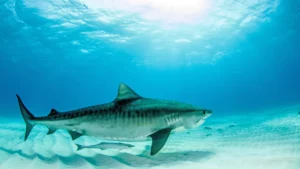
Requiem sharks are a family of grey, streamlined look-alikes, and the broadfin shark is one of the few that can be named on the spot. Look at the fins. The pectorals are unusually broad and triangular, wide at the base and only gently curved along the rear edge, and the second dorsal fin is nearly as tall as the first, where in almost every Carcharhinus it is a small stub. There is no ridge of skin between the dorsal fins, and the anal fin has a nearly straight rear margin instead of the deep notch of most relatives.
The head is the second clue: a long, broadly rounded snout about as long as the mouth is wide, small round eyes with a nictitating membrane, and short gill slits. The two jaws carry different teeth. The uppers are broad, triangular and finely serrated, built for cutting; the lowers are narrow, erect, smooth-edged and slightly hooked, built for holding, a mix discussed on our page on shark teeth.
Colour is plain: light grey to grey-brown above, fading to off-white below, with no black or white fin tips and no markings, so a fresh specimen looks bleached beside the black-tipped and bronze whalers landed with it. The only shark it can be confused with is its sister species, the Borneo broadfin shark (Lamiopsis tephrodes), separated in 2010 on vertebral counts, tooth shape and colour and confined to the waters around Borneo.
How big does the broadfin shark get?
The largest reliably measured broadfin shark was about 168 cm (5.5 ft) long, and most adults seen in landings are between 120 and 150 cm. The figures of "3.8 ft for males and 4.3 ft for females" sometimes given as the size of the species are in fact the sizes at maturity: males mature at roughly 114–116 cm and females at about 130 cm, and both keep growing afterwards. Females are the larger sex.
Pups are big for the size of the mother. Newborns measure 40–60 cm (16–24 in), a quarter to a third of adult length, which is typical of placental requiem sharks that give birth in open, predator-rich inshore water and must produce young able to fend for themselves at once.
Weight has never been properly recorded. A requiem shark of this build at 150–170 cm generally weighs somewhere between 20 and 30 kg, and that is the guide range in the table above; it is an estimate from body shape, not a measurement. The size bar below sets the 168 cm maximum against a 1.8 m diver: a broadfin shark is a little shorter than a person and heavier-bodied than its length suggests, because of the deep chest and thick pectoral fins.
Where broadfin sharks live
The confirmed range of the broadfin shark is the northern rim of the Indian Ocean: the coast of Pakistan around the Indus delta, the west and east coasts of India, with the Gujarat and Maharashtra fisheries historically the most important, the delta coast of Bangladesh, and the coast of Myanmar. Older accounts stretched the range east through Thailand, Malaysia and Indonesia to Sarawak and southern China, but the Borneo animals were shown in 2010 to be a separate species, and the other Southeast Asian records need re-examination.
Within that range it is an inshore shark of shallow, warm, turbid water. Almost all specimens have come from gillnets and trawls set close to the coast over mud and sand, near the mouths of large rivers such as the Indus, the Narmada and the Ganges–Brahmaputra, in water of 26–30 °C. No systematic depth data have been published; the fishing gear that catches it works from the shoreline to a few tens of metres, and there is no evidence of the species on the outer shelf or in clear reef water.
Like other river-mouth requiem sharks of the region, including the bull shark, it tolerates reduced salinity, though there is no record of it entering fresh water. Nothing is known about its movements. The map below shows the confirmed range.

What broadfin sharks eat and how they hunt
Stomach contents from Indian landings give a clear picture: crustaceans dominate, above all swimming crabs and penaeid prawns, followed by small bony fish such as croakers, anchovies and ponyfish, and then cephalopods, mainly cuttlefish and small squid. That is the menu of the mud-bottom shelf off the Indus and the Gulf of Khambhat, where prawn trawlers and shark gillnets work the same ground, and the shark is essentially eating what the fishery targets.
The teeth fit the diet. Narrow, hooked lower teeth pin a crab or a fish against the broad serrated uppers, which then cut; a broadfin shark does not need the massive jaws of a seal-eater, and does not have them. The long snout carries a dense field of ampullae of Lorenzini, and in water where visibility is often measured in centimetres these electroreceptors, with smell and the lateral line, must do most of the work of finding prey buried in or resting on the mud.
The broad pectoral fins are probably part of the same story. Wide, low-aspect fins give lift and manoeuvrability at slow speed rather than efficiency at cruising pace, which suggests a shark that patrols close to the bottom, turning tightly and stopping short to take prey, rather than one that runs down fast fish in open water. It probably hunts most at night and on the flood tide, as its neighbours do, but nobody has watched a broadfin shark feed.
Behaviour and adaptations
Almost nothing has been observed of the living animal. Every published fact about the broadfin shark comes from dead specimens on a fish-market floor or a museum bench, so what follows is inference from anatomy and from better-known relatives. It is a requiem shark, so it must swim continuously to breathe, and its small eyes and turbid habitat mean vision matters less than it does for the reef-dwelling members of the family; smell, electroreception and the lateral line lead.
Landings suggest some structure in how the species uses its habitat. Pregnant females and newborn pups are taken close inshore in the months around the monsoon, which points to shallow river-mouth nurseries of the kind used by many coastal requiem sharks, while larger animals of both sexes come from slightly deeper water. Whether adults segregate by sex, as many Carcharhinus do, is not recorded.
The tolerance of warm, silty, low-oxygen water is the species' most obvious adaptation, shared with the Ganges shark and the spadenose shark that live alongside it. Such water is rich in prey and poor in large predators, so a shark that can work it year-round has much of the food to itself. The price is that it lives exactly where human fishing effort is heaviest. For a wider account of how the family is built, see our introduction to requiem sharks.
Reproduction and lifespan
The broadfin shark is viviparous with a yolk-sac placenta, the standard requiem-shark arrangement: after the embryo exhausts its yolk, the empty sac attaches to the wall of the uterus and nourishes it until birth. Litters of 4 to 8 pups are recorded; the "around eight" of older accounts is the top of the range, not the average. Pups are born at 40–60 cm.
Indian records place births in the pre-monsoon and monsoon months, roughly March to September, when pregnant females and small juveniles both appear in inshore catches, which suggests that the river-mouth shallows serve as nurseries. Gestation has not been measured; in requiem sharks of similar size it lasts nine to twelve months, and it is likely, though unproven, that females breed only every second year, as most do.
Males mature at about 114–116 cm and females at about 130 cm. Age at maturity, growth rate and lifespan are all unknown: no one has read the vertebral growth bands of a broadfin shark, and with the species now so rarely landed the chance to do so is shrinking. For a shark of this size and reproductive mode a lifespan of 15–25 years and maturity at 6–10 years would be typical, but that is a comparison with relatives, not a measurement; our page on how long sharks live explains why such gaps matter.
Is the broadfin shark dangerous?
There is no reason to think so, and no evidence that it has ever hurt anyone. The broadfin shark is a medium-sized requiem shark with jaws built for crabs and small fish, living in muddy water where people net and wade constantly, and in two centuries of records there is not one bite attributed to it. The SharkSider database, summarised below, holds no incident for the species, and the International Shark Attack File has none either. The regional bite record along the coasts of Pakistan and India is dominated by the bull shark and by large unidentified whalers, and this species is not among the suspects.
In principle a 1.7 m shark can injure a person, and a broadfin shark thrashing in a gillnet or on a deck should be handled with the same respect as any other; the serrated upper teeth will cut. But that is a fisheries hazard, not a swimming one. The honest summary is that the danger runs entirely the other way: people have reduced this shark to a rarity, and it has never so much as scratched one in return. For the handful of species that do bite, and what to do if you meet one, see our page on surviving a shark encounter.
The SharkSider database has no incident attributed to this species. The database draws on the International Shark Attack File, the Global Shark Attack File and verified local reports, and is updated weekly.
Conservation status
The IUCN Red List assesses the broadfin shark as Endangered (2020), on the grounds of a steep and continuing decline across a range that coincides with some of the most intensive and least regulated inshore fisheries in the world. Once a regular part of the shark landings at Karachi, Veraval and Mumbai, it is now recorded only occasionally, and where it does appear the animals are mostly juveniles, a classic sign of a population fished before it can breed. Earlier estimates of its numbers were inflated by the Borneo animals counted with it before 2010, so the true population is smaller than it once looked.
The threats are gillnets, bottom trawls and longlines set for prawns, croakers and other sharks in exactly the shallow, muddy water the species depends on. Every part of the catch is used: the meat is eaten or dried locally and the fins enter the international trade, and there is no size limit, quota or closed season for the species anywhere in its range. Coastal development, dredging and river damming have degraded the estuarine nurseries on top of that.
Legal protection is thin but improving. All requiem sharks, this one included, were added to CITES Appendix II in November 2023, so fins and other products now need export permits showing the trade is not harmful, though enforcement in the region remains weak. It is not listed under the Convention on Migratory Species and has no specific national protection in Pakistan, India, Bangladesh or Myanmar. It fits the pattern our page on why sharks are endangered describes: a slow-breeding coastal species caught by everyone and managed by no one.
Similar species and close relatives
Lamiopsis contains only two sharks. The broadfin shark's sister species, the Borneo broadfin shark (Lamiopsis tephrodes), was described as a separate species in 2010 after decades of being lumped with it; it lives around Borneo, has fewer vertebrae, differently shaped teeth and a darker grey colour, and is itself Endangered. Beyond the genus, its exact position within the family is still debated.
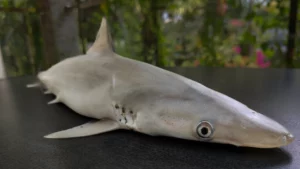
The species it is most often landed and confused with are the small whalers of the same muddy coasts. The spadenose shark (Scoliodon laticaudus) is much smaller, under a metre, with a flattened, trowel-shaped snout. The milk shark and the whitecheek shark are slimmer, with long pointed snouts and small second dorsal fins. The hardnose shark has calcified snout cartilage that can be felt through the skin. None has the broadfin shark's oversized pectorals or tall second dorsal, and once those are checked the identification is settled. The rare Ganges shark of the same rivers is a different genus altogether, with tiny eyes and a very short snout, and the small Borneo shark (Carcharhinus borneensis) is a different animal from the Borneo broadfin despite the name.
- Ganges Sharkspecies profile
- Spadenose Sharkspecies profile
 Milk Sharkspecies profile
- Whitecheek Sharkspecies profile
- Hardnose Sharkspecies profile
- Borneo Sharkspecies profile
Frequently asked questions
How big is a broadfin shark?
The largest measured broadfin shark was about 168 cm (5.5 ft), and most adults are 120 to 150 cm. Males mature at roughly 114 to 116 cm and females at about 130 cm; the 3.8 ft and 4.3 ft figures sometimes quoted are those maturity sizes, not maximums. Pups are born at 40 to 60 cm. No weight has been recorded.
Where do broadfin sharks live?
In shallow, muddy inshore waters of the northern Indian Ocean: Pakistan around the Indus delta, both coasts of India, Bangladesh and Myanmar, usually near large river mouths. Older records from Thailand, Malaysia, Indonesia, Borneo and China are doubtful, because the Borneo animals proved in 2010 to be a separate species.
Why is it called the broadfin shark?
For its pectoral fins, which are unusually wide and triangular for a requiem shark. It is also one of the few members of the family whose second dorsal fin is nearly as large as the first. The scientific name honours Coenraad Jacob Temminck, the Dutch zoologist who directed the natural history museum in Leiden in the 1800s.
What do broadfin sharks eat?
Mostly crustaceans, especially swimming crabs and prawns, then small bony fish such as croakers and anchovies, and cuttlefish and squid. The narrow hooked lower teeth hold the prey while the broad serrated upper teeth cut. In turbid water it finds food mainly by smell and by the electroreceptors in its long snout.
How do broadfin sharks reproduce?
Reproduction is placental: the pups develop inside the mother, fed through a yolk-sac placenta. Litters contain 4 to 8 pups, each 40 to 60 cm long at birth. Indian records place births in the pre-monsoon and monsoon months, roughly March to September, in shallow river-mouth nurseries. Gestation has not been measured but is probably nine to twelve months.
How long do broadfin sharks live?
Nobody knows. The species has never been aged from its vertebrae, and it is now landed so rarely that the opportunity is shrinking. Requiem sharks of similar size typically live 15 to 25 years and mature at 6 to 10, so figures in that range are plausible, but they are a comparison with relatives rather than a measurement.
Is the broadfin shark dangerous to humans?
No. Despite living in shallow water where people fish and wade every day, it has never been recorded biting anyone; the SharkSider database and the International Shark Attack File both hold no incident for the species. Like any 1.7 m shark it should be handled carefully in a net, but it poses no threat to swimmers.
Is the broadfin shark endangered?
Yes. The IUCN lists it as Endangered after steep declines in the gillnet, trawl and longline fisheries of Pakistan, India, Bangladesh and Myanmar, where it was once a regular landing and is now rare. Since November 2023 it has been on CITES Appendix II with all other requiem sharks, but it has no national protection anywhere in its range.
Is the Borneo broadfin shark the same species?
No. The Borneo broadfin shark, Lamiopsis tephrodes, was separated from the broadfin shark in 2010 on vertebral counts, tooth shape and colour. It lives around Borneo, while the broadfin shark proper is confined to the northern Indian Ocean. Because the two were counted together for decades, earlier population estimates for the broadfin shark were too high.
References

A small team focused on researching sharks and making marine biology easy to understand. Every page is reviewed against current species records and the SharkSider attack database, and updated when new incidents or research appear.
Published October 11, 2022 · Last updated September 22, 2026 · No incident attributed to this species in the SharkSider attack database, which is updated weekly.