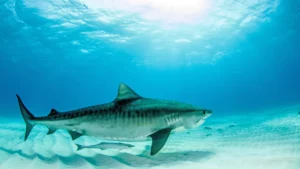
The Brazilian sharpnose shark (Rhizoprionodon lalandii) is a small requiem shark of the western Atlantic, from Panama to southern Brazil and Uruguay, reaching about 80 cm (2 ft 8 in) and living over sandy and muddy bottoms between roughly 3 and 70 m. It is slender and plain grey-brown above with a white belly, a long pointed snout, large eyes and long furrows at the corners of the mouth.
It eats small bony fish such as sardines and anchovies, along with shrimp and squid. Females bear one to four pups, and few individuals live past eight years. The IUCN assessed it as Vulnerable in 2019 because coastal fisheries take enormous numbers of it. It is harmless to people.
- Maximum length80 cm (2 ft 8 in), females larger
- WeightNot published; a large adult is a few kilograms
- LifespanAbout 6–8 years
- Depth range3–70 m (10–230 ft)
- DietSmall bony fish, shrimp, squid
- IUCN statusVulnerable (assessed 2019)
- Kingdom
- Animalia
- Phylum
- Chordata
- Class
- Chondrichthyes
- Order
- Carcharhiniformes
- Family
- Carcharhinidae
- Genus
- Rhizoprionodon
- Species
- Rhizoprionodon lalandii
- Family (common)
- Requiem sharks
- Also known as
- Brazilian sharpnose, Cação-frango
On this page
- How to recognise a Brazilian sharpnose shark
- How big does a Brazilian sharpnose shark get?
- Where Brazilian sharpnose sharks live
- What Brazilian sharpnose sharks eat
- Behaviour and daily life
- Reproduction and lifespan
- Is the Brazilian sharpnose shark dangerous?
- Conservation status
- Relatives and look-alikes
- Frequently asked questions
- References
How to recognise a Brazilian sharpnose shark
This is a small, neat, unremarkable-looking shark, and the identification hangs on three details rather than on anything dramatic. The first is the snout, which is long, narrow and sharply pointed, noticeably longer than the width of the mouth: the feature the whole genus is named for. The second is the pair of furrows at the corners of the mouth, which in Rhizoprionodon are unusually long, running forward along the upper lip far enough to see without handling the animal.
The third is the position of the second dorsal fin. It is small, and its origin sits well back, over the rear part of the anal fin base rather than above the fin's front edge, which separates the sharpnose sharks at a glance from the young Carcharhinus they are landed alongside. The first dorsal fin is moderate and begins behind the pectoral fins; the tail has a strong upper lobe with a notch near the tip.
Colour adds little. The back is grey, olive-grey or grey-brown, the belly white, and the fins are plain, sometimes with slightly paler rear margins. Unlike adult Atlantic sharpnose sharks, which develop scattered small white spots along the flanks, this species stays unmarked. The eyes are large and oval with a working nictitating eyelid, and the teeth in both jaws are small, oblique and serrated along the rear edge, a design for cutting small slippery fish.
How big does a Brazilian sharpnose shark get?
Not big at all. The largest recorded females reach about 80 cm (2 ft 8 in) in total length, males a little less, and the common size in commercial landings is nearer 55 cm. A full-grown Brazilian sharpnose is a shark you can hold along one forearm.
Pups are born at 33 to 34 cm, well over a third of the maximum adult length, which is the usual pattern for a small placental requiem shark: few young, each of them large and capable. Growth after that is rapid. Females are mature at roughly 55 to 66 cm and males at about 51 to 58 cm, and Brazilian studies put both sexes at maturity in their second year.
Weight is not published in any source worth quoting, and a figure invented from length would be misleading, so none is given here. On the size bar below the species reaches to about the knee of a 1.8 m diver. That smallness is the key to everything else about the animal: it lives fast, breeds young, dies early, and is caught in nets set for fish rather than for sharks.
Where Brazilian sharpnose sharks live
The species belongs to the western Atlantic coast of South and Central America. Its range runs from Panama and Colombia along the northern shoulder of the continent through Venezuela, Trinidad and Tobago, the Guianas, and then south along the whole Brazilian coast to Rio Grande do Sul and into Uruguayan waters, roughly between 13°N and 35°S. It is most abundant in the south-east and south of Brazil.
It is a shallow-water animal throughout. Records run from about 3 m to 70 m, and the great majority come from under 40 m, over sand and mud on the inner shelf. It is frequently caught within sight of the beach and in the mouths of bays and estuaries, although unlike the bull shark it does not push far into fresh water.
Those shallow muddy grounds are also the most intensively fished part of the South American shelf, and the overlap is total: there is no part of this shark's range or depth band that is not worked by trawlers or gillnetters. That fact explains the conservation section further down better than any other single piece of information about the species.
2 countries list the brazilian sharpnose shark in their species guide; the count is the number of incidents attributed to it there in the SharkSider database. Browse every guide on sharks around the world and sharks in the US.
What Brazilian sharpnose sharks eat
Small fish first. Stomach studies along the Brazilian coast are dominated by schooling clupeids and engraulids, the sardines and anchovies that fill the inshore water column, along with croakers and other small bottom fish. Shrimp come second and squid third, and the proportions shift with the season and with what is locally abundant.
The interesting part is where it feeds. Analyses of its stomach contents show both demersal prey, taken on or just above the bottom, and pelagic prey taken well clear of it, which means the shark moves between the two zones rather than specialising. For a predator of 60 cm in murky coastal water, that flexibility is worth more than any particular hunting skill.
The equipment is modest and well matched. The small oblique teeth, serrated along their trailing edges, slice through a sardine without needing force; the large eyes work in the green-brown light of coastal water; and the ampullae of Lorenzini in the long snout locate a shrimp in the sediment at close range. There is no ambush, no breach and no cooperative hunting on record, just a small, quick shark eating small, quick food.
Behaviour and daily life
Brazilian sharpnose sharks are gregarious in the loose sense that matters for a small coastal shark: they are caught in numbers in single net hauls, and those hauls are often dominated by one sex or one size class. That sorting, rather than any social bond, is what produces the appearance of schooling. Adults and juveniles occupy the same general grounds, with the smallest animals concentrated closer to shore.
Seasonal movement along the coast is well documented in the south of the range. Catches rise and fall on an annual cycle tied to water temperature and to the reproductive calendar, with inshore concentrations building ahead of the pupping season. Whether individuals travel long distances is unknown, as almost no tagging has been done on the species.
Its own position in the food chain is unglamorous. A 60 cm shark on a South American beach is prey for larger requiem sharks, including the blacknose and larger Carcharhinus, and in estuaries for bull sharks; our page on what eats sharks covers the wider picture. The species compensates in the only way available to a small animal with many predators, by breeding early and often, which is the theme of the next section.
Reproduction and lifespan
The species is viviparous with a yolk-sac placenta. Each embryo consumes its own yolk, then the emptied sac attaches to the uterine wall and works as a placenta, supplying nutrients and oxygen from the mother's blood until birth. That mode, standard in the requiem sharks, is compared with the alternatives on our page about how sharks reproduce.
Litters are small: one to four pups, occasionally more, born at 33 to 34 cm. Gestation is estimated at roughly ten to twelve months, and females appear to breed annually, with pupping concentrated in the warmer months in the south of the range. Newborns stay in very shallow inshore water through their first months.
Lifespan is the number that changes how you read everything else. Ageing studies on the Brazilian coast give a maximum of around six years in tropical waters and about eight further south, with maturity reached in the second year. By shark standards that is extraordinarily fast: a daggernose shark from the same coast takes years longer to mature, and the large species covered in how long sharks live can take decades. A short life and early maturity should make a population resilient, and for this species they very nearly do.
Is the Brazilian sharpnose shark dangerous?
No. The SharkSider database holds no incident attributed to the species, and neither do the Brazilian records. An 80 cm shark with small slicing teeth built for sardines is not capable of a serious injury, and it shows no interest in anything larger than its own prey. It sits comfortably among the species on our list of the least dangerous sharks.
That matters more here than on most pages, because the Brazilian sharpnose lives in exactly the water where people swim, all along the beaches of south-eastern Brazil, and is caught by the thousand within sight of bathers. The serious incidents on that coast, concentrated around Recife, involve bull and tiger sharks in a very different setting, and the record is set out on the Brazil attack page. Confusing a small sharpnose in the shallows with those species is a common mistake and an entirely avoidable one.
The SharkSider database has no incident attributed to this species. The database draws on the International Shark Attack File, the Global Shark Attack File and verified local reports, and is updated weekly.
Conservation status
The IUCN Red List assessed the Brazilian sharpnose shark as Vulnerable in 2019, and the case is a useful lesson in how a productive species can still be in trouble. Fast growth, maturity at about two years and annual litters should buffer it against fishing. What they cannot buffer is the sheer volume of gear in its habitat. The species is among the most commonly landed sharks in Brazil, taken in artisanal gillnets, beach seines and shrimp trawls along the entire coast, and because it lives from 3 m outward there is nowhere in its range that is not fished.
Most of that catch is incidental rather than targeted, and it is not wasted: the meat is sold fresh, dried and salted through South American markets, and in Colombia and Venezuela it is a familiar ingredient in traditional dishes. Juveniles are taken along with adults, which removes animals before they have bred even once.
Like every member of the requiem shark family, it was added to Appendix II of CITES in November 2023, so international trade in its fins and meat now requires permits and a finding of sustainability. Domestic fisheries, which account for almost all of the catch, are untouched by that listing, and there is no national management plan aimed at the species. Better monitoring of small coastal sharks is the practical need here, a point our page on why sharks are endangered returns to repeatedly.
Relatives and look-alikes
The genus Rhizoprionodon holds several nearly identical small sharks, and misidentification in landings is routine. The Caribbean sharpnose shark overlaps with this species in the northern part of its range and is the hardest to separate; the two are told apart on snout proportions, the exact position of the second dorsal fin relative to the anal fin, and vertebral counts, none of which can be judged from a photograph. The Atlantic sharpnose shark replaces it north of the Caribbean and develops small white flank spots as an adult. The Pacific sharpnose shark fills the same role on the other side of Central America and the grey sharpnose shark in the Indian Ocean, while the milk shark is the genus's most widespread member.
Outside the genus, the small requiem sharks of the same Brazilian nets are the smalltail shark, heavier-bodied with a shorter snout, and the critically endangered daggernose shark, whose extraordinary flattened spike of a snout makes it unmistakable once seen.
- Caribbean Sharpnose Sharkspecies profile
 Atlantic Sharpnose Sharkspecies profile
- Pacific Sharpnose Sharkspecies profile
- Grey Sharpnose Sharkspecies profile
 Milk Sharkspecies profile
- Smalltail Sharkspecies profile
Frequently asked questions
What is a Brazilian sharpnose shark?
A small requiem shark, Rhizoprionodon lalandii, of the western Atlantic coast of South and Central America. It reaches about 80 cm, lives over sand and mud between roughly 3 and 70 m, and is recognised by its long pointed snout, long furrows at the corners of the mouth and plain grey-brown colouring.
How big do Brazilian sharpnose sharks get?
Females reach about 80 cm (2 ft 8 in) in total length and males a little less, though the common size in landings is nearer 55 cm. Pups are born at 33 to 34 cm. Females mature at roughly 55 to 66 cm and males at about 51 to 58 cm, both in their second year of life.
Where do Brazilian sharpnose sharks live?
In shallow coastal water of the western Atlantic, from Panama and Colombia along Venezuela, Trinidad and Tobago and the Guianas, then south along the whole Brazilian coast to Uruguay. They are most abundant in south-eastern and southern Brazil, over sand and mud between about 3 and 70 m, mostly shallower than 40 m.
What do Brazilian sharpnose sharks eat?
Mainly small schooling bony fish such as sardines, anchovies and croakers, plus shrimp and squid. Stomach studies show both bottom-living and midwater prey, so the shark hunts through the water column rather than specialising in one zone. Its small serrated teeth slice small fish without needing much force.
How long do Brazilian sharpnose sharks live?
About six years in the tropical part of the range and up to eight in cooler southern waters, which is exceptionally short for a shark. Both sexes mature in their second year. That fast life history usually protects a species from fishing, and here it is offset by the sheer intensity of coastal netting.
How do Brazilian sharpnose sharks reproduce?
They are viviparous with a yolk-sac placenta, like other requiem sharks. Once an embryo exhausts its yolk, the emptied sac fuses to the wall of the uterus and draws nutrients directly from the mother until birth. Litters are one to four pups, born at 33 to 34 cm after an estimated ten to twelve months.
Are Brazilian sharpnose sharks dangerous to humans?
No. The SharkSider database carries no record for this shark, and Brazilian incident files name much larger species. At 80 cm, with teeth built for sardines, it could not injure a person seriously, even though it shares the shallow water where people swim along the Brazilian coast and is netted there daily.
Are Brazilian sharpnose sharks endangered?
The IUCN assessed the species as Vulnerable in 2019. It is one of the most commonly landed sharks in Brazil, taken in gillnets, beach seines and shrimp trawls across its whole range and depth band, with juveniles caught alongside adults. Like all requiem sharks it was added to CITES Appendix II in November 2023.
Can you eat Brazilian sharpnose shark?
Yes, and most of the catch is eaten. The meat is sold fresh, dried and salted through South American markets and is a familiar ingredient in traditional dishes in Colombia and Venezuela. As with other sharks, mercury accumulates in the flesh, so frequent consumption is not recommended, particularly during pregnancy.
How do you tell it apart from the Atlantic sharpnose shark?
By the flanks and the range. Adult Atlantic sharpnose sharks develop scattered small white spots along the sides; the Brazilian sharpnose stays plain. The Atlantic species also occurs north of the Caribbean, from the Gulf of Mexico to the eastern United States, while this one runs from Panama south to Uruguay.
References

A small team focused on researching sharks and making marine biology easy to understand. Every page is reviewed against current species records and the SharkSider attack database, and updated when new incidents or research appear.
Published November 9, 2022 · Last updated September 22, 2026 · No incident attributed to this species in the SharkSider attack database, which is updated weekly.