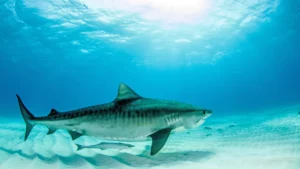
The bigeye houndshark (Iago omanensis) is a small houndshark of the north-western Indian Ocean, reaching about 58 cm (23 in) in females and around 37 cm in males, that lives near the bottom between roughly 110 and 1,000 m in the Red Sea, Gulf of Aden, Gulf of Oman and Arabian Sea. It is plain grey-brown with dark-edged dorsal fins, a short snout, large oval eyes and long gill slits.
It feeds on small bony fish, squid and crustaceans. Females bear 2 to 10 live pups after a 10 to 12 month pregnancy. The IUCN lists it as Least Concern, and at half a metre long in deep water it has never been involved in an incident with a person.
- Maximum length58 cm (23 in), females; males to about 37 cm
- WeightNot recorded; under 1 kg
- LifespanUnknown
- Depth range110–1,000 m (360–3,300 ft); Red Sea records to about 2,200 m
- DietSmall bony fish, squid, crustaceans
- IUCN statusLeast Concern (assessed 2020)
- Kingdom
- Animalia
- Phylum
- Chordata
- Class
- Chondrichthyes
- Order
- Carcharhiniformes
- Family
- Triakidae
- Genus
- Iago
- Species
- Iago omanensis
- Family (common)
- Houndsharks
- Also known as
- Oman houndshark, Bigeye hound shark
On this page
- How to recognise a bigeye houndshark
- How big is the bigeye houndshark?
- Where bigeye houndsharks live
- What bigeye houndsharks eat
- Behaviour and adaptations to deep, oxygen-poor water
- Reproduction and lifespan
- Is the bigeye houndshark dangerous to people?
- Conservation status
- Relatives and look-alikes
- Frequently asked questions
- References
How to recognise a bigeye houndshark
Picture a very small, very plain houndshark and you have it. The body is slender and slightly compressed, the snout short and rounded, and the colour an even grey-brown above shading to a paler belly, with no spots, bars or saddles; the only markings are dusky edges to the two dorsal fins and, on some animals, to the tail. Nothing about it would catch the eye on a trawl deck except the eyes themselves, large, oval and set high on the head, and the gill slits, unusually long for a shark of this size. Both are adaptations to dim, oxygen-poor water, and both separate it from the small catsharks it is hauled up beside.
The family marks are all present. There is a nictitating eyelid that sweeps across the eye, a small spiracle behind it, an anal fin, two spineless dorsal fins of similar size, the first beginning above the rear of the pectoral fins, and a tail without the precaudal pits of a requiem shark. The teeth are small, with a single oblique cusp and a blade-like edge, alike in both jaws and arranged in many rows for holding small fish rather than shearing large prey.
Its genus, Iago, contains only two or three species. The longnose houndshark of Australia and Vanuatu has a longer snout and stays far outside this range, and a third form from south-western India, described in the 2010s as Iago mangalorensis, is so similar that some older Indian records may belong to it. In the Red Sea and the Gulf of Oman, a small brown houndshark with big eyes from below 100 m can be nothing else.
How big is the bigeye houndshark?
Small. Females, the larger sex, reach about 58 cm (23 in) in total length; males are markedly smaller and are not known to exceed about 37 cm (15 in). The old page's figures of 1.3 ft for females and 0.98 ft for males, roughly 40 and 30 cm, are the lengths at which each sex matures, not the adult size, and they have been quietly promoted to a maximum on many copies of that text.
Pups are born at about 16 to 17 cm (6.5 in), which is more than a quarter of the mother's length; a female carrying eight or ten of them near term is visibly distended. Weight has never been published for the species, and a 58 cm houndshark of this slender build would weigh well under a kilogram, so no figure is given rather than a guess. On the size bar below the species barely registers against a 1.8 m diver, which is the right impression: the bigeye houndshark is a shark you could hold in two hands, and it belongs on any list of the smallest sharks.
Where bigeye houndsharks live
The bigeye houndshark is confined to the north-western Indian Ocean and its two great inlets. It is common in the deep basins of the Red Sea, from the Gulf of Aqaba off Israel and Jordan down past Egypt and Saudi Arabia, through the Gulf of Aden and around Arabia to the Gulf of Oman, where it was first described in 1939, and along the Arabian Sea slope of Oman, Pakistan and the west coast of India. Older records extend it to the Bay of Bengal and Myanmar.
What makes the species remarkable is not where it lives but what it tolerates. It is a bottom-associated shark of the continental slope, recorded from about 110 m to 1,000 m, and down to about 2,200 m in the Red Sea, whose deep water is unlike any other ocean's: warm all the way down, around 21 °C at 1,500 m, salty, and poor in oxygen. The Gulf of Oman and the Arabian Sea carry one of the most intense oxygen-minimum zones on the planet at the same depths. Most sharks avoid such water; the bigeye houndshark is the dominant shark in it, and in trawl surveys of the Gulf of Aqaba it has been the most abundant fish of any kind below 300 m.
Within that habitat the sexes and sizes sort themselves by depth, with pregnant females and juveniles often taken shallower than adult males, a pattern seen in other houndsharks.

2 countries list the bigeye houndshark in their species guide; the count is the number of incidents attributed to it there in the SharkSider database. Browse every guide on sharks around the world and sharks in the US.
What bigeye houndsharks eat
Stomachs from Red Sea and Gulf of Oman trawls show a shark that eats whatever small animals share its dim, sluggish world: bony fish first, especially lanternfish and other members of the deep scattering layer, then squid, and then shrimps and other crustaceans. Everything is small, because the shark is small and its mouth is a narrow slot lined with little single-cusped teeth for gripping rather than cutting.
Hunting in the oxygen-minimum zone sets its own rules. Sustained pursuit is expensive when there is little oxygen to burn, so the bigeye houndshark is presumed to cruise slowly and pick off prey that is itself sluggish or resting, and it may follow the nightly rise of the scattering layer toward shallower water. The large eyes are the primary hunting sense in a habitat where a little light still filters down through clear Red Sea water at 300 m, backed by the ampullae of Lorenzini on the snout for the last few centimetres of a strike and by a lateral line that picks up the wake of a lanternfish in the dark.
The long gill slits are the other half of the story: a larger gill surface extracts more oxygen from each litre of water, which is what lets a shark hunt at depths holding a fraction of the surface's oxygen (see how sharks breathe).
Behaviour and adaptations to deep, oxygen-poor water
Almost everything known about bigeye houndshark behaviour comes from research trawls in the Gulf of Aqaba and the Gulf of Oman, not from watching living animals. Those catches show a shark that is abundant, that lives in loose sex- and size-sorted groups by depth, and that appears to reproduce year-round rather than in a fixed season, which is what a stable, warm, seasonless environment would predict.
The physiology is more interesting than the behaviour. Deep water in most oceans is cold, and the sharks that live there are slow because they are cold; the bigeye houndshark lives in deep water that is as warm as a tropical reef, so it cannot rely on cold to lower its oxygen demand. Instead it is built small, slim and light-boned, with a relatively large liver for buoyancy so that it need not swim to stay off the bottom, and with gills whose area is high for its size.
Vision matters more here than in most deep-sea sharks. The Red Sea is exceptionally clear, and enough daylight reaches 300 to 400 m for a large-eyed animal to see silhouettes above it; below that, the lanternfish it eats produce their own light. The eyes are protected by a nictitating membrane, a feature of the ground sharks, that can be drawn across the eye when the shark seizes struggling prey. Whether it migrates or how far individuals move along the slope is unstudied; there is no tagging record of any kind.
Reproduction and lifespan
The bigeye houndshark is viviparous with a yolk-sac placenta, the usual houndshark arrangement: each embryo lives first on its yolk, and when that is exhausted the empty yolk sac attaches to the wall of the uterus and passes nutrients from the mother's blood for the rest of the pregnancy (the four reproductive modes are compared on our page on how sharks reproduce). Litters run from 2 to 10 pups, and gestation is put at about 10 to 12 months. In the Gulf of Aqaba pregnant females are caught in every month, so there is no single pupping season; females probably mate again soon after giving birth.
Pups measure about 16 to 17 cm at birth and are independent at once. Males mature at roughly 30 cm and females at around 40 cm, which, for an animal that tops out at 58 cm, means the females spend most of their adult life carrying young. The combination of small litters, early maturity and year-round breeding gives the species a faster turnover than the big houndsharks such as the tope, which take a decade or more to mature, and that resilience is part of why it is still abundant in fished waters.
Lifespan is unknown. Nobody has aged a bigeye houndshark from its vertebrae, and there is no captive record. Small houndsharks in general live ten to twenty years (how long sharks live gives the family figures), and a lifespan of around a decade would fit everything else known about it, but that is inference, not measurement.
Is the bigeye houndshark dangerous to people?
It is not, and it could not be. The bigeye houndshark is shorter than a man's forearm, has a mouth a couple of centimetres wide filled with teeth built for lanternfish, and lives hundreds of metres down in water that no swimmer, diver or surfer enters. The SharkSider database has no incident attributed to the species, nor does any other record, and there is no plausible way for one to arise. It is the definition of a harmless shark, and it appears in the same company as the catsharks and dogfishes on our list of the least dangerous sharks.
The only people who handle it are the crews of deep-water trawlers off India, Pakistan and Oman and the scientists who sort research catches in the Red Sea, and for them the hazard is nil beyond a scratched hand from the rough skin. The sharks that matter for anyone worried about the Red Sea or the Arabian coast are the oceanic whitetip, tiger and grey reef sharks of the surface reefs, and they are covered on the country pages for Egypt, Israel and Oman.
The SharkSider database has no incident attributed to this species. The database draws on the International Shark Attack File, the Global Shark Attack File and verified local reports, and is updated weekly.
Conservation status
The IUCN Red List classes the bigeye houndshark as Least Concern (2020). The assessment rests on its abundance in the Red Sea and Gulf of Oman, its wide depth range, which puts much of the population below the reach of most fishing gear, and a life history of early maturity and continuous breeding that lets it replace losses faster than most sharks. It is not listed under CITES or the Convention on Migratory Species, and no country protects it specifically.
It is fished all the same. Deep-water trawlers working the slope off Pakistan and south-western India take it in quantity as bycatch, and the catch is generally reduced to fishmeal or sold cheaply as food; it has no fin value. In the Gulf of Oman it turns up in trawl and gillnet fisheries, and around the Red Sea it is taken in small numbers wherever deep trawling is permitted. None of this appears to have dented the population, but there is no monitoring or stock assessment, so the judgment rests on surveys decades apart.
The larger uncertainties are the ones that apply to all warm oxygen-minimum-zone animals. These zones are expanding and intensifying as the ocean warms, which may squeeze the species into a narrower band of the slope, and the deep Red Sea is warming too. A shark that already lives at the edge of what shark physiology can tolerate has little room to adjust. For now it is common and unprotected, which is a reasonable place to be (see why sharks are endangered for the wider picture).
Relatives and look-alikes
The houndshark family, Triakidae, holds around fifty species, most of them small, slim, plain, bottom-living sharks of the continental shelf, and the bigeye houndshark is one of the smallest and deepest-living. Its closest relatives outside its own genus are the topesharks of the genus Hemitriakis, such as the whitefin topeshark and Japanese topeshark of the western Pacific, and the tope, a 2 m cosmopolitan houndshark that reaches the Arabian Sea only at its margins. The smooth-hounds of the genus Mustelus, such as the spotted houndshark, the banded houndshark and Australia's gummy shark, share the body plan but have flat crushing teeth and live in shallow water.
Within its range the sharks most likely to be confused with it are the small deep-water catsharks of the Arabian Sea, such as the Arabian catshark, and the weasel sharks, including the sicklefin weasel shark. Catsharks have small eyes without a nictitating eyelid and lay eggs; weasel sharks are larger and shallower.
- Whitefin Topesharkspecies profile
- Japanese Topesharkspecies profile
- Tope Sharkspecies profile
- Spotted Houndsharkspecies profile
- Banded Houndsharkspecies profile
- Gummy Sharkspecies profile
Frequently asked questions
What is a bigeye houndshark?
A small houndshark, Iago omanensis, of the family Triakidae, found in the deep water of the Red Sea, Gulf of Aden, Gulf of Oman and Arabian Sea. It is plain grey-brown with dark-edged dorsal fins, large oval eyes and long gill slits, reaches about 58 cm, and is one of the few sharks that thrives in warm, oxygen-poor depths.
How big does the bigeye houndshark get?
Females reach about 58 cm (23 in) and males only around 37 cm. Males mature at roughly 30 cm and females at about 40 cm, which older pages wrongly present as adult sizes. Pups are born at 16 to 17 cm. Weight has never been recorded, but a 58 cm animal of this slender build weighs well under a kilogram.
Where do bigeye houndsharks live?
Only in the north-western Indian Ocean: the Red Sea including the Gulf of Aqaba, the Gulf of Aden, the Gulf of Oman and the Arabian Sea coasts of Oman, Pakistan and western India, with older records to the Bay of Bengal. They live near the bottom at about 110 to 1,000 m, and to about 2,200 m in the Red Sea.
How does the bigeye houndshark survive in low-oxygen water?
Its deep habitat is warm, around 21 °C in the deep Red Sea, and starved of oxygen. The shark copes by being small and slim with a low metabolic rate, by having unusually long gill slits and a large gill surface to extract oxygen efficiently, and by keeping a large oily liver for buoyancy so it need not swim constantly.
What do bigeye houndsharks eat?
Small bony fish, above all lanternfish and other deep scattering-layer species, plus squid, shrimps and other crustaceans. Their narrow mouths and small single-cusped teeth are made for gripping small prey that is swallowed whole. They are thought to hunt slowly, using their large eyes in the dim light and following prey that rises at night.
How do bigeye houndsharks reproduce?
They are viviparous with a yolk-sac placenta. Females carry 2 to 10 pups for about 10 to 12 months and give birth to young of 16 to 17 cm. In the Gulf of Aqaba pregnant females occur in every month, so the species breeds year-round rather than in a season, and females probably mate again soon after pupping.
Are bigeye houndsharks dangerous?
No. The species is under 60 cm long, has a mouth a couple of centimetres wide, and lives hundreds of metres down where nobody swims. The SharkSider database has no incident attributed to it and there is no record of one anywhere. The only people who ever handle it are deep-water trawler crews and researchers.
Are bigeye houndsharks endangered?
No. The IUCN lists the species as Least Concern because it is abundant, lives across a wide depth range and breeds early and continuously. It is caught as bycatch by deep trawlers off India and Pakistan and used for fishmeal, but there is no evidence of decline. It has no CITES or CMS listing and no specific legal protection.
Why is it called the bigeye houndshark?
Because its eyes are much larger, relative to its head, than those of other houndsharks, an adaptation to the dim light of its deep habitat, where the clear Red Sea water still lets a little daylight reach 300 m. The species name omanensis records the Gulf of Oman, where the first specimens were collected before it was described in 1939.
How long do bigeye houndsharks live?
Nobody has measured it; no vertebral ageing study or captive record exists. Small houndsharks generally live ten to twenty years, and a species that matures at about 30 to 40 cm and breeds continuously would be expected to have a fairly short life of around a decade, but this is inference from its relatives rather than a measured figure.
References

A small team focused on researching sharks and making marine biology easy to understand. Every page is reviewed against current species records and the SharkSider attack database, and updated when new incidents or research appear.
Published November 4, 2022 · Last updated September 22, 2026 · No incident attributed to this species in the SharkSider attack database, which is updated weekly.