The Australian blacktip shark (Carcharhinus tilstoni) is a bronze, black-finned requiem shark of the tropical shelf of northern Australia, growing to about 2 m (6.6 ft) and 52 kg. It has a pointed snout, black-tipped falcate fins, a pale flank stripe and 174 to 182 vertebrae, the character that separates it from its near-identical cousin.
It hunts schooling fishes, squid and small sharks from the surface down to about 150 m. Females carry one to six pups for ten months and give birth in January in inshore nurseries. Maturity comes at three to four years and the species lives twelve to fifteen. The IUCN lists it as Least Concern, and no bite has ever been attributed to it.
- Maximum length2 m (6.6 ft); adults usually 1.5–1.8 m
- WeightUp to 52 kg (115 lb)
- Lifespan12–15 years (vertebral ageing)
- Depth rangeSurface to about 150 m (490 ft)
- DietSchooling bony fishes, squid, small sharks
- IUCN statusLeast Concern (assessed 2018)
- Kingdom
- Animalia
- Phylum
- Chordata
- Class
- Chondrichthyes
- Order
- Carcharhiniformes
- Family
- Carcharhinidae
- Genus
- Carcharhinus
- Species
- Carcharhinus tilstoni
- Family (common)
- Requiem sharks
- Also known as
- Australian blacktip, Tilston's whaler
On this page
- How to recognise an Australian blacktip shark
- How big do Australian blacktip sharks get?
- Where Australian blacktip sharks live
- What Australian blacktip sharks eat
- Behaviour, movement and a famous hybrid
- Reproduction and lifespan
- Is the Australian blacktip shark dangerous to people?
- Conservation status
- Similar species and close relatives
- Frequently asked questions
- References
How to recognise an Australian blacktip shark
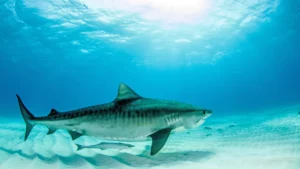
Begin with the general shape, because it is textbook requiem shark: a spindle body, a long pointed snout, round eyes with working nictitating eyelids, sickle-shaped pectorals and a tall falcate first dorsal fin that rises behind the pectoral origin. The second dorsal is only moderately tall, the caudal fin is strongly asymmetric, and there is no ridge of skin running along the back between the dorsal fins.
Colour is bronze to grey-bronze above and white below, with a pale band running along each flank from the pelvic region towards the gills. The pectoral tips, the second dorsal, the lower lobe of the tail and often the first dorsal carry black markings, which is where the name comes from; the anal fin stays pale, a detail worth noting because it separates this animal from the spinner shark, whose anal fin is black-tipped. After death the bronze drains away to a flat grey, which has caused plenty of confusion in fish markets.
In the mouth there are 32 to 35 rows of narrow, finely serrated teeth in the upper jaw and 29 to 31 rows of slimmer teeth below. None of this, unfortunately, will distinguish it from the common blacktip shark. The only reliable external character is a statistical difference in vertebral count: 174 to 182 total vertebrae in this species against 182 to 203 in the common blacktip. Genetics is the other route, and in practice it is the one used.
How big do Australian blacktip sharks get?
The maximum reliably recorded length is about 2 m (6.6 ft), with a maximum weight of 52 kg (115 lb). Most adults encountered in the northern Australian gillnet fishery measure between 1.5 and 1.8 m, so a two-metre animal is a genuinely large one. Older descriptions of this shark quote a maximum of 6.6 feet in height rather than length, which is simply a slip: sharks are measured nose to tail tip.
Growth is fast by shark standards and then stops early. Pups are born at around 60 cm, roughly two feet, already able to feed themselves, and both sexes mature at about 110 to 115 cm at an age of three to four years. That is a quick apprenticeship compared with a common blacktip, which needs four to five years, and very quick compared with the decades required by large coastal species.
Females grow slightly larger than males, the usual requiem shark pattern, though the difference is small. Because the species stops growing so early relative to its maximum, length is a poor guide to age in adults: a 1.6 m shark could be five years old or twelve. The bar below compares the 2 m maximum against a 1.8 m diver, which puts the species in its proper place as a mid-sized coastal predator rather than a large one.
Where Australian blacktip sharks live
This shark is an Australian endemic, and the map is unusually tidy for a requiem shark. It occupies the tropical continental shelf of northern Australia, from about Thevenard Island on the Pilbara coast of Western Australia, across the Kimberley and the Northern Territory, around the Gulf of Carpentaria and Torres Strait, and down the Queensland coast into central New South Wales. It reaches its southern limit roughly around the latitude of Sydney, where the water stops being tropical.
Reports from the wider Indo-West Pacific, including Papua New Guinea and Indonesia, need care. Because the species is so hard to tell from the common blacktip, many such records have turned out on examination to be Carcharhinus limbatus, and the current position is that C. tilstoni is confined to Australian waters.
Within that range it is a shelf animal. It occurs from the intertidal zone and turbid coastal bays out to the shelf edge, most often between the surface and about 150 m, and it uses the whole water column: acoustic and trawl data show the sharks close to the seabed through the day and higher up at night. Large aggregations form on the Northern Territory and Gulf of Carpentaria grounds, which is why the species has supported a commercial fishery for half a century.

What Australian blacktip sharks eat
Bony fish account for the overwhelming majority of the diet, and the list reads like a survey of northern Australian shelf life: grunters, herrings and sardines, ponyfishes, mullet, small mackerel and juvenile tuna. Cephalopods come second, mostly squid, and small sharks appear regularly, among them sharpnose sharks and the juveniles of species such as the snaggletooth shark.
Diet shifts with age in a way that has been documented properly here. Juveniles and smaller adults take mostly demersal fishes caught near the bottom; larger sharks move towards midwater prey and eat proportionally more squid. That change matches the diel vertical movement of the sharks themselves, which spend daylight hours low in the water and rise after dark to intercept schooling fish near the surface.
The hunting method is speed rather than stealth. Slim, fast requiem sharks of this build drive into a bait school from below and take individual fish with a rapid snap, using narrow serrated teeth that cut a small fish cleanly rather than sawing through a large one. Their close relative the spinner shark is famous for corkscrewing up through a school and clearing the water, and Australian blacktips have been seen doing something similar, though less acrobatically. For the family context see the requiem sharks.
Behaviour, movement and a famous hybrid
Australian blacktips are schooling, mobile sharks. Tagging in northern Australia shows most individuals staying within a few hundred kilometres of where they were released, moving along the coast rather than out to sea, with a minority covering more than a thousand kilometres. Claims that the species routinely travels hundreds of miles offshore misread those data: this is a shelf shark, and long movements are coastal ones.
Its senses are the standard requiem package, and they are very good without being magical. The electroreceptive ampullae of Lorenzini detect prey at close range, the lateral line picks up the pressure waves of a struggling fish across a bay, and smell works over hundreds of metres down-current rather than the miles of legend, a point worth reading in full under how far sharks can smell blood.
The most remarkable thing about this species is genetic. In 2012 researchers sampling sharks along the northern Australian coast found that C. tilstoni and the common blacktip interbreed, producing fertile hybrids across thousands of kilometres of coastline. It was the first case of hybridisation ever documented in sharks, and it complicated everything: hybrid animals carry the mitochondrial DNA of one parent species and the body proportions of the other, so a shark can be one species by genetics and another by measurement. Fisheries in the region now assess the two together for that reason.
Reproduction and lifespan
Reproduction is placental viviparity, the requiem shark speciality: after the yolk supply runs down, the exhausted yolk sac fuses with the wall of the uterus to form a true placenta, and the mother feeds the embryos directly for the rest of the pregnancy. It is the most advanced reproductive arrangement in any fish, and it is why requiem shark pups are born so large and so capable.
The annual cycle is well described for this species. Mating takes place in February and March; females store sperm and ovulate in March and April; gestation runs for about ten months; and the pups, one to six per litter with three the usual number, are born the following January. Before giving birth the females move into shallow inshore water, with mangrove creeks, estuaries and turbid coastal embayments across the Top End serving as nurseries where the 60 cm newborns are safe from larger sharks.
Maturity arrives at three to four years and around 110 to 115 cm. Vertebral ageing studies on the Great Barrier Reef give maximum ages of thirteen years for males and fifteen for females, and FishBase records a maximum of twelve; the figure of twenty years that appears in older web accounts is not supported. An age-validation study also warned that bands in the largest animals may not be laid down annually, so the true maximum could be slightly higher. Even so, a twelve to fifteen year life with annual litters of three makes this one of the faster-breeding requiem sharks, and that is exactly why its stocks have proved resilient (see how long sharks live).
Is the Australian blacktip shark dangerous to people?
No bite anywhere in the world has ever been attributed to Carcharhinus tilstoni, and the SharkSider database holds no record for the species. That is partly genuine and partly a problem of identification: an incident in northern Australia involving a shark of this type would almost certainly be logged as a blacktip without a species name, and it is impossible to separate the two blacktips from a description of a bite.
Taken on its own merits, the risk is low. This is a two-metre fish-eater with narrow cutting teeth built for sardines, it lives on a coastline where very few people swim, and it shows no interest in large animals. Where problems do occur they involve spearfishing, when a shark is drawn to a struggling speared fish and a person happens to be holding it, which is a competition over food rather than an attack. Northern Australian waters carry genuinely dangerous species, including bull sharks in the rivers and estuaries; the sensible reading is on the Australian shark attack record and in what to do in a shark encounter.
The SharkSider database has no incident attributed to this species. The database draws on the International Shark Attack File, the Global Shark Attack File and verified local reports, and is updated weekly.
Conservation status
The IUCN Red List assessed Carcharhinus tilstoni in 2018 as Least Concern, and the assessment is one of the more cheerful on this site. The species is abundant across northern Australia, breeds annually, matures in three to four years and is managed under a fisheries regime that has held up.
It has not always looked that way. Taiwanese gillnet vessels working the Arafura Sea and the Gulf of Carpentaria through the 1970s and early 1980s took very large quantities of blacktip and spot-tail sharks, and by 1986 the stock had been driven to roughly half its unfished size. Foreign gillnetting was excluded from the Australian Fishing Zone, effort was capped, and the population rebuilt. Today the species is still the mainstay of the Northern Territory offshore net fishery, taken for its meat and fins, but under catch limits and with regular stock assessment.
Two caveats belong here. The first is that hybridisation with the common blacktip means catch statistics for either species alone are approximate, and management treats the complex as a unit. The second is international: since November 2023 every member of the requiem shark family, this species included, has been listed on Appendix II of CITES, so trade in its fins and meat now requires permits and proof of sustainable, legal sourcing. Both measures matter more than they sound, for reasons explored under why sharks are endangered.
Similar species and close relatives
The one that matters is the common blacktip shark (C. limbatus), which shares the whole northern Australian range, looks the same, eats the same food and interbreeds with this species. It grows larger, to about 2.5 m, matures a year later, and has more vertebrae; beyond that, only a laboratory can tell you which you have.
The spinner shark is the next trap. It is slimmer still, its first dorsal starts further back, and its anal fin is black-tipped, which neither blacktip's is. The graceful shark, another northern Australian Carcharhinus, is stockier with a shorter snout and a much deeper body. Working inshore, the creek whaler and the nervous shark are smaller, blunter animals of the same coast that lack the clean black fin tips.
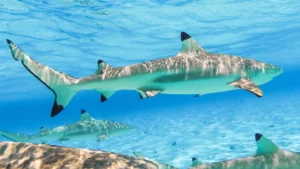
Among the small sharks this species eats are the Australian sharpnose shark and the blackspot shark, both under a metre, both common on the same grounds. And for completeness, the blacktip reef shark of the coral flats, despite the name, is not a close match at all: it is a smaller, stubbier shark with a single unmistakable black-and-white marking on the first dorsal fin, and it belongs on the reef rather than the open shelf.
 Black Tip Sharksspecies profile
 Spinner Sharkspecies profile
- Graceful Sharkspecies profile
- Creek Whaler Sharkspecies profile
- Blackspot Sharkspecies profile
- Nervous Sharkspecies profile
Frequently asked questions
How big does an Australian blacktip shark get?
The maximum recorded length is about 2 metres, or 6.6 feet, and the maximum weight 52 kilograms. Most adults caught in northern Australia are 1.5 to 1.8 metres. Pups are born at around 60 centimetres and both sexes mature at 110 to 115 centimetres, which they reach at three to four years old.
Where do Australian blacktip sharks live?
Only in Australian waters. The species occupies the tropical continental shelf from Thevenard Island in Western Australia, across the Northern Territory and the Gulf of Carpentaria, and down the Queensland coast into central New South Wales. It ranges from the intertidal zone out to about 150 metres depth.
How is it different from the common blacktip shark?
Barely at all externally. The Australian blacktip has 174 to 182 vertebrae against 182 to 203 in the common blacktip, grows slightly smaller at about 2 metres against 2.5, and matures a year earlier. Reliable identification needs a vertebral count or a genetic test, which is why fisheries assess the two together.
What do Australian blacktip sharks eat?
Mostly schooling bony fishes such as grunters, herrings, ponyfishes, mullet and small tuna, plus squid and occasionally small sharks. Young sharks take more bottom-dwelling fish; larger ones eat more midwater prey and cephalopods. They feed low in the water by day and rise towards the surface after dark.
Are Australian blacktip sharks dangerous to humans?
No bite has ever been attributed to this species, and the SharkSider database holds no record for it. It is a two-metre fish specialist with narrow cutting teeth and no interest in large prey. The main scenario for trouble is spearfishing, where a shark is drawn to a speared fish rather than to the diver.
How many pups does an Australian blacktip shark have?
One to six, with three the usual number. The embryos are nourished through a true placenta after the yolk runs out, which is why they are born large at about 60 centimetres. Mating happens in February and March, gestation lasts around ten months, and the pups arrive the following January.
How long do Australian blacktip sharks live?
Twelve to fifteen years. Vertebral ageing on the Great Barrier Reef gave maximum ages of thirteen for males and fifteen for females, and FishBase lists twelve. The twenty-year figure repeated in older web accounts is not supported by any study, although validation work suggests bands in the largest sharks may be laid down irregularly.
Do Australian blacktip sharks hybridise with other sharks?
Yes, and it was the first shark hybridisation ever documented. A 2012 study found fertile hybrids between this species and the common blacktip along thousands of kilometres of northern Australian coast. Hybrids carry one parent's mitochondrial DNA and the other's body proportions, which makes identification and catch reporting genuinely difficult.
Is the Australian blacktip shark endangered?
No. The IUCN assessed it as Least Concern in 2018. Foreign gillnetting cut the stock to about half its unfished level by 1986, but exclusion of those fleets and catch limits allowed it to rebuild. Since November 2023 the species has been listed on CITES Appendix II along with all other requiem sharks.
Why is it called the Australian blacktip shark?
Because of the black markings on the pectoral tips, second dorsal and lower tail lobe, and because the species is found nowhere except Australia. The scientific name honours Tilston, and the fish is also called Tilston's whaler, whaler being the standard Australian term for sharks of the requiem family.
References

A small team focused on researching sharks and making marine biology easy to understand. Every page is reviewed against current species records and the SharkSider attack database, and updated when new incidents or research appear.
Published October 10, 2022 · Last updated September 22, 2026 · No incident attributed to this species in the SharkSider attack database, which is updated weekly.