The African lanternshark (Etmopterus polli) is a tiny deep-water dogfish of the lanternshark family, reaching only 24 cm (9.4 in), that lives on the upper continental slope of the eastern Atlantic from Guinea to Angola at 300–1,000 m. It is dark grey-brown with a black belly, a black flank mark behind the pelvic fins, large green eyes and a grooved spine in front of each dorsal fin.
Like its relatives it almost certainly eats small crustaceans, squid and lanternfish, and bears live young from eggs retained inside the mother, though no litter has been described. It has never harmed a person and is caught only by accident in deep-water trawls. The IUCN lists it as Least Concern.
- Maximum length24 cm (9.4 in)
- WeightNo reliable measurement; a few tens of grams
- LifespanUnknown; no ageing study exists
- Depth range300–1,000 m (985–3,280 ft) on the upper slope
- DietSmall crustaceans, squid and small fish (inferred from relatives)
- IUCN statusLeast Concern (2020 assessment)
- Kingdom
- Animalia
- Phylum
- Chordata
- Class
- Chondrichthyes
- Order
- Squaliformes
- Family
- Etmopteridae
- Genus
- Etmopterus
- Species
- Etmopterus polli
- Family (common)
- Lanternsharks
- Also known as
- Poll's lanternshark
On this page
- How to recognise an African lanternshark
- How big is an African lanternshark?
- Where African lanternsharks live
- What African lanternsharks eat
- Behaviour and the glowing belly
- Reproduction and lifespan
- Is the African lanternshark dangerous?
- Conservation status
- Similar species and close relatives
- Frequently asked questions
- References
How to recognise an African lanternshark
You will only ever meet this shark in a trawl net or a museum jar, and even then it takes a practised eye to pick it out of the other lanternsharks hauled up off West Africa. Start with size: an adult fits across the palm of a hand, and anything longer than about 25 cm is another species. The body is stout for a lanternshark, the snout short and rounded, the gill slits short, and the eyes large and oval with the green reflective shine typical of the family.
The two dorsal fins each carry a grooved spine in front, and the second fin is about twice the size of the first. The first dorsal begins well forward, roughly over the rear tips of the pectoral fins rather than over the pelvics. There is no anal fin, the pectoral fins are small, and the tail is fairly long with a low lower lobe.
Colour does the rest. The back and sides are dark grey to brown and the underside from snout to abdomen is black, a sharp two-tone pattern rather than a gradient. Behind and above each pelvic fin sits a black flank marking with a short forward branch and a long tapering branch running back towards the tail; the exact shape of this mark, together with the position of the dorsal fins and the count of the tooth cusps, is what a taxonomist uses to tell Etmopterus polli from the smooth lanternshark and great lanternshark that share its waters. Tiny light organs, the photophores, are scattered over the belly and concentrated inside the flank mark. Upper teeth are small and multi-cusped; lower teeth are blade-like and interlock into one cutting edge.
How big is an African lanternshark?
This is one of the smallest sharks in the Atlantic. The largest specimen on record measured 24 cm (9.4 in) in total length, and the collection from which the species was described in 1953, taken by the Belgian research vessel Mbizi off the Congo and Angola, contained nothing longer. Mature males and females both fall in the 19 to 24 cm range, with females averaging slightly larger, as in most lanternsharks. Compare that with the 90 cm or so reached by the great lanternshark or the 60 cm of the velvet belly, the family's best-known member.
Nobody has published a weight, and none is worth inventing: a 24 cm shark of this build weighs a few tens of grams, less than a small apple. Newborn size is equally undocumented, but lanternsharks of this size are born at roughly 6 to 9 cm, so a pup would be about the length of a finger. Only the dwarf lanternshark of the Caribbean, at about 20 cm, and a handful of other pygmy species undercut it, which is why the African lanternshark belongs in any list of the smallest sharks in the world. The size bar below sets that 24 cm against a 1.8 m diver.
Where African lanternsharks live
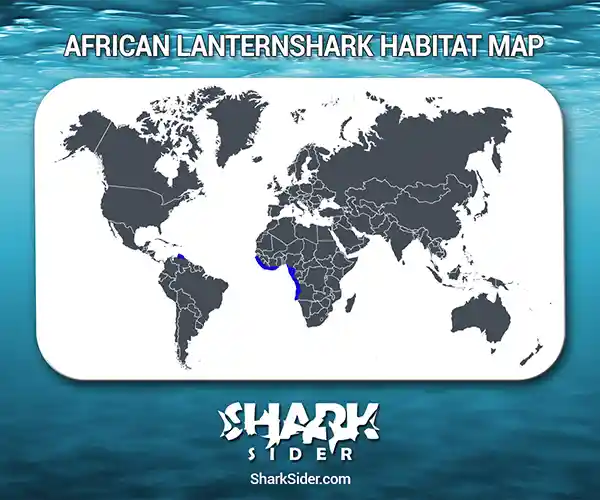
The whole known range is a strip of continental slope along the bulge and south-western coast of Africa, between roughly 12°N and 18°S. Records run from the waters off Guinea and Sierra Leone past Ghana, Nigeria, Cameroon, Gabon and the Congo to Angola, where the cold Benguela Current begins and the species appears to stop; it has not been reported from Namibia or South Africa. Whether it extends north towards Senegal is unresolved because so little deep-water sampling has been done there.
Depth, not latitude, defines its home. Specimens come from the upper and middle slope in 300 to 1,000 m of water (985 to 3,280 ft), most of them between about 350 and 700 m. That is the twilight zone: water of 5 to 10 °C, permanently dark to the human eye but still lit faintly from above by day, which is exactly the light regime a glowing shark's belly is designed for. The species lives close to the bottom rather than in open midwater, and is taken in bottom trawls alongside deep-sea hakes, grenadiers and other small squaloid sharks.
A slope shark that never comes near a beach appears on none of the site's country pages, so there is no range list below the map. Our page on where sharks live explains how the slope differs from the reef and shelf most species use.
What African lanternsharks eat
No stomach-content study exists for this species, so everything here is inferred from its jaws and from better-sampled relatives. The dentition tells a clear story: small grasping teeth above and a continuous cutting edge below is the toolkit of a shark that seizes small, soft prey and slices it. In the velvet belly lanternshark of the eastern Atlantic, which has been examined thoroughly, that means krill and other small crustaceans when young, then a growing share of squid and small bony fish, especially lanternfish, as the shark matures. The African lanternshark almost certainly follows the same course on a smaller scale, with shrimps, mysids and tiny cephalopods at the core of the diet.
The hunting method is presumably the family's: hang in the water or drift close to the bottom, let the belly photophores erase your silhouette against the faint light from above, and take prey that comes within a body length. Lanternsharks have large, sensitive eyes and a full set of electroreceptive ampullae of Lorenzini, so they can find prey in near-total darkness without needing a burst of speed. What it does not do is hunt anything large. With a mouth a centimetre or two across, the African lanternshark is prey for hake, larger sharks and squid far more often than it is a predator of anything bigger than a shrimp.
Behaviour and the glowing belly
The defining trait of the family is bioluminescence, and the African lanternshark's photophores are arranged in the standard etmopterid pattern: dense on the belly, sparse on the sides, absent on the back, with a concentration inside the dark flank mark. Work on other lanternsharks has shown that this arrangement serves at least three purposes. The belly glow matches the dim downwelling light so that a predator below cannot see the shark's outline, a trick called counter-illumination. The flank and fin patterns are species-specific and are thought to work as recognition signals, letting a shark find a mate of its own kind in the dark. Bright patches along the dorsal spines may warn predators off. The light is a cold blue-green controlled by hormones rather than nerves, so it brightens and dims slowly, over minutes.
Beyond the light, behaviour is almost entirely unknown. Lanternsharks are usually taken in numbers by a single trawl, which suggests loose groups, and some species segregate by size and sex at different depths. The African lanternshark's large eyes and small pectoral fins point to a slow, hovering swimmer that relies on its oil-rich liver for buoyancy rather than on constant motion. Nothing has been published on its movements or seasonality; a species worth nothing to a fishery attracts no tagging money.
Reproduction and lifespan
Every lanternshark examined so far is ovoviviparous, more precisely aplacental viviparous: the female retains the eggs in her uterus, the embryos live on their yolk sacs, and the pups are born fully formed. The African lanternshark is assumed to do the same, and mature females with developing eggs have been recorded, but no litter has ever been described in print. In the closest well-studied relatives, litters are small, typically 6 to 20 pups, and gestation is long and poorly defined. A handful of pups of 6 to 9 cm every year or two is a reasonable expectation for a 24 cm species, not a measurement.
Maturity comes at 19 to 24 cm for both sexes. When that is reached in years is unknown, because nobody has aged the species: lanternshark dorsal spines and vertebrae can be read for growth bands, but the work has only been done for a few commercial species. Deep-sea squaloids as a rule grow slowly, mature late and live long for their size (the velvet belly is thought to live past 20 years), so the African lanternshark probably measures its life in decades rather than in the few years its tiny body suggests. Our page on how long sharks live explains why cold, deep water slows the shark clock, and why that makes deep-sea species so slow to recover from fishing.
Is the African lanternshark dangerous?
No, and it could not be. This is a shark shorter than a dinner knife, with jaws that open a centimetre or two, living 300 to 1,000 m down off a coast where almost nobody dives below thirty. There is no way for a person and a live African lanternshark to meet in the water, and the only humans who handle the species are trawler crews and biologists sorting a dead catch. The SharkSider database has no incident attributed to it and none is ever likely to appear.
The only mild hazard is the pair of dorsal spines, which can prick a careless hand during sorting. That is true of every lanternshark and dogfish and is not worth losing sleep over. If you want to know which sharks along the same coast do warrant caution, the relevant pages are those for the bull shark and tiger shark, both of which patrol West African estuaries and reefs, and the country page for Nigeria.
The SharkSider database has no incident attributed to this species. The database draws on the International Shark Attack File, the Global Shark Attack File and verified local reports, and is updated weekly.
Conservation status
The IUCN Red List assessed the African lanternshark as Least Concern in its 2020 evaluation, having previously called it Data Deficient. The reasoning is straightforward: the species occupies a long stretch of slope, much of it deeper than the trawl fisheries currently reach, and there is no evidence of decline. It is not listed on CITES or CMS, and no country protects it by name. Nor does any country manage it: it has no commercial value and appears in no catch statistics, so its status rests on the assumption that a wide, deep range is a safe one.
The pressure that does exist comes from bottom trawling. Deep-water fleets working off Angola, Gabon and the Gulf of Guinea for hake, shrimp and other slope species take small squaloid sharks as bycatch, and lanternsharks brought up from several hundred metres do not survive being returned. Where they are landed at all they go for fishmeal or are dried and eaten locally. As trawling pushes deeper, a slow-breeding shark can decline for years before anyone notices, as deep-sea sharks did in the north-east Atlantic in the 1990s.
The real conservation task is simply to look at it: better identification of deep-water bycatch and observer coverage on the trawl fleets would settle within a decade whether Least Concern is right. The broader story is on our page on why sharks are endangered.
Similar species and close relatives
Lanternsharks are one of the largest shark families, with around forty species of Etmopterus alone, and several overlap with this one. On the same West African slope live the smooth lanternshark, which is much larger (up to 50 cm), paler and has no distinct flank mark, and the great lanternshark, biggest of the family and found on both sides of the Atlantic. Further north, in European waters, the velvet belly lanternshark is the species whose biology fills the gaps in this page. Further south the southern lanternshark replaces it off South Africa.
Across the Atlantic the Caribbean lanternshark and the dwarf lanternshark are close in size and build, and the blackbelly lanternshark of the Pacific shares the sharply black underside. Outside the family, the small cookiecutter shark also glows, but it lives in open midwater and its heavy lower teeth cut discs out of large animals, a different life entirely.
- Smooth Lanternsharkspecies profile
- Great Lanternsharkspecies profile
- Velvet Belly Lanternsharkspecies profile
- Southern Lanternsharkspecies profile
- Caribbean Lanternsharkspecies profile
- Dwarf Lanternsharkspecies profile
Frequently asked questions
How big is the African lanternshark?
Tiny. The largest specimen ever measured was 24 cm (9.4 in) long, and adults of both sexes fall between about 19 and 24 cm. No weight has been published, but a shark of that size weighs only a few tens of grams. It is among the ten smallest sharks in the world.
Where does the African lanternshark live?
Only in the eastern Atlantic off West Africa, from Guinea and Sierra Leone south past Ghana, Nigeria, Gabon and the Congo to Angola, between about 12°N and 18°S. It lives near the bottom on the continental slope at 300 to 1,000 m, mostly in 350 to 700 m of cold, dark water.
Does the African lanternshark really glow?
Yes. Like all lanternsharks it carries thousands of tiny light organs called photophores, densest on its black belly and inside the dark mark behind the pelvic fins. The blue-green glow hides its silhouette from predators below, and the pattern probably helps it recognise its own species in the dark.
What does the African lanternshark eat?
Nobody has studied its stomach contents, so the answer is inferred from its teeth and its relatives: small shrimps and other crustaceans, tiny squid and small fish such as lanternfish. The grasping upper teeth and blade-like lower teeth are built for seizing and slicing soft prey no bigger than a finger.
How does the African lanternshark reproduce?
Almost certainly like every other lanternshark: eggs hatch inside the mother and the pups are born alive, nourished by their yolk sacs. Litter size, gestation and pup length have never been recorded for this species; relatives of similar size bear a few pups of 6 to 9 cm. Maturity comes at 19 to 24 cm.
How long do African lanternsharks live?
Unknown. No ageing study has been done on this species. Deep-water dogfish in general grow slowly and live long for their size, and the related velvet belly lanternshark is thought to reach 20 years or more, so a lifespan of one to two decades is plausible but unproven for the African lanternshark.
Is the African lanternshark dangerous to humans?
No. It is shorter than a dinner knife, lives hundreds of metres below the deepest recreational dive, and has jaws that open a centimetre or two. The SharkSider database contains no incident attributed to it. The only people who ever touch one are trawler crews sorting a catch, who risk at most a prick from a dorsal spine.
Is the African lanternshark endangered?
No. The IUCN lists it as Least Concern in its 2020 assessment, because it has a long, deep range and no evidence of decline. It is caught only as bycatch in deep-water trawls off Angola and the Gulf of Guinea, where it is discarded or turned into fishmeal, and no country regulates or protects it.
Why is it called Poll's lanternshark?
The scientific name Etmopterus polli honours Max Poll, the Belgian ichthyologist who led the surveys of the Congo and Angola coast in the late 1940s from the research vessel Mbizi that collected the first specimens. Bigelow, Schroeder and Springer described the species from that material in 1953.
References

A small team focused on researching sharks and making marine biology easy to understand. Every page is reviewed against current species records and the SharkSider attack database, and updated when new incidents or research appear.
Published October 6, 2022 · Last updated September 22, 2026 · No incident attributed to this species in the SharkSider attack database, which is updated weekly.